
14 min 18 sec
Available in: English
Why Simple Wins: Escape the Complexity Trap and Get to Work that Matters
By Lisa Bodell
Shows why workplaces fill up with meetings, reports and rules nobody needs. It gives teams and leaders practical tools, from a complexity survey to a rule-killing exercise, for clearing them out and returning to meaningful work.
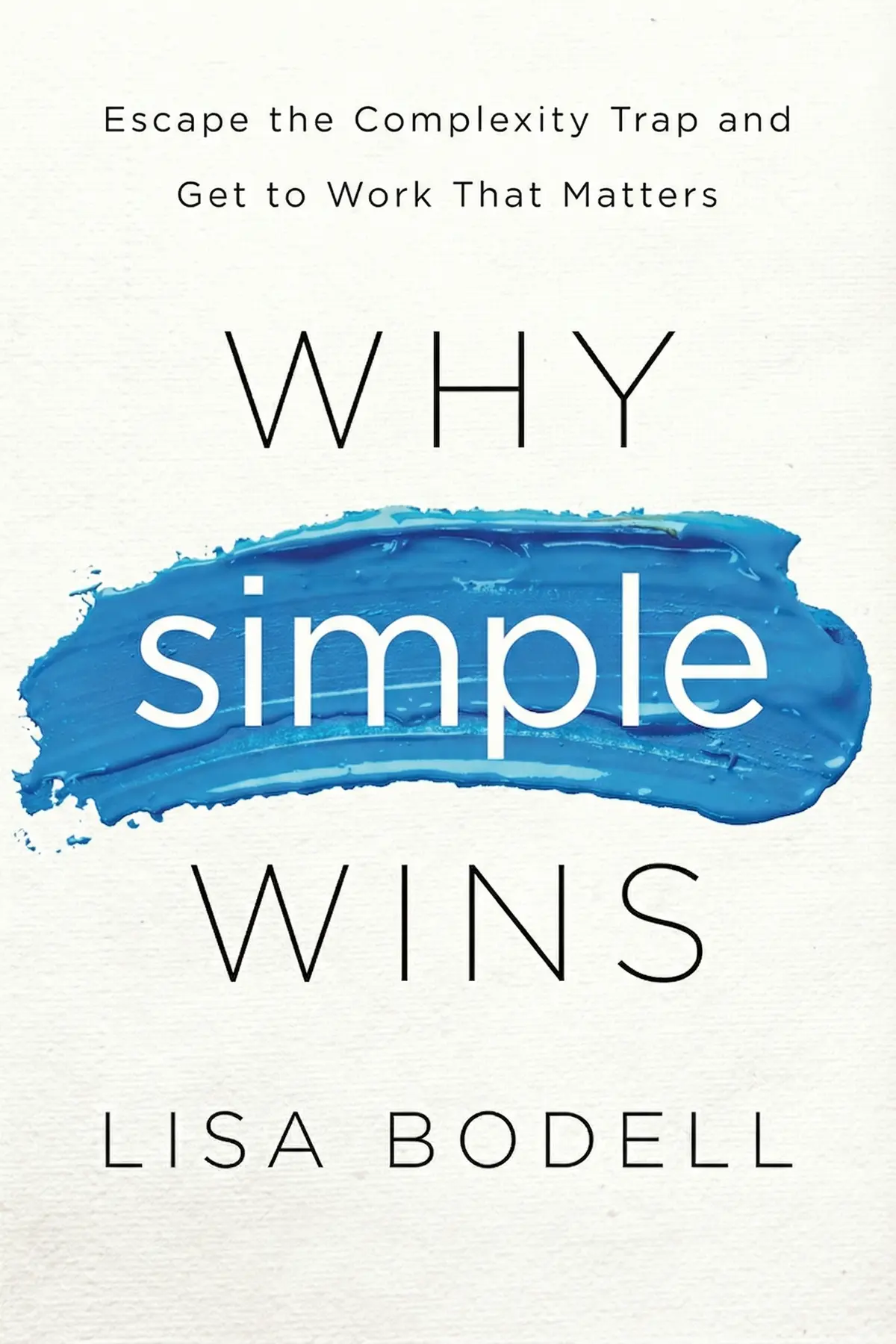
Table of Content
1. Introduction
1 min 09 sec
If your workday ends with a full calendar and nothing important finished, the cause is often the clutter surrounding the work. In Why Simple Wins, futurist and innovation trainer Lisa Bodell argues that most of that clutter is self-made: meetings, emails, reports and rules that teams keep adding because more feels like better. Her central claim is that simplicity is not a matter of doing less. It is a shift in how a whole organization thinks, a steady commitment to clearing away low-value work so people can reach the work they were hired to do.
The book moves from diagnosis to action. Bodell offers a four-hour survey that scores a company’s complexity, a one-hour exercise for killing pointless rules, a five-step method for making simplification last, and a portrait of leaders who see themselves as chief simplifiers. Along the way come HBO, Sprint, Airbnb and Richer Sounds, whose leader set up a committee devoted to cutting nonsense. What it offers is a team that spends its hours on what counts.
2. Spot the complexity that leaves busy days empty
1 min 59 sec
Email and video calls were supposed to save time, yet many people end each day drained and with little to show for it. Bodell traces the cause to two sources, and one of them sits inside our own heads.
3. Find where complexity hides in four hours
2 min 07 sec
In many companies, nobody can remember why certain rules exist, yet everyone still follows them. A short, structured exercise can show exactly where the waste lives, and one company learned the hard way why it should be run twice.
4. Turn simplifying into a team habit in five steps
2 min 00 sec
Simplification projects often die in arguments about what to call them or in requests for better catering. Bodell names the trap and a sequence that keeps a team moving from noticing waste to removing it for good.
5. Clear out stupid rules and wasted meetings
1 min 53 sec
Every office has rules that make people sigh, and they survive because nobody is allowed to question them. An exercise needing little more than sticky notes changes that, and one company using a similar approach identified more than a hundred stupid rules.
6. Fix the work and the culture will follow
1 min 48 sec
Companies pour effort into mission statements and value lists, yet staff still feel empty at the end of the day. Bodell argues the order of operations is wrong, and a founder with a blunt committee name shows what happens when it is reversed.
7. Lead by making your team's work easier
2 min 07 sec
Ask what sets top chief executives apart and most people say vision. Research with Harvard Business School found something plainer at the top of their lists, and it is a role any manager can take on tomorrow.
8. Conclusion
1 min 15 sec
Bodell’s book adds up to a reversal of instinct. Organizations grow complicated one sensible-looking addition at a time, a report here, a rule there, an extra approval step for safety. Because each layer protects someone, complexity defends itself, and good intentions, values statements and new software only add weight. What breaks the cycle is a habit of subtraction that everyone shares, backed by leaders willing to see simplifying as their real job.
The practical path is short. Before your next meeting or report, ask whether it improves the work or only fills the day, and drop it if the answer is the second. Give your team one hour, a stack of sticky notes and permission to vote a green rule out of existence, the way HBO found more than a hundred worth removing. And when you change a process, check again with everyone it touches, so the fix for one group does not land as extra work for another, as it did with that expense system.
None of this needs a grand program. Sprint lost 30 percent of its meetings by asking what each one was for. Simplicity, in Bodell’s telling, starts the moment someone stops adding.
About this book
What is this book about?
Many professionals start the day ready to think, collaborate and build something new, then spend it in approval chains, crowded inboxes and back-to-back calls. Lisa Bodell argues that this clutter is mostly self-made. People use tools because they exist, and organizations add metrics, reports and rules because more feels like better. Fear of being held accountable then adds micromanagement on top, until complexity sustains itself. Bodell treats simplicity as a mindset shared across a whole organization, a commitment to clearing out low-value work. She offers a four-hour Diagnostic Survey that scores a company's complexity, a five-step method for making simplification stick, and the Kill a Stupid Rule exercise, which needs only sticky notes and an hour. Examples include HBO, Sprint, Airbnb, Merck Canada and Julian Richer of Richer Sounds. Readers get a way to see where their own time disappears, tools to remove it with their teams, and a model of leadership built on making work easier. Bodell's case is that once the work is fixed, a stronger culture follows.
Book Information
Who it's for
Managers with packed calendars
Managers and team leads whose calendars are full of meetings and whose teams feel buried in process.
Leaders of growing companies
Founders and operators watching their growing company slow down under rules, reports and approval chains.
Busy professionals
Professionals who end each busy day frustrated that the work they care about never gets done.
About the Author
Lisa Bodell
Lisa Bodell is an author, futurist and speaker who founded futurethink, a firm focused on innovation research and training. She has designed training programs for innovators at companies including 3M, GE and Johnson and Johnson, and has spoken in more than 30 countries. Her earlier book, Kill the Company, won the 2014 Axiom Best Business Book Award. She has written for Harvard Business Review and Forbes and has taught innovation and creativity at American University and Fordham University.
Ratings & Reviews
Ratings at a glance
What people think
Listeners find the book to be both perceptive and accessible, packed with hands-on examples and drills. They value its approach to stripping away needless complications, with one listener noting that the included prompts and tools are easy to implement. Feedback regarding the pacing is varied, as several listeners observe a significant amount of repetition within the content.
Top reviews
Ahmed
Finally got around to reading this after seeing my manager use the 'Kill a Stupid Rule' exercise in our retreat. It is a highly practical manual for anyone drowning in corporate red tape and endless email chains. The matrix comparing simplicity and value was a major lightbulb moment for me personally. Not gonna lie, some sections feel redundant, but the worksheets are where the real value lies. We often overcomplicate things just to feel busy, and Bodell gives you the permission to stop. The distinction between what is essential and what is just habit is crucial for modern productivity. I have already started applying the 'Is it repeatable?' filter to our weekly reports with great results. It is not perfect, but it is a solid toolkit for organizational change.
Show moreSuwit
As someone who spends eight hours a day in meetings that should have been emails, this book felt vital. Bodell identifies the culture of 'busyness' that is currently poisoning our offices and making us all less productive. Since finishing the chapters on identifying low-value tasks, I have managed to cut my administrative load significantly. The worksheets are incredibly straightforward and helped me realize that most of my urgent work was not actually valuable. Look, the book can be repetitive at times, but sometimes you need to hear a message twice before it sinks in. It is about building a mindset where simplicity becomes the default rather than a special project for the team. My department is now using the simplification mindset to audit our monthly goals with great success.
Show morePaisley
Ever wonder why we have made work so much harder than it actually needs to be for everyone? This book dives deep into the 'complexity trap' that most corporations fall into as they grow much larger. I loved the focus on 'killing stupid rules' because it empowers employees to question the status quo daily. The pacing is a bit hit-or-miss, and some examples feel like they are pulled from a generic deck. Still, the underlying message is powerful because simplicity is a competitive advantage in a world of constant noise. The tools provided are accessible enough for a small team lead but robust enough for a department. Gotta say, it really changed how I view 'value-added' work versus just being productive for the sake of it.
Show moreIce
Not what I expected, but exactly what I needed to peel away the unnecessary layers of my workday. I thought this would be another vague business book full of buzzwords, but the exercises are actually quite rigorous. The matrix for simplicity versus value helped me prune my to-do list for the first time in years. To be fair, it could have been shorter, as there is a lot of redundancy in the first half. But the actionable steps for breaking down tasks into their smallest parts are worth the price of admission. It is a great guide for anyone looking to reclaim their time from the jaws of bureaucracy. This book provides real business value if you actually follow the provided instructions and checklists.
Show moreMilk
After hearing Lisa Bodell speak at a conference, I had high hopes for this book and its core message. It mostly delivers on the promise of showing you how to cut through the workday clutter and useless tasks. The emphasis on creating a 'simplification mindset' among employees is a fresh take on modern organizational culture. Instead of just giving us a set of rules, she gives us a way to think about work. I will admit that the 50 questions were a bit much to digest all at once during one sitting. However, picking five or six to focus on was a total game changer for our specific department goals. The writing is clear, the tone is encouraging, and the examples are relatable for anyone in a corporate environment.
Show moreSureerat
Why do business books always insist on being two hundred pages when forty would do the trick? Bodell clearly has experience in the field, but the writing here is quite thin and frequently cycles back. The distinction between 'complex' and 'complicated' is handled loosely, which might irritate those looking for a rigorous framework. To be fair, the actual tools and checklists provided in the later chapters are quite useful for identifying friction. It is a bit of an odd duck, caught between being self-help and a strategic manual for CEOs. If you can skim past the repetitive anecdotes, you will find a few gems about your locus of control. It is a decent weekend read, just do not expect any deep philosophy from the author.
Show morePawinee
This book is a bit of a strange mix of high-level business strategy and basic self-help advice. One moment you are learning to re-engineer a supply chain, and the next you are cleaning your desk. This dichotomy feels a bit disjointed, but the core thesis remains strong and relevant for most modern workers. I appreciated the specific document samples and the detailed process descriptions for cutting through the daily clutter. However, the author’s tendency to use 'complex' and 'complicated' interchangeably makes the logic feel a bit sloppy in places. In my experience, the best way to read this is to treat it as a practical workbook. Grab the templates from the website, do the exercises, and skip the fluff in the middle chapters.
Show moreWanphen
The concept is great, but the execution of the writing is a bit uneven across the different chapters. Bodell makes a compelling case for why simple wins, but she occasionally misses the nuance of why complexity exists. My main concern is that following these 'quick fixes' might lead to local maximums with far-ranging limitations. The book is at its best when it provides concrete worksheets and planning documents for the reader to use. It is at its worst when it leans into repetitive anecdotes about unnamed companies that feel quite fake. Personally, I found the chapter on 'simplification behavior' to be the most insightful part of the entire text. It is a decent resource to have on the shelf, even if you only read the exercises.
Show moreAey
The irony of this book is almost painful to witness. Bodell tries to sell the idea of simplicity by providing a list of fifty questions. Fifty questions is far too many for a book on this topic. If I had the time to answer fifty questions about my workflow, I would not need a book. While the core message about killing stupid rules is valid, the delivery feels like it is drowning in complexity. It reads like a long-winded consulting pitch that could have been a short blog post. Frankly, the pacing is sluggish because the author repeats the same three points in every chapter using different anecdotes. I expected a streamlined guide but instead received a mountain of unnecessary busywork. It is truly disappointing to see such bloat in a volume dedicated to minimalism.
Show moreA
I wanted to love this, but the filler is just overwhelming for a book about being simple. The text argues for minimalism while being incredibly verbose and repetitive throughout the chapters. Why are there so many pages of anecdotal testimonials that do not actually add any new information to the thesis? It felt like I was being sold a service I had already purchased. Truth is, the author seems to confuse being thorough with being helpful to a busy professional. There is a good message buried under all the corporate jargon about synergy and innovation through reduction. I found myself flipping through pages just to find a single actionable step that was not common sense. Sadly, it fails its own test of being minimal and accessible to the reader.
Show moreQuestions about this book
What is the main idea of Why Simple Wins?
Lisa Bodell argues that most workplace complexity is self-made. Teams pile on tools, meetings, reports and rules because more feels like better, and fear of accountability adds micromanagement on top. She treats simplicity as a mindset shared across an organization, a commitment to removing low-value work so people can focus on what matters. Once the work is simpler, she says, a stronger culture and better results follow.
What is the Kill a Stupid Rule exercise?
It is a one-hour session that needs only sticky notes. Participants list the rules that frustrate them most, then sort them into red rules, which are legal and untouchable, and green rules, which are open to change. The group discusses which green rules hurt productivity most and votes to eliminate some on the spot. HBO used a similar approach and identified more than one hundred rules to remove.
How does the Diagnostic Survey in Why Simple Wins work?
It is a five-step process of about four hours involving staff at every level. People rate statements about functions such as HR, legal and product development, and the answers produce a complexity score from Strongly Simplified to Crippling Complexity. Teams then discuss the worst areas, define specific problems and brainstorm what to stop, reduce, streamline, outsource or combine. Bodell recommends repeating it after changes are made.
How can leaders apply the ideas in Why Simple Wins?
Bodell asks leaders to act as chief simplifiers. They should explain why simplification matters and involve their teams, be open about the why, what and how so it is not mistaken for cost-cutting, and let employees make decisions without constant approval, as Merck Canada did. She advises starting with a few areas and building momentum through small wins instead of tackling everything at once.
Featured in
Readers also enjoyed

A Bigger Prize: How We Can Do Better Than the Competition
Margaret Heffernan





A Year with Peter Drucker: 52 Weeks of Coaching for Leadership Effectiveness
Joseph A. Maciariello



AUDIO SUMMARY AVAILABLE
Listen to Why Simple Wins in 15 minutes
Get the key ideas from Why Simple Wins by Lisa Bodell, plus 5,000+ more nonfiction titles.
- 5,000+ titles
- Listen as much as you want
- 7-day free trial
- Cancel anytime









