

15 min 43 sec
Available in: English
Until the End of Time: Mind, Matter, and Our Search for Meaning in an Evolving Universe
By Brian Greene
Brian Greene follows the universe from the big bang to its far-off end. He shows how evolution builds order and entropy wears it down, and why humans evolved to search for meaning anyway.
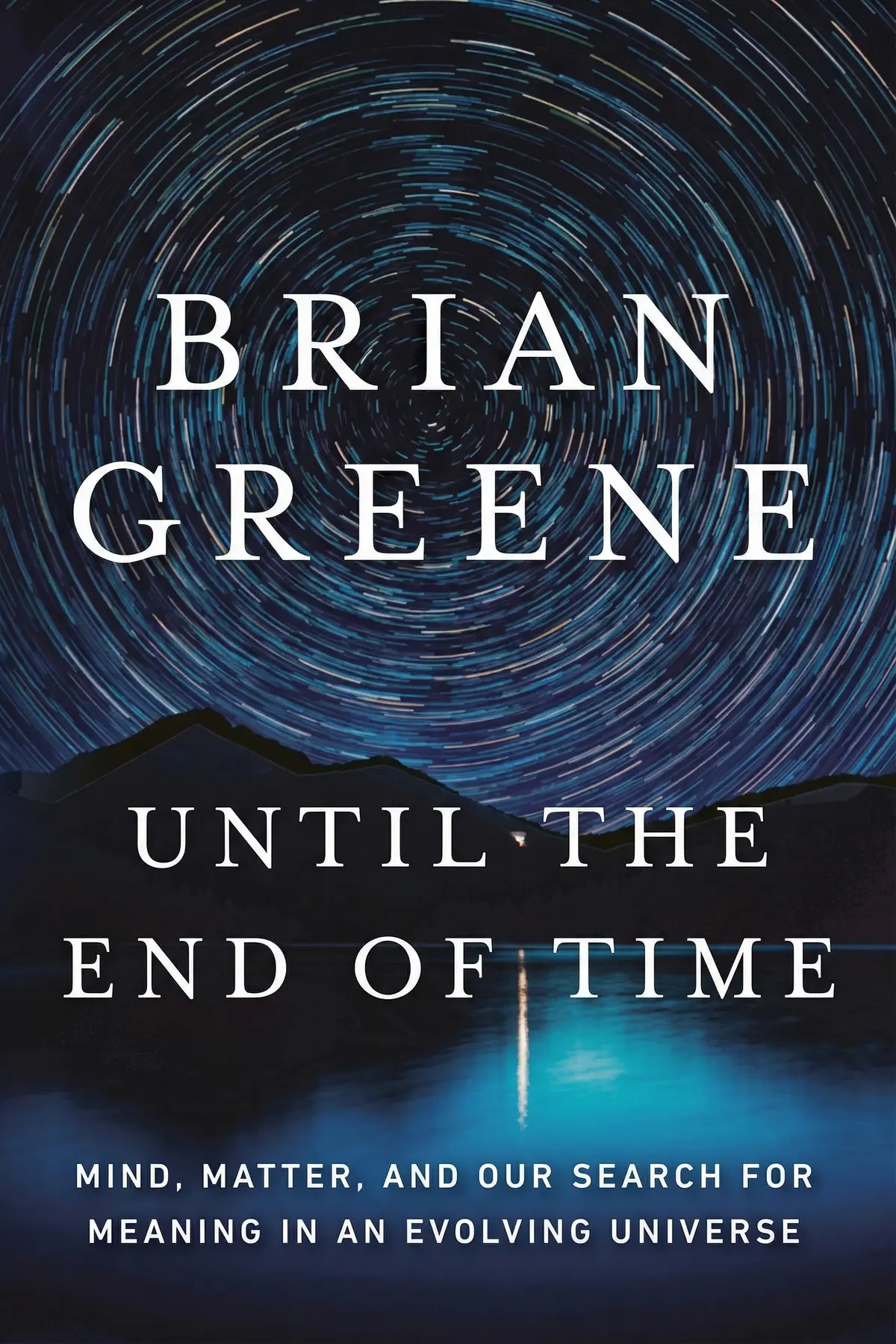
Table of Content
1. Introduction
1 min 00 sec
Everything you care about, from a favorite sweater to the sun itself, is a rare pocket of order that the universe is slowly taking apart. In Until the End of Time, physicist Brian Greene starts from that fact to explain why anything exists at all, and why it can still feel meaningful. His argument is that two forces drive the whole history of the cosmos. Evolution builds structure, from stars to brains, while entropy, the drift toward disorder, wears it down.
Humans are the part of that history that asks what it is all for, and Greene believes the asking evolved because it helped us survive. His account runs from the first instant after the big bang to a future so remote its dates need dozens of zeros, linking your cat, a black hole and Beethoven’s Ninth Symphony in one frame. Along the way it offers a steadier way to think about endings, your own included.
2. See every ordered thing as rare and costly
1 min 43 sec
A messy desk and a melting candy bar obey the same law that governs galaxies. Once you see what that law demands, ordinary objects and even the people around you start to look like small miracles.
3. Learn what repulsive gravity set off at the big bang
1 min 52 sec
Gravity is supposed to pull things together. Greene describes a version that does the opposite, and it may explain both the first moment of the cosmos and why the night sky is full of stars.
4. Trace your own body back to dying stars
2 min 01 sec
The atoms in your hand were assembled long before Earth existed, and a violent crash in the planet’s youth still decides when you need a coat. Greene connects the two in one family history.
5. Understand where your thoughts actually come from
1 min 52 sec
A thought pops into your head and it feels entirely yours. Greene follows the particles behind that feeling and arrives at a claim about choice that many readers will find unsettling.
6. Gossip and stories kept our ancestors alive
1 min 42 sec
Most of what people say to each other is talk about other people, which hardly sounds like a survival strategy. Greene suggests it may be exactly that, and that scary tales served a purpose too.
7. What religion and art give a mortal mind
1 min 56 sec
Prayer and painting seem to do nothing to put food on the table, yet our ancestors made time for both. Greene weighs the competing explanations, including one that compares the arts to cheesecake.
8. Discover how everything ends and why hope remains
2 min 21 sec
The sun, the Earth and every star will eventually be swallowed, and even the black holes that swallow them will vanish. Yet Greene finds a reason for hope in the very last particles.
9. Conclusion
1 min 16 sec
Greene’s universe holds two truths at once. Every ordered thing, from a star to a sweater to a person, is improbable, temporary and paid for with disorder sent elsewhere. The same physics that guarantees the ending also produced creatures who need their lives to mean something. In Greene’s account that need is an evolved trait that bound groups together, eased the fear of death and turned sound and color into ties between people.
This changes where value can come from. If nothing is permanent, worth has to live in what we make and share while the order holds. For Greene, the one quest worth pursuing is the search for meaning and connection.
When something you love feels fragile, count its brief life as part of its worth, like leaves that redden and fall. When a thought pushes in from nowhere, remember it is your brain at work, and look at it before acting on it. And make room for stories, music and shared rituals, which on his account have always helped humans hold together.
Stars will go dark and black holes will fade. What we do with the light while it lasts is the part that belongs to us.
About this book
What is this book about?
Everything around us, from galaxies to a candy bar to the people we love, is an unlikely arrangement of particles, and none of it will last. Physicist Brian Greene takes that hard fact as his starting point and tells the full story of the cosmos through two forces: evolution, which builds structure, and entropy, which takes it apart. His account runs from repulsive gravity driving the big bang to the birth of the first stars. It covers the atoms they forged and the collision with a planet called Theia that gave Earth its moon and seasons. It then turns to the mind, arguing that consciousness follows physical law and that free will is a fiction. He explains how language, gossip, storytelling, religion and art helped our species survive. The book ends in the deep future, as black holes swallow every star and then evaporate, and the laws of physics themselves may change. Readers get a single frame linking the big bang to human culture. They also get a way to think about endings that makes the search for meaning feel more urgent, not less.
Book Information
Who it's for
Curious professionals
Curious professionals who want the big bang, stars, minds and culture explained as one connected story.
Unsettled by mortality
Readers unsettled by mortality who want a scientific way to think about endings.
Physics or philosophy students
Students of physics or philosophy looking for a clear picture of entropy and the far future.
About the Author
Brian Greene
Brian Greene is a professor of physics and mathematics at Columbia University, where he directs its center for theoretical physics. He studied at Harvard and earned his doctorate at Oxford as a Rhodes scholar. His research includes mirror symmetry and topology change in string theory. He writes for general readers, and The Elegant Universe, The Fabric of the Cosmos, The Hidden Reality and Until the End of Time were all top 10 New York Times bestsellers. He hosted two NOVA miniseries that won Emmy and Peabody Awards, and he co-founded and chairs the World Science Festival.
Ratings & Reviews
Ratings at a glance
What people think
Listeners value the thorough scientific explanations in this work, including one who mentions its coverage of intricate themes ranging from entropy to consciousness. Furthermore, they consider it deeply stimulating, offering perspective and life context through the exploration of topics such as religion and morality. The writing is clear and accessible; one listener remarks that it reads like a college-level textbook, whereas others characterize the work as a mind-expanding journey. Listeners also commend the quality of the narrative, with one emphasizing the blend of scientific facts and illustrative storytelling, making it an excellent choice for those with curious minds.
Top reviews
Jiraporn
Wow. Brian Greene has transitioned from being a mere explainer of string theory to a profound philosopher of the human condition. This book is a masterwork that demands your full attention, moving seamlessly from the molecular mechanics of the Big Bang to the eventual cold silence of the cosmos. If you’re looking for a quick beach read, look elsewhere, because Greene dives deep into the Higgs field and the Schwarzschild Radius with the precision of a textbook. However, he balances the heavy physics with a soul-searching narrative about why we exist at all. The way he describes the 'entropic two-step'—how life creates order while inevitably increasing the universe's total chaos—is nothing short of brilliant. It’s a mind-expanding experience that left me feeling both tiny and incredibly significant. Truth is, I haven't felt this sense of cosmic awe since reading Sagan. A breathtaking achievement.
Show moreSangduan
The chapter on the 'entropic two-step' alone is worth the price of admission. It finally helped me visualize how complex order can emerge from chaos without violating the laws of thermodynamics. Greene writes with a compassion and humility that is rare among physicists of his stature, acknowledging the existential dread that often accompanies these topics. His prose is often as beautiful as a novel, yet it carries the weight of rigorous scientific inquiry. Personally, I found the exploration of how our brains evolved to tell stories to be the most fascinating part of the journey. He manages to bridge the gap between the cold facts of the cosmos and the warmth of human experience. This isn't just a science book; it’s a meditation on what it means to be a conscious observer in a temporary world. Absolutely supernova.
Show moreVera
As someone who usually finds physics intimidating, I was shocked by how accessible this felt. Greene uses personal anecdotes to ground these massive cosmic concepts, making the reader feel like they're having a conversation rather than attending a lecture. The way he connects the laws of physics to the human search for meaning is masterful. Frankly, I didn't expect a book about entropy and the end of time to be so uplifting. He provides a framework for understanding morality and religion within a strictly physicalist worldview, which is a rare feat. The scientific exposition is deep without being alienating, and the narrative flow keeps you moving through some very dense material. It’s a thought-provoking look at the universe that manages to be both scientifically rigorous and deeply poetic. A must-read for anyone curious about the big questions.
Show moreManika
Directly stated, this is the most comprehensive 'big history' book I have ever read. Greene manages to synthesize physics, biology, and philosophy into a single, cohesive story that spans from the Big Bang to the final dark era of the universe. The level of detail is impressive—especially the 74 pages of footnotes—but the main text remains fluid and engaging. I particularly enjoyed the discussion on the Schwarzschild Radius and how gravity and entropy have been in a continuous battle since the beginning of time. It’s a book that invites you to think deeply about your place in the cosmos. While some might find the physicalist approach a bit cold, I found his conclusion about the 'nobility of being' to be incredibly inspiring. We are just collections of particles, but we are particles that can think and love. Truly a masterwork.
Show moreHugo
Ever wonder why we bother creating art or religion in a universe destined for cold, dark heat-death? Greene tackles these heavy existential questions by framing our brief existence as a 'flitting burst of activity' against an eternal backdrop. The book is well-written and easy to understand for the most part, though some of the sections on quantum fluctuations required a second reading. I found his discussion on the 'nobility of being' particularly moving, as it suggests that meaning isn't something we find, but something we manufacture. Gotta say, the scientific narrative is top-notch, providing a cohesive story that links the earliest particles to our modern quest for purpose. My only gripe is that the pacing slows down significantly when he discusses the future of consciousness. Still, it’s a thought-provoking journey for anyone with an inquiring mind.
Show moreRatchada
Picked this up during a particularly gloomy week, and it surprisingly provided a lot of comfort. There’s something strangely liberating about acknowledging our own impermanence alongside the stars. Greene does a fantastic job of making complex topics like the second law of thermodynamics accessible to a general audience. He uses clever analogies—like his story about blowing up an oven as a kid—to ground the more abstract concepts. The narrative quality is high, and he successfully weaves a story that spans trillions of years. Although he admits that free will might be an illusion, he still manages to make the human experience feel special. It reads like a college-level textbook but one taught by the most engaging professor you've ever had. A few sections on the far future felt a bit repetitive, but the overall impact is profound. Definitely worth your time.
Show moreWacharapol
Finally got around to finishing this massive tome, and I feel like my brain has been expanded and flattened simultaneously. Greene’s exploration of the 'entropic two-step' is a highlight, explaining how life can flourish even as the universe runs down. The book covers a dizzying array of topics, from the molecular spark of life to the eventual disintegration of matter itself. Not gonna lie, some of the chapters on the distant future are genuinely haunting and may cause a bit of existential anxiety. However, the author’s tone is so empathetic that you never feel completely lost in the void. He argues that the very fact we can contemplate our own end is what gives us dignity. While the book is deep, the language is clear enough for a layman to follow. It’s a grand journey that reminds us how lucky we are to exist at all.
Show moreIce
It’s a bit of a mixed bag, if I’m being frank. The first few chapters on entropy and the early universe are classic Greene—crisp, informative, and genuinely mind-bending. I loved the scientific exposition regarding how stars are born and how they eventually die. But then, the book undergoes its own form of entropic decay. About halfway through, Greene veers away from physics and into 'softer' territories like linguistics, myth-making, and the evolution of religion. To be fair, his writing remains elegant, but I felt like I was reading a talented amateur rather than an expert in those middle sections. Some parts felt like hand-waving filler designed to stretch a physics essay into a full-length book. I appreciated the personal anecdotes, especially the one about his daughter on the swing, yet I really just wanted more of the hard cosmology that made his earlier books so essential.
Show moreSue
After hearing so much hype, I found the middle section on consciousness and storytelling to be a bit of a disappointment. To be fair, Greene is an incredible writer who knows how to turn a phrase. However, his foray into philosophy felt a bit shallow compared to the deep-dive physics he's known for. I found myself skimming the parts about the evolutionary benefit of the arts just to get back to the talk of black holes and the Higgs field. In my experience, these 'everything' books often lose their way by trying to cover too much ground. He starts with the birth of time and ends with its death, which is a massive scope, and naturally, some parts feel rushed or speculative. It’s a decent read for the science, but the philosophical 'woffle' didn't quite land for me. Three stars for the stellar beginning and ending.
Show moreJonathan
Not what I expected from a world-class physicist. While the science in the beginning is solid, the book eventually devolves into what I can only describe as amateur sociology and linguistics. Greene is a master of string theory, but here he spends far too much time speculating on the origins of religion and the 'meaning' of consciousness without providing much new data. I felt like an eager student waiting for the physics to return, but instead, I got a lot of flowery prose about the human spirit. Look, he's a great writer, but this felt like he was overreaching his expertise. The transition from the Big Bang to discussing 'Finnegans Wake' felt disjointed and somewhat pretentious. It lacked the sharp, focused wonder of 'The Elegant Universe.' For me, the 'soft science' chapters were a slog that didn't offer enough substance to justify the detour.
Show moreQuestions about this book
What is the main idea of Until the End of Time by Brian Greene?
Greene argues that two forces shape everything in the universe: evolution, which builds structure, and entropy, which breaks it down. He follows them from the big bang through stars, planets and life to human language, religion and art, then into a distant future when black holes consume everything. Our search for meaning, he says, is an evolved trait, and it matters most precisely because nothing lasts.
What does Brian Greene say about entropy?
Greene explains that the second law of thermodynamics pushes everything toward disorder, because random arrangements of particles vastly outnumber ordered ones. Any ordered thing, from a galaxy to a person, survives only by sending disorder out into its surroundings. Stars do this through heat and light. He traces the universe’s original order to the big bang, an extremely unlikely low-entropy starting point.
Does Until the End of Time say free will is real?
No. Greene argues that the brain is made of particles governed by the same laws as stars or bananas, and that our usual idea of free will is a fiction. The brain simplifies what we perceive and hides its own workings, which is why thoughts seem to arise from nowhere. They feel like our own, but in his view they result from particles moving under physical law.
How will the universe end according to Brian Greene?
In about five billion years the sun will swell, scorch Earth and later shrink into a white dwarf that eventually goes dark. Black holes will grow until they swallow every star and then every particle. Following Stephen Hawking’s work, Greene expects them to glow, shrink and finally evaporate. The Higgs field might even change and alter physical law, yet remaining particles could someday form life again.
How can I apply the ideas in Until the End of Time?
The book suggests treating impermanence as a source of value, the way spring leaves seem brighter because they will fall. Its view of the mind holds that even sudden urges come from physical processes in the brain that obey the laws of physics. And its account of religion, stories and art suggests giving real time to the shared rituals and creative work that have long held people together.
Readers also enjoyed

A Life Decoded: My Genome: My Life
J. Craig Venter

A Planet of Viruses
Carl Zimmer

A Short History of Nearly Everything
Bill Bryson

A Thousand Brains: A New Theory of Intelligence
Jeff Hawkins




Alien Earths: The New Science of Planet Hunting in the Cosmos
Lisa Kaltenegger

AUDIO SUMMARY AVAILABLE
Listen to Until the End of Time in 15 minutes
Get the key ideas from Until the End of Time by Brian Greene, plus 5,000+ more nonfiction titles.
- 5,000+ titles
- Listen as much as you want
- 7-day free trial
- Cancel anytime









