

13 min 36 sec
Available in: English
Unlocking Potential: Seven Coaching Skills That Transform Individuals, Teams & Organizations
A guide for leaders who want people to grow, built on four principles: trust, potential, commitment and execution. It shows how good questions, self-led feedback and stepping back help people do their best work.
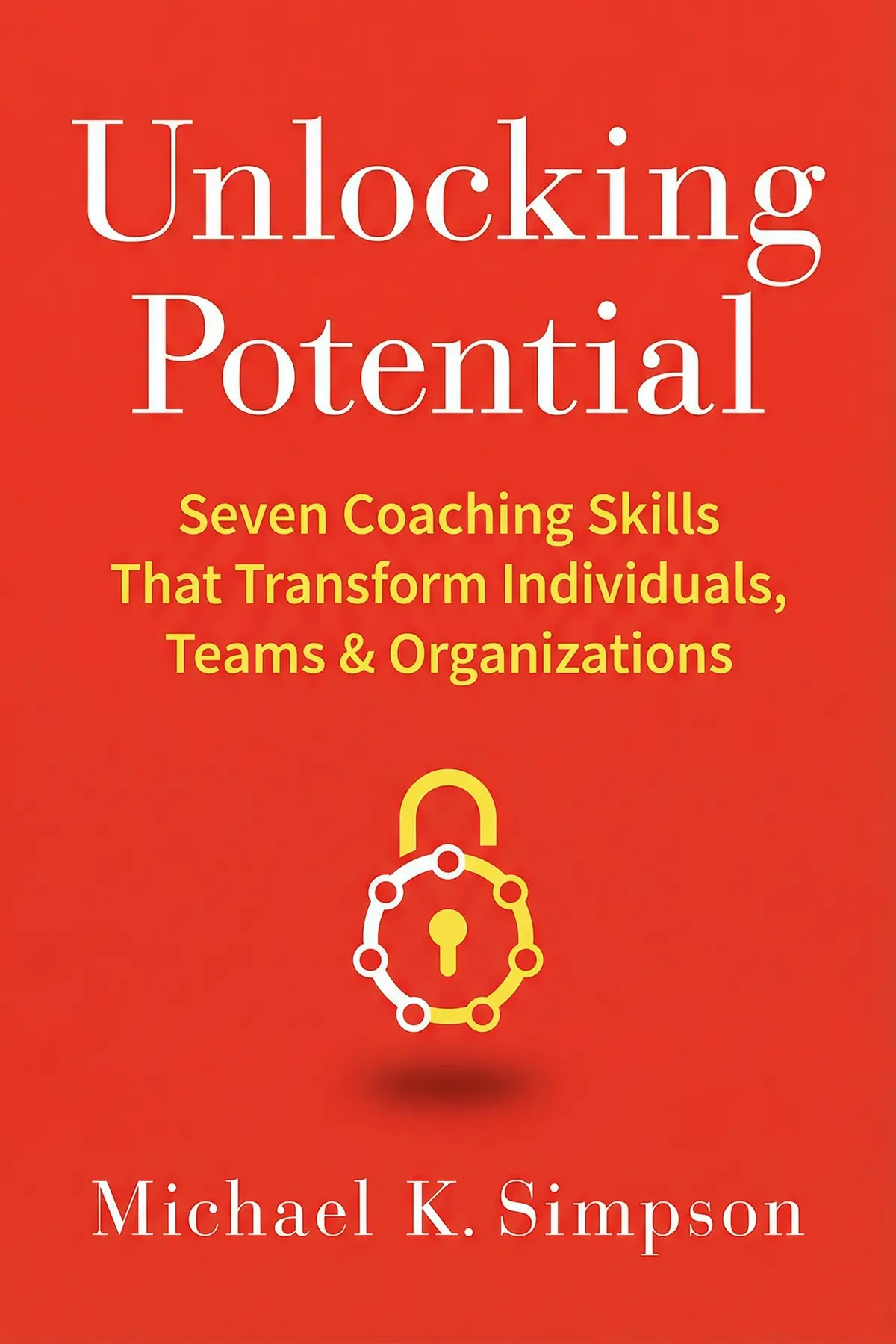
Table of Content
1. Introduction
1 min 10 sec
If you lead a team, you have probably felt the gap between wanting people to grow and actually seeing it happen. In Unlocking Potential, executive coach Michael K. Simpson argues that the fix is coaching, which he treats as its own style of leadership. Advice is only part of it. The main job is to draw out the ability a person already has. Simpson has spent more than 25 years coaching executives and consulting on individual and organizational change, and was once a senior consultant to FranklinCovey; he builds his method on four principles: trust, potential, commitment and execution.
His throughline is simple to state. Coaching works when you earn a person’s trust, assume they can grow, help them commit to goals they chose themselves, and then get out of the way so they deliver on their own. At every stage, questions do most of the work.
Along the way you get a handful of questions you can borrow tomorrow, a better order for giving feedback, and a reason to spend your coaching time on the steady people in the middle of your team.
2. Earn trust by pairing honesty with skill
1 min 47 sec
A manager can be completely honest and still lose the team’s trust. Simpson explains what that manager is missing, and why trust has to be built from two directions before any coaching can begin.
3. Find the hidden belief that limits someone
1 min 55 sec
Some people stay stuck because of something they believe about themselves, and skill has little to do with it. Simpson shows how to spot that belief, and why being tough on it usually makes things worse.
4. Commitment that lasts starts with their own why
1 min 53 sec
Targets handed down from above rarely survive a bad month. Simpson explains what makes a goal stick, and why a career plan that ignores home life is likely to collapse later.
5. Keep long-term goals alive inside the daily whirlwind
1 min 56 sec
Company strategies lose a striking share of their promised value somewhere between the plan and the result. Simpson describes what a coach does about that gap, and what a coach should never try to do.
6. Let people give themselves feedback first
1 min 50 sec
Most feedback fails before the first sentence is finished, because of when it arrives. Simpson suggests a simple change of order that makes people far more likely to act on what they hear.
7. Grow your middle performers for the biggest gains
1 min 58 sec
The middle group, which makes up most of the workforce, rarely gets the attention it needs to grow. Simpson explains why that habit wastes a company’s largest source of improvement, and what micromanagement costs.
8. Conclusion
1 min 07 sec
Simpson’s coaching model rests on one habit: the leader asks, and the other person supplies the answer. Credibility earns the right to ask hard questions. Belief in potential makes those questions worth asking. Commitment grows when people hear their own reasons said out loud, and execution holds when the coach steps aside and protects the long-term goal from the daily whirlwind. At each stage the insight comes from the person being coached, and that is why it lasts.
The method fits into an ordinary week. When someone says they can’t do something, ask why they assume that is true, then ask what else they could try. Before you give feedback, ask what they think went well, and let their answer come first. And choose one steady performer from the middle of your team, the kind who never causes trouble and never gets attention, and give them a clear goal and the room to reach it.
Most of a team’s untapped ability sits with people nobody is coaching. A leader who keeps asking will find it there.
About this book
What is this book about?
Most leaders want their people to keep learning and improving, but wanting it rarely makes it happen. Advice gets ignored, feedback stings, and long-term goals disappear under daily pressure. Michael K. Simpson, who has coached executives for more than 25 years, argues that coaching is its own style of leadership. Its purpose is to draw out the ability a person already has. Advising and consulting are only part of it. Simpson builds his approach on four principles: trust, potential, commitment and execution. He shows how credibility depends on both character and competence, and how sharp questions bring out the beliefs that hold people back. He explains why personal and professional missions have to be planned together, and how a coach keeps strategy alive inside the whirlwind of daily demands. Readers also get practical tools: questions that test limiting assumptions, a way to give feedback that starts with the person's own view, and a reason to focus coaching on the large middle group of steady performers. The book draws on research about failed strategies and micromanagement, so leaders can see why stepping back often works better than pushing.
Book Information
Who it's for
Managers and team leads
Managers and team leads who want their people to grow but find that advice rarely sticks.
Wanting a simple framework
New coaches and HR or learning professionals looking for a simple four-part framework.
Leaders wary of micromanaging
Leaders worried about micromanaging, or about the steady performers they rarely talk to.
About the Author
Michael K. Simpson
Michael K. Simpson has spent more than 25 years coaching executives and consulting on individual and organizational change. As a senior consultant to FranklinCovey, he taught at the Executive Leadership Summit alongside Stephen Covey and Ram Charan, and his clients have included Marriott, Hilton, Nike and Hewlett Packard. He has taught or lectured at universities including Hong Kong University and Brigham Young University. He wrote Your Seeds of Greatness and Ready, Aim, Excel, and co-wrote Building Team and Organizational Trust with Stephen M.R. Covey.
Ratings & Reviews
Ratings at a glance

What people think
Listeners find this work to be a useful introductory manual for nurturing leadership abilities, although some listeners believe the material rehashes ideas from other popular business books. There is praise for the organized models, such as the four coaching principles, which offer a functional strategy for establishing trust and driving results. Furthermore, the provided sample questions and case studies assist listeners in implementing these techniques within their professional groups. The idea of "moving the middle" is frequently cited as a standout feature; specifically, one listener remarked that it offers an "eye-opening" viewpoint on prioritizing average employees to achieve lasting success.
Top reviews
A
After hearing a lot about the '80/20 rule' in management, Simpson’s take on 'Moving the Middle' felt like a genuine revelation for my leadership style. Instead of obsessing over the superstars who might leave anyway, he argues for lifting the bulk of the team to drive long-term success. It is a truly compelling shift in perspective. The book is divided clearly into four principles—Trust, Potential, Commitment, and Execution—which provide a structured roadmap that I actually found useful during our quarterly reviews. While some might say the advice on building trust is basic, the way he ties it to 'challenging paradigms' creates a cohesive system. I really appreciated the specific coaching questions he provides; they are much more tactical than the vague platitudes you find in most business books. Truth is, if you are looking for a practical guide to stop micromanaging and start developing talent, this is a top-tier resource. It’s concise, well-organized, and emphasizes the human element of execution.
Show moreKiattisak
The chapter on strategic clarity alone justified the purchase price for me. As a small business coach for nearly ten years, I can attest that the lessons Simpson shares are foundational for anyone trying to build a high-performing culture. He breaks down the Seven Coaching Skills in a way that is both professional and accessible. Tapping into talent and moving the middle are concepts that my clients struggle with every single day. The truth is that most leaders focus on the 'problem children' or the 'rockstars' while the heart of the company gets ignored. Simpson provides a brilliant framework to fix that imbalance. I didn't find the writing to be poor at all; instead, it felt direct and focused on results rather than flowery language. This is essentially gospel for coaches who want to see their teams execute flawlessly without the need for constant micromanagement.
Show moreCarlos
Wow, what a refreshing take on talent development that doesn't just circle back to standard micromanagement tactics. I've been looking for frameworks like these to help my department transition into a more collaborative environment. We are all coaches now, whether we know it or not, and this book shows you how to embrace that role effectively. The section on challenging paradigms was particularly useful for our creative team. It pushed us to look at our existing workflows through a different lens. Simpson makes it clear that the responsibility for change ultimately lies with the employees, but the coach provides the tools and the clarity needed to succeed. Not gonna lie, I was skeptical about another business book, but the focus on integrity and potential really won me over. It’s a brilliant guide for any level of leadership.
Show moreAna
Picked this up during a transition into a leadership role, and it served as a solid compass for my first few months. The four principles of coaching—Trust, Potential, Commitment, and Execution—are easy to remember and even easier to explain to my own team. I especially liked the section on 'strategic clarity' because it helped me realize I wasn't being nearly specific enough with my expectations. Personally, I found the real-world examples and the focus on 'Execution' to be the strongest parts of the book. It avoids the dreaded 'corporatespeak' that usually makes these management guides feel like a chore to finish. While some of the Seven Skills felt a bit like common sense, having them laid out in this specific order makes for a great reference guide. I would have liked a companion website for the forms mentioned, but the core message is strong enough to stand alone.
Show moreLandon
As someone who grew up playing competitive sports, the analogy Simpson uses between the sideline coach and the business lead clicked instantly. In sports, the coach can’t actually run the plays; they have to rely on the players to execute the vision. This book treats the office the same way, emphasizing that workers today don't want to be micromanaged. They want a project, a deadline, and the trust to get it done. The Seven Skills provide a great roadmap for building that kind of environment. I particularly appreciated the focus on honesty and integrity as the foundation of 'Trust.' While the book does lean on some familiar concepts from other authors, the structure makes it much more actionable for a busy supervisor. It's a quick read that functions as a great reminder of the power of asking the right questions.
Show moreWin
Finally got around to reading this, and I was pleasantly surprised by the list of specific coaching questions included in the later chapters. Many leadership books stay in the clouds, but this one actually gets down into the dirt of daily interactions. The framework of 'Trust, Potential, Commitment, and Execution' is a helpful way to diagnose where a team is currently struggling. If your team isn't performing, you can usually trace it back to a breakdown in one of those four areas. I also found the 'Move the Middle' strategy to be an eye-opening perspective on long-term growth. Investing in the average performers ensures that your organization doesn't collapse if a few top-tier talents decide to leave for other opportunities. It’s a pragmatic, real-world approach that avoids the nonsense buzzwords found in most modern business literature.
Show moreZoe
This book offers a highly structured approach to what can often feel like a very abstract 'soft skill.' By breaking coaching down into the 4 principles and 7 skills, Simpson gives you a checklist to ensure you aren't missing any critical steps in talent development. It is a good reminder of the power of questions and how nothing trumps honesty in a professional relationship. While the prose isn't exactly 'delightful,' it is functional and easy to digest. I think the comparison to Jim Collins is fair, but Simpson adds enough of his own coaching flavor to make it worth the read. The advice on giving effective feedback was particularly helpful for our mid-level managers who often struggle with being too vague. It’s a solid, four-star guide that delivers exactly what the subtitle promises without overcomplicating the message with useless corporate jargon.
Show moreThawee
Ever wonder if there's actually a significant difference between being a traditional manager and being a coach? Simpson tries to bridge that gap here, though the result feels more like a standard management handbook than a revolutionary coaching manual. The advice isn't much different from what you would find in any entry-level leadership course. The 'Move the Middle' concept is the only truly fresh perspective in the entire text. It’s a good reminder that our average performers often represent our greatest untapped potential if we just give them the right attention. However, the rest of the book relies heavily on established frameworks that feel a bit dated in the modern workspace. It is a decent, middle-of-the-road read that works well as a refresher for veteran leaders but likely won't blow anyone’s mind with original theories or groundbreaking prose.
Show morePim
To be fair, I expected a bit more depth from a seasoned expert like Simpson, but this felt like a virgin text that never saw an editor. The prose is clunky, and at times, it feels like an amazing percentage of the book is just unnecessary filler used to stretch ideas. Most of the content is a clear repackaging of ideas already mastered by Stephen Covey or Jim Collins. If you've read 'The 7 Habits' or 'Good to Great,' you won’t find many new insights here. He gives you a list of coaching questions, but frankly, you could find more nuanced prompts with a five-minute Google search. I was hoping for deep strategies on 'moving the middle,' but the book remains disappointingly shallow on the actual implementation. It’s not a total waste of time for an absolute beginner, but for anyone who has been in management for more than a year, it’s mostly redundant.
Show moreEnd
Not what I expected at all, especially given the hype around these specific coaching frameworks. My imagination failed me while trying to find value in what essentially felt like a collection of recycled blog posts. The book covers lots of fundamental facts about talent development to an amazingly shallow level of detail. It is not enough to convince skeptics and offers zero new insights to those already familiar with leadership basics. Plus, the writing style is incredibly distracting and feels like it skipped the final proofreading stage entirely. You can explain business concepts and still delight your reader with decent prose, but Simpson fails to do either here. Save your money and just search for 'coaching questions' online. You'll get the same list of bullets without having to slog through pages of repetitive filler that adds nothing to the conversation.
Show moreQuestions about this book
What is the main idea of Unlocking Potential by Michael K. Simpson?
Simpson argues that coaching is a distinct style of leadership whose purpose is to draw out the ability a person already has. It rests on four principles: trust, potential, commitment and execution. A coach earns trust through character and competence, challenges limiting beliefs with questions, helps people commit to goals they own, and then steps back so they can deliver on their own.
What are the four principles of coaching in Unlocking Potential?
The four principles are trust, potential, commitment and execution. Trust makes honest conversation possible. Potential means assuming every person can grow and finding the beliefs that block them. Commitment comes from helping people see their own goals and the reasons behind them. Execution means helping people reach those goals under their own power, partly by working in a flow state and guarding long-term goals from daily demands.
How should a coach give feedback, according to Simpson?
Simpson recommends asking people to assess themselves first, for example by asking what they liked about the step they just took. Only then should the coach add factual observations and suggestions. People are more likely to act on feedback they have spoken themselves. He also suggests starting from strengths, asking which areas people see as their greatest strengths and how they could focus on them.
Why does Simpson focus on middle performers?
Drawing on Jack and Suzy Welch, Simpson notes that most companies have a low-performing group and a high-performing group of 10 to 20 percent each, and a middle group of 60 to 70 percent. The middle group is capable of greatness but seldom gets attention. Because it is the majority, helping it work better has a large effect on overall productivity.
How can I apply Unlocking Potential at work this week?
Pick a colleague who says they can’t do something and ask why they assume that is true, then what else they could try. In your next feedback conversation, let the other person evaluate their own work before you speak. Each week, name one long-term goal the daily rush might bury and block time for it. And give one steady middle performer a clear goal and room to reach it.
Readers also enjoyed



A Year with Peter Drucker: 52 Weeks of Coaching for Leadership Effectiveness
Joseph A. Maciariello



Acting with Power: Why We Are More Powerful Than We Believe
Deborah Gruenfeld

All In: How Great Leaders Build Unstoppable Teams
Mike Michalowicz


AUDIO SUMMARY AVAILABLE
Listen to Unlocking Potential in 15 minutes
Get the key ideas from Unlocking Potential by Michael K. Simpson, plus 5,000+ more nonfiction titles.
- 5,000+ titles
- Listen as much as you want
- 7-day free trial
- Cancel anytime









