

14 min 19 sec
Available in: English
Unicorn Team: Nine Leadership Types to Launch Ideas with Speed & Success
By Jen Kem
Shows why promising ideas stall, how to test one before funding it, and how to match dreamers, planners and doers to each stage of a launch so the work actually ships.
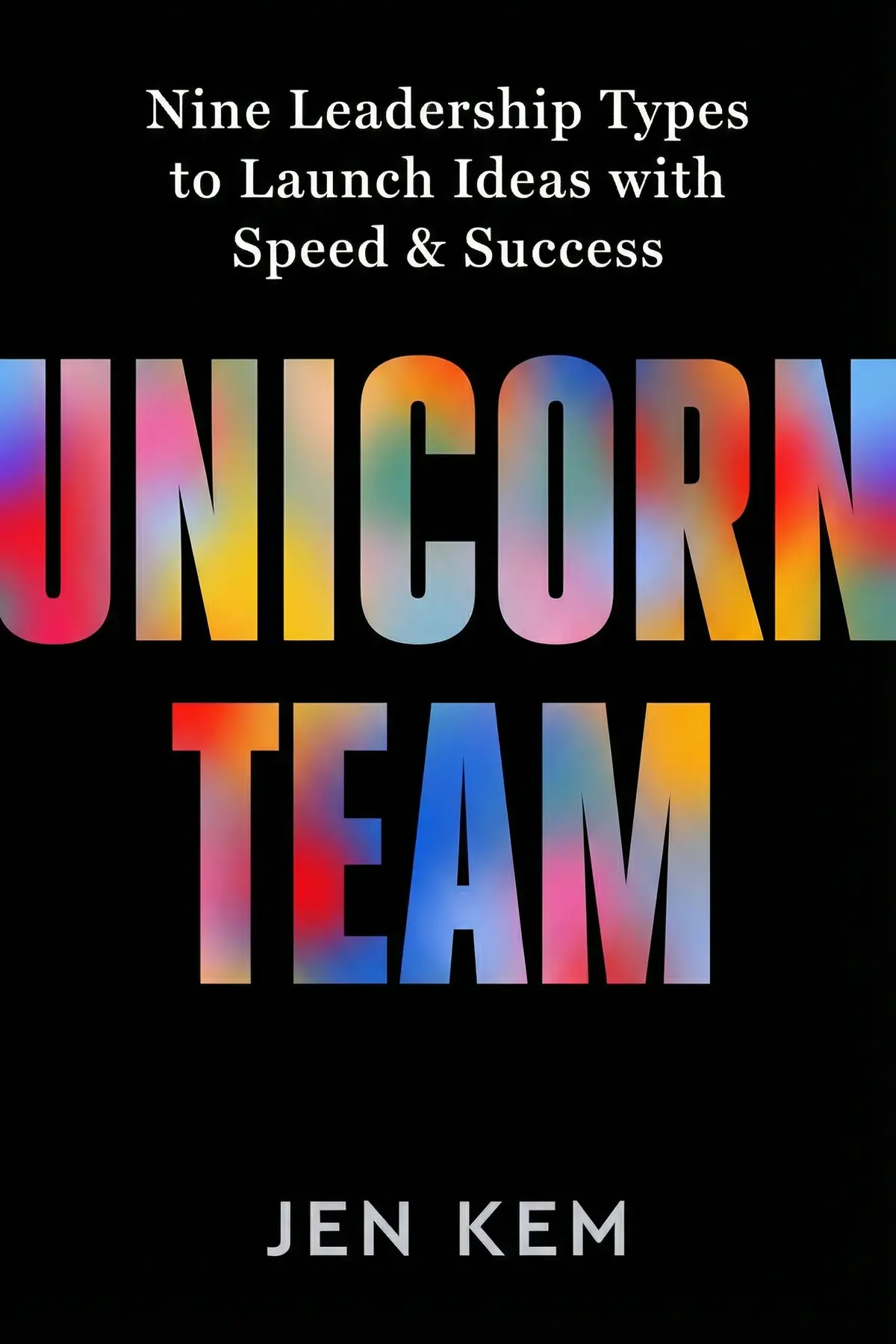
Table of Content
1. Introduction
59 sec
Plenty of teams work hard on ideas that were never going to pay off, and the cause is usually a missing check at the start rather than a lack of effort. In Unicorn Team, strategist Jen Kem argues that most ideas fail because nobody tested them properly, and that the testing works best when each stage is led by a different kind of person. She names the stages Visionize, Strategize and Mobilize, and she gives an idea about 100 days to prove itself with a measurable win.
Kem’s case is that an idea succeeds when the people who imagine it, the people who plan it and the people who carry it out are matched to the right stage and learn to work together. Her examples run from BetterHelp and Starbucks to the strategist behind Oprah Winfrey. What follows is a way to tell which role you play, which one your team is missing, and what to do when the three start pulling against each other.
2. Test an idea before you fund it
1 min 41 sec
Starbucks spotted real demand, built a product to meet it, and still had to abandon it. The reason had nothing to do with customers and everything to do with a question most teams forget to ask.
3. Give your big-idea people the structure they lack
1 min 38 sec
The founders behind Airbnb and DoorDash saw what others missed. Yet the very talent that produces breakthrough ideas also tends to sink them, unless someone recognizes the pattern early.
4. Build the plan that gets a vision moving
1 min 40 sec
Oprah Winfrey and Jennifer Lopez both had someone working out of sight who turned talent into an empire. Their role is easy to overlook and easy to get wrong in a surprising way.
5. Respect the people who finish the work
1 min 42 sec
The people who keep projects on schedule are often treated as helpers. Kem argues they are specialists, and that one hidden fear keeps many of them from becoming leaders.
6. Map your team across nine leadership types
2 min 02 sec
Steve Jobs, Taylor Swift, Ray Dalio and a professional basketball player each represent a different way of leading. Knowing which one you resemble tells you exactly whom to hire next.
7. Turn team clashes into faster decisions
1 min 45 sec
When a new idea lands on a busy team, work often freezes. Kem treats that tension as useful, but only if the team handles three common breakdowns in a specific way.
8. Keep your strongest people from walking away
1 min 45 sec
Most resignations, by the figures Kem cites, could have been prevented. The biggest reason good people leave is feeling unrespected or unrewarded, and regular conversations about their satisfaction can help keep them.
9. Conclusion
1 min 07 sec
Unicorn Team adds up to a plain diagnosis for stalled ideas: usually the right person is missing from the right stage. A big idea without a Strategizer stays a dream. A plan without Mobilizers stays a document. And a group of capable people who never learned how their styles collide will spend its energy on friction instead of progress.
Kem’s model gives that diagnosis a shape you can use. Before the next idea gets money, ask what problem it solves, whether people will take it up the way Starbucks customers took to cold brew, and what a measurable win in 100 days would look like. Then look around the table, name who is dreaming, who is planning and who is doing, and notice which seat is empty. When the team argues over a new idea, send it through those same three stages and agree who owns the call.
And keep talking with your strongest people about where they are heading. A Mobilizer growing into a Strategizer is the team’s next stage, as long as someone makes room for the new seat.
About this book
What is this book about?
Many teams pour months and money into ideas that were never going to work, then wonder why effort did not translate into results. Jen Kem argues that the trouble usually starts early. Ideas get judged by how exciting they feel, and the people asked to deliver them are placed in roles that do not suit how they think. Her answer has two parts. The Unicorn Innovation Model runs every idea through three filters: what problem it solves, whether people will adopt it, and whether it can show a measurable win within 100 days. The Unicorn Leadership Model then describes the people each filter needs: Visionizers who imagine, Strategizers who plan and Mobilizers who execute, along with nine leadership types that blend or concentrate those strengths. Readers get cases from BetterHelp, Starbucks, DoorDash and the strategists behind Oprah Winfrey and Jennifer Lopez. They also get practical guidance on handling conflict between styles, avoiding approval limbo and keeping high performers who now have more options than ever.
Book Information
Who it's for
Ideas stalling before launch
Founders and product leads whose promising ideas keep stalling between the pitch and the launch.
Managers shaping their team
Managers building or rebalancing a team who want to know which roles are missing.
Leaders losing top performers
Leaders losing high performers and looking for practical ways to keep them engaged.
About the Author
Jen Kem
Jen Kem led business-to-business strategy and marketing as an executive at a large company before founding her own strategy firm. Forbes has recognized her expertise in building brands, and she has helped companies such as Microsoft, Coca-Cola and the Oprah Winfrey Network launch products. She also runs a private equity club that funds innovations for women and children, and she created the Unicorn Leadership Type Assessment, which looks at the self-directed motivation of the people a business needs. She lives in the San Francisco Bay Area.
Ratings & Reviews
Ratings at a glance
What people think
Listeners find that this leadership book merges creative concepts with actionable tactics, detailing the nine vital leadership styles necessary for achievement. The book is also lauded for its accessibility; one listener notes that it doesn't waste time on fluff. Additionally, listeners value the novel perspective on innovation, the hands-on guidance, and the methods for developing strong teams. This guide is simple to digest and put into practice, proving inspirational to listeners, with one review mentioning how it bolsters their vision.
Top reviews
Sudarat
Finally, a business book that recognizes ideas are the easy part; execution is the real beast. Jen Kem breaks down why your big vision might be failing by introducing the nine leadership types, and frankly, it is a revelation. I realized I was trying to be a Visionizing Strategizer when I really needed a Mobilizer to get things across the finish line. The Unicorn Innovation Model provides a three-stage filter—Visionize, Strategize, and Mobilize—that acts like a reality check for every project. It is dense with strategy but written with such clarity that you can start applying it to your team meetings the next day. The focus on the 100-day execution window in the Mobilize stage is particularly brilliant for keeping momentum high. This isn't just dry theory; it is a manual for anyone tired of seeing great concepts stall out.
Show morePat
As an entrepreneur who has spent years in the 'I do everything' trap, this book felt like a targeted intervention. The Unicorn Leadership Type Assessment (ULTA) completely changed how I view my own strengths and, more importantly, where my blind spots are hiding. I discovered I am a Strategizing Visionizer, which explains why I have great plans but struggle with the daily grind of execution. Kem’s writing style is punchy and direct, avoiding the typical corporate fluff that plagues most leadership guides today. While the nine hybrid archetypes might seem overwhelming at first, the way she illustrates them—like using Taylor Swift as an example of The Mastermind—makes it incredibly relatable. If you are serious about scaling without burning out, you need to understand the synergy between Visionizers, Strategizers, and Mobilizers. It is an absolute game-changer for building a culture that actually sticks.
Show moreA
Is your big idea actually viable, or is it just a resource drain in disguise? Unicorn Team forces you to answer that question before you spend a single dime on a new hire or a marketing campaign. I appreciated the structured approach of the Visionize-Strategize-Mobilize framework, as it provides a necessary filter for the 'shiny object syndrome' many founders suffer from. The BEIT analysis was a standout tool for me, offering immediate clarity on budget and energy integrations that I had previously overlooked. Truth be told, identifying these three distinct pillars of leadership has simplified how I assign roles in my own company. While some of the naming conventions for the hybrid types take a minute to memorize, the core message about aligning strengths is too important to ignore. It is a solid resource for anyone leading a growing team in a competitive market.
Show moreRatchada
Jen Kem doesn't waste a single page on filler or fluff. She gets straight to the meat of why teams fail and how to fix the friction points that kill innovation. The concept of the 'Unicorn Team' isn't about finding mythical employees; it is about intentionally mixing the doers, the dreamers, and the planners. I specifically loved the sections on conflict management, showing how tension between a Visionizer and a Mobilizer can actually be a source of strength if managed correctly. The book is incredibly easy to read but demands that you actually do the work—the IdeaStorm exercises are particularly useful for group brainstorming sessions. Personally, I think this should be required reading for any manager stepping into a new leadership role. It simplifies the complexity of human dynamics into a blueprint that actually yields measurable results.
Show moreRoydao
Consultants might think they don't need this because they work solo, but Unicorn Team proved me wrong almost immediately. It helped me identify my own 'unicorn energy' and finally explained why I struggled in certain corporate roles in the past—I was a Strategizer forced to act like a pure Mobilizer. The book is a masterclass in self-awareness that allows you to stop apologizing for what you aren't and start leaning into what you are. Jen’s advice on how to attract the right people to help you 'win' with an idea is incredibly tactical and actionable. I have already started using the DOIT Analysis (Drivers, Obstacles, Identity, Triggers) to re-evaluate my 2025 business goals. Look, if you want to stop feeling like you are pushing a heavy boulder uphill, read this today. It is an empowering guide that respects the individual's worth while showing how to build a collective powerhouse.
Show moreNiramai
The chapter on tactical execution alone is worth the price of admission. Most leadership books stay at the 30,000-foot view, but Jen Kem brings you right down to the ground with tools like the BEIT analysis. As someone who manages a creative team, the way she explains the friction between the 'Big Idea' people and the 'Action' people was incredibly relatable. We have all seen what happens when you have too many Visionizers and no one to build the systems to support them. The writing is compassionate yet firm, pushing you to take ownership of your leadership style and your team's outcomes. I have already seen a shift in how my staff communicates after we identified our specific ULTA types last week. It is rare to find a book that balances deep psychology and practical business strategy this effectively.
Show moreAurora
After following Jen’s work for a while, I finally dove into the full book to see if it lived up to the hype. It is a refreshing take on team dynamics that moves beyond the typical personality tests by focusing on how people actually get things done. I particularly liked the 'Legend' and 'Innovator' archetypes; they give a face to the abstract concepts of vision and strategy. The book does a great job of explaining that leadership is not a solo act but a team performance. My only minor gripe is that some of the real-world examples felt a bit grand—not everyone is trying to build a global music empire—but the underlying principles remain sound. It is a very practical manual for anyone ready to stop doing everything themselves and start leading with intention.
Show moreTakeshi
Don't fall into the trap of confusing activity with real progress. Jen Kem outlines exactly why the 'hustle harder' mentality is a recipe for failure if you do not have the right structure behind you. The transition from idea to strategy to mobilization is where most businesses die, and this book provides the map to navigate that valley. I found the section on retention and transitions particularly insightful; keeping top talent means allowing them to evolve into different leadership types over time. Use the Mobilizing Visionizer examples, like Martha Stewart, to understand how to blend personal craft with scalable business systems. The prose is fast-paced and energetic, making it a quick read despite the depth of the content. In my experience, this is the most useful hiring guide I have read in a decade.
Show moreMalee
Picked this up on a recommendation, and I am quite glad I did. The Unicorn Innovation Model is a brilliant tool for ensuring your team is solving the right problems rather than just staying busy with low-impact tasks. I appreciated the focus on psychological safety and how to foster a culture where different 'types' can actually collaborate without constant friction. Gotta say, the section on the 'Strategizing Strategizer' was a bit dry compared to the rest of the book, but the overall framework is incredibly sturdy. It is an excellent guide for entrepreneurs who are ready to step out of the day-to-day operations and into a true leadership role. The advice on handling difficult conversations and team alignment is pure gold for any manager. I will be keeping the 'Specialist' and 'Sage' descriptions handy for my next round of interviews.
Show moreSangduan
To be fair, the framework presented here is very well-organized, but I struggled with the sheer number of leadership archetypes. With nine different hybrid configurations, it felt like the system was becoming more complex than the people it was trying to describe. While the core pillars of Visionizers, Strategizers, and Mobilizers make sense, the nuances between a Mobilizing Visionizer and a Visionizing Mobilizer felt like splitting hairs. That said, the Unicorn Innovation Model is quite useful for vetting new business ideas to see if they are worth pursuing. I found the Mobilize stage—focusing on that 100-day window—to be the most practical part of the book for my current needs. It is a decent resource for identifying team gaps, but I wish it were a bit more streamlined for smaller startups with fewer than five people. It is worth reading for the innovation model alone, but be prepared for some jargon.
Show moreQuestions about this book
What is the main idea of Unicorn Team by Jen Kem?
Kem argues that ideas fail mostly because they are never properly tested and because the wrong people lead each stage. Her model runs every idea through three stages, Visionize, Strategize and Mobilize, and matches each stage to a leader who thrives there: Visionizers who imagine, Strategizers who plan and Mobilizers who execute. A team that balances all three, and handles its conflicts well, launches ideas faster.
What is the Unicorn Innovation Model?
It is Kem’s three-step filter for deciding whether an idea deserves investment. Visionize asks what urgent problem the idea solves, as BetterHelp did by making therapy easier to reach through video chat. Strategize asks whether people will adopt it, as Starbucks learned when smoothies slowed baristas and cold brew worked better. Mobilize asks whether the idea can show a measurable win within 100 days.
What are the nine Unicorn leadership types?
Six types blend two core roles: the Legend and the Mastermind mix vision and strategy, the Innovator and the Creator mix vision and execution, and the Chief and the Guide mix strategy and execution. Three are pure forms: the Guru is purely a Visionizer, the Sage purely a Strategizer, and the Specialist purely a Mobilizer. Kem gives examples ranging from Steve Jobs and Taylor Swift to Ray Dalio and Toni Kukoč.
How does Unicorn Team suggest handling team conflict?
Kem treats tension between leadership types as useful when managed. When a new idea collides with ongoing work, run it through the three-stage framework so each role weighs in on trade-offs, risks and limits. Avoid approval limbo by sharing ownership of wins and mistakes. Check whether poor results come from the strategy itself, and let leaders model accountability with sincere apologies.
How can leaders keep their best people, according to Jen Kem?
Kem notes that voluntary turnover costs US businesses one trillion dollars a year and that more than half of people who quit say their company could have kept them. She recommends regular conversations about satisfaction and future opportunities, real recognition for high performers, and helping people move into roles that fit as they grow. She also encourages open talk about staying, starting something new or taking a sabbatical.
Readers also enjoyed

A Bigger Prize: How We Can Do Better Than the Competition
Margaret Heffernan





A Year with Peter Drucker: 52 Weeks of Coaching for Leadership Effectiveness
Joseph A. Maciariello



Acting with Power: Why We Are More Powerful Than We Believe
Deborah Gruenfeld
AUDIO SUMMARY AVAILABLE
Listen to Unicorn Team in 15 minutes
Get the key ideas from Unicorn Team by Jen Kem, plus 5,000+ more nonfiction titles.
- 5,000+ titles
- Listen as much as you want
- 7-day free trial
- Cancel anytime









