

13 min 11 sec
Available in: English
Transcendence: How Humans Evolved Through Fire, Language, Beauty, and Time
By Gaia Vince
Explains how a marginal African mammal came to dominate Earth. Culture, working with environment and genes, gave us four tools our bodies alone could not: fire, language, beauty and a sense of time.
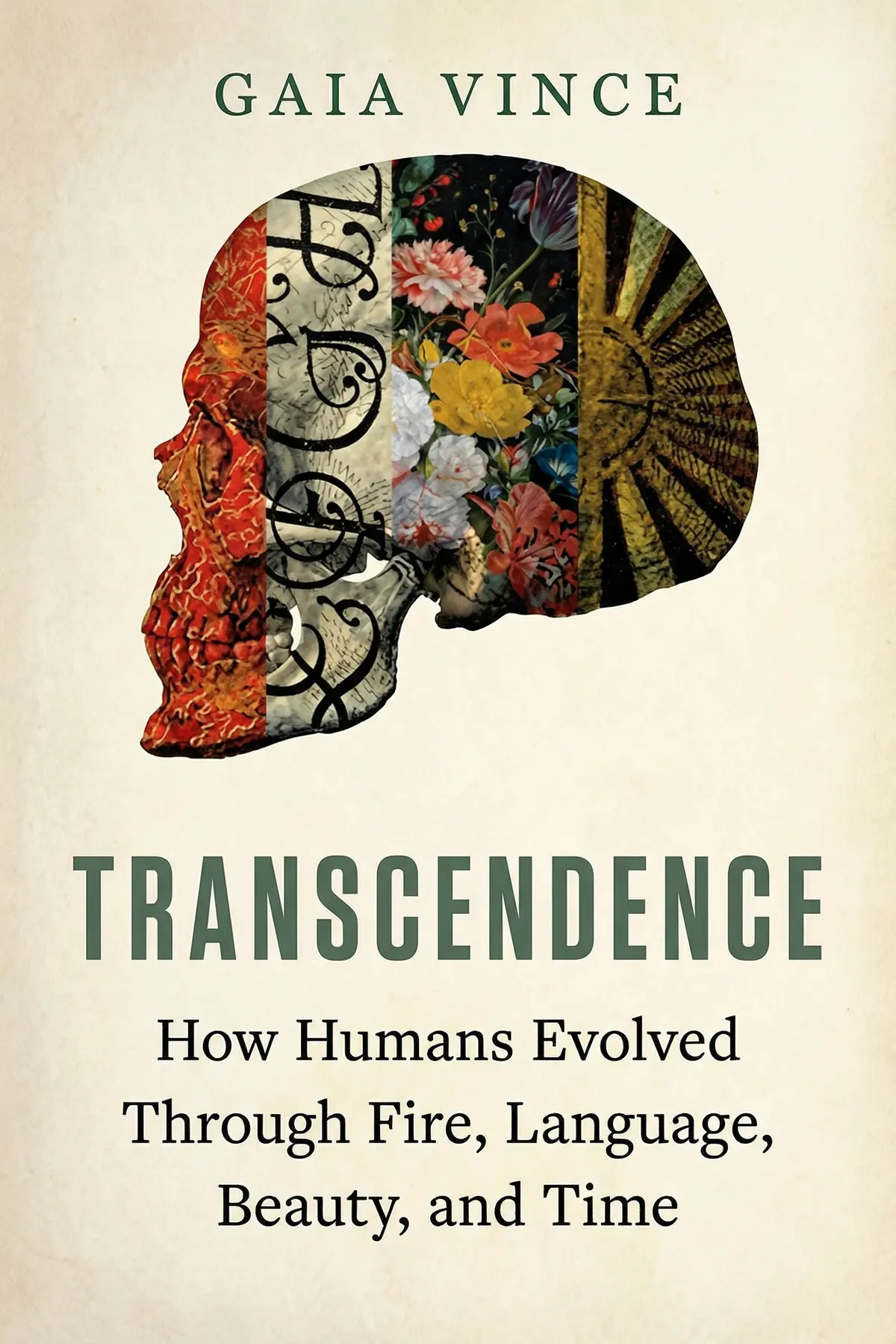
Table of Content
1. Introduction
1 min 05 sec
Most of us picture human progress as a story of bigger brains, as if biology alone lifted us off the savanna. In Transcendence, science journalist Gaia Vince argues that we never did it alone: our environment, our genes and our culture shaped each other, and culture is the part that kept pushing us past our limits.
Drawing on anthropology, genetics, environmental science and psychology, she singles out four cultural inventions that set our species apart: fire, language, beauty and time. Each gave us something our bodies could not. Fire supplied extra energy, language a way to store and pass on knowledge, beauty meaning and structure, and time a way to reason about cause and effect.
Follow those four threads and the rise of a marginal African mammal to the planet’s dominant species starts to make sense. It also gives you a fresh way to look at your dinner, your jewelry, the stories you tell at work and the clock on your wall.
2. See the three forces that made us human
1 min 58 sec
A man born seeing only gray can now perceive more colors than anyone alive. His device looks like the future, yet Vince argues it reveals something our species has been doing for a very long time.
3. Trace big brains and big societies back to fire
2 min 05 sec
An outback people turn a poisonous seed into everyday bread. The knowledge behind that recipe points to the single invention that, in Vince’s account, fed our brains and taught us to teach.
4. Tell it as a story and people remember
2 min 19 sec
Chimpanzees share almost all of our speech gene, yet they manage only a handful of words. Vince explains what the small difference bought us, and why the way you package information decides whether anyone keeps it.
5. Read the status signals hidden in beauty
2 min 22 sec
A necklace’s color can tell a stranger whether its wearer is single or widowed. Vince argues that our taste for beautiful things did far more than decorate: it drew trade routes, launched voyages and may have built the first cities.
6. Plan for later, the oldest human tool
2 min 12 sec
An ancestor finishes a meal and walks off holding her stone axe. Vince sees in that small gesture a mental leap that led, over a million years, to farming, factory shifts and the clock on your wall.
7. Conclusion
1 min 10 sec
Vince turns the usual picture of human success inside out. A marginal mammal on the African savanna did not become the dominant species through its body alone. Its environment set the stage, its genes supplied a few unusual traits, and culture did the rest, piling up knowledge each generation could build on. Fire bought energy, language kept knowledge alive across centuries, beauty gave life meaning and social order, and time let us reason about cause and effect. Neil Harbisson’s antenna is simply the newest example of a habit as old as the first cooking fire: using what we make to go beyond what we were born with.
That view has everyday uses. When you want an idea to last, tell it as a story, since stories stick far better than lists. When a group thrives, look at how well it teaches what it knows. And when you set a plan, remember that the plain notion of later was once a breakthrough.
Vince admits the road ahead is uncertain. What she shows is that tomorrow keeps arriving, and humans have always met it with the tools they carried out of yesterday.
About this book
What is this book about?
For most of our past, humans were a minor species scraping by on the African savanna. Today we live on every continent and reshape the planet. Science journalist Gaia Vince sets out to explain that rise, and her answer is that we never managed it through biology alone. Drawing on anthropology, genetics, environmental science and psychology, Vince describes an evolutionary triad of environment, genes and culture acting on one another. Culture, the knowledge each generation passes to the next, is the part that kept pushing us past our limits. She follows four cultural inventions in detail. Fire gave us more energy than our bodies could produce. Language let us store and share knowledge. Beauty gave life meaning and social order. A sense of time let us reason about cause and effect. Along the way readers meet an artist who hears colors through an antenna in his skull, an outback people who bake bread from poisonous seeds, a temple older than farming and a stone axe carried away for later. The result is a clear frame for understanding what makes humans different, and why stories, symbols and schedules still shape daily life.
Book Information
Who it's for
Curious why humans dominate
Curious readers who want a clear account of why humans, and not other apes, came to dominate Earth.
Educators and presenters
Teachers, trainers and presenters who want to know why stories outlast lists of facts.
Professionals curious about inventions
Professionals interested in how fire, symbols and clocks still shape work and daily life.
About the Author
Gaia Vince
Gaia Vince is a freelance journalist and broadcaster who focuses on the environment. She studied chemistry, writes for The Guardian, and earlier held editing roles at Nature and New Scientist. Her first book, Adventures in the Anthropocene, won the 2015 Royal Society Winton Prize for Science Books, making her the first woman to win it outright. She later wrote Nomad Century, on climate migration, and has presented programs on Channel 4 and BBC Radio 4.
Ratings & Reviews
Ratings at a glance
What people think
Listeners consider this title to be an excellent listen that is both approachable and expertly authored. They value the educational depth, with one listener highlighting how the narrative shifted their outlook on the world in unexpected ways.
Top reviews
Hugo
Picked this up on a whim and was completely blown away by the scope of Gaia Vince’s vision. She manages to synthesize an enormous amount of knowledge into four distinct pillars: fire, language, beauty, and time. I found the section on how fire allowed us to 'outsource' our energy needs to be particularly enlightening, as it explains the biological leap toward our massive brains. Her writing style is remarkably fluid for such a dense subject, making complex evolutionary concepts feel like a gripping narrative. To be fair, some of the connections between beauty and economic exchange felt a bit ambitious, but the sheer originality of the synthesis kept me hooked. This is exactly the kind of 'big history' book that changes the way you look at a simple campfire or the words you speak. It feels like a definitive guide to what makes us uniquely human in a world governed by genetics.
Show moreJom
The chapter on beauty alone makes this worth the price of admission for any curious reader. Vince argues that our drive for aesthetic objects was a primary catalyst for economic exchange, which is a brilliant way to connect art and survival. I was also deeply moved by the descriptions of Australian Aboriginal songlines and how they serve as musical maps for navigation and survival. It’s rare to find a science journalist who can write with such empathy while still maintaining a focus on hard facts and data. Not gonna lie, I was worried this would be a dry read, but her storytelling is top-notch and kept me engaged through some of the more technical passages. She successfully shows how we have transcended our biological limits to become a species that determines its own destiny. This book really expanded my world view in surprising and delightful ways.
Show morePim
Wow. This is essentially a roadmap of how we hacked our own biology to become the most influential force on Earth. Gaia Vince writes with such clarity that even the most complex theories about cultural evolution become easy to grasp. I loved the way she connected the discovery of fire to the eventual development of metallurgy and modern cities; it makes our technological progress feel like an inevitable chain reaction. Truth is, I haven't been this excited about a science book since I first read The Selfish Gene years ago. The way she incorporates beauty and time as evolutionary drivers is both fresh and deeply intuitive. While the book is relatively short, it packs a massive punch and covers an incredible amount of ground without ever feeling rushed. It is a wonderful read that I’ll be recommending to everyone I know. Absolutely superb work by a world-class science journalist.
Show moreSaengdao
To be fair, I usually find anthropology a bit dry, but this reads more like a gripping narrative of our shared ancestry than a dusty academic text. Vince has this incredible ability to weave together disparate threads from archaeology, genetics, and sociology into a truly workable whole. I was especially struck by the discussion on 'shared attention' and how reciprocity is the foundation of human learning; it really put the importance of our social structures into perspective. While some critics argue that the themes are predictable, I found her specific focus on beauty as an economic catalyst to be a fresh and thought-provoking angle. The writing is fluid, the research feels expansive, and the overall message is one of profound hope for what we might become. It’s an informative, wonderful read that definitely expanded my worldview in ways I didn't anticipate when I first opened the cover.
Show moreChaiwat
As someone who devours 'big history' books like Sapiens, I found Transcendence to be a worthy addition to the shelf, even if it covers some familiar territory. Vince’s focus on the synergy between our genes and our culture is the real highlight here. I especially loved the details about assisted birthing and how our social nature evolved alongside our physiology. It’s fascinating to consider that our brains didn't just grow in a vacuum; they were fueled by the discovery of cooking and the cultural transmission of fire-making skills. Frankly, the narrative can be a bit repetitive if you’ve read a lot of anthropology, but her prose is so much more accessible than your average textbook. My only real gripe is that the chapter on time felt a little rushed compared to the deep dives into language. Overall, it is a very solid and informative read for anyone curious about our origins.
Show moreThitima
Finally got around to reading Gaia Vince, and her prose is remarkably fluid for such a dense and expansive subject. She has a real gift for taking massive archaeological findings and turning them into relatable human stories. I particularly enjoyed the discussion on 'shared attention' and how reciprocity is the foundation of how we learn to speak and interact. It’s an interesting way to present the human story, emphasizing that we are a collective intelligence rather than just individual geniuses. To be fair, I did notice the occasional lack of specific citations that other reviewers mentioned, which might bother the more academically inclined. But for a general audience, this is a fantastic piece of science communication that makes sense of our chaotic history. The book is short on political details, but it excels at explaining the biological and cultural feedback loops that made us who we are today.
Show moreRin
After hearing about Vince’s previous work on the Anthropocene, I had high hopes for this deep dive into our cultural evolution. For the most part, she delivers a compelling argument about how fire and language allowed us to escape the prison of genetic determinism. The sections on how we use stories to remember complex data—making information 22 times more memorable—really resonated with me as a reader. It’s a well-researched book, though I do wish there was a more comprehensive bibliography for those of us who want to dig into the primary sources. Some of her premises about early human migration felt a little speculative, but that’s the nature of archaeology to some extent. The tone is generally optimistic, focusing on our capacity to overcome obstacles through innovation and cooperation. It’s a very informative read that manages to be both educational and entertaining.
Show moreDuangjai
Ever wonder how humans actually became the dominant species on this planet despite being relatively weak primates? Gaia Vince attempts to answer this by looking at four major cultural catalysts, and for the most part, she succeeds in providing a readable overview. However, I felt like the book didn't offer many truly 'new' insights if you are already well-versed in the works of David Christian or Stephen Pinker. The ideas are organized well enough, but the lack of a chronological structure made the pacing feel uneven at times. In my experience, the middle sections on language and beauty were the strongest, while the beginning felt a bit like a retread of basic evolutionary biology. It is definitely a well-written account, and I appreciate the effort to bring so many disciplines together, but it didn't quite reach that 'magisterial' level for me. It's a good introductory text for newcomers to the genre.
Show moreMoo
Look, if you’ve already read Harari and Pinker, you might find this a bit redundant in terms of the actual facts presented. Most of the core concepts—like fire unlocking nutrients for brain growth—are fairly standard in the 'big history' genre these days. Gaia Vince is a talented writer, but I found the structure of the book a bit meandering, as it jumps between millennia without a clear through-line. Personally, I would have preferred more footnotes and a deeper dive into the history of ideas or philosophy, which seemed largely absent here. That said, it is a very easy read and would be a perfect resource for a college student or someone just starting to explore cultural anthropology. It’s a respectable effort to organize the vastness of human evolution, even if it feels a bit like a collection of interesting magazine articles rather than a unified theory.
Show moreHiroshi
Not what I expected after the glowing praise this book has received in science circles. While Gaia Vince clearly has a massive amount of knowledge at her fingertips, the presentation felt incredibly disjointed and often speculative. Truth is, I struggled with the lack of rigorous source references for some of her more ambitious claims about early hominid behavior. She meanders from point to point, occasionally making grand statements that felt more like pop-philosophy than hard evidence-based science. For a book that positions itself alongside heavyweights like Harari or Pinker, it simply doesn't have the same level of narrative cohesion or academic weight. I found the discursive writing style quite frustrating to follow, especially when the arguments jumped back and forth through time without a clear chronological anchor. It’s an interesting attempt at a 'big take' on humanity, but the execution left me wanting much more substance.
Show moreQuestions about this book
What is the main idea of Transcendence by Gaia Vince?
Vince argues that humans rose to dominate the planet through an evolutionary triad of environment, genetics and culture acting on one another. Culture, the knowledge passed between generations, kept extending what our bodies could do. She focuses on four cultural tools that stand out: fire for energy, language for storing knowledge, beauty for meaning and social structure, and time for reasoning about cause and effect.
Why does Gaia Vince say fire was so important?
Cooking made food easier to digest and more nutritious, and cooked meat yields 40 percent more calories than raw. Vince argues this extra energy helped our brains grow. Keeping fires lit also pushed people to invent tools and teach each other, and the best communicating groups spread furthest. Fire then led to pottery, food storage, and later kilns and plows.
What does Transcendence say about storytelling?
Vince writes that stories help us entertain, build empathy, share values and make sense of the world. Brain scans show a story aligns the minds of teller and listener, as if both were living the events. According to her, facts woven into a narrative stick in the mind 22 times better than a bare list of facts, which accounts for the survival of myths across thousands of years.
How can I apply the ideas in Transcendence?
Present anything you want remembered as a story with people and action, not a list. In teams, pay attention to how well know-how is passed on, since Vince shows the groups that taught best were the ones that grew. Read clothing and ornaments as signals of status and belonging. And practice planning for later, the mental leap she traces back 1.5 million years.
Who should read Transcendence?
It suits readers who want one clear frame for human evolution that combines biology and culture. Students of anthropology or history get vivid cases, from the Yandruwandha’s seed bread to Göbekli Tepe. Teachers and presenters get a reason to use stories. Anyone curious about why we decorate ourselves or watch the clock will find the roots of those habits here.
Readers also enjoyed

1491: New Revelations of the Americas Before Columbus
Charles C. Mann
Age of Anger: A History of the Present
Pankaj Mishra

A Life Decoded: My Genome: My Life
J. Craig Venter

1929: Inside the Greatest Crash in Wall Street History--and How It
Andrew Ross Sorkin

Agent Sonya: The Spy Next Door
Ben Macintyre

A Planet of Viruses
Carl Zimmer

A Biography of Loneliness: The History of an Emotion
Fay Bound Alberti
Alexander Hamilton
Ron Chernow

A Short History of Nearly Everything
Bill Bryson
AUDIO SUMMARY AVAILABLE
Listen to Transcendence in 15 minutes
Get the key ideas from Transcendence by Gaia Vince, plus 5,000+ more nonfiction titles.
- 5,000+ titles
- Listen as much as you want
- 7-day free trial
- Cancel anytime









