

13 min 54 sec
Available in: English
Third Millennium Thinking: Creating Sense in a World of Nonsense
A physicist, a philosopher and a psychologist show how to judge information the way good scientists do: put odds on your beliefs, check your own bias, keep facts and values apart and decide well with people who disagree.
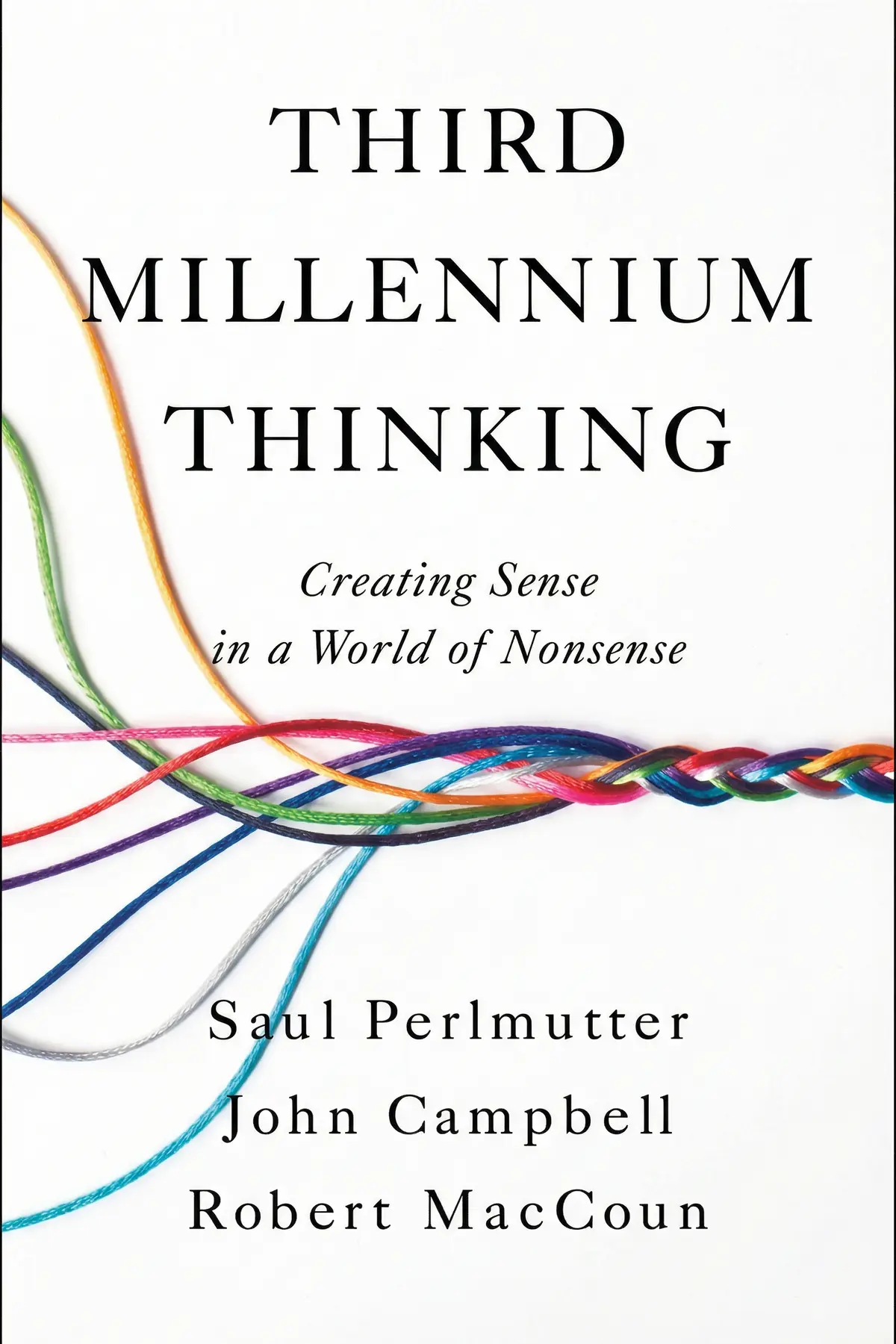
Table of Content
1. Introduction
1 min 02 sec
If every scroll through your feed leaves you less sure what to believe, reading more will not fix it. What helps, according to Third Millennium Thinking, is borrowing the working culture of science: putting honest odds on your beliefs, checking yourself for bias and deciding alongside people who disagree with you. The book comes from a physicist, a philosopher and a psychologist: Nobel-winning Saul Perlmutter, John Campbell and Robert MacCoun.
Their argument is that good judgment is a shared practice. Smart people who know all about bias still fall for it, so the real protection lies in habits and processes that let others catch our mistakes, joined to a belief that hard problems have solutions.
The ideas ahead turn that into tools for daily life: a test for deciding which experts to trust, a trick for setting your standards before your hopes can bend the evidence, and a method that brought randomly chosen Texans to common ground on energy.
2. Spot the shortcuts the information flood pushes on you
1 min 44 sec
Billions of pages sit one search away, yet most people end up believing roughly what they believed before. The authors trace that to a handful of shortcuts nearly everyone uses, and to a 2011 argument that started the whole project.
3. Trust experts who show you their weak spots
1 min 40 sec
A famous scientist’s brilliance feels like a good reason to believe them. The authors disagree, and they offer a different test for deciding whom to trust when credentialed experts contradict each other on the same question.
4. Put a number on how sure you are
1 min 52 sec
Saying something is true or false feels decisive, yet it throws information away. A small change in how you state your views protects your credibility and takes away the pressure of always having to be right.
5. Read the evidence before you know what it says
1 min 36 sec
Knowing about bias does surprisingly little to stop it, even among physicists. One technique borrowed from the lab works on a medical decision at home, and it depends entirely on timing.
6. Separate facts from values, then reason about both
1 min 52 sec
Science is supposed to handle the facts while everyone else sorts out the values. The authors defend that split, then show exactly where it breaks, from standards of proof to the debate over autism.
7. Let ordinary citizens weigh the evidence together
1 min 35 sec
Legislatures suggest the public can no longer reason together. A utility regulator in Texas tried a method built on randomly chosen citizens, and the energy mix it produced was not the expected one.
8. Pair a skeptic's brake with an optimist's gas pedal
1 min 26 sec
Doubt protects you from bad ideas, but on its own it goes nowhere. The authors pair it with a particular kind of hope, and explain why that pairing matters for problems as large as climate change.
9. Conclusion
1 min 07 sec
The title is a bet about the coming centuries: that the habits keeping science honest can work far outside the lab. Those habits were never about being cleverer. Perlmutter, Campbell and MacCoun shaped them into a Berkeley course, Sense and Sensibility and Science, which about 30 volunteers spent roughly nine months designing. The lesson they kept returning to is that nobody sees their own blind spots, so good sense has to be built into how people work together.
That makes the payoff personal and shared at once. When a headline grabs you, give the claim a percentage before you react, and keep brand-new controversies out of your opinion budget for a while. Before a big decision, pick your trusted sources first, so your hopes cannot steer the verdict. And when you argue with a relative or a colleague, treat the conversation as a search for your own mistakes.
The authors admit that no single book can heal a divided society. Their wager is smaller and sturdier: keep one foot on the brake, one on the gas, and keep moving.
About this book
What is this book about?
Every day brings vaccine scares, miracle supplements, opinion pieces dressed up as news and feeds tuned to keep you angry. Physicist Saul Perlmutter, philosopher John Campbell and psychologist Robert MacCoun argue that the answer lies in the working culture of science, the unspoken habits researchers pick up from one another, applied to ordinary choices. The first half of the book covers habits of mind: putting a probability on what you believe, hedging your opinions, weighing two kinds of error and using blind analysis so your hopes cannot shape how you read evidence. The rest turns to habits of community, because people who know all about bias still fall for it. Here the authors separate facts from values without treating values as mere taste, and describe methods such as deliberative polling, where randomly chosen citizens question experts and find common ground. Readers get tools for conflicting medical advice, tense family debates about climate and shared decisions at work, along with a reason to keep going: skepticism works as the brake, optimism as the gas, and progress needs both.
Book Information
Who it's for
Professionals weighing conflicting evidence
Professionals who face conflicting reports and must decide which evidence to trust.
Parents sorting health advice
Parents sorting through contradictory medical and health advice online.
Team leads, engaged citizens
Team leads and engaged citizens tired of arguments that go nowhere and looking for ways to decide together.
About the Author
Saul Perlmutter
Saul Perlmutter is a physics professor at the University of California, Berkeley, and a senior scientist at Lawrence Berkeley National Laboratory. In 2011 he won a share of the Nobel Prize in Physics for finding that the expansion of the universe is accelerating. John Campbell teaches philosophy at Berkeley, works on meaning, metaphysics and the philosophy of psychology, and has held Guggenheim and National Endowment for the Humanities fellowships. Robert MacCoun, a social psychologist by training, is Kowal Professor of Law at Stanford Law School and studies decision making and bias in how people read research evidence. The book grew out of courses Perlmutter helped create and taught with colleagues.
Ratings & Reviews
Ratings at a glance
What people think
Listeners find this book highly educational, with one review specifically praising the helpful illustrations used to explain scientific principles. They also value its readability; one listener mentioned how easy it is to remain fully engaged with the material.
Top reviews
Kenji
The final section on the importance of community really tied everything together for me in a way I didn't anticipate. We often think of critical thinking as a solitary endeavor—a person in a room fighting their own brain—but the authors argue that cold calculation is often a miscalculation. They use the analogy of Mr. Spock from Star Trek perfectly, showing how logic must be tempered by human connection and shared goals to be truly effective. This book isn't just about avoiding errors; it’s about how we can function better as a collective in a world that feels increasingly polarized. The prose is punchy. The examples are relevant to the struggles of the 2020s. I found myself highlighting entire pages of advice on probabilistic thinking and distant future impacts.
Show moreManika
I’ve spent years looking for a manual on collective decision-making that actually works in the real world, and this might be it. The authors don't just tell you to 'think better'; they explain the specific mechanisms of the scientific community that allow for progress despite human error. Applying these same concepts to our broader society is a genius move that feels both urgent and practical. The writing is accessible enough for a teenager but deep enough for a professional to gain some new perspectives. I especially appreciated the breakdown of how to weigh evidence when experts disagree. This is the kind of book that should be required reading in every high school and university across the globe. It offers a way to move forward when everything feels stuck.
Show moreJiraporn
After hearing about the Berkeley course that inspired this book, I had high hopes for a toolkit that could cut through the modern noise. The collaboration between a physicist, a philosopher, and a psychologist results in a surprisingly cohesive guide to navigating uncertainty and cognitive bias. It feels like a masterclass in intellectual humility. It reminds us that being wrong is often the first step toward finding a better answer. I particularly enjoyed the illustrations that broke down complex scientific concepts into digestible bites without sacrificing their inherent rigor or nuance. While it doesn't solve every existential crisis, it provides the scaffolding needed to build a more rational outlook on our current global challenges. It’s a readable, engaging entry point for anyone tired of being misled by flashy headlines and partisan bickering.
Show moreJom
In an era of deepfakes and constant noise, this acts as a necessary anchor for anyone feeling overwhelmed by information. The authors provide a brilliant set of 'tricks of the trade' from the scientific world that are surprisingly applicable to voting, shopping, and even social media. I loved the emphasis on being careful with our own certainty, which is a trait that seems to be disappearing in public discourse lately. The layout is clean and the illustrations help bridge the gap between abstract theory and practical reality. Truth is, we all need a refresher on how to evaluate evidence without letting our emotions take the driver's seat. It’s a solid, four-star read that deserves a spot on any modern citizen’s bookshelf for the sake of our collective future.
Show moreSamuel
Look, we are living through a massive shift in how we process reality, and this book provides the necessary software update for our brains. The discussion on 'Third Millennium Thinking' highlights that our old ways of processing information are no longer sufficient for a globalized, high-tech society. I found the examples regarding climate change and public health policy to be particularly enlightening and well-reasoned. The authors managed to make a book about logic feel surprisingly urgent and human-centric. While some parts were a bit repetitive, the overall message of using scientific rigor to build better communities is powerful. It’s a thoughtful, well-constructed argument for why we need to change our mental habits right now if we want to survive as a species.
Show moreWei
Not what I expected, but exactly what I needed to read this year. Instead of a dry academic text, I found a passionate plea for a more thoughtful and collaborative approach to the world's biggest problems. The way the authors integrate the concept of 'Spock-like' logic with the necessity of human friendship and mission was genuinely moving. It’s rare to find a book that treats its readers with this much respect while still explaining complex ideas clearly. The 'tricks of the trade' mentioned are genuinely useful for anyone trying to navigate the sea of misinformation we live in. High quality, informative, and ultimately very hopeful about the future of human thought. I will definitely be recommending this to my book club for our next meeting.
Show moreMalee
Frankly, I expected a bit more depth from a team of such high-caliber academics. While the writing is clear and the sentiment is noble, much of the advice feels like common sense dressed up in academic robes. If you already have a basic grasp of heuristics and the scientific method, you won’t find many groundbreaking revelations buried in these chapters. It serves as a decent primer for someone just starting to question their own cognitive biases, but for seasoned readers of popular science, it often feels like 'science for dummies.' The book is well-organized and professional. However, it lacks that 'aha' moment that distinguishes a good book from a truly transformative one. It’s a useful reinforcement of good habits, but nothing more.
Show moreOscar
Ever wonder how a Nobel laureate, a psychologist, and a philosopher would tackle modern chaos? This book is their answer, though it leans more toward a classroom lecture than a gripping narrative. The interdisciplinary approach is the strongest selling point, but at times the different voices feel a bit fragmented and disjointed. I found the sections on distant future impacts especially interesting, though I wish there was more 'how-to' and less 'here is why this matters.' It’s an insanely important topic, but the execution felt a bit dry in the middle sections of the text. Not gonna lie, I struggled to stay engaged during the more technical explanations of peer review and data analysis. It’s good, but it didn't quite grip me like other similar titles.
Show morePete
Picked this up on a whim and was pleasantly surprised by how accessible the prose is, even when dealing with dense logic. However, as someone who has read a lot in the 'rationality' genre, there wasn't much here that felt truly original or fresh. If you’ve already read your fair share of Kahneman or Mlodinow, you might find yourself skimming through the familiar bits about cognitive biases. To be fair, the authors bring a unique 'triangulated' perspective that adds a bit of flavor, but the core message remains largely the same as other primers. It’s a great gift for someone who doesn’t read much science, but perhaps a bit redundant for the hobbyist. It’s a polished piece of work, just not a revolutionary one.
Show moreSam
Why does every book about 'meaning' end up being a lecture on probability and statistical significance? I went into this looking for something a bit more philosophical or existential, but instead, I got a methodological manual that feels more like a textbook. The authors seem to believe that finding 'sense' in the third millennium is purely a matter of applying the right scientific tools to our daily problems. Personally, I find that approach a bit sterile and lacking in the human warmth that usually makes these kinds of deep dives worth the time. If you love spreadsheets and rigorous logical frameworks, you will likely adore this, but I found the focus on process over outcome quite tedious. It’s more nonsense than sense for my specific tastes and needs.
Show moreQuestions about this book
What is the main idea of Third Millennium Thinking?
The authors argue that making sense of today’s flood of information takes the working culture of science applied to everyday life. That means holding beliefs as probabilities, hedging opinions, guarding against your own confirmation bias and keeping facts and values distinct while reasoning carefully about both. Because people who know about bias still fall for it, the book stresses group processes where others catch our errors, paired with optimism that problems have solutions.
What is blind analysis and how can I use it in daily life?
Blind analysis is a research technique in which you fix how you will judge evidence before you can see whether it supports the answer you want. The book applies it to personal choices: before a medical decision, choose which health websites you trust, and only then read what they recommend. Because the standard is set in advance, your hopes cannot steer the outcome.
What does the book say about facts and values?
Campbell describes holding the Humean line: scientists tell us about facts, and the public decides on values. Yet the authors reject the idea that values are just taste, since that would leave only majority force to settle them. Values deserve reasoned debate too. They also point to gray areas, such as deciding how much proof is enough, and warn that experts sometimes present value judgments as science.
What is deliberative polling?
In deliberative polling, a randomly chosen group of citizens weighs evidence and questions a range of experts before giving its view. The authors report that participants handle evidence well and often change their minds. The Texas Public Utility Commission used the method for energy investment decisions, and independent sessions came to similar conclusions while pointing toward an unexpected energy mix.
Who should read Third Millennium Thinking?
It suits anyone swamped by conflicting claims: parents weighing contradictory medical advice, readers unsure whether an article about genetically modified food shows what it says, and families arguing over which climate experts to believe. Team leads and professionals who make decisions with others will find its group methods, such as deliberative polling and scenario planning, especially useful.
Readers also enjoyed


A Life Decoded: My Genome: My Life
J. Craig Venter

59 Seconds: Change Your Life in Under a Minute
Richard Wiseman

A Planet of Viruses
Carl Zimmer


A Short History of Nearly Everything
Bill Bryson


A Thousand Brains: A New Theory of Intelligence
Jeff Hawkins

AUDIO SUMMARY AVAILABLE
Listen to Third Millennium Thinking in 15 minutes
Get the key ideas from Third Millennium Thinking by Saul Perlmutter, plus 5,000+ more nonfiction titles.
- 5,000+ titles
- Listen as much as you want
- 7-day free trial
- Cancel anytime









