

14 min 34 sec
Available in: English
Thinking in New Boxes: A New Paradigm for Business Creativity
Shows why escaping your mental frame never works and how teams can build new mental models on purpose by doubting assumptions, gathering fresh data, generating many ideas and testing them against clear criteria.
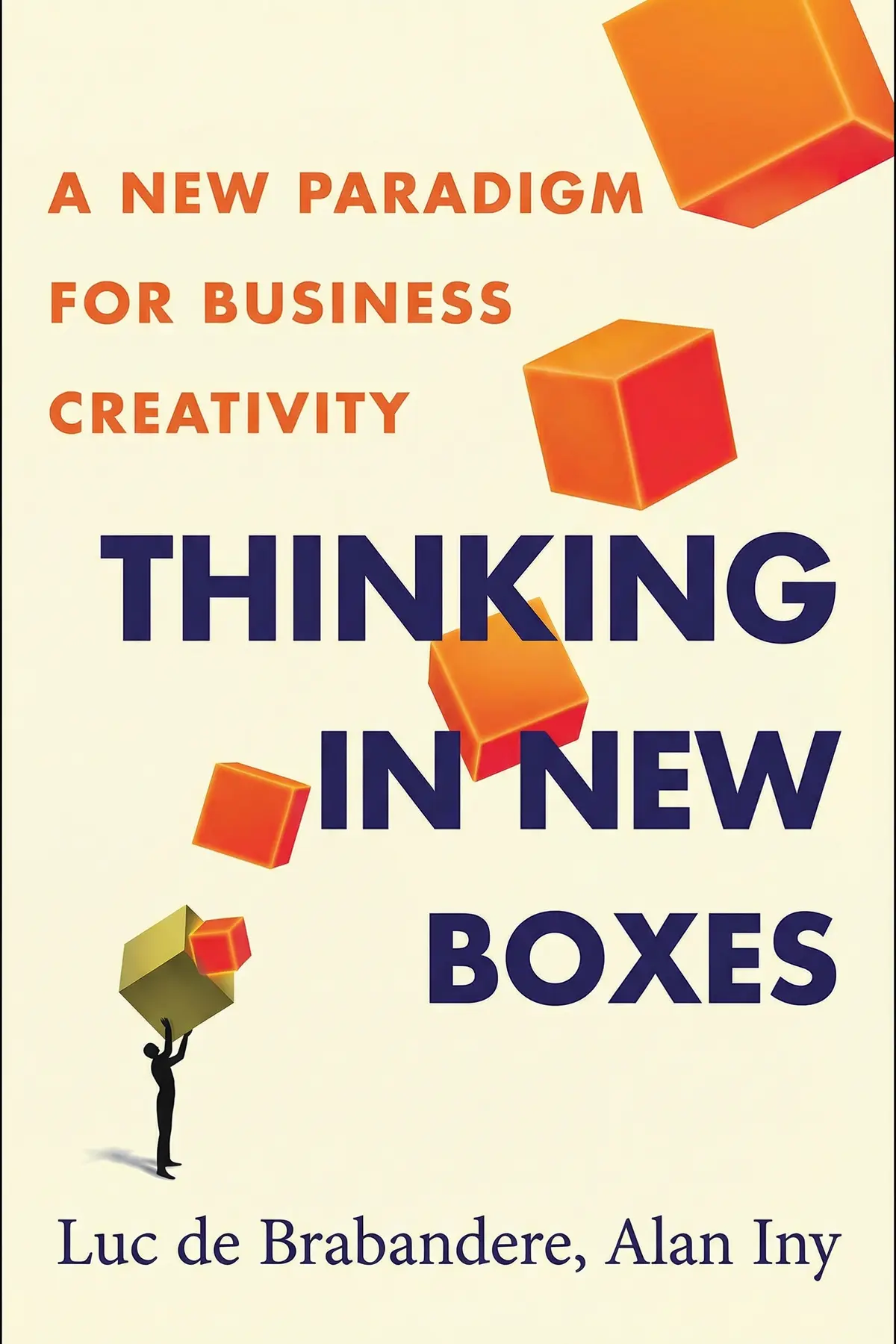
Table of Content
1. Introduction
1 min 07 sec
Teams told to think beyond their usual frame often come back with the same safe ideas, and Luc de Brabandere and Alan Iny think they know why. In Thinking in New Boxes, the two Boston Consulting Group creativity advisers argue that there is no outside. The human mind cannot reason without simplified models of the world, and stepping out of one only lands you in another.
So the real creative skill is building a new box on purpose, and that turns creativity from a mood into a method. The authors show how familiar models breed tunnel vision, why gut feeling defends whatever box you hold, and how a sequence of steps produces genuinely new ways to see a market: doubting assumptions, gathering fresh input, generating many ideas and testing them against clear criteria. Along the way come a high jumper who was laughed at, a pen maker that boxed itself in, and a Mars landing on airbags. The method suits any team stuck selling slightly different versions of the same thing.
2. Work with the mental boxes you can't escape
1 min 40 sec
A traveler looking for a cab in a new city reveals something odd about how every mind works. It also explains why a piece of advice repeated in meetings for half a century so rarely produces anything new.
3. Spot the trusted box that blinds you
1 min 38 sec
A company that defined itself as a ballpoint pen maker could only imagine new colors and designs. People who knew the Earth was round were wrong again in 2011. Both stories show how a useful model slowly becomes a wall.
4. Catch your gut steering you wrong
1 min 46 sec
An Olympic champion was mocked for the technique every later winner would copy. A crowded frozen pond feels safe and is not. Your intuition is busy defending your old ideas, and it hides that well.
5. Let fresh data overturn what everyone assumes
1 min 59 sec
For decades a whole industry agreed on exactly who its customers were, and nobody checked. A fictional game company shows what happens when you go looking for numbers that might prove you wrong.
6. Pan for many ideas, then judge them coldly
1 min 48 sec
No prospector expects gold in the first few pans of river sand, yet teams expect a breakthrough from their first few suggestions. NASA’s strangest landing shows why the odd ideas deserve to stay on the table.
7. A bigger self-definition brings bigger opportunities
1 min 46 sec
Most companies will repaint the top floor but never touch the foundations. A pen maker, a playing card company and a chemicals producer each took the riskier route, and found whole product families waiting.
8. Prepare for several futures, not just one
1 min 42 sec
Glass industry executives would likely agree on one of the biggest opportunities ahead, which is exactly the trouble. One change in how you phrase questions about the future can show you openings your competitors have not even considered.
9. Conclusion
1 min 08 sec
De Brabandere and Iny take one of business life’s most tired phrases and turn it around. Nobody escapes the box. What sets creative teams apart is a willingness to see the box they live in, doubt it and build a better one, knowing it too will wear out. Fosbury never stepped outside the sport of high jump; he built a new model for clearing the bar, and from 1976 it was the only one that won gold.
The method is a matter of discipline. When a meeting stalls, name the box everyone is sitting in and ask whether it will still be useful tomorrow. Before hunting for answers, gather enough outside data to sharpen the questions, the way Ultragames learned that its average player was 37. Produce far more ideas than feels sensible, then judge them against criteria written down in advance.
Under all of it sits the authors’ closing advice: dare to make mistakes. Fear of failure leaves you only the safe, obvious ideas within easy reach. Every new box lies on the far side of a few wrong guesses.
About this book
What is this book about?
Managers hear the advice to think beyond the box so often that it has stopped meaning anything. Luc de Brabandere and Alan Iny take the phrase seriously and conclude that it asks for the impossible. The mind cannot reason without simplified models of the world, which the authors call boxes, and leaving one only puts you inside another. Their answer is to build new boxes deliberately. They show how familiar models produce tunnel vision, why gut feeling defends whatever you already believe, and how a disciplined sequence turns doubt into new ideas: question assumptions, gather input about the world, the industry and the company, generate a wide range of possibilities, then judge them against clear criteria. Their cases run from Dick Fosbury's backward high jump and NASA's airbag landing on Mars to Bic's move from ballpoint pens to lighters and razors. Readers get a practical way to run creative work with a team, redefine a business at its foundations and plan for several possible futures instead of betting on one.
Book Information
Who it's for
Managers and team leads
Managers and team leads whose brainstorms keep producing the same safe ideas.
Rethinking their company's future
Founders and strategists rethinking what their company is and where it could grow next.
Picturing several possible futures
Consultants and planners who need a structured way to imagine several possible futures at once.
About the Author
Luc de Brabandere
Luc de Brabandere and Alan Iny both work on creativity with the Boston Consulting Group. Iny, who joined BCG in 2003, is the firm's senior global specialist in creativity and scenario planning, has trained thousands of executives and consultants, and holds an MBA from Columbia Business School. De Brabandere leads seminars with boards and executives on new visions and future scenarios, teaches at the Ecole Centrale in Paris and the Louvain School of Management, and was formerly general manager of the Brussels Stock Exchange.
Ratings & Reviews
Ratings at a glance
What people think
Listeners find the work insightful, and one person notes it gives a helpful overview of brainstorming. There is also praise for the book’s creativity, as one listener appreciates the organized method it provides for thinking about thinking. Listeners further value the book's easy readability and how it brings awareness to their own biases. However, the storytelling style results in mixed reviews from listeners.
Top reviews
David
Finally, a business book that admits the 'outside the box' cliché is actually impossible for the human brain to achieve. By accepting that we always think in boxes, we can take control of which ones we choose to use for problem-solving. The five-step process is remarkably well-structured. I found the section on 'Probing the Possible' to be an absolute game-changer for my own independent consulting practice this year. It makes you conscious of your own biases, which is the first step toward genuine innovation.
Show moreSven
This book's greatest strength lies in its ability to make you conscious of the mental shortcuts you take every day. Instead of the usual fluff, you get a well-structured approach to dismantling old assumptions and building better ones. I was particularly impressed by the chapter on scenarios, which helps businesses get out of their own way. It is a must-read for consultants leading a team through a complex problem-solving phase. The concepts are presented in a way that feels both intellectual and practical.
Show moreOrawan
Truth is, most creativity books are either too abstract or too technical, but this one finds a comfortable middle ground. By focusing on the 'new boxes' metaphor, the authors give you a concrete way to talk about abstract mental models with your team. I found the advice on questioning what you think you know to be a very helpful exercise for upper management. While some sections felt unoriginal, the structured method for brainstorming makes it worth the price of admission for me. It is a solid, insightful read that will change how you approach your next big project.
Show moreJonathan
As someone who spends most days navigating corporate strategy, this book provided a refreshing framework for mental models. The authors successfully argue that we cannot simply think outside the box because our brains naturally crave structure and categorization. Instead, they suggest we consciously choose better boxes. While the five-step method is easy to follow, I found the Diverge and Converge phases most useful for my team's weekly sessions. It is a solid read for anyone looking to improve their professional brainstorming.
Show moreMan
The authors do a fantastic job of illustrating how our own biases create invisible walls around our collective creativity. This book offers a very readable and structured method to think about how we actually process new, complex information. I particularly liked the focus on how we need to periodically reevaluate our mental models to stay competitive in a shifting market. To be fair, the storytelling is a bit of a mixed bag. Some examples are quite vivid, while others feel like they belong in a different book entirely. However, the overall framework is strong enough to make this a valuable addition to your library.
Show moreRay
After hearing about this book for months, I finally sat down to see if it lived up to the hype. The premise is fascinating: you cannot escape boxes, but you can certainly build better ones to suit your needs. The writing style is quite accessible for a business text. Gotta say, the five steps provide a very useful overview for anyone who feels stuck in a professional rut. It helped me realize how many 'boxes' I was using without even knowing they were there.
Show moreMarasri
Ever wonder why the phrase 'think outside the box' feels so useless when you are actually stuck on a problem? De Brabandere and Iny answer this by suggesting that we should focus on creating entirely new mental frameworks instead of escaping them. I enjoyed the conceptual parts of the book, but the 'Doubt Everything' step felt extreme for a fast-paced workplace. It sounds poetic but can lead to analysis paralysis. The Dick Fosbury example was interesting, yet it felt like a stretch to call his physical persistence a form of total doubt. It is a decent book for beginners who need a push to innovate.
Show moreSamroeng
Picked this up after a recommendation from a colleague who swears by the methodology for lead-level brainstorming activities. There are definitely some gems in here, especially regarding the importance of the 'Diverge' and 'Converge' stages of thinking. However, the authors' definition of a 'Eureka' moment seemed to confuse simple necessity with actual creative inspiration. They cite Toyota's lean manufacturing as a Eureka moment, but it was really more about space constraints and survival. In my experience, the book works best when you take the tools you like and ignore the filler. It is a helpful guide for facilitators who need a structured path.
Show moreSarocha
Look, I really wanted to enjoy the journey this book promised, but I found myself bogged down by the volume of anecdotes. The stories are much too long for my taste. While the core theory about mental categorization is sound, the authors spend far too much time on long-winded, repetitive historical examples. The methodology is okay, but you have to dig through a lot of fluff to find the actual actionable advice. I ended up skimming the last third of the book just to get to the summary sections.
Show moreAva
Not what I expected at all, mostly because the core concepts felt like a rehash of other popular creativity manuals. While the writing style is clear, I struggled to find unique insights. The authors focus heavily on the 'Toyota lean' philosophy, which has been covered extensively by many other business writers for decades. Frankly, the five steps are just common sense repackaged into new terminology. It might be useful for a newcomer, but I was hoping for something more groundbreaking than this.
Show moreQuestions about this book
What is the main idea of Thinking in New Boxes?
Luc de Brabandere and Alan Iny argue that stepping beyond your mental frame is impossible, because the mind can only reason through simplified models of the world, which they call boxes. Leaving one box always puts you inside another. Creativity therefore means building new boxes deliberately: noticing the one you are in, doubting it, gathering fresh input, generating many alternatives and testing them against clear criteria.
What is tunnel vision in Thinking in New Boxes?
Tunnel vision is what happens when you forget that your view of the world is only an interpretation based on a partial sample of information. Believing your box is the right one narrows what you can imagine. The authors point to Bic, which until the 1970s defined itself as a ballpoint pen maker and could only innovate with new colors and designs.
How do the authors suggest generating and testing new ideas?
First, collect a large number of possible new boxes without dismissing any, even ideas that sound absurd, like NASA landing Pathfinder on Mars in 1997 inside a shell of airbags. Then judge them against defined criteria instead of intuition. Some criteria apply to every business, such as budget, feasibility and regulation; others are specific, such as brand image, expertise and timeframe. Repeat the cycle as often as needed.
How can a company apply the idea of a bigger box?
Challenge the foundations of how the business defines itself. Bic moved from ballpoint pens to any disposable plastic item and went into lighters, razors and cell phones. Nintendo went from playing cards to video consoles, and LG from industrial chemicals to high-tech appliances. A large box holds smaller ones, so one new definition can generate a whole range of products.
Who should read Thinking in New Boxes?
It suits managers, founders, strategists and team leads who run creative work and want a method instead of slogans. It is especially useful for teams that keep producing small variations of existing products, and for anyone planning ahead who wants to prepare several scenarios rather than bet on a single forecast of the future.
Readers also enjoyed

A Bigger Prize: How We Can Do Better Than the Competition
Margaret Heffernan





A Year with Peter Drucker: 52 Weeks of Coaching for Leadership Effectiveness
Joseph A. Maciariello



Acting with Power: Why We Are More Powerful Than We Believe
Deborah Gruenfeld
AUDIO SUMMARY AVAILABLE
Listen to Thinking in New Boxes in 15 minutes
Get the key ideas from Thinking in New Boxes by Luc de Brabandere, plus 5,000+ more nonfiction titles.
- 5,000+ titles
- Listen as much as you want
- 7-day free trial
- Cancel anytime









