

A Life Decoded: My Genome: My Life
J. Craig Venter
 English
 ไทย
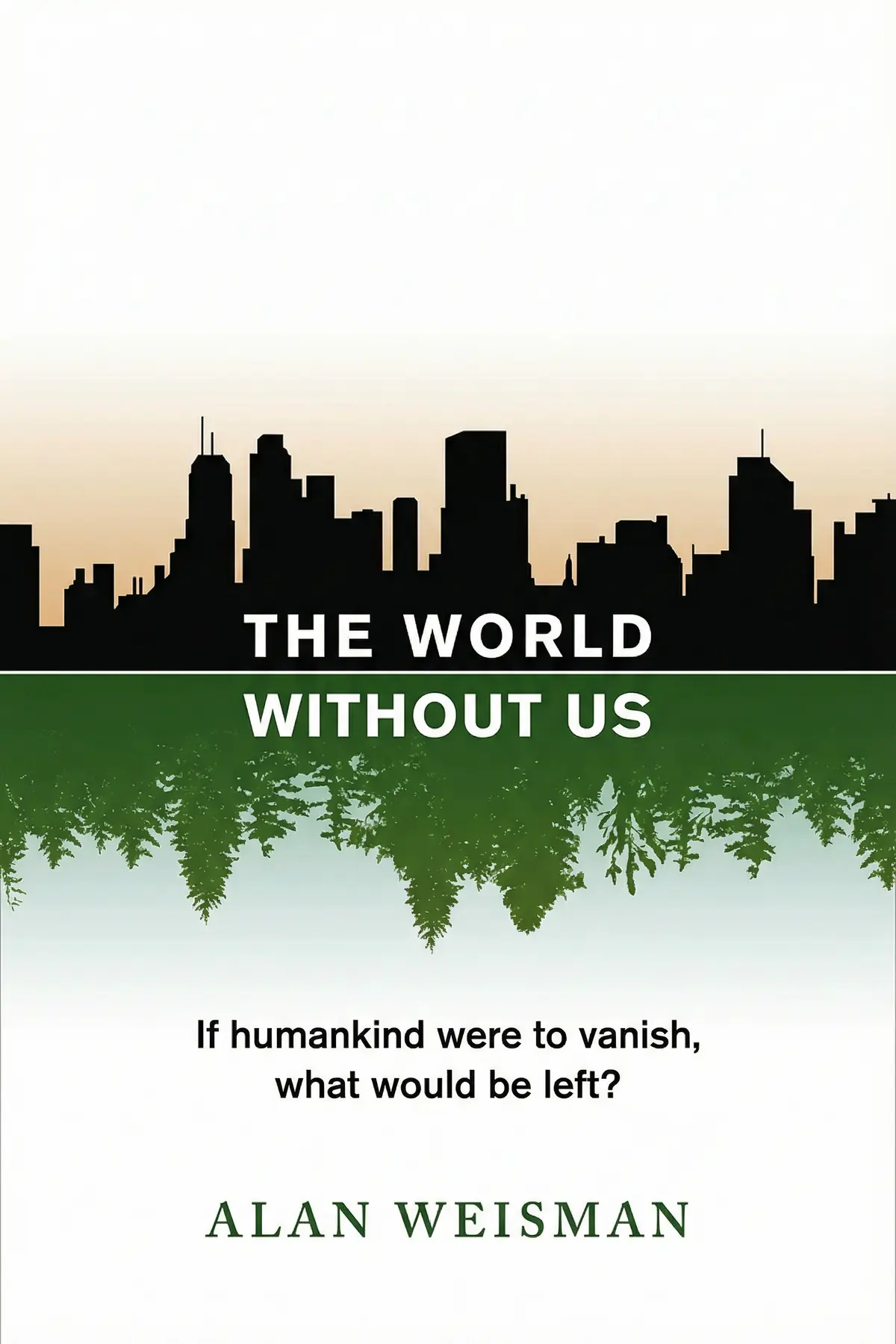
Imagines Earth after every human vanishes. It shows how quickly nature would swallow our cities, which animals would win or lose, and which inventions, from plastic to heavy metals to nuclear fuel, would linger for millennia.
1 min 04 sec
Most talk about the environment stays abstract, but one thought experiment makes it concrete: imagine every person on Earth gone tomorrow, and watch what lasts. In The World Without Us, journalist Alan Weisman runs that experiment and finds a lopsided answer. Our cities and houses would sink back into forest and water within centuries, while some of our smallest, least visible inventions would linger for thousands or even millions of years.
That contrast is the book’s argument. Nature can undo almost everything we have built, but not the substances it has no way to break down: plastic, heavy metals, refrigerator gases and nuclear fuel. Weisman moves from flooded subway tunnels to starving cattle, from a copper statue to melting reactors. Follow him, and the next time someone argues about the planet, you can say which human traces are temporary, which are effectively permanent, and why a single plastic bag deserves a second thought.
1 min 39 sec
Beneath one of the world’s busiest cities, machines fight a battle that never makes the news. Switch them off, and the time it takes for the streets to change is shorter than most people would guess.
1 min 45 sec
Steel and concrete feel built to last, yet their strength is borrowed. A drip in the roof, a curious raccoon and a stubborn root reveal how a sturdy home comes undone.
1 min 58 sec
Remove people, and the animals we spent thousands of years protecting become some of the most vulnerable on Earth. Meanwhile, creatures we nearly wiped out would finally get room to recover.
1 min 48 sec
Only one ancient wonder of the world survives today. A handful of modern works could last far longer, and the reason has nothing to do with how famous they are.
1 min 58 sec
Some pollution keeps moving long after the factory falls silent. A plant’s life cycle and an old refrigerator show how harm we cannot see can outlast our species by tens of thousands of years.
1 min 55 sec
Ground into ever smaller pieces, plastic seems to be disappearing. A simple experiment with seabed worms shows what is really happening to it, and where it will travel next.
1 min 56 sec
A nuclear plant would not explode if its operators vanished. What it would do instead is slower and, by Weisman’s account, would last longer than almost anything else humans have made.
1 min 14 sec
Weisman’s thought experiment works like an X-ray. Remove people, and the parts of civilization that look heaviest, the towers, tunnels and highways, turn out to be the most fragile. Water, roots and raccoons would clear them within a thousand years. What stays are the things nature has no way to digest: plastic ground into dust, chromium drifting for 70,000 years, reactor sites dead for a billion. Weisman does not point fingers, but the conclusion is hard to miss. Even if every person vanished today, much of the harm to plants, animals and air is already done, and more of it may soon be beyond repair.
That shifts where effort counts. The easiest place to start is plastic, because it passes through your hands every day: use it only when you truly need it, and recycle it properly when you do. Beyond that, the book asks for a wider rethink of wasteful living, for the sake of the children and grandchildren who will inherit what we leave.
The faces on Mount Rushmore may last 7.2 million years. A plastic bag will last longer, and nobody made it to be remembered.
Picture the Earth on the morning after every person has vanished. Journalist Alan Weisman follows that idea to its end, asking which parts of civilization would fade first and which would remain long after us. His answer is uneven. Cities survive only because people pump water out of subway tunnels, patch roofs and hold back forests. Without that work, most traces of us would disappear in under a thousand years. Farm animals would struggle, predators would multiply and many endangered species would recover. A few works of copper and stone, such as the Statue of Liberty and Mount Rushmore, would endure. The darker legacy is what nature cannot break down. Plastic only shrinks into smaller fragments. Heavy metals such as chromium keep circulating for tens of thousands of years. Old fridges leak gases that damage the ozone layer, and more than 400 nuclear plants would melt down into dead zones lasting a billion years. Readers get a vivid, concrete sense of which human traces are temporary and which are effectively permanent, and a clear reason to rethink plastic and waste.
Curious readers who want a vivid picture of how much lasting damage humans have already done to the planet.
Students and professionals who discuss sustainability and need concrete examples, from subway pumps to melted reactors.
People trying to cut plastic and waste who want to understand why it matters for thousands of years.
Alan Weisman is an American journalist, author and professor, born in 1947. His reporting has appeared in The New York Times Magazine, The Atlantic Monthly, Harper's and Orion. He has been a senior producer at Homelands Productions, his documentaries have aired on National Public Radio, and he has taught international journalism at the University of Arizona. The World Without Us grew out of his article Earth Without People. Time and Entertainment Weekly chose it as the best nonfiction book of 2007, and it was a finalist for the National Book Critics Circle Award.
Listeners find this title a captivating experience, praising its thorough research and remarkable prose while calling it a masterpiece of journalistic writing. They value the stimulating subject matter and view it as an excellent choice for environmental literature, with one listener highlighting the striking depiction of humanity's impact on nature. While the concept earns high marks as a significant achievement in creative reporting, some find the narrative to be deeply repetitive.
The imagery in this book is hauntingly beautiful, though I’ll admit it's a bit of a gut-punch. Weisman paints a world where nature isn't just surviving, but actively dismantling our hubris. I was captivated by the idea of the "tooth of time" eating away at reinforced concrete, which isn't nearly as permanent as we like to think. From the mega-mammals of the Clovis era to the modern-day extinction of the American Chestnut, he connects history with a speculative future seamlessly. Truth is, it’s a bit of a wake-up call. We like to think of ourselves as the masters of the Earth, but this book proves we are just a blip on the radar. It’s fantastic environmental reading material that manages to be both informative and deeply philosophical. Highly recommended for any curious mind.
Show moreAs a bit of a science nerd, I appreciated how Weisman consulted actual experts instead of just weaving a fantasy. The book is less a "end-of-the-world" thriller and more a sobering look at our ecological legacy. The detail about the Voyager spacecraft carrying our music out of the solar system as our last standing monument was a beautiful way to wrap things up. I was particularly fascinated by the Korean DMZ examples—showing how nature thrives when we just leave it alone. It’s a haunting, vivid account of human pressure on the environment. Even the darker parts, like the "ocean sinks" filled with polymers, are handled with a journalistic precision that makes the information stick with you long after you close the cover. Truly an amazing read.
Show morePicked this up after seeing it on several 'must-read' environmental lists. Weisman does a tremendous job detailing how quickly the things we take for granted—like the Panama Canal or the New York subway system—would simply fail without human maintenance. The research feels exhaustive, almost to a fault at times. I found the sections on plastics and nuclear waste particularly chilling because they remind you how permanent our "temporary" conveniences actually are. While the writing is evocative, it does get a bit repetitive when he lists every single plant species that would take over a suburban yard. Still, it’s a masterfully written piece of journalism that forces you to look at a plastic bottle and see it for the thousand-year artifact it truly is. It's thought-provoking stuff.
Show moreEver wonder what happens to our pets if we just vanished? That’s the question that got me hooked, though the answer isn't exactly a happy one for the dogs. Weisman’s exploration of how feral hogs would thrive while cattle would likely perish was a fascinating dive into domestication. The book isn't just about animals, though; it’s a deep dive into the chemical and physical footprint we leave behind. The section on the "four pillars" and the Voluntary Human Extinction Movement was an eye-opener I hadn't expected. My only gripe is that it can feel a bit lopsided, with some chapters feeling like a massive environmental rant. However, the sheer depth of research makes it worth the effort. It’s a vivid account of human pressures on the environment.
Show moreFinally got around to reading this, and it’s definitely a masterclass in imaginative reporting. I was particularly struck by the contrast between the quick decay of the Panama Canal and the thousands of years it takes for plastics to break down in the ocean. Weisman has a way of making environmental science feel like a detective story. Not gonna lie, some of the political remarks felt out of place and a bit dated, but the core message is powerful. It’s a weirdly peaceful thought to imagine the world returning to a state of balance, even if we aren't there to see it. It definitely makes you rethink your relationship with "stuff" and how much maintenance our civilization requires just to stay upright. A solid, fascinating read.
Show moreWalking through a city after reading this feels completely different; you start seeing the cracks in the pavement as the beginning of the end. Weisman does an incredible job of making the invisible processes of decay visible to the reader. Whether it's the dioxins that will outlast us or the radio towers that kill millions of birds, he highlights the unintended consequences of our existence. Personally, I found the chapter on the Voyager spacecraft to be a needed bit of hope in an otherwise depressing narrative. The book is intensely repetitive in its middle section, but the Coda at the end ties it all together beautifully. It’s a vivid, albeit somewhat biased, account of our impact on the planet. Definitely worth a look for the tree-huggers among us.
Show moreWhat stayed with me after finishing this was the sheer fragility of our infrastructure. Weisman’s description of how water would reclaim the subways within days of the power going out is the stuff of nightmares. The book is a bit of a "snoozer" if you aren't into lists of biological successions, but the imaginative reporting here is second to none. I especially liked the exploration of the Turkish zone of Cyprus; seeing a real-world example of an abandoned city gives his theories much more weight. It isn't always a "fun" read—it’s actually pretty depressing to realize our most lasting contribution might be dioxins and bronze statues— but it’s an essential one for anyone interested in our planet's future. It serves as a great springboard for more research.
Show moreLook, I’m a fan of speculative non-fiction, but Weisman goes on some wild tangents that don't always land. The premise is a tremendous feat of imaginative reporting—who wouldn't want to know how long a Barbie doll lasts in a landfill? But the execution is frequently bogged down by the author’s obvious distaste for certain modern technologies. He rails against coal and nuclear power but barely mentions any viable alternatives, which felt a bit biased. The writing style is impressive, yet the repetition of "this plant grows here, then that plant grows there" becomes exhausting by the halfway mark. It’s a good book to skim for the "what-if" scenarios, but the preachy tone was a bit of a turn-off for me. Not a total waste of time, just unbalanced.
Show moreAfter hearing so much hype about this being a "fascinating read," I was surprised by how much of it felt like a textbook. The first few chapters are great—the immediate aftermath of human disappearance is high-stakes and interesting. But then it settles into a very slow rhythm. To be fair, the research is top-notch, and he covers a lot of ground, from the Mayan ruins to the Korean DMZ. But he spends so much time on the "rant" side of environmentalism that the actual "world without us" gets lost. I wanted more about the animals and less about the author's opinions on U.S. foreign policy. It's okay, but it’s definitely not the page-turner I was hoping for. Take it with a dose of salt.
Show moreTo be fair, the central conceit of this book is brilliant, but the actual reading experience was quite a chore. I expected a fast-paced look at a post-human world, yet I found myself wading through what felt like an endless environmental lecture. Weisman is clearly not a scientist, and while his interviews with experts are great, his personal biases often leak through in ways that feel unnecessarily snide. The pacing is incredibly slow; I swear there are chapters that spend ten pages describing weeds growing through pavement. If you’re looking for a speculative "what if" game, you might enjoy it, but for me, the repetitive descriptions of floral succession made it a real struggle to finish. It’s a snoozer that didn't live up to the hype for me.
Show moreAlan Weisman imagines what would happen if every human disappeared. Nature would reclaim cities and buildings in under a thousand years, rivers would return to their old courses and many endangered species would recover. But the substances nature cannot break down, such as plastic, heavy metals, CFCs and nuclear fuel, would keep harming the planet for thousands to billions of years. The thought experiment shows which human traces are temporary and which are effectively permanent.
Among our visible works, objects made of noble metals and carved stone would last longest. The copper Statue of Liberty would keep its shape for millennia, and geologists calculate that granite Mount Rushmore will survive 7.2 million years. Plastic never biodegrades, so it would last forever, and nuclear meltdowns would leave dead zones for over a billion years, because the half-life of uranium is 704 million years.
Weisman argues that the 441 nuclear plants on Earth would lose the electricity that cools their reactors. Relief valves would release water for a while, but once the water ran out or a valve failed, the cores would melt within weeks into radioactive lava. There would be no explosion, but the radiation would kill all life for miles, creating dead zones at more than 400 sites.
The book’s practical advice centers on plastic, because it never biodegrades and its long-term effects on nature are unknown. Use it only when you really need it, and recycle it properly. More broadly, Weisman’s picture of damage that outlasts us calls for rethinking wasteful habits, since every person’s impact on nature takes a long time to heal and future generations will live with it.
It suits readers who want to understand environmental damage in concrete terms rather than abstract warnings. Its examples range from the pumps that keep New York’s subway dry to lugworms that pass plastic through their bodies unchanged. Anyone who discusses sustainability at work or at home, or who wants a strong reason to cut plastic and waste, will find vivid, specific material here.
J. Craig Venter

Carl Zimmer

Bill Bryson

Jeff Hawkins




Lisa Kaltenegger


AUDIO SUMMARY AVAILABLE
Get the key ideas from The World Without Us by Alan Weisman, plus 5,000+ more nonfiction titles.









