

10 min 03 sec
Available in: English
The Venture Mindset: How to Make Smarter Bets and Achieve Extraordinary Growth
Shows how venture capitalists pick rare winners by rejecting fast on clear dealbreakers, judging founders, welcoming disagreement and backing bold bets patiently, and how to use the same habits for hiring, buying and team decisions.
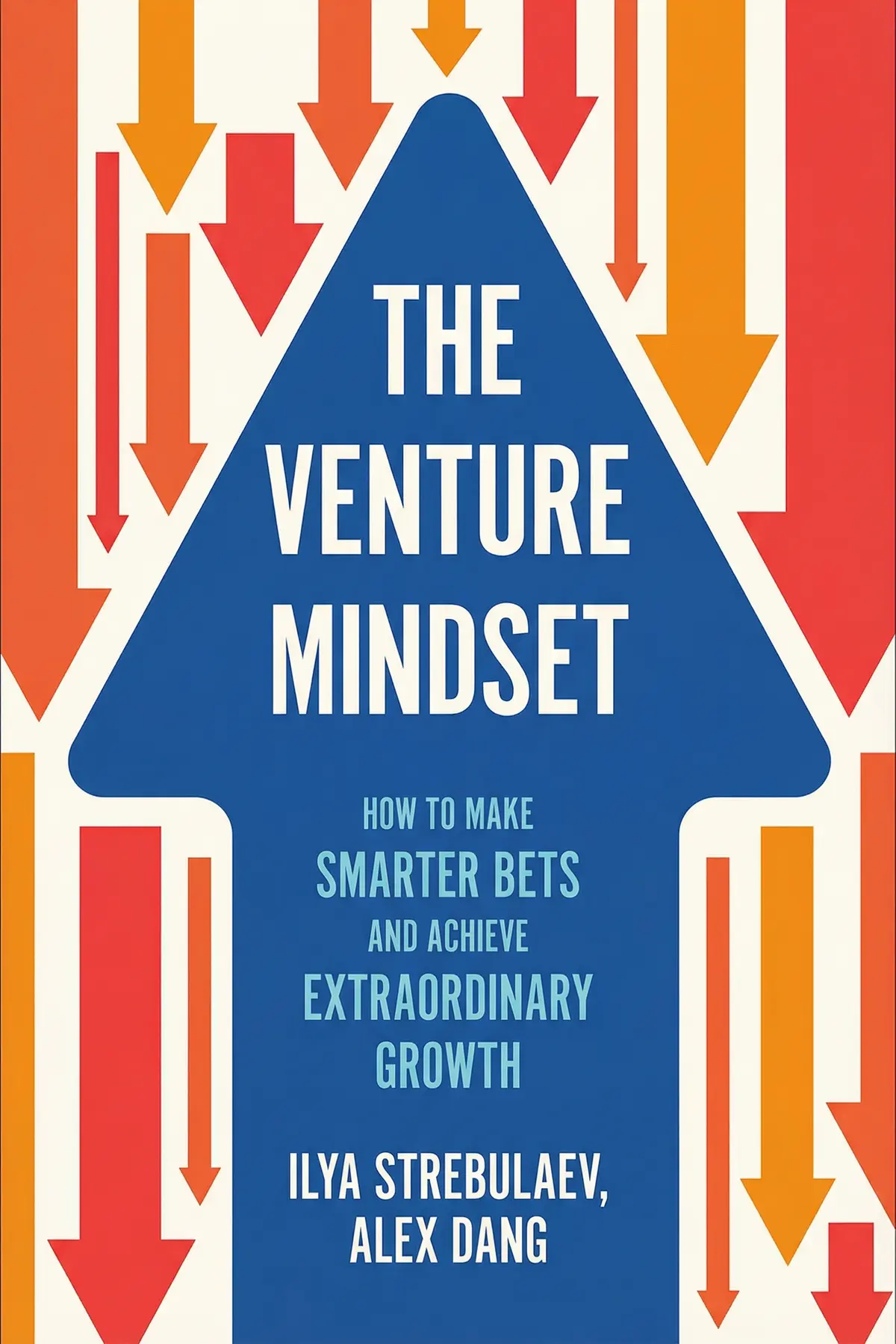
Table of Content
1. Introduction
1 min 13 sec
Most of us judge new ideas, hires and projects the way a careful committee would: we look for safe options everyone can agree on, and we miss the rare one that changes everything. In The Venture Mindset, Stanford finance professor Ilya Strebulaev and former McKinsey partner Alex Dang argue that venture capitalists work the other way round. The best of them, the authors say, turn down 100 opportunities for each one they back, and that habit is what frees their attention for the few ideas worth a real look.
The argument is that big wins rarely look safe at the start, so good bets come from rejecting fast, judging the people behind an idea, welcoming a divided room and staying patient once committed. The evidence runs from a small video startup that eight firms turned down to a Stanford pitch night, Greylock’s stated taste for deals that divide its partners and the launchpad failures of SpaceX. The result is a way to sort options quickly, argue better as a group and hold your nerve while a good bet still looks like a bad one.
2. Say no fast to find the rare yes
2 min 03 sec
Investors at a Stanford pitch night get only minutes per startup, yet their snap rejections are not careless. The trick is a question asked in reverse, and it works just as well for hiring or house hunting.
3. Spot a winner before the crowd agrees
1 min 59 sec
Two giants already owned video calls, the startup had no paying customers and eight firms had walked away. Three investors still wrote a check, and what they looked at instead of the numbers is the lesson.
4. Turn a divided room into better decisions
1 min 54 sec
To most teams, a unanimous vote feels like success. At one well-known venture firm it is a warning sign, and a few simple meeting rules show how to turn a divided room into a better decision.
5. Patient backing turns failure into breakthroughs
1 min 51 sec
SpaceX began with dramatic failures on the launchpad and later led commercial launches. What its backers did in between, and what they deliberately avoided doing, explains why so many bold projects die too early.
6. Conclusion
1 min 03 sec
The venture mindset asks for an uncomfortable trade. You accept turning down nearly everything, and being wrong often, in exchange for being right in a large way now and then. The investors Strebulaev and Dang describe are not reckless. They are disciplined about where doubt belongs: early and fast when hunting for flaws, loud and open while the group decides, and set aside once the money is in and the team is building.
That discipline travels well outside venture capital. Before your next hire or purchase, write down what would rule an option out, and cut quickly. When a decision matters, hear the most junior voice first and treat a unanimous room as a reason to look again. And when you back something bold, give it the kind of runway SpaceX needed to get past its early launches.
Eight firms looked at Saasbee and saw a small company with no customers and two giant rivals. Three investors looked at the same company and saw its founder. That difference in where they looked is now called Zoom.
About this book
What is this book about?
Most organizations and most people choose like a cautious committee. They favor the option everyone agrees on and drop anything that looks odd. Stanford finance professor Ilya Strebulaev and former McKinsey partner Alex Dang argue that venture capitalists succeed by thinking differently, because the ideas that pay off most rarely look safe at first. The authors draw on venture practice to show four habits. Investors hunt for a critical flaw so they can say no quickly, then examine the survivors in depth. They judge founders on vision, expertise and execution, as three investors did when they backed the startup that became Zoom after eight firms passed. They distrust easy consensus, as at Greylock, where a split partnership counts as a good sign. And they stay patient through failure, as the early launchpad setbacks of SpaceX show. Readers get a practical way to apply those habits beyond investing: sorting job candidates or suppliers, running sharper decision meetings and giving bold projects the time they need to work.
Book Information
Who it's for
Curious how VCs decide
Founders and investors who want to see how venture capitalists filter pitches and judge people.
Managers wanting sharper decisions
Managers who run hiring, supplier or project decisions and want faster, sharper choices.
Hoping for honest debate
Team leads whose meetings end in easy agreement and who want honest debate instead.
About the Author
Ilya Strebulaev
Ilya Strebulaev is a financial economist who has been a professor at Stanford's business school since 2004, specializing in venture capital, startups and corporate innovation. He founded the Venture Capital Initiative, teaches a popular venture capital class and has advised companies and investors on the venture industry. Alex Dang has about twenty years in technology and digital strategy. As a Partner at McKinsey he helped clients build new digital businesses, and as a product leader he brought services to millions of customers in ecommerce, supply chain and AI.
Ratings & Reviews
Ratings at a glance
What people think
Listeners find this work exceptional for its deep dives into the venture ecosystem, with one listener observing that data is crystallized into actionable advice. Furthermore, the content is both absorbing and useful, utilizing actual anecdotes from leading venture capitalists to offer a thorough manual on developing a venture mindset. Listeners also praise the book’s attention to persistence, with one listener pointing out its emphasis on embracing failure, while noting its use of data to back its arguments. Finally, listeners value its pertinence, with one remarking that it is useful well outside the realm of venture capital.
Top reviews
Pawinee
Finally got around to reading 'The Venture Mindset,' and it's a total game-changer for how I view professional risk. The authors break down the VC world into nine clear principles that feel surprisingly applicable to everyday decision-making, especially the idea that strikeouts don't matter as long as you hit one home run. I loved the data-driven insights into why we should seek out disagreement rather than simple consensus. It’s not just for investors; it’s for anyone trying to build something that lasts. The writing is punchy, though it does lean on familiar tech giants like Zoom and SpaceX to make its points. Still, the way it crystallizes complex investment logic into actionable advice is remarkable. If you've been playing it safe, this book will push you to think bigger and embrace the turbulence of innovation.
Show morePat
Ever wonder why some ideas explode while others fizzle? This book offers a fascinating look behind the curtain of VC decision-making, using the story of Zoom’s early days to show why betting on the 'jockey' is often more important than the initial product. The authors argue that in a world of rapid change, incrementalism is the enemy. I found the concept of the venture mindset incredibly empowering, particularly the emphasis on resilience and long-term thinking. It’s refreshing to see a business book that doesn't just celebrate success but actually breaks down the logic of why failure is a necessary part of the growth process. The prose is clear and the chapters are structured in a way that makes it easy to dip in and out. Truly a must-read for any aspiring entrepreneur.
Show moreApichat
The data-backed approach here is what sets it apart from your average motivational business read. Ilya and Alex have done the work to show how the venture mindset can be applied far beyond Silicon Valley. Whether you're running a small team or a massive corporation, the principles of 'making the pie bigger' and 'preparing your mind' for opportunity are universal. I loved the poker analogies—they perfectly illustrate the reality of making big bets with incomplete information. The writing style is professional yet conversational, and the real-world examples are used effectively to anchor the more abstract concepts. It’s rare to find a book that is both this comprehensive and this practical. It really changed the way I think about growth and strategic risk.
Show moreSudarat
After hearing Ilya speak, I had high hopes for this, and it did not disappoint. The core message is that we need to stop thinking incrementally and start thinking disruptively. One of my favorite parts was the discussion on 'Agreeing to Disagree.' It's a counter-intuitive take that suggests if everyone is on board with a project, it might not be ambitious enough. To be fair, the book is quite optimistic and leans toward success stories, but the underlying research is hard to argue with. It provides a toolkit for making smarter bets in any area of life. I’ve already recommended this to several colleagues who are struggling to get innovative projects off the ground. It’s a brilliant, well-researched guide to a world that usually feels very opaque.
Show moreAnong
This is the 'Good to Great' for the venture era. While Jim Collins focused on established giants, Strebulaev and Dang show us how the next generation of giants is being built from the ground up through strategic aggression. The book is a gift for anyone who wants to understand the logic of risk. It covers everything from round staging to the importance of a founder's vision with a long-term perspective. I especially liked the emphasis on 'Home Runs Matter, Strikeouts Don't.' In most corporate environments, a strikeout is a career-ender, but here it's just part of the game. It’s a refreshing, necessary perspective for the modern economy. Whether you're an investor, a founder, or just someone interested in how the world is changing, you need this on your shelf.
Show moreStella
As someone who works in corporate strategy, I found the 'Agree to Disagree' chapter particularly enlightening. We often get bogged down in consensus-seeking, but Strebulaev and Dang argue that if everyone likes an idea, it’s probably too safe to generate outsized returns. The book is well-researched and successfully bridges the gap between high-level academic theory and the grit of Silicon Valley. To be fair, some of the examples—like the Slack pivot or the WeWork fallout—have been covered in a dozen other business books already. However, the 'critical flaw' approach for filtering out dealbreakers early is a tool I’ve already started using in my own department. It’s a practical guide for injecting some early-stage energy into older, slower organizations. Definitely worth the read if you feel your company is becoming too risk-averse.
Show moreCarlos
This book provides a much-needed framework for navigating a high-stakes environment. Personally, I found the 'Double Down or Quit' principle to be the most valuable takeaway, as it addresses the common trap of escalating commitment to failing projects. The research is extensive, yet the narrative remains accessible and engaging for those without a finance degree. My only gripe is that it occasionally glosses over the hundreds of times these same mindsets lead to spectacular losses in things like crypto scams. However, as a guidebook for founders trying to understand the VC psyche, it is indispensable. It teaches you how to look for reasons to say no quickly so you can focus on the opportunities that actually have a shot at changing the world. It's a solid, practical read.
Show moreChokdee
Picked this up after seeing a16z post about it, and I'm glad I did. The book does a fantastic job of explaining why VCs are willing to back completely unproven ideas with millions of dollars. It’s all about the 'critical flaw' analysis—finding the one reason a company might fail and deciding if it’s a risk worth taking. Truth is, most people are conditioned to avoid failure at all costs, but this book redefines that relationship. It views failure as a signal that you’re pushing boundaries. I appreciated the specific details on cap tables and employee incentives, which aren't always covered in these types of high-level mindset books. It’s an easy read that manages to stay insightful throughout without becoming too verbose. Highly recommended for any leader.
Show moreKofi
The core concepts are solid, but I was honestly hoping for more deep-dive academic analysis. Ilya Strebulaev is a heavy hitter at Stanford, so I expected a bit more math and raw data on investment ratios rather than the standard anecdotes about Elon Musk. Look, it’s a very readable book and the framework is helpful, but it occasionally feels like another 'airport business book' that simplifies complex systems for a general audience. The stories are engaging, but they do suffer from a bit of survivorship bias by focusing almost exclusively on the unicorns that made it. That being said, the section on 'Saying No 100 Times' is a great reminder for founders on how VCs actually filter their pipelines. It’s a good 101 guide, just don’t expect a dense textbook.
Show moreSomboon
Not what I expected based on the authors' credentials. Frankly, it felt like a highlight reel of stories I've already read on TechCrunch and LinkedIn. While the nine principles are logical, they aren't exactly groundbreaking if you've been in the tech industry for more than a minute. We get it. Slack was a failed game, SpaceX had a rough start, and WeWork was a mess. I was looking for more original research or perhaps some new, untold stories from the Stanford archives. It’s a quick read, but it follows the typical business-book trope of cherry-picking examples to fit a specific narrative. If you’re brand new to the world of venture capital, you’ll probably find it amazing. For the rest of us, it’s a bit repetitive and recycled.
Show moreQuestions about this book
What is the main idea of The Venture Mindset?
Ilya Strebulaev and Alex Dang argue that the habits of venture capitalists help anyone make smarter bets. Because the ideas that pay off most rarely look safe at first, investors reject quickly on clear dealbreakers, judge the founder’s vision and ability to execute, welcome disagreement over easy consensus and stay patient through early failure, as the backers of Zoom and SpaceX did.
What is the critical flaw approach?
It is a two-speed way of deciding. First, you hunt for a single reason to say no, such as a medical device company with no healthcare experts on its board, which lets you drop weak options in minutes. Options that survive then get slow, careful checking of team, product and market. The authors note the best venture investors say no 100 times for every yes.
How can a team use disagreement to make better decisions?
The authors suggest naming a devil’s advocate to argue against the leading view, letting junior people speak before senior ones, and collecting each person’s feedback separately before the group meets. Reid Hoffman of Greylock has said his firm likes deals that split the partners in half. Once the debate is over, the whole team should commit to the decision together.
Who should read The Venture Mindset?
It suits founders and investors who want to understand how venture capitalists choose, and managers or team leads who make decisions about hires, suppliers or new projects. Its methods are concrete: look for dealbreakers first and hunt for reasons to say no, treat a unanimous room as a warning, judge the person behind an idea, and give bold projects enough runway to survive early failures.
Readers also enjoyed



A Year with Peter Drucker: 52 Weeks of Coaching for Leadership Effectiveness
Joseph A. Maciariello



Acting with Power: Why We Are More Powerful Than We Believe
Deborah Gruenfeld

All In: How Great Leaders Build Unstoppable Teams
Mike Michalowicz


AUDIO SUMMARY AVAILABLE
Listen to The Venture Mindset in 15 minutes
Get the key ideas from The Venture Mindset by Ilya Strebulaev, plus 5,000+ more nonfiction titles.
- 5,000+ titles
- Listen as much as you want
- 7-day free trial
- Cancel anytime









