

13 min 05 sec
Available in: English
The Self-Made Billionaire Effect: How Extreme Producers Create Massive Value
Shows how self-made billionaires think as producers, pairing customer empathy with imagination, patience with fast action and bold moves with steady partners, and how anyone can practice the dual thinking behind those habits.
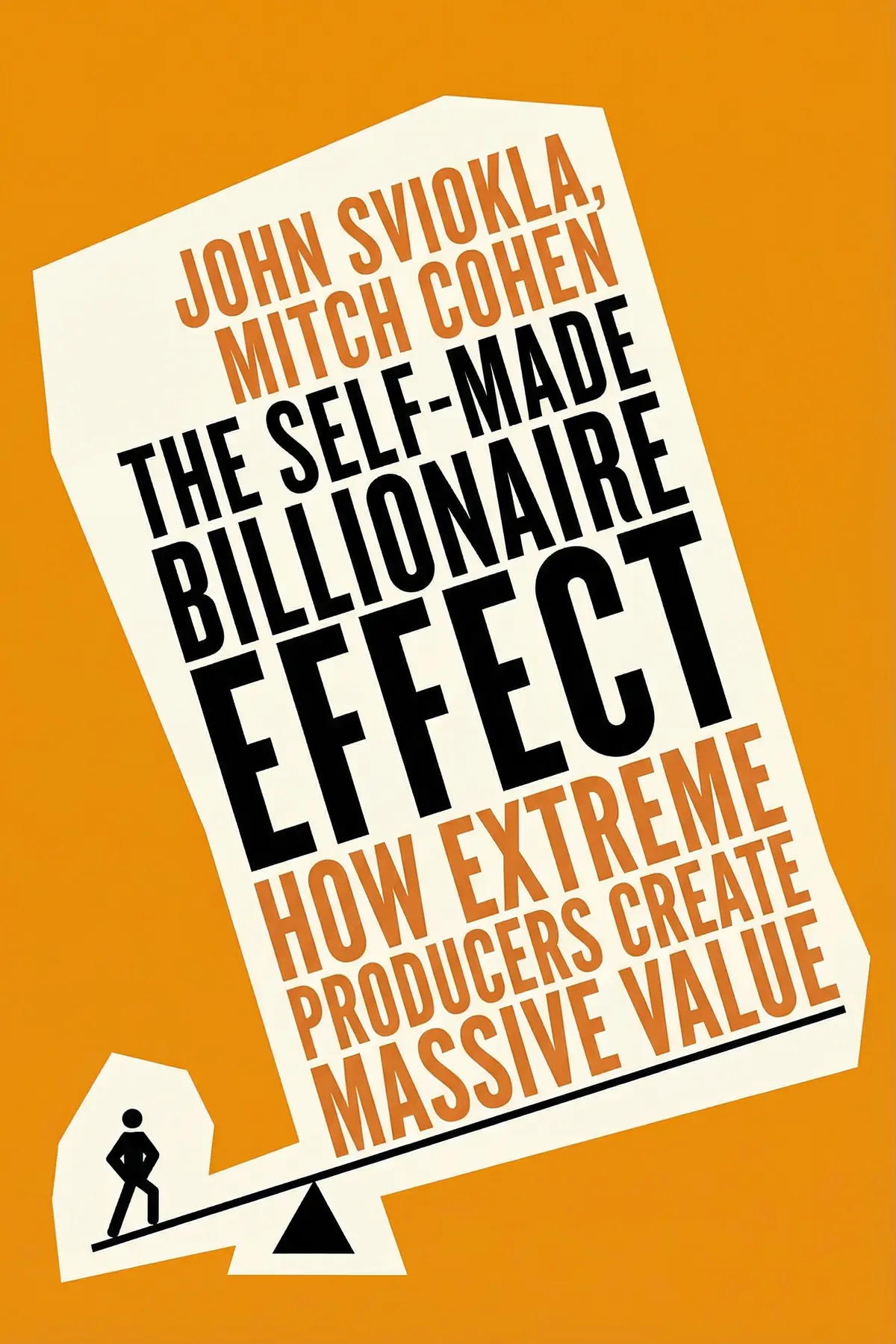
Table of Content
1. Introduction
1 min 06 sec
Most ambitious people assume the very rich got there through daring bets or one brilliant idea. In The Self-Made Billionaire Effect, longtime PwC leaders John Sviokla and Mitch Cohen report something more surprising: the billionaires they study take no more risk than ordinary entrepreneurs. They are simply less frightened of losing what they already have.
That attitude is one of several habits the authors find in people they call producers. A producer holds opposites together. Imagination sits beside empathy for the customer, patience beside urgency, invention beside careful execution, and a bold vision beside a partner who keeps the books.
Every story here shows one of those pairings at work, from a sandwich seller in California to a napkin maker in China and a cruise line with only three ships. The pay-off is a set of tests you can run on your own ideas this week, and a clearer sense of which role you play: the producer, or the performer every producer needs.
2. Hold two ideas at once without losing focus
1 min 45 sec
Standard advice tells anyone starting out to focus on a single thing. Bill Gates ignored it while running Microsoft and starting other companies, and the authors argue his habit is a skill rather than a distraction.
3. Find the idea customers already wish existed
1 min 50 sec
Two entrepreneurs in very different businesses each put the same $80,000 into a single product. Neither had a famous invention. What they had instead was something most founders skip in their hurry to build.
4. Know when to wait and when to act fast
1 min 52 sec
One founder spent a decade preparing for a company that some people might have called an overnight hit. Another agreed to a deal he had no idea how to deliver. The authors say both were right.
5. Turn a crowded market into your opening
1 min 47 sec
A cruise company with three ships and slow sales looked like a poor inheritance for a young chief executive. By the late 1980s it was the leading cruise brand worldwide, showing that a market that looks saturated can still be redesigned.
6. Lose your fear of loss and judge risk better
1 min 48 sec
The popular picture of billionaires as fearless gamblers does not survive a closer look. A woman who closed a thriving company and a trader fired at the height of his career point to a different trait entirely.
7. Pair your big vision with someone who executes
1 min 38 sec
Behind several famous fortunes stands a second person whose name is rarely on the sign. The authors argue that this partner is no supporting act, and that a visionary without one cannot leave the ground.
8. Conclusion
1 min 19 sec
Stripped of the famous names, the book makes a modest and useful claim. The billionaires in it are not a separate species. They are people who refuse to choose between things the rest of us treat as either-or: a creative idea and a customer’s real need, waiting and moving, inventing and delivering, risking what they have and recovering when it fails, their own vision and someone else’s discipline. The authors trace all of it to dual thinking, and they believe it can be learned. With training and dedication, they argue, anyone can expand working memory and carry more ideas at once.
That gives you a few places to start. Keep a second idea alive beside your main work instead of shelving it. Before your next big decision, separate the real cost of losing from the fear of it.
If you lead a team, take the authors’ most direct advice. Give the people who show producer potential protected think time, hours set aside only for new projects and ideas.
Gates built two companies while running a third. Spanos turned a sandwich route into a housing business. Neither waited for life to become simple, and the habit worth building is the comfort of holding two things at once, long enough to see what they make together.
About this book
What is this book about?
Many people assume the very rich got there through wild bets, rare genius or luck. John Sviokla and Mitch Cohen look at self-made billionaires from Bill Gates and Oprah Winfrey to the founders of Morningstar, AOL and Little Caesars, and they find a pattern of shared mental habits instead. At the center is a type of person the authors call a producer, someone comfortable holding two ideas or forces at once. Producers merge creativity with real empathy for customers. They wait patiently, then act fast when the moment comes. They redesign products while inventing them, they weigh risk differently from other entrepreneurs, and they team up with performers, the skilled specialists who keep a business grounded. The book tells these traits through stories: a sandwich seller in California who moved into real estate, a zipper maker in China who found his fortune in sanitary napkins, a cruise company with three ships that became the world leader. Readers get a clear set of habits to test against their own ideas, a way to see which role they naturally play, and practical advice for leaders who want to grow producers on their own teams.
Book Information
Who it's for
Founders and would-be founders
Founders and would-be entrepreneurs who want to test an idea against the habits of people who built billion-dollar firms.
Early-career professionals weighing risk
Young professionals deciding whether to stay in a safe job or take a calculated leap.
Team leaders
Team leaders looking for ways to spot and grow the idea people on their teams.
About the Author
John Sviokla
John Sviokla held leadership roles at PwC, including US Advisory Innovation Leader and head of global and US thought leadership, and he was vice chairman and chief innovation officer at Diamond Management and Technology Consultants until November 2010. He spent twelve years researching and teaching at Harvard Business School. Mitch Cohen spent more than three decades at PwC, where he became a partner, worked with large telecom and technology clients and later served as Vice Chairman and a strategy leader for the firm's US Assurance practice.
Ratings & Reviews
Ratings at a glance
What people think
Listeners find the work captivating and simple to digest, valuing its thorough investigation and useful perspectives from prominent industry figures. This title examines imaginative cognition and the billionaire mindset, with one listener emphasizing its functional utility for corporate leadership. Feedback regarding the authors' material is varied among listeners.
Top reviews
Uraiwan
Ever wonder why some people just seem to 'see' the future of a market while others are stuck executing a playbook? This book dives deep into that question with some of the best research I've seen on the topic. The authors don't just give you platitudes; they break down the 'Five Habits of Mind' that allow these individuals to scale value so effectively. I found the section on 'reversing the risk equation' to be particularly enlightening. Billionaires aren't necessarily reckless; they just view risk differently than the rest of us. They worry more about missing out on a massive future than failing in the present. It’s a subtle but powerful shift in perspective. If you are an executive or an aspiring founder, the Producer/Performer pair concept will change how you hire and partner. Highly recommended for anyone serious about growth.
Show moreLena
The chapter on 'patient urgency' alone makes this book worth your time. It perfectly describes that weird paradox of moving fast when the opportunity is right but having the discipline to wait for the market to mature. Most business books tell you to 'fail fast' or 'grind 24/7,' but Sviokla and Cohen provide a much more nuanced view of timing. The writing is straightforward and accessible. I really appreciated that they didn't just focus on the usual Silicon Valley suspects but looked at leaders across dozens of different industries. It gives the research a lot more weight. The idea that you can create massive value by being a 'Producer' within a larger organization is also a very helpful take for those of us not ready to quit our day jobs yet.
Show moreBond
Wow, I’m genuinely impressed by the depth of research that went into this study. It’s not just another collection of motivational quotes; it’s a systematic look at what actually differentiates the billionaire mindset from the millionaire one. The concept of the 'Producer-Performer duality' is a total game-changer for organizational design. It explains why so many innovative people leave big companies—they are Producers being treated like Performers. This book gives a language to that frustration. I also loved the emphasis on 'inventive execution.' It’s not just about the idea; it’s about how you integrate that idea into a working business model. It’s easy to read, packed with data, and provides a very practical framework for anyone looking to understand the mechanics of massive success. A must-read for business leaders.
Show moreMason
As someone who spends a lot of time mentoring new entrepreneurs, I found the data on 'Producers' versus 'Performers' to be incredibly insightful for long-term growth. Most corporate cultures are built to reward the high-performing worker who follows the script, but Sviokla and Cohen argue that the true billionaire-level value comes from those who can bridge the gap between imagination and judgment. It’s a compelling argument. The authors use their access to 120 self-made billionaires to dispel the myth that you have to be a nineteen-year-old tech wiz to make a massive impact. In reality, most of these individuals are over thirty and working in crowded, mature markets. While the prose is a bit dry—typical for management consultants—the core concepts like 'patient urgency' provide a fresh lens for looking at business strategy. It’s not a perfect manual, but it’s a strong addition to any executive's library.
Show moreSamart
After hearing about the 'Self-Made Billionaire Effect' on a podcast, I decided to see if the research lived up to the hype. The most striking takeaway for me was the concept of 'inventive execution' and how billionaires manage to solve problems in fresh ways within traditional industries. It’s a great counter-narrative to the idea that you need a brand-new invention to succeed. The authors show that many of these titans actually thrived in 'red oceans' where competition was fierce. They simply did things differently. The writing is clear and the case studies are varied enough to keep things interesting. I would have liked more focus on the financial mavericks like Icahn, as the book leans heavily on innovators, but the 'Producer' framework is still a valuable tool for identifying talent in your own company.
Show moreMats
Finally got around to this one and I'm glad I did, primarily for the myths it busts about age and industry. It was incredibly heartening to see that 70% of the billionaires studied didn't even land on their billion-dollar idea until after they turned thirty. It proves that experience and maturity are actually assets rather than hurdles in the entrepreneurial world. The authors do a great job of explaining why 'Performers' often get stuck in middle management while 'Producers' are the ones who actually build the ships. The dual habit of mind—the ability to hold clashing ideas simultaneously—is a concept I’ll be thinking about for a long time. It’s a solid piece of research that offers a much-needed reality check on what success actually looks like in the real world.
Show moreIff
Picked this up because I wanted to understand the mindset of the ultra-successful, and while I learned a few things, it wasn't the revelation I was hoping for. If you’re new to the world of business literature, you will probably find the 'Producer-Performer' dichotomy quite fascinating and useful for your career path. However, for those of us who have read widely in this genre, a lot of this feels like old wine in a new bottle. I did appreciate the anecdote about Sara Blakely’s father encouraging failure at the dinner table; it’s a great reminder that mindset starts early. The book is well-organized and easy to skim, but it lacks the deep, visceral 'how-to' that some other biographies offer. It’s an okay read, just don't expect it to change your life overnight.
Show moreSau
In my experience, books written by major consulting firms usually lack the personal touch that makes a business book truly memorable. This one is no exception. While the distinction between Producers and Performers is a clever framework, the rest of the book feels like a list of traits we already knew were important. The authors focus on things like 'empathetic imagination' and 'relative risk,' but they don't provide a roadmap for how a normal person can cultivate these habits. It’s all very high-level and corporate. I also found the lack of attention to the financial sector quite glaring. Most self-made billionaires in the US come from hedge funds and financial markets, yet this book ignores that segment almost entirely. It feels like a narrow view of a very broad subject.
Show moreWanphen
Frankly, this feels like a glorified marketing brochure for a consulting firm rather than a rigorous piece of business research. The authors are very open about their roles at PwC, and it shows in the overly polished, slightly detached writing style that often prioritizes corporate buzzwords over actionable depth. I kept waiting for the 'Five Habits of Mind' to go beyond the surface level, but they mostly just recap common traits like empathy and persistence without offering a real methodology for development. They claim to have interviewed dozens of billionaires, yet most of the stories feel like recycled press releases or brief coffee chats with no real grit. It’s not that the information is wrong; it’s just that it’s been said better by Peter Drucker and Napoleon Hill decades ago. For a book about extreme value creation, the value for the reader is surprisingly thin.
Show moreSirichai
This book is a total waste of time and brings absolutely nothing new to the conversation regarding innovation or wealth. If you have to choose between reading this and comparing the different flavors of toothpaste at the supermarket, go with the toothpaste. Seriously. It’s a boring collection of observations from management consultants who seem to have missed the actual nuance of what makes a billionaire tick. They mention 'multidisciplinary topics' and 'curiosity' as if these are revolutionary concepts rather than basic human traits. There is no real model provided, just a series of surface-level anecdotes that don't go past what you could find in a five-minute Google search. It’s dry, it’s unoriginal, and it’s a chore to get through. Avoid this one.
Show moreQuestions about this book
What is the main idea of The Self-Made Billionaire Effect?
John Sviokla and Mitch Cohen argue that self-made billionaires share a set of mental habits rather than luck or reckless daring. They call these people producers: individuals who hold opposites together, such as creativity and customer empathy, patience and urgency, invention and execution. Producers also team up with performers, skilled specialists who keep the business grounded. The authors trace all of this to dual thinking, which they believe anyone can practice.
What is the difference between a producer and a performer?
In the book, a producer has a clear vision, brings new ideas, unites the right people and uses every available resource. A performer is a talented specialist who excels in one field, such as finance or technology. At POM Wonderful, Lynda Resnick found the product and built the marketing, while Stewart Resnick ran the budget and operations and kept her creative ideas in check.
Do billionaires take bigger risks than other entrepreneurs?
Not according to the studies the authors cite. Billionaires take no more risks, and no larger ones, than the average entrepreneur. Drawing on Daniel Kahneman’s theories, the authors say the difference is that billionaires are less afraid of losing what they have while chasing more. Zhang Yin closed a successful company in Hong Kong to start over in the United States, and Michael Bloomberg built a firm after being fired.
What is empathic imagination?
It is the authors’ term for merging creative ideas with a deep understanding of what customers need. Joe Mansueto saw how hard it was for investors to compare mutual funds and built Morningstar to make the data simple. Hui Lin Chit knew the needs of poor rural women in China and made a cleaner, safer sanitary napkin, which grew into Hengan International.
How can a manager apply the ideas in this book?
The authors’ direct advice is to give employees who show producer potential dedicated think time, set aside only for new projects and ideas. Managers can also pair people deliberately, matching a visionary producer with a disciplined performer, as the Ilitches did at Little Caesars, where Mike created recipes and marketing while Marian managed the finances.
Readers also enjoyed



A Year with Peter Drucker: 52 Weeks of Coaching for Leadership Effectiveness
Joseph A. Maciariello



Acting with Power: Why We Are More Powerful Than We Believe
Deborah Gruenfeld

All In: How Great Leaders Build Unstoppable Teams
Mike Michalowicz


AUDIO SUMMARY AVAILABLE
Listen to The Self-Made Billionaire Effect in 15 minutes
Get the key ideas from The Self-Made Billionaire Effect by John Sviokla, plus 5,000+ more nonfiction titles.
- 5,000+ titles
- Listen as much as you want
- 7-day free trial
- Cancel anytime









