

13 min 09 sec
Available in: English
The Program: Lessons From Elite Military Units for Creating and Sustaining High Performance Leaders and Teams
Shows how lessons from elite military units help anyone build a team that keeps its standards: values made visible, honest accountability, leaders who serve mission and people, deliberate toughness and communication that closes every loop.
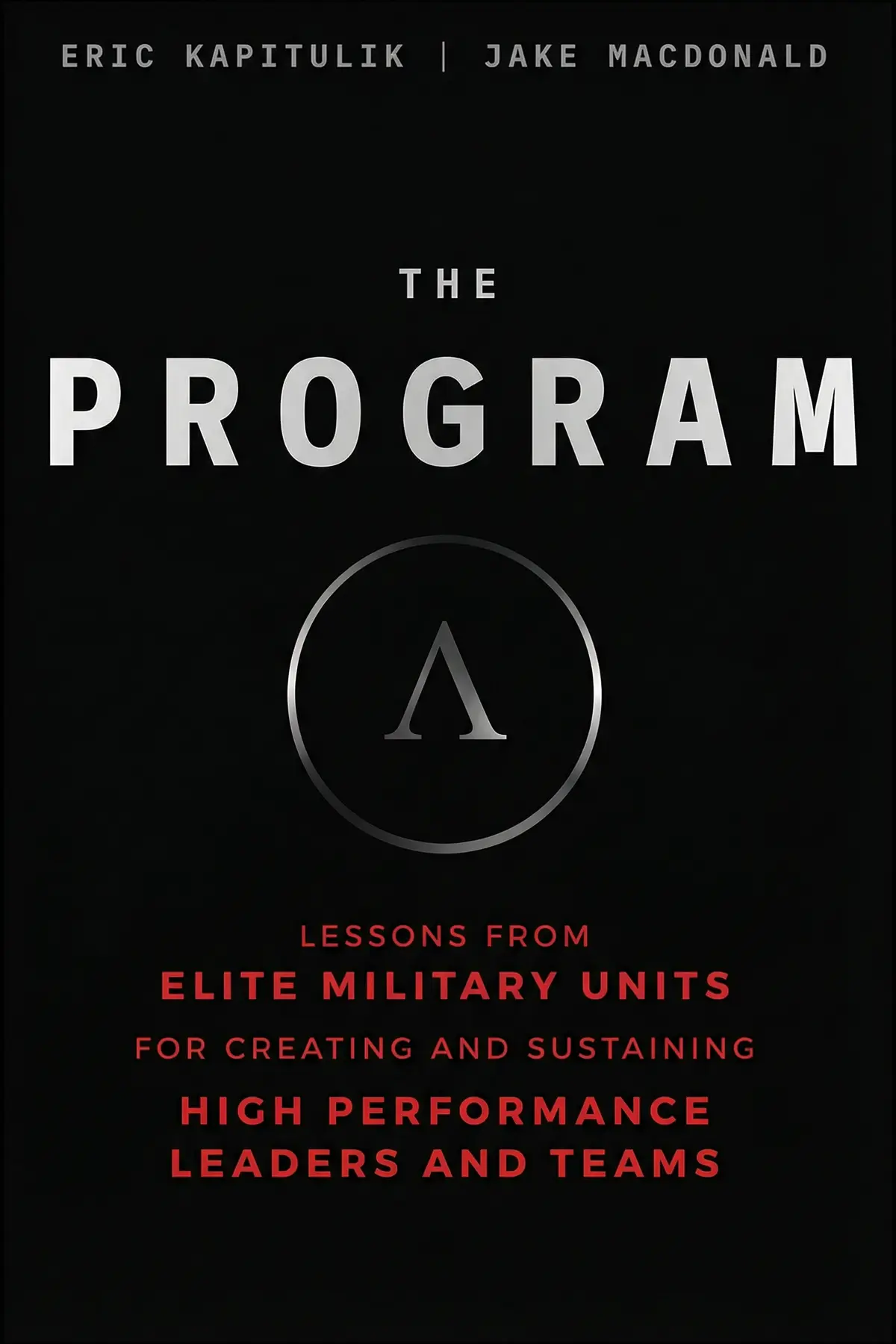
Table of Content
1. Introduction
1 min 10 sec
Most teams fail in ordinary ways: a meeting that never starts on time, a teammate who blames instead of fixing, a leader who wants the credit and none of the blame. In The Program, former Marine officers Eric Kapitulik and Jake MacDonald argue that these small lapses are where elite performance is won or lost, and that the cure is to turn values into standards everyone can see and enforce.
Kapitulik built the leadership company behind the book after a helicopter carrying his Force Reconnaissance team crashed during a training exercise in December 1999. The lessons come from Green Berets in Afghanistan, a handpicked Marine special operations unit and soldiers pinned down at Normandy.
The case they make is that strong teams are made on purpose, through clear values, shared accountability, leaders who serve both the mission and the people, toughness trained in advance and communication that leaves nothing to chance. Each of these becomes a habit you can start practicing this week, at work, in sport or at home.
2. Turn your values into standards anyone can check
1 min 52 sec
Values printed on a wall rarely change how anyone behaves on a busy afternoon. A Green Beret team in the mountains of Afghanistan showed what it looks like when a value survives real danger.
3. Be the teammate who checks their own work first
1 min 59 sec
Some teammates are quick to spot every mistake except their own. A Marine unit training for Iraq offers a simple hand gesture for telling the two kinds apart, and a harder lesson about kindness.
4. Judge any leader by the mission and the people
1 min 44 sec
Organizations often hand the leadership job to whoever performs best, and then wonder why the team suffers. The authors offer two tests that reveal whether someone is actually leading.
5. Build toughness before the hard days arrive
2 min 07 sec
Anyone can perform when conditions are perfect. A mountaineer who trained with the Marines explains why the real test comes later, and why waiting for life to toughen you up is a poor plan.
6. Speak so people under pressure actually hear you
1 min 33 sec
On a beach crowded with thousands of soldiers, men still felt completely alone, and the attack stalled. What got them moving again was something any team leader can use in a meeting tomorrow.
7. Close every loop so nothing falls through
1 min 36 sec
A busy hotel juggles thousands of tasks a day, yet its leaders do not chase each one. The habit that makes that possible takes seconds, and most teams skip it.
8. Conclusion
1 min 08 sec
The Program treats high performance as something a team builds from small, repeated acts. A Green Beret finishing his lunch, a Marine checking his own work before pointing at a friend’s, a sergeant making frightened men speak: none of these moments is dramatic on its own, and each is a value showing up when it costs something. The authors’ wager is that a team which practices these acts on ordinary days will still practice them on the day the helicopter goes down.
That makes the work concrete. Choose one value your team says it holds and give it a standard anyone could check, starting with yourself. When something goes wrong, press your thumb into your own part before raising a finger at someone else’s. Look for one hard thing this week, a tougher assignment or a cold morning run, and do it on purpose. And close your loops, so every task you hand over comes back confirmed.
None of this needs a uniform. It needs a leader willing to go first, and teammates kind enough to refuse to let the standard drop.
About this book
What is this book about?
Most teams do not collapse in a crisis. They erode through small lapses: meetings that drift, teammates who blame instead of fixing, leaders who take credit and dodge blame. Eric Kapitulik and Jake MacDonald, both former Marine officers, argue that elite performance comes from refusing to let those small lapses slide. Drawing on Green Berets in Afghanistan, a handpicked Marine special operations unit preparing for Iraq, Kapitulik's years as a mountaineer and soldiers pinned down at Normandy, the authors lay out a practical model. Core values become clear standards. Teammates check their own work before criticizing others and choose kindness over niceness. Leaders are judged on two counts, accomplishing the mission and caring for their people. Toughness is trained through chosen discomfort, and communication follows simple rules such as CLAPP and closed loops. Readers get a set of habits that work in an office, on a playing field or at a family dinner table, along with a plain test for each: can someone see the value being lived today?
Book Information
Who it's for
Managers and captains
Managers and team captains whose groups agree on values but rarely live them.
Newly promoted leaders
New leaders promoted for their own performance who now need to lead others.
Avoiding hard conversations
Anyone who avoids hard conversations and wants a way to hold people accountable with kindness.
About the Author
Eric Kapitulik
Eric Kapitulik served as a Marine infantry officer and then a special operations officer in 1st Force Reconnaissance Company, earned an MBA from the University of Chicago in 2005, and in 2008 founded The Program, a leadership and team-building company. He has completed eight Ironman triathlons and climbed five of the Seven Summits. Jake MacDonald captained the Tufts football team, led reconnaissance Marines on two combat tours in Iraq, led a Scout Sniper Platoon in Afghanistan as a Major, received a Purple Heart and is a lead instructor for The Program.
Ratings & Reviews
Ratings at a glance
What people think
Listeners find this work to be a top-tier choice for leadership and team dynamics, with one listener pointing out how well it helps establish a championship culture. The material also generates positive reactions, as one listener highlights the many examples drawn from the world of sports. Additionally, the text is praised for being easy to follow, and listeners enjoy the mix of motivational stories and real-world applications.
Top reviews
Iff
Finally finished this one after my manager recommended it for our quarterly off-site. The concept of "One More" really stuck with me because it shifts how you perceive standard effort levels. Kapitulik doesn't just talk about being a boss; he dives into what it means to be a teammate who actually holds people accountable. The stories from the world of college athletics made the lessons feel tangible rather than just abstract business theory. Truth is, I wasn’t expecting a military-style book to resonate so well with a tech sales team, but the principles of habits and training are universal. You don’t magically rise to a challenge; instead, you sink to the level of the habits you’ve built over time. It’s a sobering thought that has already changed my morning routine. If you want a roadmap for a championship culture, this is it.
Show moreFon
As a high school coach, I’m always looking for ways to get my players to buy in to a shared vision. After taking my team through a similar workshop, picking up this book was the logical next step to sustain that energy. The real-life applications are incredibly clear, particularly the parts about earning what you get rather than just deserving it. Frankly, the story about Cory Ross was a major highlight for me and helped my athletes visualize what true leadership looks like in practice. Each chapter is short and carries a specific lesson, making it easy to digest one a day during the season. This isn't just a book you read once; it’s a manual you keep in your gym bag for constant reference.
Show moreFilm
Wow, this is easily one of the most impactful books on leadership I have picked up in the last five years. It doesn't just offer vague advice; it provides a rigorous roadmap for creating a championship culture that survives under pressure. I was particularly moved by the stories of grit and the reminder that we earn our results through daily commitment. The writing style is incredibly accessible, which made it a quick read even though the themes are quite heavy. Personally, I think this should be mandatory reading for anyone in a position of influence, whether you are a pastor or a CEO. It forces you to look in the mirror and ask if you are truly the teammate your organization deserves to have.
Show moreOak
After hearing Eric Kapitulik speak, I knew I had to grab the book to see if the written word was as powerful as the presentation. It did not disappoint. The way he bridges the gap between the battlefield and the boardroom is masterfully done. He makes it clear that to accomplish a mission, you need a daily commitment to the standards you’ve set for your team. The book is filled with inspiring stories that make the "Hard Work Is One More" mantra feel like a lifestyle rather than a slogan. It’s rare to find a book that is both this motivating and this practical. It’s a must-read for anyone who is tired of average results and wants to push for something truly great.
Show moreAraya
Direct and to the point is the only way to describe the writing style of Kapitulik and MacDonald. They don’t waste your time with fluff, moving quickly through short chapters that each tackle a different pillar of leadership. I specifically liked the focus on how we don't rise to the occasion but instead sink to our training levels. It’s a concept that applies to everything from sports to emergency medicine. I’d argue the book is very intense and might feel a little overwhelming if you aren't ready for a total culture overhaul. But for those ready to do the work, the nuggets of wisdom found here are gold. It's a great companion for any leader looking to build a more effective and cohesive unit.
Show moreRatthapong
Ever wonder why some teams just click while others fall apart? This book argues that failure isn't about a lack of people, but a lack of the right people and standards. I found the chapters on building mental toughness to be the highlight, especially the section on how we fall back on our training during high-stress moments. The writing is punchy and moves fast, which I appreciate as someone with a busy schedule. To be fair, some of the military analogies feel a bit recycled if you’ve read a lot of other leadership books recently. However, the specific action items for coaches and business leaders are unique enough to justify the read. It’s a solid blueprint for anyone trying to instill a sense of urgency in their organization.
Show moreLincoln
The chapter on accountability hits like a ton of bricks and makes you question your own commitment to the team. Kapitulik and MacDonald lay out a very specific framework: get the best people, set the standards, and never stop holding them to those goals. I liked that they focused on "SMART" goals because it provides a measurable way to track progress instead of just using empty motivation. Gotta say, the tone is quite intense, which might not be for everyone, but it’s effective for those needing a kick in the pants. My only gripe is that some of the "One More" examples felt a bit repetitive by the end of the book. Still, the message of falling back on your training during adversity is something every leader needs to hear.
Show moreOn
Picked this up on a whim after seeing it on a colleague's desk and I'm glad I did. The authors do a great job of blending military precision with athletic drive to show how excellence is a choice. One of my favorite takeaways was the idea that teams don't fail because they lack people, but because of the character of those people. It’s a blunt assessment that cuts through the usual corporate fluff found in most management books. In my experience, the "One More" philosophy is actually quite easy to implement immediately in small ways. The book is neatly compiled and the action items are easy to follow, even if the tone is a bit aggressive at times. A very useful read for anyone wanting to sharpen their competitive edge.
Show moreThanit
Not what I expected given the hype surrounding "The Program" in my industry circles. While the emphasis on accountability is vital, I found the "Command and Control" style of leadership a bit dated for a modern creative office. If you are managing people who need to brainstorm and pivot, this rigid structure might stifle their output. Look, there are definitely some nuggets of wisdom regarding goal setting and being "Relevant and Timely." However, I spent a lot of time sifting through slog chapters that felt more like a boot camp manual than a leadership guide. It’s a decent book for high-intensity environments like sports or tactical units, but it lacks the nuance needed for knowledge workers who thrive on flexibility.
Show moreErn
This book provides a very specific perspective that won't suit every environment, particularly those that thrive on creative freedom and employee autonomy. The authors lean heavily into a "Command and Control" style that feels entirely too rigid and outdated for my current team dynamic. While I appreciate the basic emphasis on "Specific and Measurable" goals, the focus on strict habits felt like a repetitive slog through most of the middle chapters. Not gonna lie, I found much better insights in standard HBR articles that were concise and didn't rely on this hyper-aggressive "grind" mentality. If you are managing knowledge workers who need space to innovate, I would strongly suggest you stay far away from the practices mentioned here. It is just too dogmatic for the modern workplace.
Show moreQuestions about this book
What is the main idea of The Program by Eric Kapitulik and Jake MacDonald?
The authors argue that high-performing teams are built deliberately. Core values must become clear, visible standards that everyone, starting with the leader, meets every day. Teammates hold each other to those standards, leaders are judged on both mission accomplishment and care for their people, toughness is trained before it is needed, and communication follows simple rules that prevent anything from being lost.
What is the difference between a thumb teammate and a finger teammate?
A finger teammate is quick to point at what others are doing wrong without looking at their own role. Someone who acts like a thumb teammate first leans into their own duties and examines what they themselves contributed, and only then criticizes others. The authors draw the idea from Det 1, a Marine special operations unit in which every member answered for his own job and for keeping others up to standard.
What does CLAPP stand for in The Program?
CLAPP is the authors’ guide to speaking well: clear, loud, with authority, pauses and posture. Clarity makes sure the message lands as intended, volume shows confidence, authority comes from cutting filler, pauses let listeners absorb the point and give the speaker time to think, and posture reinforces the message because body language often says more than words.
How can I apply The Program at work?
Start by picking one team value and turning it into a standard anyone can check, such as meetings that always begin on time, and meet it yourself first. Use closed-loop communication: have people repeat tasks back and confirm when they are done. Choose kindness over niceness by having the honest conversation you have been avoiding, and seek out a hard assignment to build toughness.
Readers also enjoyed

A Bigger Prize: How We Can Do Better Than the Competition
Margaret Heffernan





A Year with Peter Drucker: 52 Weeks of Coaching for Leadership Effectiveness
Joseph A. Maciariello



Acting with Power: Why We Are More Powerful Than We Believe
Deborah Gruenfeld
AUDIO SUMMARY AVAILABLE
Listen to The Program in 15 minutes
Get the key ideas from The Program by Eric Kapitulik, plus 5,000+ more nonfiction titles.
- 5,000+ titles
- Listen as much as you want
- 7-day free trial
- Cancel anytime









