

13 min 39 sec
Available in: English
The Prepared Leader: Emerge from Any Crisis More Resilient Than Before
Shows leaders how to catch the early signs of a crisis, prepare their teams before it hits, contain the damage and recover in a way that leaves the organization stronger.
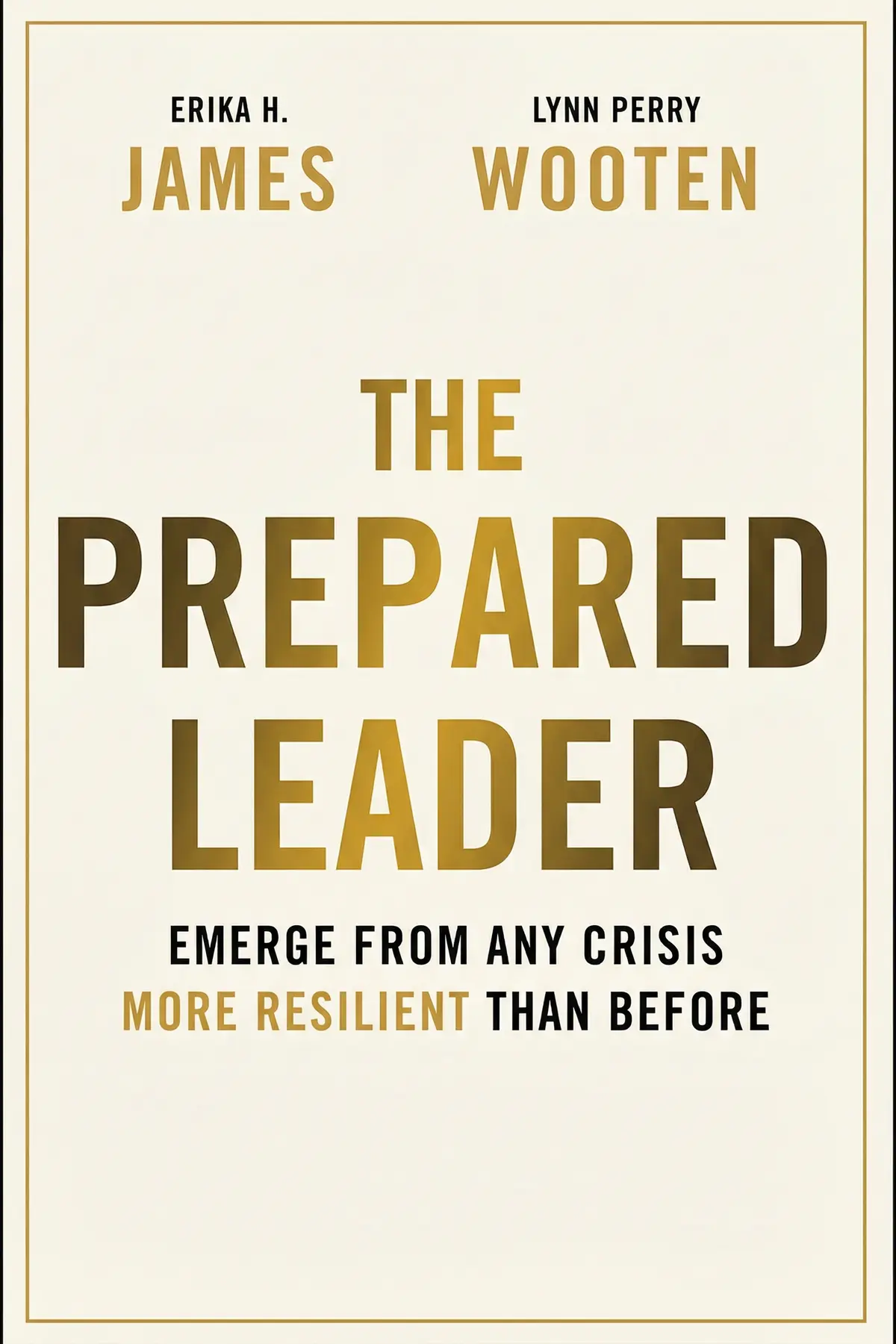
Table of Content
1. Introduction
1 min 07 sec
Most leaders meet a crisis as a surprise, even when the warnings were visible for months. In The Prepared Leader, academic leaders Erika H. James and Lynn Perry Wooten argue that this blindness is built into the human mind, and that it can be trained out. We favor the danger in front of us over the one on the horizon, so a distant threat feels like someone else’s problem until it arrives.
The authors want prepared leadership treated as a fourth responsibility, next to people, planet and profit. Their case is that crises follow five recognizable phases, each phase rewards specific skills, and a leader who builds those skills in calm times can come out stronger than before.
Along the way you will meet a sports commissioner who stopped a season, a defense electronics firm that had one of its best years in 2020, and a pub chain and a fitness founder whose responses made things worse. What you get is a map of those phases and the habits to practice with your team before the next disruption.
2. Spot the biases that hide the next crisis
1 min 51 sec
Experts warned for decades that a global pandemic was coming, and most organizations still were caught unready. The reason has less to do with carelessness than with the way human minds rank danger.
3. Act on the facts before everyone else does
1 min 50 sec
One league boss made a call no one in his sport had ever made, and it cost a fortune. Then he spent even more. The way it ended explains what the authors mean by a leader’s agency.
4. A five-phase map for any crisis
1 min 51 sec
A pub chain told tens of thousands of staff to look for work at a supermarket, and the damage spread far beyond payroll. It failed one stage of a cycle that almost every crisis passes through.
5. Build a team that reads warning signs early
1 min 56 sec
A migratory bird climbs high into the sky twice a day before deciding where to fly. A defense electronics company kept that kind of watch, and 2020 turned out to be one of its best fiscal years ever.
6. Prepare people to act without waiting for you
1 min 57 sec
In the worst week of a crisis, the leader’s attention is pulled to a handful of huge problems. Whether everything else keeps working depends on choices made months earlier.
7. Come out of a crisis stronger than before
1 min 54 sec
A billion-dollar fitness founder lost his job within days, and the tool that sank him is the same one that helped another company thrive. The difference lies in what leaders learn and teach.
8. Conclusion
1 min 13 sec
The Prepared Leader rests on a hopeful claim. The biases that make us ignore distant threats are real, but they are not fate. Adam Silver listened to scientists and trainers outside his circle and paid early, and his league finished the year with revenue to show for it. Mercury Systems had a mixed team watching for months, and 2020 became one of its best years. JD Wetherspoon and Greg Glassman show the reverse: one careless message can turn a hard moment into lasting damage.
What James and Wooten describe is a change in when leadership work happens. Most of it belongs to calm periods, in the team you assemble, the trust you build and the habits of learning you set. When the crisis comes, you draw on what is already there.
Start small. Set a regular moment to look above daily work, like the swift, and invite colleagues with different views to say what worries them. Give one decision to someone closer to the problem, so the team can move without you. After the next disruption, however minor, look for its cause as well as your way through it.
Crisis will come back. Whether it finds you ready is the part you can shape.
About this book
What is this book about?
Crises are as certain in business as taxes, yet most leaders still meet them as surprises. Erika H. James and Lynn Perry Wooten argue that this is no accident. Human minds rank immediate dangers above distant ones, and biases such as probability neglect and anchoring keep us from acting on warnings we can plainly see. Their answer is prepared leadership, which they add as a fourth responsibility alongside people, planet and profit. They describe five phases most crises pass through, from early warning to learning and reflection, and nine skills that help a leader succeed in each one, including sense-making, organizational agility, risk-taking and promoting resilience. The ideas come alive through cases from the COVID-19 years: the NBA commissioner who suspended the season and built a bubble, a defense electronics firm that had one of its best years in 2020, and the pub chain and fitness founder whose responses made things worse. Readers get a clear map of how crises unfold and the habits to build with their teams before the next one arrives.
Book Information
Who it's for
Managers and team leads
Managers and team leads who want their people ready before the next disruption hits.
Founders and executives
Founders and executives who were caught off guard by COVID-19 and want a clear crisis plan.
Building leadership programs
HR and development professionals building leadership programs around trust, learning and resilience.
About the Author
Erika H. James
Erika H. James became dean of Wharton, the University of Pennsylvania's business school, in 2020, the first woman in that role, after six years as dean of Emory's Goizueta Business School. She is known for her work on crisis leadership and workplace diversity. Lynn Perry Wooten became the ninth president of Simmons University in 2020, its first Black president, after serving as a dean at Cornell and spending nearly 20 years on the faculty of Michigan's Ross School of Business. Her work centers on positive leadership, crisis leadership and inclusion.
Ratings & Reviews
Ratings at a glance
What people think
Listeners find that while perspectives differ on the extensive use of COVID-19 case studies, many value the authors' professional framework for guiding organizations through crises. Furthermore, listeners appreciate the practical breakdown of nine essential skills and five management stages intended to cultivate long-term durability. The material is also lauded for its utility as an accessible reference, with one listener emphasizing its power to help leaders "break the cycle of panic" and "bounce forward" from difficult times. Additionally, they point to the unique advantage of the authors' backgrounds as veteran academic leaders who offer realistic, well-supported insights that enrich any professional library.
Top reviews
Laddawan
Finally, a crisis leadership book that prioritizes the human element of management alongside the bottom line. As a woman in a leadership position, hearing the perspectives of these two groundbreaking Black female academics was incredibly refreshing and provided a unique lens on institutional trust. They break down the "cycle of panic" in a way that is both intellectually stimulating and deeply practical for real-world application. The emphasis on "sense-making" and "perspective-taking" changed how I view my team’s communication during high-stress quarters. It is an essential addition to any professional library, especially for those of us who want to lead with both poise and data-driven confidence. Buy it, highlight it, and keep it close.
Show morePannipa
This manual should be required reading for anyone stepping into a C-suite role in today’s volatile market. Look, we all know crises are coming, yet we continue to act shocked when things fall apart. This book provides the psychological tools to fight "probability neglect" and "anchoring effects" that keep us from seeing the warning signs early on. The authors' expertise in organizational psychology shines through every chapter, offering a masterclass in how to build a resilient culture before you actually need it. It is about more than just recovery—it is about learning and reflecting so that the organization emerges fundamentally better. Truly a top-tier reference for modern management.
Show moreTak
James and Wooten have crafted a concise, actionable guide that moves beyond the typical reactionary "putting out fires" approach to leadership. I particularly appreciated the five phases of crisis management because they force you to look at signal detection long before the storm actually hits. The book isn't just about surviving; it is about "bouncing forward" and using upheaval as a catalyst for organizational evolution. While some of the case studies, like the NBA bubble, are well-known, the authors provide a fresh psychological perspective on why leaders make those high-stakes decisions. It is a quick read but provides a solid mental model for anyone in a high-pressure role who needs to prioritize trust and transparency.
Show moreBrooklyn
As a manager in the tech sector, I found the chapter on technology as a "double-edged sword" to be surprisingly relevant, even if the CrossFit example was a bit cringey to revisit. The authors do a great job of explaining how digital tools can either streamline communication or facilitate a leader's public demise in seconds. I enjoyed the concept of the "mega community" and how global networks can be leveraged during a local crisis. My only gripe is that the book leans a bit too heavily on the COVID era, but the underlying theories are sturdy enough to outlast the pandemic context. It is a well-researched, pithy guide that encourages proactive preparation over reactive chaos.
Show moreClaire
The section on Adam Silver and the NBA bubble was a standout for me, illustrating how "prepared leadership" involves looking outside your immediate circle for expertise. It is rare to find a business book that balances academic rigor with such readable, high-stakes storytelling. James and Wooten effectively argue that crisis is the new "third certainty" in business, and their nine-skill framework gives you a roadmap to handle that reality. The book is short, which I actually appreciated; I don't need 400 pages of fluff when I am trying to learn how to manage a team. It is an empowering read that focuses on agency rather than victimization in the face of disaster.
Show moreLeah
To be fair, The Prepared Leader offers some decent takeaways regarding organizational agility and the necessity of diverse perspectives during a meltdown. However, the writing felt strangely disjointed at times, almost as if the two authors’ voices were competing rather than harmonizing. I found myself skimming through the repetitive sections on risk-taking to get to the actual meat of the nine essential skills. It is a helpful reference for new managers who need a structured way to think about resilience, but seasoned executives might find the content a bit elementary. It serves its purpose as a basic manual, though it lacks the depth I expected from such prestigious academics.
Show moreWatcharaporn
Is this a revolutionary text or just a timely one? I am leaning toward the latter, as the core of the book is essentially a breakdown of the 2020-2022 timeline viewed through a management lens. The five phases are logical and easy to remember, which makes it a good reference tool for quick huddles during a project failure. That said, the authors tend to circle back to the same points about diversity and trust without offering many new ways to implement them. It is a decent primer on resilience, but I wish there were more diverse case studies involving small businesses or non-profits rather than just massive corporations and professional sports leagues.
Show moreNannapat
After hearing so much buzz about the Wharton Dean’s new book, I expected a deeper dive into the mechanics of institutional change. What I got instead was a very accessible, slightly surface-level overview of crisis management that leans heavily on recent events. Truth is, the "nine skills" are well-categorized and provide a helpful checklist for organizational audits. But the ROI on this read depends entirely on how much you already know about basic management theory. If you are a seasoned leader, much of this will feel like a refresher course rather than a revelation. It is a solid, middle-of-the-road guide that is probably best suited for MBA students or middle management.
Show moreRyan
While I respect the credentials of Erika James and Lynn Wooten, this book felt like a missed opportunity to expand beyond recent headlines. Almost every single lesson is anchored in the COVID-19 pandemic, which makes the advice feel dated and less applicable to the specific, non-health-related crises my company faces daily. It is a very thin volume that often restates common sense in academic jargon rather than offering groundbreaking insights. Frankly, the entire framework could have been condensed into a long-form article or a single podcast episode without losing the core message. If you are already exhausted by pandemic retrospectives, you might find this frustratingly narrow in scope and repetitive in its delivery.
Show moreFatima
I really wanted to like this, given the authors' incredible backgrounds at Wharton and Simmons, but the execution felt hollow. The prose is repetitive and reads somewhat like it was generated by a software program—there is a lot of "leadership speak" but very little "how-to" for the average worker. For instance, telling a leader to "be creative" or "take risks" during damage containment is easy to say but hard to execute without more specific, non-COVID examples. I finished the book feeling like I had read a very long brochure for a management seminar. It is certainly accessible, but for the price, I expected much more substance and a lot less filler.
Show moreQuestions about this book
What is The Prepared Leader about?
Erika H. James and Lynn Perry Wooten argue that crisis is a certainty in business and that human biases, such as probability neglect and anchoring, keep leaders from acting on early warnings. They propose prepared leadership as a fourth responsibility beside people, planet and profit, built on five phases of crisis management and nine skills that help leaders act early and recover stronger.
What are the five phases of crisis management in The Prepared Leader?
The authors describe Early Warning and Signal Detection, Preparation and Prevention, Damage Containment, Recovery, and Learning and Reflection. Most crises give signs before they strike, so the first phase is about noticing them. The middle phases cover readiness and limiting harm, as the pub chain JD Wetherspoon failed to do. The last phase turns the experience into lasting improvement instead of a purely defensive reaction.
What skills does a prepared leader need?
The book names nine: sense-making and perspective-taking for spotting warnings; influence, organizational agility and creativity for preparation; effective communication and risk-taking for containing damage; and promoting resilience and individual and systemic learning for recovery. The authors call learning perhaps the most important, because the world keeps changing and employees are the eyes and ears that spot the next crisis.
How can I apply The Prepared Leader at work?
Hold regular reviews where people from different parts of the organization report what they see, as Mercury Systems did months before the 2020 lockdown. Consult beyond your inner circle before big calls, as NBA commissioner Adam Silver did. Give teams the authority to decide without you, keep communication open and empathetic, and after each disruption record what caused it and share the lessons.
Who should read The Prepared Leader?
It suits managers, founders and executives responsible for others during disruption, and those who design leadership training. The book is built around cases from the COVID-19 period, from the NBA bubble to Mercury Systems, so it speaks most directly to leaders who want to avoid being caught unready again and to build teams that can act on early signs.
Readers also enjoyed



A Year with Peter Drucker: 52 Weeks of Coaching for Leadership Effectiveness
Joseph A. Maciariello



Acting with Power: Why We Are More Powerful Than We Believe
Deborah Gruenfeld

All In: How Great Leaders Build Unstoppable Teams
Mike Michalowicz


AUDIO SUMMARY AVAILABLE
Listen to The Prepared Leader in 15 minutes
Get the key ideas from The Prepared Leader by Erika H. James, plus 5,000+ more nonfiction titles.
- 5,000+ titles
- Listen as much as you want
- 7-day free trial
- Cancel anytime









