

A Life Decoded: My Genome: My Life
J. Craig Venter
 English
 ไทย
Shows how evolutionary psychology explains attraction, jealousy, infidelity, favoritism toward children, kindness and the struggle for rank as products of unconscious genetic drives that still shape how we treat each other.
1 min 03 sec
Most of us explain our own jealousy, generosity and ambition as choices we make, good or bad. In The Moral Animal, journalist Robert Wright presents the case from evolutionary psychology that many of these feelings were shaped long before any choosing, by an unconscious pull toward passing on our genes. Take jealousy: in a 1982 study, men’s bodies reacted most strongly to imagining a partner’s sexual affair, while women were more shaken by the thought of a partner’s emotional bond with someone else.
Wright’s throughline is that love, envy, kindness and the hunger for rank run on a few simple genetic drives, which show up in a surprisingly wide range of behavior. The evidence comes from labs, from villages in Paraguay and the Kalahari, from Micronesian islands and from chimpanzee colonies. Follow it and you gain a sharper way to read your own reactions, the people close to you and the politics of any group you belong to.
1 min 49 sec
Men are famously relaxed about brief encounters, yet both sexes turn strict when choosing a lasting partner. Two studies point to what that strictness is really measuring, and it has little to do with personal taste.
1 min 47 sec
Wired to electrodes, volunteers imagined their partners straying in two different ways. Their bodies split sharply along sex lines, and one of the reactions seems to answer a danger that modern life has largely removed.
1 min 38 sec
A famous Marilyn Monroe song makes a cynical claim about what women want from men. Field reports from bonobos and from a Kalahari people suggest the claim, and a darker strategy behind it, deserve a closer look.
1 min 51 sec
Fairy tales love the prince who marries the servant girl. Records of inheritance, infanticide and parental attention suggest those stories reflect a real calculation about which child, son or daughter, a family bets on.
1 min 43 sec
Volunteers who believed they had broken expensive lab equipment were offered a chance to make up for it. Whether they accepted depended on one detail that says a great deal about where our conscience comes from.
1 min 45 sec
A hunting people who share every piece of meat equally turned out to reward their best hunters in less visible ways. A hormone study then raised a different question: are leaders born, or does the role change them?
1 min 37 sec
A small chimpanzee ruled his group with noise and kerosene cans, and a former alpha kept real power after handing his title to an ally. Their tactics look uncomfortably familiar to anyone who has watched office politics.
1 min 11 sec
Wright’s picture of human nature can sound bleak at first: kindness as a loan, love as a breeding calculation, leadership as an alliance game. Yet the account he presents is not as narrow as it seems. The basic genetic urges are simple, but the emotions and choices they produce are endlessly varied, from a man’s racing pulse at an imagined affair to a poor family doting on its daughter. And some of that old logic is plainly out of date, like sexual jealousy firing in an age of contraception.
That leaves room for a more honest kind of morality. When a strong feeling arrives, whether jealousy, a burst of generosity or a craving for rank, ask what it once did for our ancestors and whether it still serves you. Before acting on guilt, notice whether it would feel as strong if nobody had seen. In any group that calls itself equal, look past the official fairness and the loud displays to the alliances that truly hold power.
Yeroen understood that last lesson without a word of theory. The rest of us can learn it on purpose.
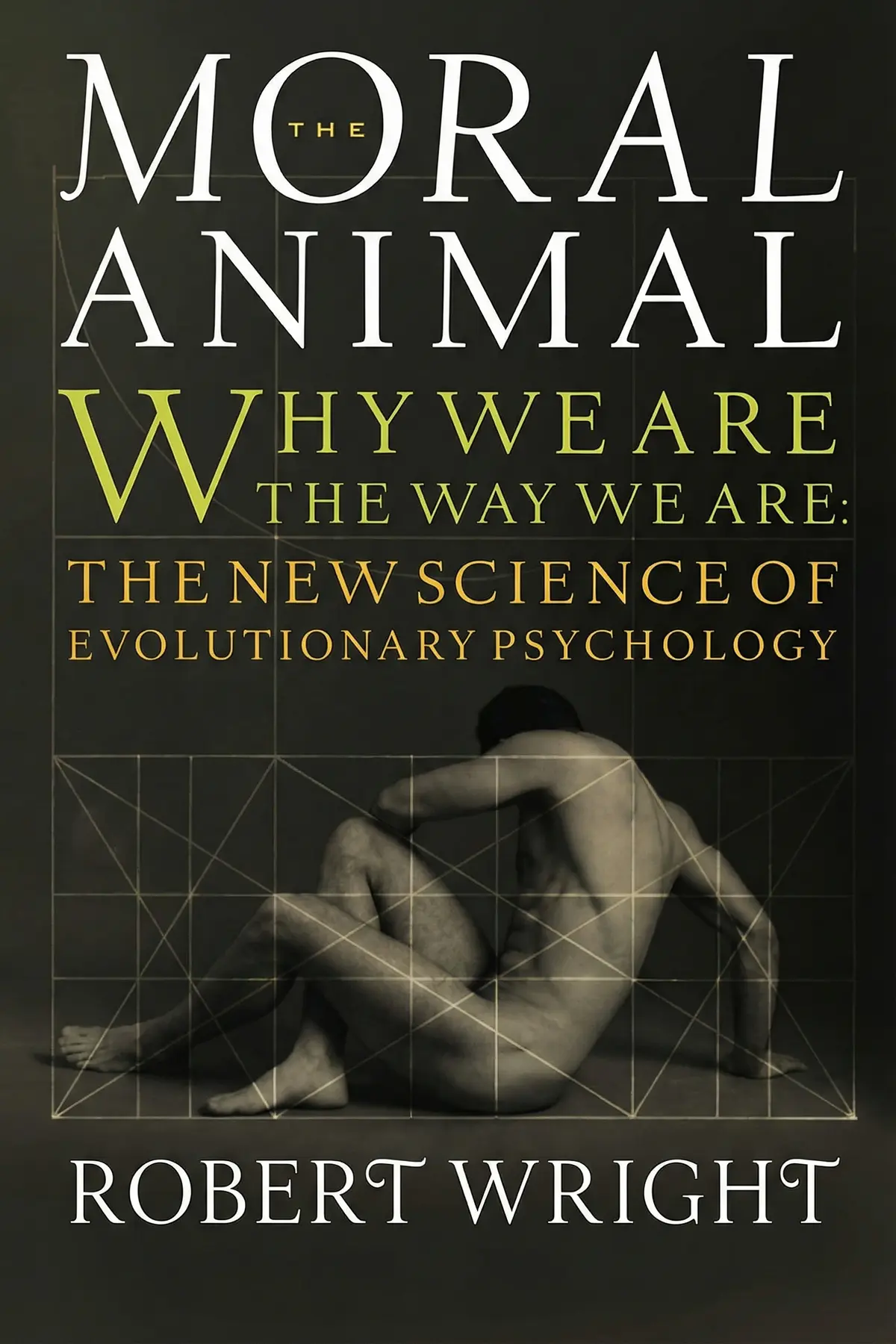
We tend to think of morality as a choice: we decide to be kind, faithful or fair. Robert Wright sets out the view of evolutionary psychology, a field that was highly controversial when it emerged in the early 1990s, that many of our deepest feelings serve an older purpose, the unconscious drive to survive and pass on our genes. Wright gathers evidence from laboratories, hunter-gatherer villages, island communities and chimpanzee colonies. He shows why men and women feel jealousy about different things, why poor families have tended to favor daughters and rich ones sons, why we feel guiltier when caught, and why even equal-looking societies hide a ranking. The book offers a sharper way to read your own emotions and the people around you. It does not reduce people to simple machines: the urges are basic, but the behavior they produce is remarkably varied, and some of it no longer fits the world we live in.
Curious readers who want to understand where jealousy, guilt and generosity come from.
Couples and parents puzzled by reactions that seem stronger than the situation deserves.
Managers and team members who want to read the hidden ranks and alliances in their groups.
Robert Wright is an American author and journalist who writes about philosophy, science, history, politics and religion, with a particular focus on evolutionary psychology. His five books include Nonzero, The Evolution of God and Why Buddhism is True, and he has won the National Magazine Award for Essay and Criticism. He has taught at Princeton University and the University of Pennsylvania, was a visiting professor at Union Theological Seminary in 2019, and co-founded Bloggingheads.tv.

Listeners find the work impactful and skillfully composed, with one review highlighting its concise explanation of human evolution. Additionally, it is celebrated as a pivotal text in evolutionary psychology, and one listener specifically enjoyed its Darwinian approach to discussing morality. Nevertheless, the narrative flow and style get varied feedback, as some think it is accessible while others argue it's not an easy read. The caliber of the arguments also results in mixed views, with some listeners finding them difficult to grasp.
Picked this up because I wanted to understand the biological roots of our behavior, and Wright delivers a masterclass in synthesis. This book is a landmark work that explains human evolution in concise, often biting terms that make you rethink every social interaction. I especially loved how the author used Charles Darwin’s own life and Victorian struggles as a recurring case study for evolutionary principles. It makes the abstract science feel grounded and personal rather than just a list of dry theories. While some critics argue that evolutionary psychology excuses bad behavior, Wright is careful to suggest we should rise above our primitive urges. The truth is, understanding our 'hairy history' is the first step toward genuine moral progress. It is a powerful read that remains relevant decades after its initial publication.
Show moreWow, Robert Wright has crafted a truly landmark work that fundamentally changed how I view human interactions and our collective sense of ethics. By stripping away the veneer of 'free will,' he exposes the cold, Darwinian calculus that drives everything from sibling rivalry to corporate ladder-climbing. Some might find this perspective bleak, but I found it oddly liberating to see the gears of the 'moral animal' turning so clearly. The way he integrates biography with biology is a stroke of genius that keeps the pacing brisk and engaging. Not gonna lie, I had to reread several paragraphs to fully grasp the nuances of his utilitarian arguments. However, the effort was well worth it for the sheer depth of insight provided here. It’s easily one of the most influential books I’ve encountered on the nature of our species.
Show moreAfter hearing so much about evolutionary psychology, I finally dove into this classic and found it to be incredibly powerful and deeply moving. Wright doesn't just explain evolution; he explains the soul, or at least the biological ghost that we mistake for one. The discussion on 'gene machines' and how we are designed to deceive ourselves is both terrifying and brilliant. He argues that our brains are not designed to see the truth, but rather to help us survive and reproduce at any cost. This realization is a bitter pill to swallow, yet Wright presents it with such wit and clarity that you can't help but be impressed. It is a landmark book that bridges the gap between the hard sciences and the humanities perfectly. Every page offers a new 'aha!' moment that sticks with you long after you close the cover.
Show moreThis book provides a concise yet deep dive into the Darwinian roots of our most 'human' traits like altruism, shame, and spite. I was blown away by how Wright manages to connect ancient primate group dynamics to the way we behave on crowded subways today. He successfully argues that our big, fancy brains are often just tools for rationalizing the primitive urges of our 'hairy' ancestors. The book is well-written and packed with provocative ideas that challenge the standard social science model of human behavior. Personally, I think this is essential reading for anyone interested in why our society is structured the way it is. It isn't just a science book; it’s a mirror that reflects the most uncomfortable parts of our nature. If you want to understand the 'why' behind the 'what,' start here.
Show moreThe chapter on Victorian morality versus our modern dating landscape was eye-opening, even if it felt a bit speculative at times. Wright explores how natural selection has shaped our sense of 'right' and 'wrong' to favor genetic survival over actual happiness. To be fair, the writing style is a bit dense and isn't always the easiest to navigate during a quick lunch break. You really have to sit with these ideas and chew on them to get the full effect of his arguments. I found the discussion on Trivers’ papers and reciprocal altruism to be the strongest part of the narrative. Even though some of the gender generalizations made me uncomfortable, the logic behind them is hard to dismiss entirely. It’s a thought-provoking look at why we aren't as selfless as we like to pretend.
Show moreEver wonder why we feel crushing guilt or why men and women seem to have such different approaches to short-term courtship? This book attempts to answer those questions by looking at the 'software' our genes have written for us over millions of years. Wright is a fantastic writer who manages to make complex concepts like kin selection and parental investment feel accessible to the average reader. My only real gripe is that the book meanders a bit in the middle, losing the sharp focus it had in the beginning. In my experience, the chapters on social status and the 'cheater detection' mechanism were the most insightful. Even if you don't agree with every conclusion, the framework Wright provides for analyzing behavior is incredibly useful. It’s a solid 4-star read that will definitely spark some heated dinner-table conversations.
Show moreTo be fair, the writing style isn't always the easiest to navigate, with some transitions feeling quite awkward during long reading sessions. I found the book's reliance on Trivers' papers a bit repetitive, though the core arguments remain quite sturdy despite the age of the material. What really saved the experience for me was the way Wright framed Darwin's life as the ultimate test case for his theories. It adds a human element to a science that can often feel cold or deterministic. Gotta say, the explanation of how 'selfless' behavior is actually a form of genetic selfishness was particularly well-handled. It challenges your vanity and forces you to look at your own motivations through a much more clinical, yet fascinating, lens. It's a heavy read, but rewarding for those who persevere through the denser chapters.
Show moreAs someone who has read a lot about evolution, I wasn't sure if Wright would bring anything new to the table, but I was pleasantly surprised. He weaves a narrative that is both an intellectual history of Darwinism and a forward-looking manifesto for a new science of the mind. While I agree with some critics that he occasionally overreaches into 'just-so' story territory, his logic is usually tight and compelling. The truth is, we are animals, and ignoring our biological heritage leads to all sorts of social and personal pathologies. Wright’s exploration of the disjunction between our ancestral design and modern life is particularly poignant and well-reasoned. It’s a thought-provoking, landmark work that deserves a spot on your shelf, even if you find some of the conclusions difficult to accept. It definitely made me look at my own 'moral' choices in a new light.
Show moreFrankly, this book is a bit of a mixed bag for me; while the application of evolutionary theory is often brilliant, some sections feel like mere arm-waving. I found myself rolling my eyes at the way Wright stretches thin evidence to cover complex human emotions like grief or chronic spite. There is a lot of focus on a few specific papers from the 1970s, which makes the science feel slightly dated in a modern context. On the other hand, the anecdotes about Darwin’s marriage and his inner turmoil were genuinely fascinating and kept me turning the pages. It’s a decent introduction to the field, but you definitely need to read it with a grain of salt. If you’re looking for a definitive guide to the human mind, this might leave you wanting more data. It’s more of a philosophical exploration than a rigorous scientific text.
Show moreNot what I expected, as the book seems to lean too heavily on older research to justify some pretty outdated and regressive gender dynamics. I understand that evolutionary psychology is about the 'ancestral environment,' but Wright’s flippant dismissal of social fluidity felt incredibly narrow-minded. It felt like he was using science to validate a very specific, patriarchal view of the world under the guise of 'natural' laws. Furthermore, the transitions between sections were often awkward and disjointed, making it hard to maintain a steady train of thought. Look, I appreciate the attempt to ground morality in biology, but the execution here feels biased and occasionally mean-spirited toward feminist critiques. It’s an interesting historical artifact of the field, but I wouldn't call it an objective look at human nature. There are better, more modern takes on this subject available now.
Show moreRobert Wright presents the evolutionary psychology view that much of human behavior, including attraction, jealousy, infidelity, favoritism toward children, kindness and status-seeking, grows out of unconscious drives to survive and pass on genes. He argues that these drives are simple, but the behavior they produce is varied, and he supports the case with studies of people in labs, hunter-gatherer communities, island societies and chimpanzee groups.
Wright points to research from 1982 by Martin Daly and Margo Wilson, in which men reacted most strongly to picturing a partner’s sexual affair, while women were more upset by a partner’s emotional bond with another woman. Evolutionary psychologists explain male sexual jealousy as an unconscious fear of raising another man’s child, a reflex that persists even though contraception has weakened the link between sex and pregnancy.
In part. The book describes kindness as creating a debt, an instinct that made sense in small communities where you met the same people daily. But Wright argues morality is driven most by concern for how others see us. In an experiment credited to Robert Trivers, volunteers who thought they had been caught breaking lab equipment were much more willing to help the researchers afterward.
Wright reports that nearly every human society has a hierarchy, even egalitarian-looking groups like the Ache of Paraguay. A study of vervet monkeys and college fraternities found serotonin rose only after males became dominant, suggesting leaders are not genetically fixed. Chimpanzee studies by Jane Goodall and Frans de Waal show that display can win status briefly, but alliances keep it.
J. Craig Venter

Richard Wiseman

Carl Zimmer


Bill Bryson


Jeff Hawkins



Steven C. Hayes
AUDIO SUMMARY AVAILABLE
Get the key ideas from The Moral Animal by Robert Wright, plus 5,000+ more nonfiction titles.









