
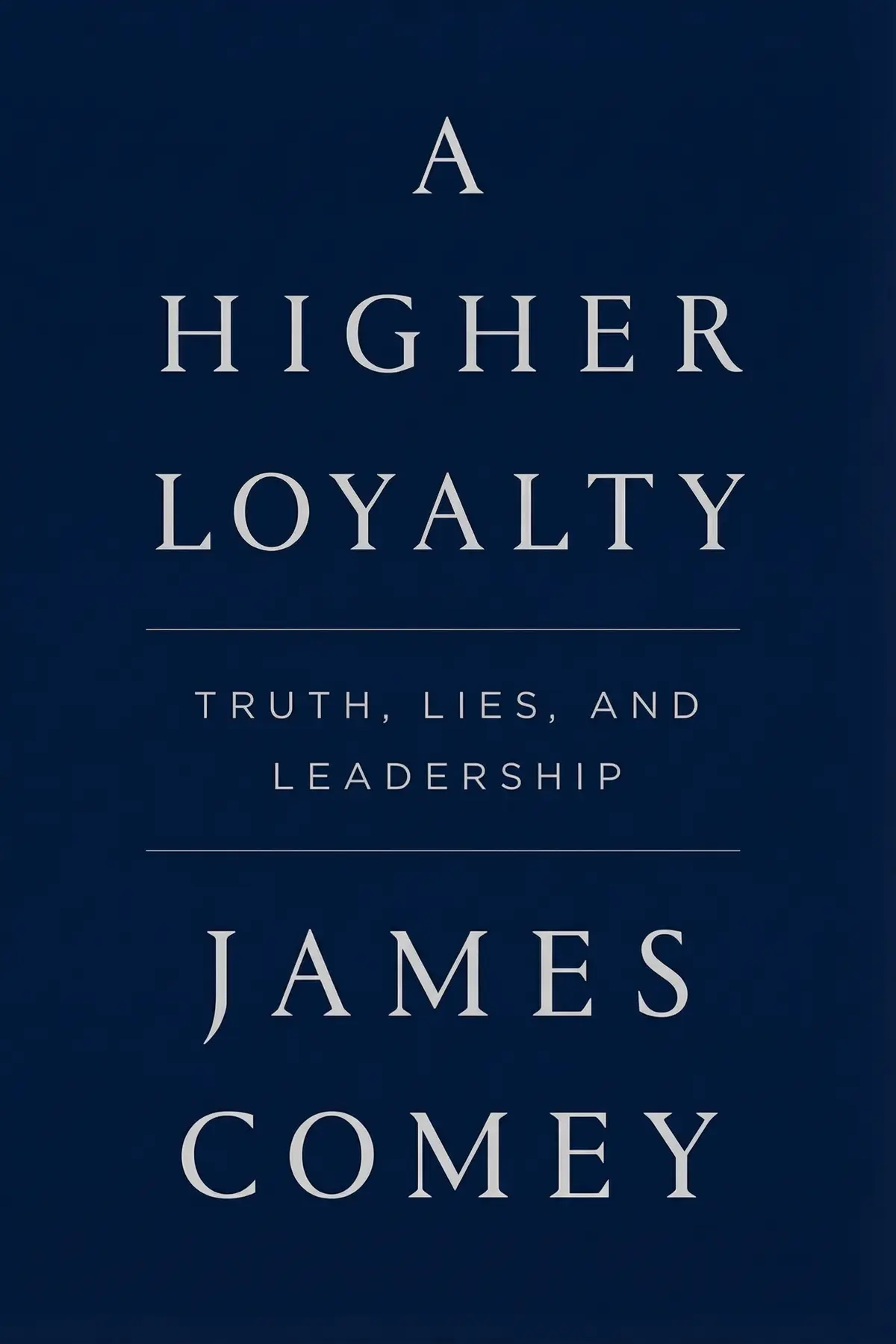
A Higher Loyalty: Truth, Lies and Leadership
James Comey
 English
James Burnham's 1941 case that power was passing from owners to the managers who run corporations and the state. It offers a lens for seeing who really controls any large institution, whatever its legal structure.

1 min 04 sec
The people who run your organization may seem to multiply while the people who own it fade from view. James Burnham saw that pattern coming in 1941. In The Managerial Revolution, the philosopher and former Trotskyist activist argued that capitalism was ending and that communism would not be its heir. The new masters, he claimed, would be the managers, the people who control production without owning it.
Burnham wrote in the middle of the Second World War, after years of mass unemployment. His case moves through capitalism’s anatomy, a warning from ancient history, a grim reading of Soviet Russia and the swelling payrolls of corporations and the American state.
His throughline is simple. Whoever controls the machinery of a society rules it, whatever the title deeds say. Follow his argument and you gain a question to ask of any company, ministry or institution: who actually decides here, and who gets the larger share?
1 min 55 sec
Most people assume they know what capitalism is because they live inside it. Burnham pins it down to four traits, and one of them carries a weakness that the rest of his argument will press on hard.
1 min 52 sec
In 1941 most people trusted that capitalism would simply carry on. Burnham looked back to Athens, Rome and the end of the Middle Ages and found a repeating signal that a whole social order was running out of road.
1 min 54 sec
The Soviet Union abolished private ownership of every factory and railroad. By the logic of its founders, class should have vanished with it. Figures printed in the Soviet press itself told a very different story.
1 min 48 sec
A society where no individual owns the factories sounds like one without a ruling class. Burnham’s definition of rule closes that loophole, and it explains how a group can take power without staging anything resembling a coup.
1 min 55 sec
The owner who ran his own mine or shipping firm once defined capitalism. By the 1940s he was vanishing, and the people who replaced him at the controls had no need to own anything at all.
1 min 46 sec
By 1941 the American federal payroll had doubled in under a decade. Burnham counted everyone who relied on the state for a living and concluded that half or more of the American population already depended on government in some way.
1 min 19 sec
Burnham’s book is finally an argument about where power hides. Capitalists ruled because they controlled production. Soviet Russia showed that abolishing owners only handed that control, and a larger share of income, to someone else. In the corporations and government agencies of 1941, Burnham saw that someone taking shape: the managers, a class that rules by running things rather than holding title to them.
Read today, the book also offers a habit of mind. When an institution grows, follow the decisions instead of the deeds, and ask who allocates resources and who benefits first from what is produced. When a system keeps leaving people without useful work, treat it the way Burnham treated mass unemployment in Athens, Rome and the late Middle Ages, as a sign that the structure itself is failing. And when a change is presented as giving power to everyone, check whether a new administering group is forming in the gap.
Burnham wrote as war spread and old certainties broke apart. His deepest claim travels well beyond that moment. The people who control the machinery will, sooner or later, become the people in charge.
Writing in 1941, with world war raging and mass unemployment entrenched across the United States and Western Europe, James Burnham asked what kind of society would follow capitalism. Many thinkers on both the left and the right expected communism. Burnham predicted something else: a managerial society in which the state owns the main means of production and a new ruling class governs it. His argument turns on one idea. A ruling class is whoever controls access to production and takes the larger share of what it yields, and control can do the work of ownership. Burnham builds the case from several sources. He starts with capitalism's defining features and the mass unemployment that marked the final years of Athens, Rome and medieval Europe. He adds Soviet statistics showing deep inequality after private property was abolished, and the growth of corporate managers and government bureaucrats in his own day. Readers get a sharp, unsettling way to read any large organization. Look past who owns it and ask who decides, who runs it day to day and who benefits first.
Professionals in large organizations who wonder why managers keep multiplying and who really makes the decisions.
Students of politics, history or economics looking for a classic theory of class and power beyond Marx.
Readers curious about the growth of government and where control over the economy is heading.
James Burnham (1905 to 1987) was born in Chicago, chaired the philosophy department at New York University and published his first book, An Introduction to Philosophical Analysis, in 1931. In the 1930s he was a prominent activist in the American Trotskyist movement. He then broke with Marxism and became a theorist of the political right and a leader within American conservatism, editing and writing regularly for William F. Buckley's National Review. The Managerial Revolution, published in 1941, is his most famous book.

Listeners find the work highly insightful, as one listener observes the incredible parallels between the book's theory and analysis. The quality of the prose is also praised, with one listener noting that it is extremely well written.
Finally got around to reading the source material for so much of our modern political discourse. Burnham’s prose is razor-sharp and his willingness to 'swing for the fences' makes this an exhilarating read. Most people remember his failed predictions about the Axis powers, but they overlook his profound understanding of how administrative law replaces the traditional rule of law. He describes a world where the state and the economy merge, driven by a new elite that values efficiency and control above all else. This isn't just a dusty history book; it's a manual for understanding the contemporary 'expert' class. Truth is, his description of the managerial drive for social dominance accurately maps onto our current institutions. It is easily one of the most influential works I’ve read this year. Highly recommended for anyone interested in the real mechanics of power.
Show moreWow. This is one of those books that permanently changes how you view the news and the world around you. James Burnham takes the complex social movements of the mid-20th century and distills them into a single, terrifyingly logical narrative. He argues that we aren't moving toward freedom or socialism, but toward a totalizing rule by administrators and bureaucrats. Personally, I think he was more right than he knew, even if the 'mutation' of capitalism took a few more decades than he predicted. The way he identifies the 'New Deal' as a primitive form of this revolution is particularly enlightening. His prose is tight, authoritative, and completely devoid of the usual academic fluff. It’s a minor modern classic that deserves way more attention in the current political climate. If you want to know who really rules, start here.
Show moreBurnham presents a chillingly prescient look at how power shifts, even if his specific wartime predictions didn't age perfectly. Writing in 1941, he captures a world in total flux where the old bourgeois structures were crumbling under the weight of mass unemployment and global conflict. While he incorrectly assumed capitalism was on its deathbed, his description of a 'managerial class' taking the reins of production feels incredibly relevant to our current era of technocratic governance. You can see why Orwell was so obsessed with this text; the blueprint for 1984's tripartite world is right here. The prose is surprisingly tight and lacks the dry, academic slog you might expect from a mid-century political treatise. I found the parallels between the New Deal, Stalinism, and Nazi Germany provocative, even if they're a bit reductive by modern standards. It’s a dense read but serves as a vital historical bridge for anyone studying the evolution of the state.
Show moreAs someone who spends way too much time in corporate meetings, this hit close to home. Burnham’s 'managers' are the spiritual ancestors of the modern middle-management layer that seems to run everything without actually owning anything. Look, the guy was a bit obsessed with the end of the world being just around the corner, but his observation about technical specialists gaining power is spot on. He explains how the separation of ownership and control leads to a totally different kind of social structure. The writing style is punchy and keeps you engaged even when the subject matter gets a bit dense or repetitive. I was particularly struck by how he views ideologies as tools for mass manipulation by the elite. It makes you look at modern political movements in a much more cynical, yet realistic, way. A solid four stars for the sheer number of 'aha!' moments it provided.
Show morePicked this up after seeing it referenced in a piece about the 'Great Reset' and found it fascinating. The parallels between Burnham’s 1941 world and our current trajectory are nothing short of amazing. He details a shift toward centralized planning and managed currencies that feels like it was written yesterday instead of eighty years ago. His theory that socialism would never actually manifest as a classless society, but rather as a bureaucratic oligarchy, was incredibly brave for a former Trotskyist. You can tell he’s a product of the Great Depression, as he's convinced capitalism is broken beyond repair. Even though history proved him wrong on that specific point, his broader vision of a technocratic elite is undeniable. The writing is extremely well-crafted and keeps a brisk pace throughout. It’s definitely a book that forces you to rethink your assumptions about who really holds the levers of power.
Show moreAfter hearing George Orwell praise (and then dismantle) this book, I had to see for myself. It’s clear that Burnham’s vision of three massive super-states served as a direct inspiration for the world of Oceania. He describes a drive for social dominance by a 'managerial class' that is cold, calculating, and ultimately successful. While the book suffers from a bit of 'present-ism'—the idea that whatever is happening now will continue forever—it’s still a powerhouse of political theory. Gotta say, his breakdown of why the Russian Revolution didn't lead to socialism is one of the clearest I’ve ever read. He sees through the ideological smokescreens to the raw power dynamics underneath. There are some dry patches where he gets bogged down in 1940s economic data, but the core arguments remain vital. It’s an essential read for understanding the 20th century's structural legacy.
Show moreIs this book a masterpiece of political science or just a relic of the 1940s? To be fair, the truth lies somewhere in the middle. Burnham argues that capitalism is a temporary phase, a claim that seems laughable given the resilience of neo-liberalism today. However, his core thesis regarding the 'coordinator class' remains an essential insight for understanding modern corporate and governmental power dynamics. He correctly identified that control over the means of production is moving away from traditional owners and toward those who manage the technical systems. Some chapters feel like a slog because of his obsession with the immediate events of WWII, which ultimately didn't play out the way he envisioned. Still, the analytical depth he brings to the table is undeniable. It’s a fascinating, if flawed, exercise in historical materialism from a Machiavellian perspective.
Show moreThe chapter on the transition from feudalism to capitalism was surprisingly the highlight for me. Burnham uses this historical precedent to argue that we are currently in the middle of a similar seismic shift. He posits that just as the bourgeoisie replaced the lords, the managers are now replacing the capitalists. While I think he overestimates the decline of private property, his analysis of 'state ownership' as a tool for a new ruling class is compelling. My main gripe is that he ignores the role of culture and religion, focusing almost exclusively on economic levers of power. It’s a very materialist view of history that can feel a bit hollow at times. However, his sharp wit and clear prose make it much easier to digest than most political theory from that era. It’s a good supplementary read but shouldn't be your only source on the topic.
Show moreEver wonder why every government agency and corporation seems to speak the same language? Burnham’s book explains the rise of the technocrats who make these decisions behind the scenes. He views mass unemployment as a symptom that the capitalist social organization is finished, which was a bold claim to make in the 1940s. While he was definitely wrong about the timeline of capitalism’s 'death,' his description of how managers consolidate power via the state is spot on. To be fair, the book can be repetitive, and his dismissal of democracy as an 'irrelevant distraction' is hard to swallow. It’s a very Machiavellian look at the world where power is the only currency that matters. I’d recommend it for the insights into the 'coordinator class,' but take his specific predictions with a massive grain of salt. It’s an intriguing historical document that still has some bite.
Show moreNot what I expected given the hype surrounding its historical importance. Frankly, the book is horribly outdated and almost entirely wrong in its specific geopolitical forecasts. Burnham writes with a confidence that borders on arrogance, yet he completely underrated capitalism’s ability to reinvent itself through consumerism. Reading his takes on the Soviet Union and Nazi Germany feels like looking through a distorted lens that hasn't been cleaned in eighty years. While the concept of a 'managerial class' has some merit, he applies it so broadly that it loses all meaning. He tries to reduce complex human behaviors to a rigid, pseudo-scientific sociological framework that just doesn't hold up. I struggled to finish this because the tone is so relentlessly bleak and deterministic. If you want to understand the 1940s zeitgeist, it’s fine, but don't expect it to explain the 21st century.
Show moreJames Burnham argued in 1941 that capitalism was ending and that communism would not replace it. Instead, a managerial society would emerge, with the state owning the major means of production and managers forming the new ruling class. His key point is that a ruling class is defined by control over production and a larger share of its output, so managers can rule without owning anything, through their grip on corporations and the state.
He pointed to the Soviet Union. The Soviets abolished private property, yet society became more class-bound. Statistics from the Soviet press, cited by Leon Trotsky in 1939, showed the top 11 percent taking about half the national income, compared with 35 percent for the top 10 percent in the United States. Early freedoms such as trade unions also gave way to banned opposition parties and organizations stripped of rights.
They are the people who actually run production: in his era, production managers, operating executives, superintendents and administrative engineers in business, and bureaucrats in government. Burnham argued their power grew as corporations became huge and technically complex, as ownership spread across many weak shareholders, and as governments took over sectors such as mail, transportation, housing and health care.
Use Burnham’s definition of power as a test. In any company or institution, look past who legally owns it and ask who sets budgets, approves hires and decides what gets made, and who benefits first from the results. Treat a system that keeps producing people it cannot use as a sign of structural failure. And when a reform promises to spread power, watch whether a new administering group forms instead.
James Comey

Anthony Pratkanis



Barack Obama

Masaji Ishikawa

John Rawls



Miles Taylor
AUDIO SUMMARY AVAILABLE
Get the key ideas from The Managerial Revolution by James Burnham, plus 5,000+ more nonfiction titles.









