

12 min 24 sec
Available in: English
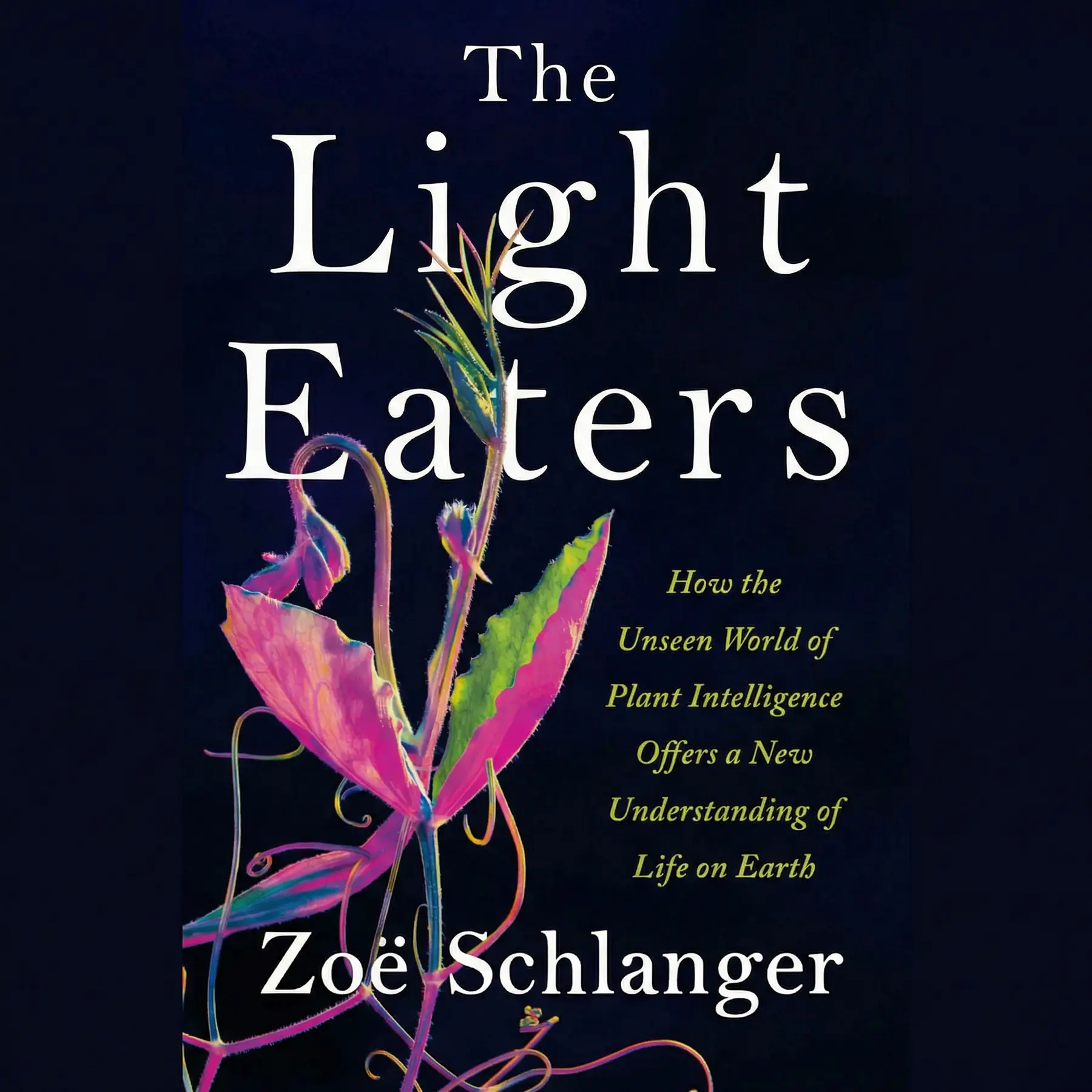
The Light Eaters: How the Unseen World of Plant Intelligence Offers a New Understanding of Life on Earth
Shows how plants with no brain or nerves warn their neighbors, respond to electrical signals, pick up meaningful sounds, learn from experience and recruit other species, and why that widens what we mean by intelligence.
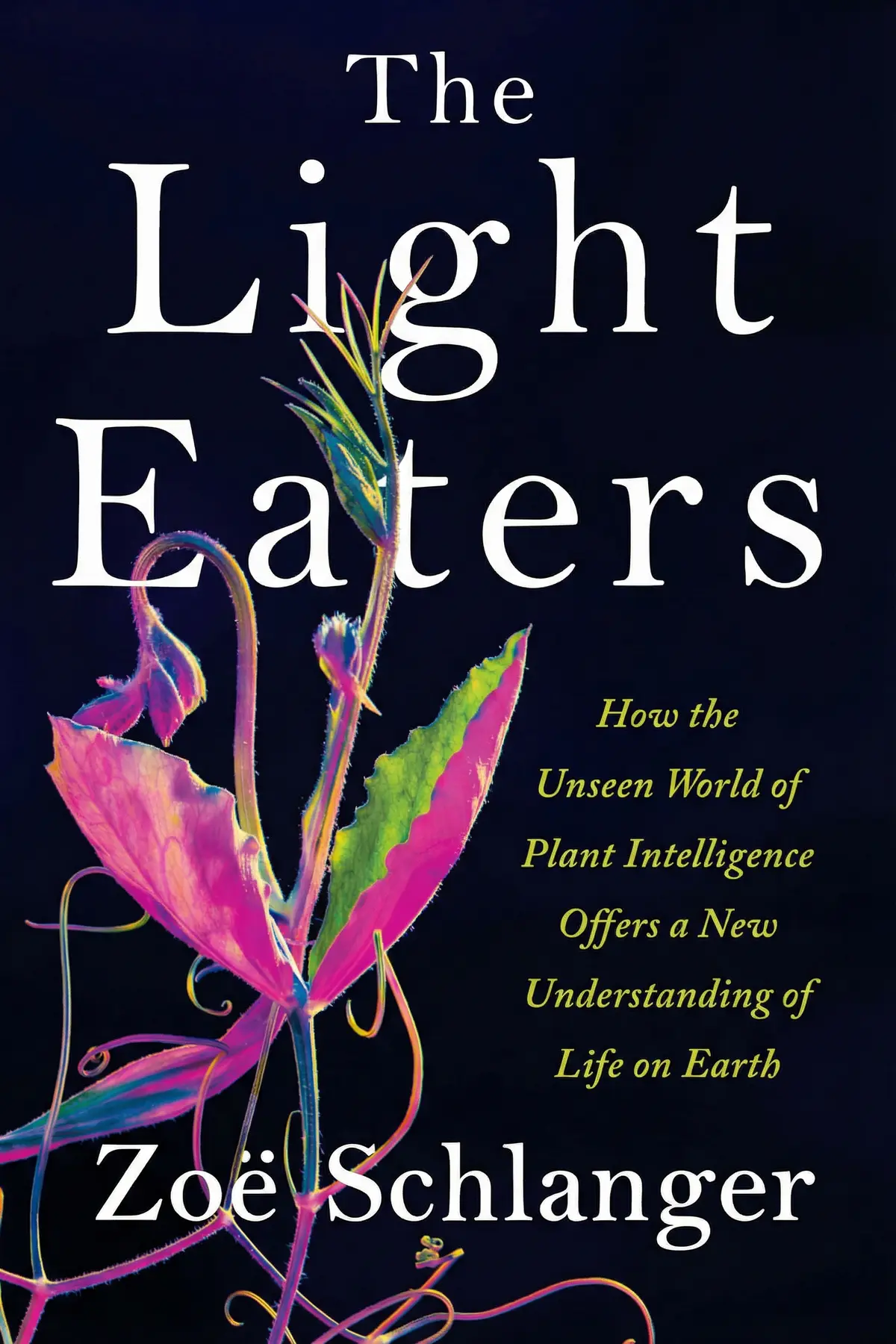
Table of Content
1. Introduction
1 min 08 sec
Most of us walk past plants as if they were furniture, green and silent and doing nothing. Yet an acacia being eaten by antelope can turn its leaves bitter enough to kill, and it can warn the trees around it to do the same. In The Light Eaters, Atlantic staff writer Zoë Schlanger follows the scientists who study behavior like this. For a long time their field sat on the fringe, partly because of a 1973 book, The Secret Life of Plants by Peter Tompkins and Christopher Bird. That book claimed plants felt pain and liked classical music better than rock. Scientists dismissed it as anecdote, and talk of plant awareness became something researchers steered clear of.
Schlanger’s case is more careful. Plants do not think or feel the way we do. Without a brain, though, they sense, signal, remember and strike bargains with the living world around them. Follow the evidence and the word intelligence grows wider, and a hedge or a houseplant stops looking like scenery.
2. Spot the defense hiding in a still plant
1 min 59 sec
Thousands of kudu suddenly died on South African game ranches, their stomachs holding mostly acacia leaves and a lethal dose of tannins. The investigator traced the deaths to an unlikely culprit, and to a kind of teamwork nobody expected from trees.
3. Learn how a plant can be put to sleep
1 min 57 sec
A Venus flytrap exposed to an anesthetic stops snapping shut, just as an animal would go under. But a flytrap has no brain to switch off, so what exactly is being silenced?
4. Know what a plant is actually listening for
1 min 55 sec
Playing music to a houseplant probably does nothing. Yet one plant reacts to the sound of a caterpillar chewing, and a flower responds to a bee’s wingbeat. The difference reveals how plant senses are tuned.
5. Memory can live in a body without a brain
2 min 01 sec
Researchers dropped the same plants again and again. At first they folded their leaves in alarm, then they stopped. What changed tells us something unsettling about where learning can happen.
6. See the deals plants strike with other species
1 min 57 sec
Starving honeybees bite into leaves that give them no food at all. It looks like wasted effort, until you see what the plants do next and who else they call on for help.
7. Conclusion
1 min 27 sec
For fifty years, the memory of The Secret Life of Plants made scientists wary of crediting plants with anything like awareness. The researchers Schlanger follows came at the question from the other side, with jellyfish genes that glow, recordings of chewing caterpillars and Mimosas dropped again and again. Where they landed is more interesting than the 1973 claims. Plants do not prefer Mozart, and they do not feel pain as we do. They do sense, signal, remember and bargain, all without a brain, using chemistry, electricity and vibration spread through their bodies. On this view intelligence comes in many shapes, and ours is only one.
That has practical weight. Schlanger argues that seeing plants as responsive organisms should change how we treat them, and above all how much we value protecting whole plant communities for the planet’s health. A meadow is a network, not a backdrop.
You can carry this outside today. Pass a hedge and remember the acacias on the Transvaal ranches warning each other. Brush a leaf and picture the wave of light Gilroy and Toyota watched spreading from a wound. And when someone calls a living thing simple because it has no brain, think of the Mimosa that learned, after a few falls, that falling was safe.
About this book
What is this book about?
For decades, serious scientists avoided the idea that plants might be aware of anything. A 1973 bestseller had claimed that plants felt pain and enjoyed classical music. Critics called it anecdote, and the whole subject was pushed to the edge of pseudoscience. Zoë Schlanger returns to the question by following the researchers who have rebuilt it on firmer ground. She tells of acacias that poisoned thousands of antelope by working together and of sage bushes that warn their relatives first. She describes Venus flytraps that an anesthetic can put to sleep, flowers that sweeten their nectar when they detect a bee's wingbeat, and Mimosa plants that learn a fall is harmless. Her claim is careful. Plants do not think or feel the way we do, but they detect, communicate and adapt in ways that stretch the meaning of the word intelligence. Readers come out with a set of vivid, well-sourced stories they can retell. They also gain a new way to look at gardens, forests and fields: as networks of active organisms rather than green scenery, which Schlanger argues are worth protecting as whole communities.
Book Information
Who it's for
Curious about plant life
Curious readers who walk past gardens and forests and want to know what is happening inside them.
Students and lifelong learners
Students and lifelong learners interested in biology, consciousness and what counts as intelligence.
Gardeners and nature fans
Gardeners and nature lovers who want strong, science-backed stories to share.
About the Author
Zoë Schlanger
Zoë Schlanger is a staff writer at The Atlantic, where she covers climate change and environmental health. Her reporting has also appeared in The New York Times, The New York Review of Books, Time, Newsweek and The Nation, and she has been heard on NPR. Her work was selected for Best American Science and Nature Writing 2022. She won a 2017 reporting award from the National Association of Science Writers and was a Livingston Award finalist. She studied at New York University.
Ratings & Reviews
Ratings at a glance
What people think
Listeners find this book as readable as a compelling novel, packed with intriguing details about botanical life, and view it as essential for nature lovers. The prose is superb, and listeners characterize it as a marvelous tale that shifts their connection to plants. They value the stimulating look at plant intelligence and the investigation into how various species communicate with each other.
Top reviews
Carlos
This book completely rewired how I look at my backyard garden. I used to see my hostas as simple decorations. Now? I see them as active participants in an ancient, chemical conversation. Schlanger takes us through incredible studies on plant kinship and defense mechanisms that left me absolutely stunned. Her writing is fluid and narrative, almost like a novel, yet it's packed with data about how plants sense and react to their environment. I was particularly fascinated by the sections on how plants recognize their own genetic relatives. It makes you realize that the world is far more 'alive' than we give it credit for. If you enjoy learning about the hidden complexities of nature, this is mandatory reading. It’s the kind of book that stays with you long after you close the final page.
Show moreHom
Ever wonder if the vines on your trellis are actually 'aware' of their surroundings? This book suggests they might be, and the evidence is wild. The section on the Boquila trifoliolata—a plant that can mimic the leaves of completely different species—is worth the price of admission alone. How does it do that without eyes? Schlanger explores these mysteries with a sense of wonder that is infectious. She manages to balance the hard science of epigenetics with a philosophical inquiry into what it means to be a sentient being. The writing is top-notch; she has a way of making even the smallest cellular process feel like a high-stakes drama. It’s a beautiful, world-expanding piece of non-fiction that every nature lover should own. Truly a magnificent achievement in science communication.
Show morePriya
Wow, what an absolute journey into the silent green world that usually just fades into the background of our lives. I’ve read a lot of nature books, but this one felt different. It’s not just about what plants do; it’s about how they perceive. Schlanger makes a convincing case that we need a new vocabulary for life. The chapters on plant hearing and their response to sound frequencies were mind-blowing. I loved how she interviewed the actual researchers, giving us a 'behind-the-scenes' look at the struggles of studying things that don't have a central nervous system. The writing is elegant and evocative. It’s rare to find a book that is both intellectually stimulating and emotionally resonant. I’ve already bought three copies to give to friends this year. It is a wondrous story indeed.
Show moreVilaiporn
Honestly, I wasn't expecting to be so moved by a book about botany, but Schlanger has a way of making every leaf feel like a miracle. This is the kind of writing that changes your relationship with the physical world. I spent the afternoon after finishing this just staring at the trees in the park, thinking about the chemical signals moving through the air between them. The depth of research is astounding, yet it never feels dry. She weaves together personal anecdotes, historical context, and cutting-edge studies into a seamless narrative. It’s a beautiful exploration of the 'unseen world' mentioned in the title. I think this book is destined to become a classic in the genre. If you have even a passing interest in nature, you need this on your shelf.
Show moreTod
After hearing about the shapeshifting Boquila vine on a podcast, I knew I had to pick this up. The book did not disappoint. Schlanger is a master at making the 'boring' world of plants feel absolutely electric. She takes us on a global tour of laboratories and forests, introducing us to a new generation of scientists who are pushing the boundaries of what we thought was possible. The sections on how plants communicate to ward off predators were particularly cool. It turns out, they aren't just sitting there waiting to be eaten; they are fighting back with sophisticated chemical weaponry. The writing is brilliant, and the information is presented in a way that feels urgent and important. It’s a rare book that actually changes the way you perceive reality. Highly recommended for everyone.
Show moreWissanu
Zoë Schlanger writes with the curious eye of a reporter, which makes the complex biology in this book surprisingly accessible to a layperson. She doesn't shy away from the controversy surrounding the term 'intelligence,' which I appreciated. The truth is, our language is built for animals with brains, and plants just don't fit that mold. Still, the evidence she presents for plant memory and communication is compelling. I did find the pacing a bit slow in the middle chapters when she deep-dives into the history of botanical research, but the payoff is worth it. Her descriptions of chemical signaling are vivid. You can tell she spent a lot of time in the field with these scientists. It’s a thought-provoking look at the green world that we usually just treat as a backdrop.
Show morePakpoom
Finally got around to this after seeing it everywhere, and I have to say, the science is mind-bending. The idea that plants can 'remember' past droughts and adjust their future behavior is just incredible. Schlanger does a great job of explaining how these processes happen at a molecular level without getting too bogged down in jargon. My only gripe is that she occasionally leans a bit too heavily into the 'Secret Life of Plants' vibe, which can feel a little pseudo-scientific if you aren't careful. But to her credit, she does acknowledge the skepticism within the scientific community. The book is excellently written and flows very well. It really challenges the human-centric view of the world. Even if you don't buy into the 'intelligence' label, you’ll definitely gain a new respect for the bushes in your yard.
Show moreKet
As someone who loved Ed Yong’s writing, I found Schlanger’s approach to be equally world-expanding and insightful. She has this way of taking a tiny botanical detail and turning it into a profound philosophical question. I was particularly gripped by the discussion on plant kinship. The idea that a plant can distinguish its own offspring from a stranger and change its root growth to avoid competition is fascinating. The book is a bit of a slog in the later chapters when it moves into legal rights for plants, but the earlier sections on biology are gold. It’s a very high-quality popular science book. It makes you realize that plants aren't just objects; they are subjects with their own unique ways of being. Definitely worth a read for anyone interested in biology or ecology.
Show moreDao
To be fair, I struggled with how much the author anthropomorphizes her subjects throughout the narrative. While the facts about plant sensing are undeniably cool, the language used to describe them felt a bit over the top. Schlanger often uses verbs like 'strive,' 'want,' or 'plan,' which implies a level of conscious agency that the science hasn't fully proven yet. If you can get past the flowery prose, there is a lot of interesting information here about plant-to-plant communication and evolutionary adaptations. However, I found myself wishing for a more conservative, strictly biological approach like you'd find in a textbook. It’s an easy read and definitely engaging for a general audience, but more skeptical readers might find the 'intelligence' framing a bit too speculative for their tastes. A decent read, but not quite what I expected.
Show moreWitthaya
Look, I’m clearly in the minority here, but this felt more like a philosophical manifesto than a rigorous science book. The author is a journalist, and it shows. She takes very small, specific studies and draws massive, sweeping conclusions about plant 'consciousness' that the original researchers might not even agree with. The anthropomorphism is constant and, quite frankly, distracting. I was hoping for more hard data on chlorophyll and cellular mechanics, but instead, I got a lot of 'what if' scenarios and flowery descriptions of the author's feelings. It’s a very easy read, which I suppose is why it’s so popular, but it lacks the scientific depth of something like Entangled Life. If you want a feel-good book about plants being our 'buddies,' you’ll love it. If you want rigorous biology, look elsewhere.
Show moreQuestions about this book
What is The Light Eaters by Zoë Schlanger about?
It is about the scientists who study how plants sense and respond to the world. Schlanger shows that plants have no brain or nerves, yet they warn their neighbors with airborne chemicals, use electrical signals, react to meaningful vibrations, learn from experience and communicate with other species. She argues this widens our idea of intelligence, without claiming that plants think or feel the way humans do.
Do plants feel pain according to The Light Eaters?
No, not in the human sense. When a leaf is wounded, a wave of electrical activity spreads from the injury and triggers defensive chemicals, which Simon Gilroy and Shouhei Toyota made visible with a jellyfish gene. Pain, the book explains, is how a brain interprets signals like these. Plants have no brain, so they register damage and respond to it without feeling pain.
Can plants really hear sounds?
In a specific sense, yes. Rex Cocroft found that Arabidopsis plants make more defensive mustard oils when exposed to recordings of caterpillars chewing, but not to wind or insect song. Lilach Hadany found that evening primrose flowers produce sweeter nectar when they pick up the vibration of a honeybee’s wings. Plants respond to sounds that matter for survival, not to music.
Do plants have memory?
The research in the book suggests they do, in their own way. Stefano Mancuso repeatedly dropped Mimosa plants without harming them, and after several drops the plants stopped folding their leaves, a form of learning called habituation. Frantisek Baluska’s work on root tips and studies of plants that respond faster to a second drought point the same way.
Who should read The Light Eaters?
It suits curious general readers, students of biology or consciousness, and gardeners who want to understand the living things around them. It is built on concrete stories, from acacias that poisoned thousands of antelope to bees that bite leaves to make plants flower early, and it leaves readers seeing plant communities as active networks worth protecting.
Readers also enjoyed

A Life Decoded: My Genome: My Life
J. Craig Venter

A Planet of Viruses
Carl Zimmer

A Short History of Nearly Everything
Bill Bryson

A Thousand Brains: A New Theory of Intelligence
Jeff Hawkins




Alien Earths: The New Science of Planet Hunting in the Cosmos
Lisa Kaltenegger

AUDIO SUMMARY AVAILABLE
Listen to The Light Eaters in 15 minutes
Get the key ideas from The Light Eaters by Zoë Schlanger, plus 5,000+ more nonfiction titles.
- 5,000+ titles
- Listen as much as you want
- 7-day free trial
- Cancel anytime









