
15 min 07 sec
Available in: English
The Laws of Thermodynamics: A Very Short Introduction
By Peter Atkins
Explains the four laws of thermodynamics from the ground up. It shows why engines must waste heat, why freezers need power, what entropy really measures and why nothing can be cooled to absolute zero.
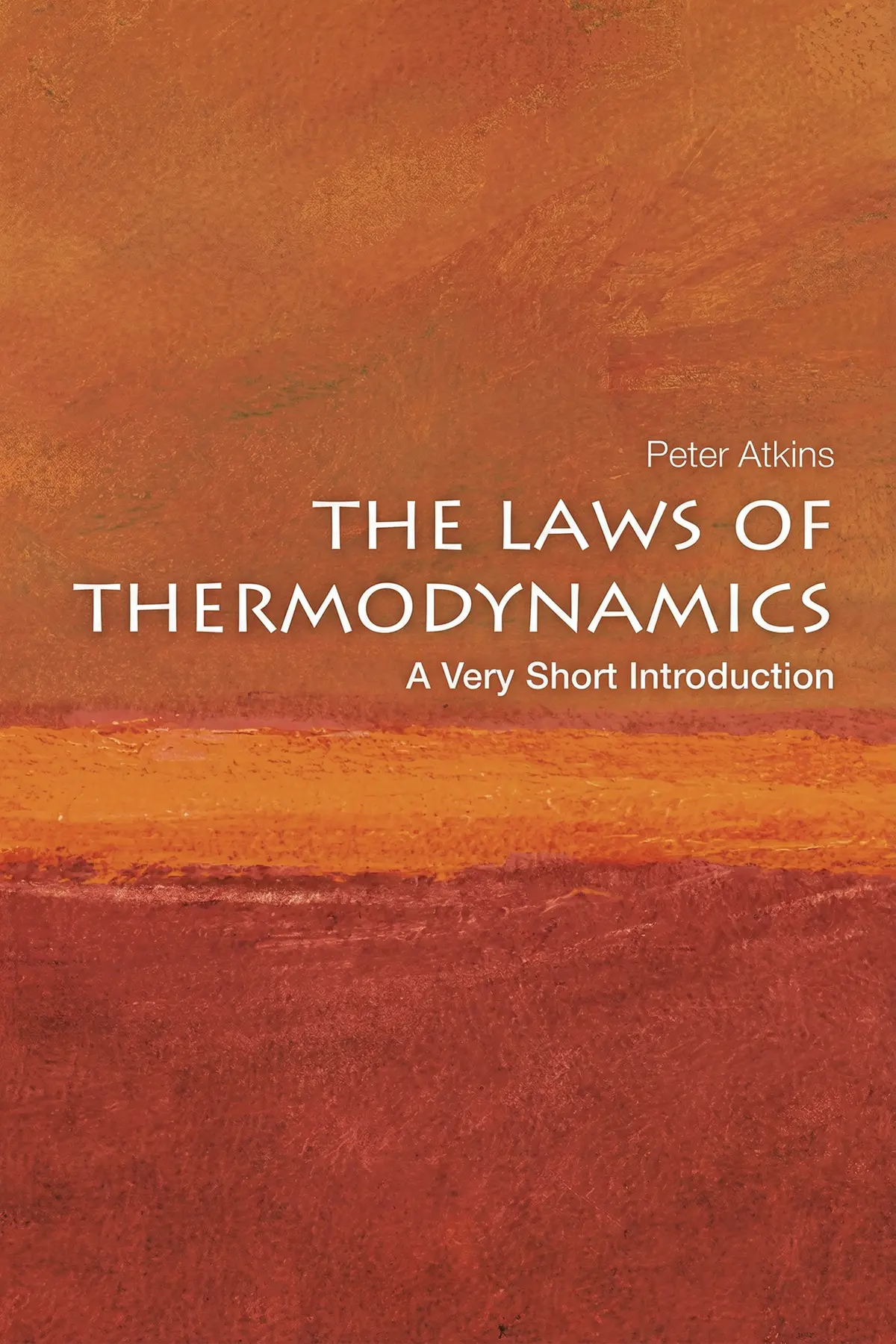
Table of Content
1. Introduction
1 min 04 sec
Words like energy and entropy get used every day, often loosely, by people who could not say what they mean. In The Laws of Thermodynamics, Oxford physical chemist Peter Atkins shows that four short laws explain why a pot lid rattles over boiling water, why burning gasoline moves a two-ton car and how a refrigerator chills leftovers. His method is to assume nothing, not even something as obvious as temperature, and to earn each idea from a simple observation.
Starting from linked cylinders, a steam engine and a mug of tea, Atkins builds four claims: temperature can be defined, energy in a sealed system is conserved, disorder grows in every spontaneous change, and there is a cold floor that no machine can reach. Follow the steps and you can explain in your own words why no engine uses all its heat, why your freezer depends on a power station, and what atoms do at the coldest temperature possible.
2. Earn the idea of temperature from three cylinders
1 min 53 sec
Everyone uses the word temperature, yet physics refuses to take it for granted. A tug-of-war between pistons that never move turns out to be the cleanest way to prove that such a thing exists at all.
3. Picture atoms as balls on storeroom shelves
1 min 42 sec
Heat a substance and something happens to its atoms that no thermometer shows directly. A school gym storeroom gives the clearest picture of it, and the same picture later explains entropy.
4. Track energy the way a climber tracks altitude
1 min 46 sec
A pulley and an electric heater could hardly look more different, yet they change a system in exactly the same way. The reason gives you a simple test for any claim about energy.
5. Learn how every engine must throw some heat away
1 min 43 sec
A steam engine has one part that seems to waste energy on purpose, and a forgotten cup of tea shows something just as stubborn. Together they hold the two halves of physics’ most feared law.
6. Use a sneeze to understand entropy
2 min 01 sec
The same small burst of energy can cause chaos in one place and pass unnoticed in another. That contrast turns entropy from a scary word into something you can picture and test.
7. Read a reaction's energy like a paycheck after tax
1 min 46 sec
Burning fuel releases energy, but not all of it is yours to use. Chemists keep a set of accounts for the deductions, and knowing them changes how you hear any quoted energy figure.
8. The coldest limit no refrigerator can reach
2 min 06 sec
Cool any substance far enough and every one of its atoms settles in one place. Getting there should only take enough power, yet no experiment has ever managed it, and the reason defines the final law.
9. Conclusion
1 min 06 sec
Atkins never asks for trust. Even temperature has to be earned, from cylinders that refuse to push each other. That patience is what makes the result so solid. A few plain scenes, a warm mug, a humming freezer, a sneeze in a library, grow into rules that govern everything from an expanding gas to a cooling metal, and they share one blunt message. Energy in a sealed system is never lost, yet some of it is always spent where you cannot use it.
That message travels well. When a machine promises to turn every bit of its heat into motion, you know why it cannot. When someone quotes the energy in a fuel or a reaction, ask for the net figure once enthalpy and entropy have taken their share. When entropy gets called chaos, offer the sharper version: it measures how little anyone can know about where one molecule sits.
The steam engine must keep its cold sink, and the best freezer still stops short of zero. Between those two limits lies everything thermodynamics allows.
About this book
What is this book about?
A pot lid rattles over boiling water, burning gasoline moves a two-ton car and a refrigerator chills leftovers. Each of these everyday events runs on the same small set of rules about how energy changes form. Peter Atkins sets out to explain those rules without asking the reader to take anything on trust, not even something as familiar as temperature. He builds the subject one step at a time. Linked cylinders lead to the zeroth law and a working definition of temperature. Pulleys and mountain climbs explain work, internal energy and heat, and the first law. A steam engine and a mug of tea reveal the second law, and a sneeze in a library makes entropy easy to picture. Shelves of balls in a school storeroom show what atoms do as they heat up or cool toward absolute zero. Readers come out able to explain the four laws in plain words, to see why no engine can turn all its heat into work, and to understand entropy as a measure of how little we can know about where a single molecule sits.
Book Information
Who it's for
Professionals hearing science terms
Curious professionals who hear words like entropy and energy at work and want to explain them properly.
Beginning STEM students
Students starting physics, chemistry or engineering who need the four laws built step by step.
Newcomers to technical work
Career switchers moving into energy or technical fields who want the core principles without the math.
About the Author
Peter Atkins
Peter Atkins is an English physical chemist, born in 1940, who studied chemistry and earned his PhD at the University of Leicester. After a year at UCLA as a Harkness Fellow, he taught physical chemistry at Oxford University as a Fellow of Lincoln College until 2007. He wrote standard textbooks such as Physical Chemistry and Molecular Quantum Mechanics, and close to 70 books in all. He was founding chairman of IUPAC's Committee on Chemistry Education and has held visiting professorships in five countries.
Ratings & Reviews
Ratings at a glance

What people think
Listeners consider this work a superb starting point for thermodynamics, as it translates intricate scientific concepts into language that is reachable for the average person. The prose is skillfully composed, and one listener remarks that it acts as a perfect supplement to more technical volumes. They value the author's deep academic authority, with one mentioning his position as a professor of chemistry at the University of Oxford. Additionally, the book earns praise for its discussion of energy, with one review specifically commending the thorough exploration of its various properties.
Top reviews
Skylar
Ever wonder why you can’t reach absolute zero or why heat never spontaneously flows from cold to hot? Atkins provides a masterclass in brevity here, distilling centuries of scientific progress into just over a hundred pages of insightful prose. I particularly enjoyed the section on the Zeroth Law and how temperature is essentially a statistical aggregation of molecular motion. The book does a fantastic job of tracing these ideas back to the age of the steam engine when the very existence of atoms was still being debated by giants like Boltzmann. It is rare to find a science book that is this professionally written while remaining truly accessible to a general audience.
Show moreNaomi
Finally got around to reading this Oxford classic, and it serves as a brilliant reminder of why thermodynamics is the foundation of all physical science. Atkins manages to make the conservation of energy feel like a gripping narrative, starting from the early days of James Watt and Sadi Carnot. The way he explains the "path independence" of work helped me understand why certain systems are far more efficient than others in a practical sense. It’s concise, professionally written, and doesn’t shy away from the philosophical implications of a universe destined for maximum entropy. If you want to understand the "why" behind every physical interaction in the cosmos, start here.
Show moreKrisada
This book is essentially a masterclass in scientific communication from one of the best in the business. Atkins doesn't just list the laws; he explains the "why" behind the uniformity of time and the molecular disorder that drives our world. I found the section on sublimation and dry ice particularly helpful for visualizing how Gibbs energy lines dictate phase transitions. To be fair, the subject is inherently difficult, but this is as accessible as it gets without losing the scientific integrity of the topic. It’s a professionally crafted guide that belongs on the shelf of any aspiring scientist or curious mind.
Show moreJiraporn
As someone who hasn't touched a physics textbook since high school, I found Peter Atkins’ exploration of thermodynamics remarkably clear. He breaks down the four laws—from the Zeroth to the Third—without leaning too heavily on the dense mathematics that usually scares off laypeople. Frankly, the distinction between open, closed, and isolated systems finally clicked for me after reading his explanation of mechanical equilibrium. While the Oxford professor is clearly an expert, he writes with a scholarly grace that keeps the material grounded. My only minor gripe is that the concept of entropy still feels a bit abstract despite his best efforts with the Boltzmann distribution. It’s a solid companion piece if you’re trying to grasp why the universe moves toward disorder.
Show moreRoo
It turns out C.P. Snow was right when he compared not knowing the Second Law of Thermodynamics to never having read Shakespeare. This book bridges that cultural gap perfectly, explaining how entropy defines the arrow of time and the very limits of what we can achieve. Atkins uses a dry, almost British humor to navigate through the complexities of heat engines and cold sinks without losing the reader in jargon. I appreciated the way he reclaims "heat" as a process of energy transfer rather than a physical fluid. Not gonna lie, some of the stuff on adiabatic demagnetization went over my head, but the core principles are laid out with surgical precision.
Show moreRatree
The chapter on free energy was the highlight for me, especially the discussion on how Gibbs energy governs chemical equilibrium and even biological processes. Atkins explains how life effectively "lives off" the availability of work, which puts a fascinating spin on the standard physics definitions. The book is small enough to fit in a pocket but packed with enough information to keep you thinking for weeks. My experience with this series has been hit or miss, but this is definitely one of the stronger entries. Just be prepared to re-read certain paragraphs two or three times to really let the implications sink in.
Show moreLily
Atkins manages to demystify the "unattainability of zero" in a way that feels both scientifically sound and strangely poetic. I was particularly fascinated by the discussion of negative absolute temperatures and why the Beta scale might actually be more natural than Kelvin. The book does a great job of name-dropping the greats like Maxwell and Clausius without it feeling like a boring history lesson. It’s a dense read for 144 pages, but the illustrations really help clarify the more quantitative aspects of the laws. This is essential reading for anyone who wants to move beyond basic pop-science and actually understand the mechanics of the world.
Show moreIce
The truth is, I tried listening to the audiobook version of this while commuting and it was a total mistake. Thermodynamics is inherently a visual and mathematical subject, so trying to parse enthalpy equations while driving through traffic just didn't work. Atkins’ style is undeniably elegant, but his prose can be quite dense when he moves into the specifics of Gibbs energy and phase transitions. To be fair, the "Very Short Introduction" branding might be a bit misleading because the content is surprisingly rigorous. I’d recommend the physical copy instead so you can actually study the diagrams and charts. It's a great resource, but it requires your undivided attention.
Show moreSuda
Understanding the distinction between heat and work is the mountain every student of physics must climb, and Atkins provides a decent map. He is very clear about the fact that heat is a mode of transfer, not an entity in itself, which corrected a lot of my prior misconceptions. However, I found the pacing a bit uneven; some sections on the Zeroth Law were very intuitive, while the Third Law felt rushed. It’s a very solid and practical summary, but it lacks the narrative flair of more popular science writers like Brian Cox. I’d call it a decent reference—functional and accurate, but slightly dry in its execution.
Show moreNam
Look, I wanted to love this, but "A Very Short Introduction" shouldn't feel like a 400-level university lecture. While I respect Atkins’ scholarly competence, the book assumes a level of comfort with scientific terminology that I just don't possess. I found myself constantly flipping to the index to remind myself what enthalpy meant versus entropy. Personally, I think the author overestimates how easily a layperson can grasp the molecular interpretation of Boltzmann's formula. If you aren't already well-versed in basic chemistry, you might find this more frustrating than enlightening. It’s certainly a high-quality text, but it’s definitely not for the casual weekend reader.
Show moreQuestions about this book
What are the four laws of thermodynamics according to Peter Atkins?
The zeroth law says that if two systems are each in thermal equilibrium with a third, they are in equilibrium with each other, which defines temperature. The first law states that an isolated system holds its internal energy steady as long as nobody performs work upon it. The second law holds that the universe’s entropy increases in every spontaneous change. The third law says perfectly crystalline substances have zero entropy at absolute zero.
What is entropy in simple terms?
Atkins describes entropy as the quality of a system’s energy, often called its disorder. A gas, with matter and energy scattered, has high entropy; a neat crystal has low entropy. At the molecular level, entropy measures uncertainty: the more energy levels atoms occupy, the harder it is to guess where any single molecule sits. At absolute zero every molecule is in the ground state, so the uncertainty, and the entropy, is zero.
Why does a steam engine need a cold sink?
Heat leaving the hot steam lowers its entropy, and turning heat into work changes no entropy at all, because only heat transfers carry it. Without a cold sink taking away some heat, the total entropy of the universe would fall, which the second law forbids. So some heat must always be released to the surroundings, and no engine can turn all of its heat into work.
Who should read The Laws of Thermodynamics?
It suits readers who want the foundations of energy, heat and entropy explained from scratch, without being asked to accept anything on faith. Students meeting thermodynamics for the first time get a clear sequence of ideas, and curious general readers get everyday pictures, from a rattling pot lid to a freezer and a sneeze in a library, that make abstract laws easy to remember and explain.
How can I use the ideas in The Laws of Thermodynamics?
The laws give you practical tests. For any claim about energy, ask where it enters, where it leaves as work or heat and what remains, since the first law requires the accounts to balance. Doubt any machine said to turn all its heat into work. And when an energy figure is quoted, ask for the net amount after the enthalpy and entropy taxes Atkins describes.
Readers also enjoyed

A Thousand Brains: A New Theory of Intelligence
Jeff Hawkins




Alien Earths: The New Science of Planet Hunting in the Cosmos
Lisa Kaltenegger




A Life Decoded: My Genome: My Life
J. Craig Venter
AUDIO SUMMARY AVAILABLE
Listen to The Laws of Thermodynamics in 15 minutes
Get the key ideas from The Laws of Thermodynamics by Peter Atkins, plus 5,000+ more nonfiction titles.
- 5,000+ titles
- Listen as much as you want
- 7-day free trial
- Cancel anytime









