

14 min 14 sec
Available in: English
The Janus Point: A New Theory of Time
Barbour proposes that the big bang was a midpoint in time, where time runs off in two directions, and that the universe keeps building structure and order instead of decaying toward a cold, still end.
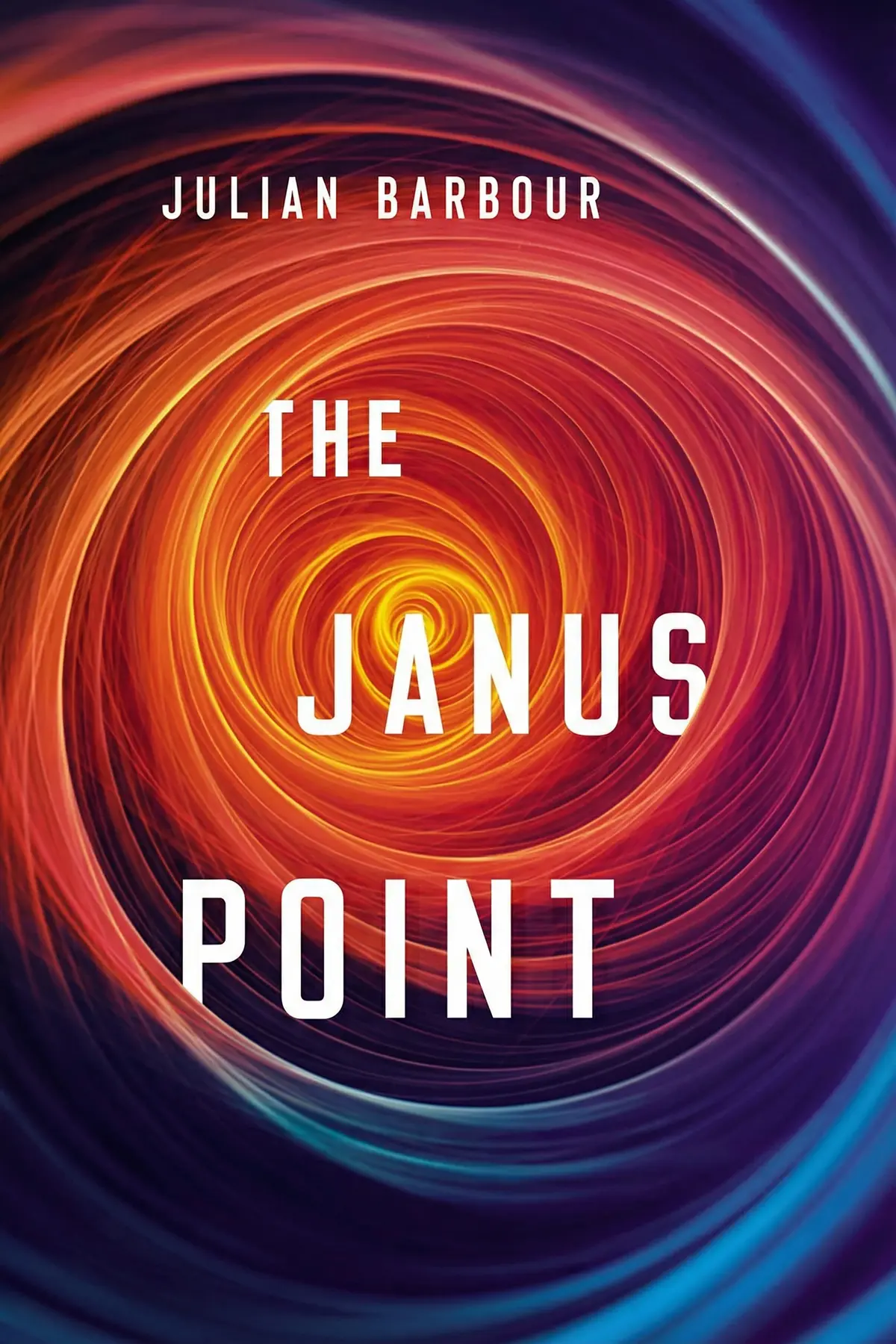
Table of Content
1. Introduction
1 min 05 sec
If you picture the universe as a fire slowly burning out, with everything drifting toward cold and disorder, you share the view most physicists have held for more than a century. In The Janus Point, physicist Julian Barbour argues that this picture may be backward. He suggests the big bang was a special point in the middle of time, where time runs off in two opposite directions.
On his account, the cosmos keeps piling up structure, from stars that forge new elements to the cities people build. That one claim, if it holds, changes how we explain why time seems to flow only forward and what the far future holds.
The argument moves from a diver and a snooker table to a model universe of only three particles. Follow it, and you will be able to explain to a friend why the arrow of time is a genuine puzzle, what Barbour’s two-faced point is, and why his new word, entaxy, might matter more than entropy.
2. See why physics cannot tell past from future
1 min 54 sec
A diver rising feet first out of a pool looks absurd to anyone. Yet the basic rules of physics raise no objection to it, and that gap between experience and law is where the whole argument begins.
3. The big bang as a midpoint in time
1 min 49 sec
Most physicists explain time’s arrow with a perfectly ordered beginning, like a fresh rack of snooker balls. Barbour calls that move arbitrary and offers a stranger picture, named after a Roman god with two faces.
4. The universe may be building order, not running down
2 min 05 sec
The gloomiest forecast in physics says everything ends frozen and motionless. Barbour traces that forecast back to the workshops of the Industrial Revolution, and asks whether a lesson learned from engines fits a universe at all.
5. Three particles that show time splitting in two
1 min 53 sec
Newton solved the motion of two bodies with ease, but three gave him headaches. Barbour turns that stubborn problem, plus a crowded ballroom, into a working model of what happens when time passes through the Janus point.
6. A ruler, clock and compass from three particles
2 min 09 sec
Release gas from a box and it seems to spread into chaos. Look closer and the escaping particles reveal a hidden order, one that leads Barbour to invent a new word and to find measuring tools inside a tiny universe.
7. What happens when the whole universe collides
2 min 06 sec
Shrink the universe to nothing and two great theories of physics give very different answers. One delivers a big bang; the other seems to forbid it. Barbour points to a candidate that might settle the dispute.
8. Conclusion
1 min 13 sec
Barbour’s book asks for a change of picture more than a change of equations. The familiar story starts with a perfect, ordered beginning and ends in a cold, still cosmos. His story has no lucky beginning. The laws carry the universe through a narrowest point, and time leaves it in two directions, each one free to call itself forward. On our side, what accumulates is structure: elements forged in stars, rock laid down in layers, houses turning into cities.
That picture changes what you can notice. When you hear that everything is running down, remember that the idea was born in the study of steam engines and gas trapped in a box, and ask whether the universe really has walls. And when time’s arrow seems obvious, recall the billiard balls: at the deepest level, nothing in the laws prefers one direction, so the arrow itself is what needs explaining.
The theory is still open, and the passage through zero size has not been shown to work. Even so, it offers something the heat death story never did: a universe whose natural tendency is to build. Seen from the Janus point, the diver rising out of the pool is simply someone living on the other side.
About this book
What is this book about?
Most physicists have long believed that disorder rules the cosmos. Entropy rises, everything decays, and the far future holds a frozen universe where nothing moves. Julian Barbour, whose 1968 doctorate dealt with the groundwork of Einstein's general relativity, believes this picture may be mistaken. His starting point is a puzzle: at the level of particles, the laws of nature work just as well backward as forward, so the one-way flow of time needs explaining. The usual answer is a specially ordered beginning. Barbour rejects that as arbitrary and proposes the Janus point instead, a moment the laws themselves lead to, where time arrives as one stream and leaves as two. He builds his case with a model universe of only three particles, a new quantity he calls entaxy, and a close look at what happens when everything collides at a single point. Readers get a clear map of an unconventional theory of time: why the arrow of time is a real problem, why the steam engine shaped our gloomy view of the cosmos, and why the universe may be getting more ordered as it grows.
Book Information
Who it's for
Wondering about time's direction
Curious readers who have wondered why time only seems to run one way.
Uneasy about cosmic doom
Science fans uneasy with the idea that the universe is doomed to a cold, motionless end.
Physics and philosophy students
Students of physics or philosophy who want an unconventional theory of time explained without equations.
About the Author
Julian Barbour
Julian Barbour was born in 1937 and lives near Banbury, England. He earned his PhD at the University of Cologne in 1968 with a thesis on the groundwork of Einstein's general theory of relativity. Since then he has pursued his research without an academic position, supporting himself partly through work as a translator. Since then he has worked outside any academic post, earning his living partly through translation.
Ratings & Reviews
Ratings at a glance
What people think
Listeners describe Julian Barbour’s investigation of theoretical physics as a demanding intellectual trek, and although views are split on whether the specialized language is too dense for the general public, most appreciate his remarkably original reasoning. They also point to the writer's exceptional talent for weaving together high-level cosmology, literature, and philosophy to create a deep outlook on the mechanics of time. Additionally, the narrative is praised for being "quippy and quotable," with one listener mentioning that the book delivers a fulfilling and greatly enhanced grasp of cosmic history. Finally, the primary concept of the "Janus point" is singled out as a captivating premise that defies traditional thoughts on entropy and the Big Bang.
Top reviews
Kung
Theoretical astrophysics doesn't get much more original or daring than Julian Barbour’s latest work. He takes the established laws of physics and re-examines them through a lens of 'shape space' and relational motion. I was stunned by his critique of background independence in standard quantum mechanics. The book is a valiant effort to keep the cutting edge of research readable, even when the concepts are inherently difficult. It’s a deep conceptual dive. You get a real glimpse of research in progress, including papers from as recently as 2018. If you have any interest in how order emerges from chaos, this is a must-read. It’s the kind of book that makes you rethink the very nature of motion.
Show moreTang
After years of reading popular science that just rehashes the same old Einstein and Hawking tropes, this felt like a breath of fresh air. Barbour’s argument that time's arrow is driven by the growth of structure, rather than a slide into disorder, is a total game changer for me. I love how he connects physics to literature and myth. It makes the cold vacuum of space feel a bit more like home. To be fair, it is a challenging text that demands your full attention. But why shouldn't the nature of time be a difficult subject? If you want a Wikipedia-level summary, look elsewhere. If you want a profound new worldview, buy this book.
Show moreTun
What a rewarding and greatly expanded look at the nature of time. Barbour is a master of the subject, and his ability to rethink the Big Bang as a Janus point is nothing short of revolutionary. I found the sections on the N-body problem and Kepler pairs to be particularly illuminating for understanding how structure actually forms in an expanding space. The book is beautifully written and filled with memorable aphorisms. While it is certainly intellectually rigorous, it doesn't repel the curious reader with sheer elitism. Instead, it invites you into a complex celebration of all that is. Order—the stuff of life—might just be the true driver of our clock. Simply magnificent.
Show moreGoy
Finally, a physicist who dares to challenge the depressing 'heat death' narrative of our universe's future. I am always bothered by the implication that disorder is our only destiny, and Barbour offers a radical alternative where order grows without bound. It is a project. Make no mistake about that. It took me a long time to digest the arguments, as the author presupposes a significant amount of background knowledge from the reader. Yet, the rewards are there if you are willing to fall down a few rabbit holes. The writing is surprisingly quippy at times, which lightens the load of the advanced cosmology. It is a demanding but deeply absorbing investment in your own brain's expansion.
Show morePot
Picked this up after hearing about the 'two-headed' time theory, and it has genuinely shifted my perspective on existence. The idea that the Big Bang is a 'Janus point'—a moment of minimal order from which time flows in two opposite directions—is simply brilliant. Barbour manages to bridge the gap between hard physics and philosophical inquiry with remarkable skill. While some of the math-heavy sections on shape spaces were a struggle, the qualitative descriptions of cosmic structure kept me engaged. It isn't a quick read, nor is it a simple one. It is, however, an incredibly informative and rich narrative that challenges the standard second law of thermodynamics in a way that feels long overdue.
Show moreBenjamin
The Janus Point is a dense, black-hole-level heavy read that somehow manages to be both thrilling and completely exhausting. Barbour is clearly a polymath, blending references to Shakespeare and Wagner with advanced thermodynamics. His insights are original. That much is certain. However, the density of the prose is staggering. Unless you are prepared to wrestle with Kepler pairs and invariant variations, you will find very little to hold onto here. It is a celebratory look at the universe, yet it’s like attending an Oxford graduation where the entire ceremony is conducted in Latin. You catch snippets of beauty, but the core remains largely locked away from the uninitiated.
Show moreSarocha
Is time really just the growth of complexity rather than the inevitable slide into entropy? This is the question Barbour poses, and it is a fascinating one to ponder. Personally, I found the concept of 'entaxy'—measured in shape-complexity—to be a brilliant pivot away from the standard 'heat death' narrative of the universe. But the reading experience was an uphill battle. The book is full of novel definitions and jargon coined specifically by the author’s own circle. It’s a mess of great ideas and impenetrable structure. I’m still not sure I understand time any better than I did before, which is a heavy burden for a reader to carry after such effort.
Show moreChai
Beware: unless you hold a PhD in mathematics or theoretical physics, this book is essentially impenetrable. I thought I could power through the difficult sections, but it felt like 60% of the content was written for experts rather than the general public. Boltzmann brains, phase spaces, and Abelian gauge theories fly by with little mercy for the reader. To be fair, I took away some interesting thoughts on relativity and ratios. However, those same conclusions could have been communicated in half the page count. It is far too esoteric for a popular science book. I wanted to learn, but I mostly just felt excluded by the academic jargon.
Show moreKae
I really wanted to love the central thesis about the Big Bang being a point where time flows in two directions. Unfortunately, the execution is overly esoteric and exhausting. I ended up giving up about 70% of the way through because the author spends more time trying to prove his theory via complex 3-body models than actually explaining the vision. It feels like a peer-reviewed paper that was bloated into a 400-page book. Frankly, I couldn't see what this hypothesis offers that classical physics doesn't already cover. While his explanation of entropy was quite good, the rest was like reading a foreign language without a dictionary. DNF for me.
Show moreEleni
This was an exercise in pure frustration, despite my deep interest in the subject matter. One of the primary issues is the writing style, which feels jagged and repetitive. The incessant auto cross-references within the text made it practically unreadable for me, as every other page seemed to point back to a previous chapter or ahead to a future one. It’s simply poorly constructed. While the central topic is fascinating, the delivery is insufferable. I’ve read a great deal of Penrose and other complex physicists, but Barbour fails to make his own ideas accessible or even coherent here. It is a pity because the core concept of time's arrow deserves better than this disorganized treatment.
Show moreQuestions about this book
What is the main idea of The Janus Point by Julian Barbour?
Barbour argues that the big bang was not where time began but a special point in its middle, which he names the Janus point. The laws of nature lead the universe to a moment of zero or smallest size, and time flows away from it in two opposite directions. On each side, he claims, the universe grows in structure and order instead of sliding toward maximum disorder.
Why do the laws of physics not explain the direction of time?
At the level of particles, Barbour explains, every law of nature works the same whether time runs forward or backward. A film of two billiard balls colliding looks believable either way. Yet everyday events, like stirred water settling or a diver splashing into a pool, only happen in one direction. Most physicists credit rising entropy and a specially ordered start for that difference, an answer Barbour finds arbitrary.
What is entaxy in The Janus Point?
Entaxy is a term Barbour coined to describe what happens to the universe after the Janus point. He defines it by counting the microscopic arrangements that fit a given large-scale state. He argues that entaxy decreases across the universe as matter gathers into stars, galaxies and black holes, while ordinary entropy still rises within those smaller subsystems.
Does Barbour think the universe will end in heat death?
No. Heat death predicts a universe so cold that all motion stops. Barbour argues that this forecast comes from thermodynamics developed for steam engines, where gas is confined in a box. The universe has no walls and keeps expanding, so in his view it need not settle into equilibrium. Instead he sees rising complexity, visible in stars forging elements, layered rock and growing cities.
Is the Janus point theory proven?
Not yet, and Barbour says so. Under Newton’s mechanics, his model passes through a total collision that resembles the big bang. Under general relativity, the shape of a shrinking universe bounces chaotically and never reaches the Janus point. A massless scalar field, a kind of matter that may have existed at the big bang, could end the bouncing, but that idea remains untested.
Readers also enjoyed



A Life Decoded: My Genome: My Life
J. Craig Venter

A Planet of Viruses
Carl Zimmer

A Short History of Nearly Everything
Bill Bryson

A Thousand Brains: A New Theory of Intelligence
Jeff Hawkins


AUDIO SUMMARY AVAILABLE
Listen to The Janus Point in 15 minutes
Get the key ideas from The Janus Point by Julian Barbour, plus 5,000+ more nonfiction titles.
- 5,000+ titles
- Listen as much as you want
- 7-day free trial
- Cancel anytime









