

11 min 59 sec
Available in: English
The Inner Clock: Living in Sync with Our Circadian Rhythms
Explains how a tiny master clock in your brain, set by light and largely by your genes, times your sleep, digestion and mood, and how to arrange light, meals and schedules around your own chronotype.
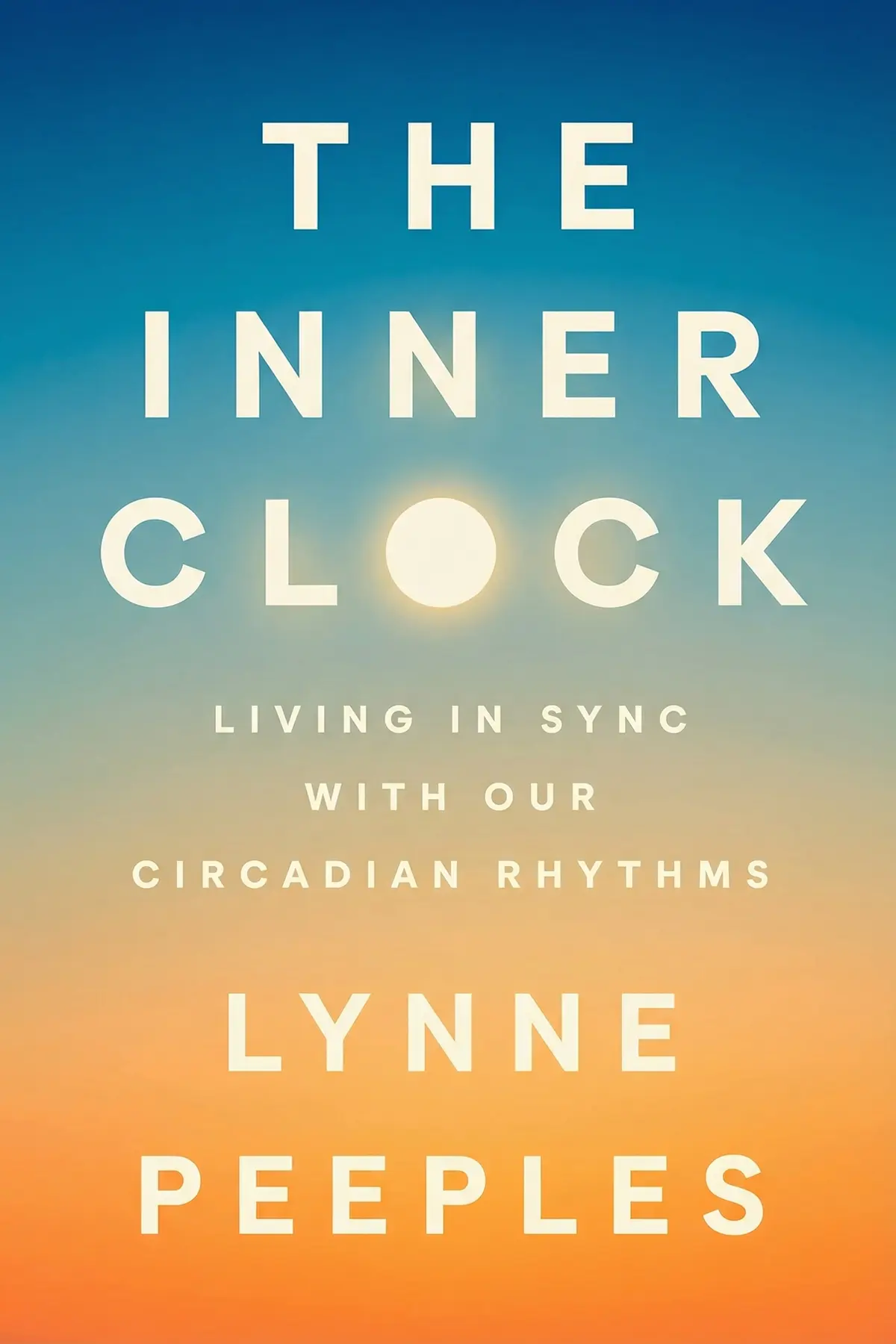
Table of Content
1. Introduction
1 min 00 sec
If you drag yourself out of bed every weekday and lie awake at night wondering what is wrong with you, the cause may be timing rather than discipline. In The Inner Clock, science journalist Lynne Peeples explains that a cluster of brain cells about the size of a grain of rice keeps time for your entire body, and that it takes its main cue from light.
Modern life feeds that clock the wrong signals: bright screens after dark, dim rooms by day and schedules that ignore how people are built. Peeples’s case is that sleep, health and mood improve when you stop fighting this inner timing and start giving it what it needs.
The evidence runs from dolphins that rest half a brain at a time to a tax that made people brick up their windows, and a job that involved firing peas at bedroom glass. By the end, you can read your own chronotype and arrange light, sleep and meals around it.
2. Understand the tiny clock that times your body
1 min 38 sec
An eighteenth-century astronomer kept a houseplant in the dark and watched it behave as if the sun were still rising and setting. What he saw points to a timer inside every one of us.
3. Stop blaming willpower for being a night owl
1 min 36 sec
Some people spring out of bed at dawn while others come alive near midnight, and the difference may trace back to an encounter in prehistoric Europe. Effort alone, Peeples argues, will not change which kind you are.
4. Dim evening screens to help your body sleep
1 min 46 sec
For centuries, governments charged people for every window they owned, and homes went dark as a result. Today the trouble runs the other way, and it may be sitting on your bedside table.
5. Protect your health from night shifts and social jet lag
1 min 43 sec
Night workers carry health risks that go well beyond feeling tired, but a regular nine-to-five does not make you safe. A habit many people enjoy every weekend can put the body out of step too.
6. Find your natural sleep times on your next vacation
1 min 36 sec
Long before phones buzzed us awake, factory towns paid people to rattle bedroom windows at dawn. Their story leads to a simple experiment that reveals the schedule your body would choose on its own.
7. Build a day that keeps your clock on time
1 min 30 sec
Your chronotype shapes far more than bedtime. The hour you eat, the moment you dim the lamps and the time you tackle hard work all send signals, and the right ones can steady your whole day.
8. Conclusion
1 min 10 sec
The Inner Clock asks you to see tired mornings and restless nights in a new light. They are less a failure of character than a timing clash between an ancient clock and a modern world. The same kind of clock that kept a mimosa opening its leaves in the dark sits in your brain, and it evolved over millions of years to trust the sun. Window taxes once kept daylight out of homes. Now LED bulbs and phones keep the night from arriving.
Peeples’s argument comes down to respect for your own biology. Your chronotype is mostly inherited, so treat it as a fact to plan around rather than a flaw to fix. Use light on purpose: bright daylight early, an artificial sunset in the evening and a dark room for sleep. Keep bedtime, wake time and meals steady across the week, so Monday stops feeling like a long-haul flight. And on your next stretch of free days, turn the alarms off and let your body show you its real schedule.
The knocker-up and his dried peas are long gone. The goal is to need no replacement for him at all.
About this book
What is this book about?
Many people blame themselves for groggy mornings, restless nights and the dull feeling of never quite being in step. Science journalist Lynne Peeples argues that the cause is often timing. A small cluster of cells deep in the brain acts as a master clock for the whole body, guided mainly by light. Artificial light, late screens and fixed schedules keep sending it the wrong signals. Peeples moves from coral reefs and dolphins that sleep with half a brain to the window taxes of seventeenth-century England and the knockers-up who fired dried peas at workers' windows. Along the way she makes the case that your chronotype, your lean toward mornings or nights, is mostly inherited, and that working against it carries real costs, from colds and low mood to the higher health risks linked with shift work. Readers get a practical way to find their own natural sleep times, a plan for using daylight and evening darkness on purpose, and simple rules on regular sleep and meal timing that help the body's clock stay on track.
Book Information
Who it's for
Guilty about mornings
Night owls tired of feeling guilty about mornings and wanting a schedule that fits their biology.
Shift workers and late-nighters
Shift workers and frequent late-nighters worried about what irregular hours do to their health.
Sleeping badly
Anyone who sleeps badly and suspects screens, lighting or erratic weekends are part of the problem.
About the Author
Lynne Peeples
Lynne Peeples is a science journalist and a former staff reporter at The Huffington Post. Her articles have appeared in The Guardian, Scientific American and Nature. She was a Knight Science Journalism fellow at the Massachusetts Institute of Technology, and she holds graduate degrees in biostatistics from Harvard's School of Public Health and in science journalism from New York University.
Ratings & Reviews
Ratings at a glance
What people think
Listeners find the book consistently educational and engaging, with one review characterizing it as an enchanting journey into every aspect of biological clocks. Furthermore, the title earns praise for its focus on wellness, as one listener points out how curating spaces that support circadian health can enhance vitality and life expectancy. Listeners also value its flow, calling the book a masterful lesson in grasping the science of internal timing.
Top reviews
Thida
Ever wonder why you're a night owl in a world designed for early birds? This book explains exactly why your biology is working against your 9-to-5 schedule without making it feel like a personal failure. Lynne Peeples writes like she’s sitting right there in your living room, explaining complex biological clocks in a way that just clicks. I particularly loved the section on chronotypes—turns out I’m a 'dolphin,' which explains so much about my fragmented sleep patterns. The history of how we moved away from natural light cycles, from window taxes to the invention of LED bulbs, was absolutely fascinating. It’s less of a dry textbook and more of a master class in how our bodies actually function. I’ve already started making small changes to my morning light exposure, and I’m genuinely feeling more alert. This is easily one of the most informative books on health and longevity I’ve read in years.
Show moreSayan
As someone who struggles with shift work, this book felt like a lifeline. We often treat sleep like a luxury, but Peeples proves that our internal clock is actually the foundation of our entire physical and mental health. The way she breaks down the risks of heart disease and diabetes for those of us living out of sync with the sun was sobering but necessary. It’s a beautifully written exploration of how we can reclaim our health by just listening to our bodies. I loved the tips on using warm, dim lighting in the evening to mimic a natural sunset. The book isn't just informative; it's entertaining and paced like a good novel. I feel much more equipped to handle my irregular schedule now that I understand the biological 'why' behind my fatigue. It’s an essential read for anyone living in the modern, 24/7 world.
Show moreAkosua
Wow, I had no idea that 17th-century window taxes still had a spiritual successor in our modern LED bulbs! This book is such a delightful adventure through every facet of circadian rhythms. It manages to be both a scientific study and a call to action for better health. I loved learning about the 'mini-clocks' in our hearts and livers—it really changes how you think about eating late at night. The pacing is excellent, and Peeples does a fantastic job of making you care about the microscopic cells driving your behavior. It’s not just about sleep; it’s about how we relate to time itself. I feel much more in tune with my 'inner clock' now and have already seen improvements in my mood just by getting more morning sunlight. Truly a master class in understanding the rhythms of life.
Show moreSoontorn
The chapter on blue light was a total eye-opener for me, though not for the reasons I anticipated. Peeples does a great job illustrating how our modern environments are basically an assault on our internal rhythms. I found the section on melatonin timing especially helpful; I’d been taking it all wrong for months! While the book leans heavily into the 'science of why' rather than a 'list of how-tos,' the information provided is still incredibly practical for anyone looking to optimize their health. Truth be told, I did find some of the experimental sections a bit long-winded, and the pacing slowed down significantly toward the middle. However, the overall message about investing in circadian-friendly environments is powerful. It’s a delightful adventure through the history and future of chronobiology. Even if you aren't a science nerd, the way she connects these rhythms to everything from metabolic processes to mood disorders is compelling.
Show moreKamol
Lynne Peeples has a real knack for taking dense biology and turning it into a narrative journey. I was surprised by how much I enjoyed the historical context, especially the bits about 'knocker-ups' during the Industrial Revolution. It’s a fascinating look at how human-made schedules have slowly detached us from the natural world. My only gripe is that the marketing makes it look like a self-help book, when it’s really a deep dive into circadian science. If you go in with the right expectations, you’ll find a wealth of knowledge here. Personally, I found the research on how Neanderthal DNA affects our current sleep patterns to be the highlight of the whole thing. It’s a master class in science journalism that manages to be both educational and deeply human. Definitely worth a read for the curious mind.
Show moreCarter
Finally got around to reading this after hearing so much about circadian-friendly habits and how they improve longevity. I’m glad I did! The book is a fascinating exploration of the 'master clock' in the suprachiasmatic nucleus. I never realized how much our meal times and light exposure dictate our metabolic health. The writing style is very conversational, which helps when you're dealing with terms like 'suprachiasmatic.' I will say, there were moments where the author went on tangents that didn't feel necessary, especially the bits about her own vacations. But the core information about how to align your daily schedule with your natural energy peaks is gold. It’s a great mix of storytelling and data that kept me engaged until the very end. I’ve already recommended it to a few friends who are perpetual night owls.
Show moreNadia
Look, if you want a step-by-step 'how to sleep' guide, keep looking. But if you want to understand the profound connection between the Earth's rotation and your own well-being, this is the book for you. It’s science-heavy but written with the flair of a seasoned journalist, making it an easy and interesting read. I was particularly struck by the discussion on how high-rise buildings and artificial light contribute to our 'social jet lag.' While some of the COVID references might not age well, the core message about respecting our biological chronotypes is timeless. It’s a great reminder that we aren't just machines; we are biological beings that evolved under the sun. I walked away with a few great tips and a lot of food for thought. A solid 4-star read for anyone interested in the intersection of health and nature.
Show moreSuvannee
Picked this up because my sleep schedule is a dumpster fire and I needed a fix. I’ll admit, the science is cool—the idea that our organs have their own mini-clocks is wild—but the book felt more like a collection of magazine articles than a cohesive guide. Frankly, I was expecting a lot more actionable advice on resetting my habits. I learned a lot about why I feel tired, but I’m still not quite sure what to do about it besides 'get more sun.' The author’s personal stories were okay, but sometimes they felt like filler to hit a word count. Also, the dolphin/lion/wolf chronotype stuff is interesting, but it felt a bit like a personality quiz you’d find online rather than deep science. It’s an easy enough read, but if you’re looking for a strict self-help book for better sleep hygiene, this might leave you wanting more.
Show moreAndrew
Not what I expected at all. I was hoping for a roadmap to fix my insomnia, but instead, I got a memoir about the author sitting in the dark for weeks on end. In my experience, the personal anecdotes took up way too much space compared to the actual science. It felt like she wanted to write a biography but got stuck with a science contract. Plus, the constant mentions of the COVID pandemic already feel super dated and weirdly specific. There are some interesting facts about the suprachiasmatic nucleus, but they get buried under speculative research that doesn't always have a clear point. If you want a rigorous look at sleep hygiene, there are probably better resources out there that don't spend ten pages on blue light filters while ignoring the total volume of light exposure. It was just a bit of a slog for me.
Show moreNiramai
To be fair, the science is solid, but the execution felt scattered and a bit sensationalist at times. The author spends way too much time on circumstantial research without giving enough weight to established facts. For example, the focus on blue light filters felt disproportionate compared to the importance of the absolute quantity of light we receive. I also struggled with the tone; it felt like it couldn't decide if it wanted to be a scientific paper or a personal memoir. The anecdotes about living in darkness felt more like a stunt than a helpful experiment. While I appreciate the effort to make science accessible, it often came at the cost of clarity and practical application. I finished the book feeling like I knew a lot of trivia but didn't have a better grasp on my own sleep hygiene. Disappointing overall.
Show moreQuestions about this book
What is the main idea of The Inner Clock by Lynne Peeples?
Peeples argues that every living thing, people included, runs on circadian rhythms. In humans, a master clock in a brain region called the suprachiasmatic nucleus coordinates smaller clocks in organs such as the liver, heart and muscles. Light is its strongest signal. Artificial light and irregular schedules throw it off, which she links to poor sleep and health problems, so she urges readers to align their days with their natural rhythms.
Can you change your chronotype?
According to Peeples, not fundamentally. Your genes largely decide whether you are a morning lark or a late-night person, and that trait stays with you for life, so willpower will not make you a different type. Light and dark cycles can shift your clock somewhat, as camping trips show, and a consistent sleep schedule strengthens your rhythm. The better strategy is to plan important tasks around your natural peaks.
How do I find out my chronotype?
Peeples recommends starting by paying attention to the times you feel naturally sharpest and the times sleepiness begins to set in. To be sure, use your next vacation or long break as an experiment: switch off all alarms, sleep and wake when your body wants, and record the times. After a few days a pattern emerges, and that pattern reflects your natural sleep-wake cycle.
What does The Inner Clock say about light and sleep?
Light is the main cue for the body clock. Blue light from phones, televisions and LED bulbs can make the brain think it is still daytime. Peeples recommends plenty of natural daylight in the morning and an artificial sunset at night: dimmer, amber-colored lighting, blue-light filters or no screens for an hour before bed, and a dark bedroom, which helps the body produce melatonin.
Is shift work bad for your health according to the book?
Peeples points to studies tying shift work to a greater chance of heart disease, diabetes and some cancers, since metabolism relies on steady daily rhythms. She advises shift workers to keep schedules as consistent as possible, even on days off, to darken the bedroom with blackout curtains, to use white noise if needed, to get daylight when not working and to consider light therapy.
Featured in
Readers also enjoyed


A Life Decoded: My Genome: My Life
J. Craig Venter


A Planet of Viruses
Carl Zimmer

A Short History of Nearly Everything
Bill Bryson

A Thousand Brains: A New Theory of Intelligence
Jeff Hawkins



AUDIO SUMMARY AVAILABLE
Listen to The Inner Clock in 15 minutes
Get the key ideas from The Inner Clock by Lynne Peeples, plus 5,000+ more nonfiction titles.
- 5,000+ titles
- Listen as much as you want
- 7-day free trial
- Cancel anytime









