

12 min 06 sec
Available in: English
The Idea-Driven Organization: Unlocking the Power of Bottom-Up Ideas
Shows leaders how to draw a steady stream of improvement ideas from front-line staff by changing how managers behave, cutting red tape, protecting time for ideas and running a simple, visible idea system.
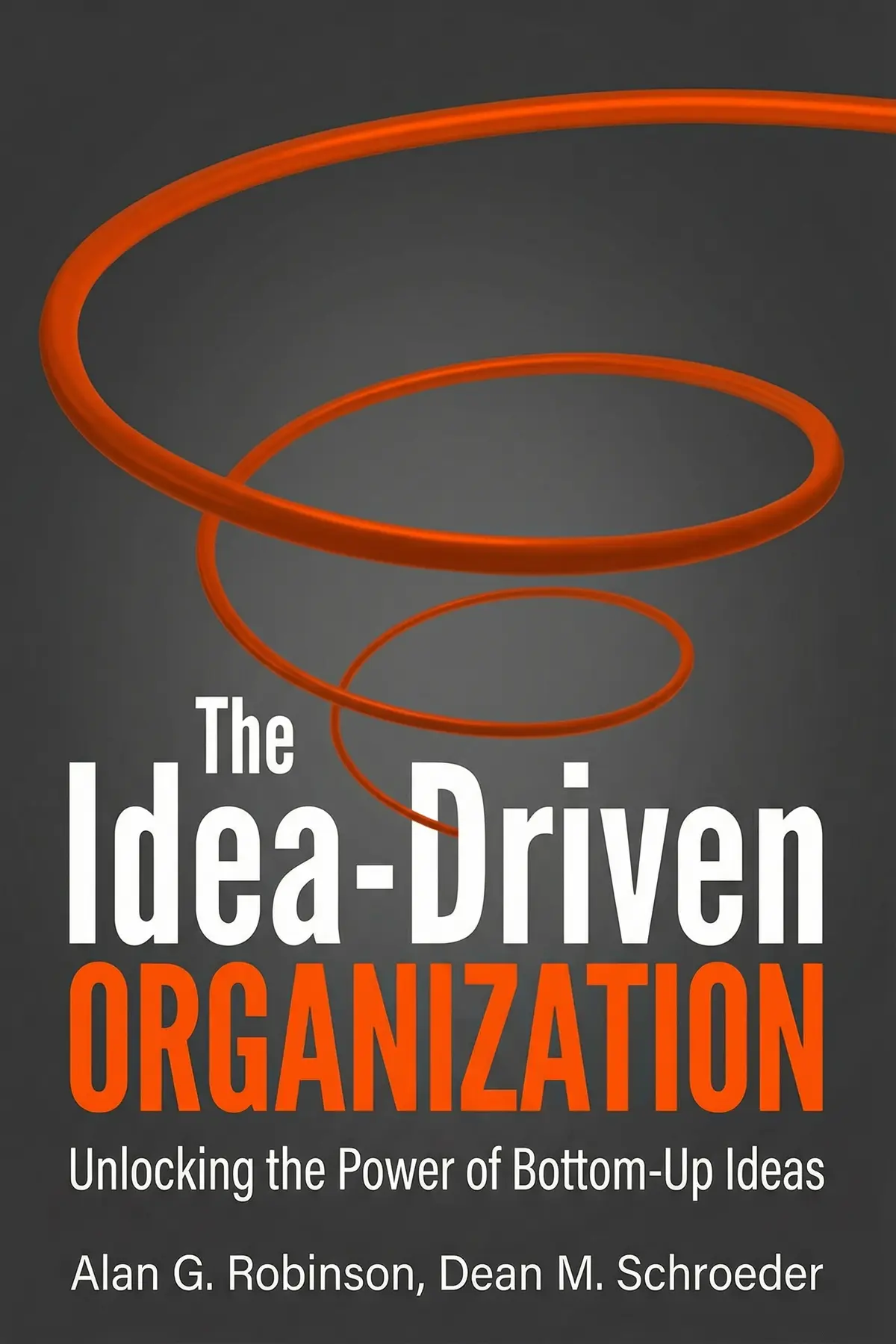
Table of Content
1. Introduction
1 min 03 sec
If you run a team, the people holding your best ideas are probably not in your strategy meetings. They are at the front desk, on the assembly line and behind the bar, and at one Stockholm hotel a dirty bar chore turned into tubes through the floor and higher sales. In The Idea-Driven Organization, management professors Alan G. Robinson and Dean M. Schroeder argue that the real engine of lasting profit is a steady stream of ideas, and that most of them come from the bottom of the organization, not the top.
Their claim is that great ideas are easy to want and hard to produce, so leaders have to build the conditions for them on purpose. That means humble managers who listen, less red tape, time set aside for thinking, rewards that count, a simple system to run it all and ways to find ideas once the obvious ones are used up. The examples run from a Swedish truck factory that stops its line every week to a car plant in Indiana rethinking its plastic.
2. Find your best ideas where customers actually are
1 min 40 sec
Market research and focus groups can be sophisticated, yet they miss something the newest employee sees every shift. A Stockholm hotel found out what happens when you ask the people who face guests all day.
3. Hire managers who stay humble and listen
1 min 39 sec
In the authors’ view, suits, private offices and bigger paychecks feed that sense of superiority. Stanford researchers found they shape how bosses see the people below them, and that view can shut off the very ideas a company needs most.
4. Strip out red tape so ideas can move
1 min 45 sec
A broken computer that needs a memo and a trip through accounting is a small annoyance. Multiplied across a company, it explains why some firms take a year to do what one retailer does in two weeks.
5. Give people time to think, then reward ideas
1 min 34 sec
A Swedish truck maker halts its assembly line every week and deliberately hires more people than each team needs. It sounds wasteful, until you see what has happened to its productivity year after year.
6. Pick the idea system that fits your team
1 min 38 sec
Becoming an idea-driven company sounds like a vast transformation project. The authors describe three far simpler starting points, one of which runs on nothing more than a wall and a bit of healthy embarrassment.
7. Keep ideas coming after the easy fixes run out
1 min 39 sec
Every new idea system starts with a rush of suggestions, then slows. A Subaru plant in Indiana showed that one short lesson on a single distinction can restart the flow with hundreds of fresh proposals.
8. Conclusion
1 min 08 sec
What the book adds up to is a shift in where a leader looks. Profit, in Robinson and Schroeder’s account, follows from ideas, and ideas follow from people who are close to the work and are given a reason and a way to speak. The bottle tubes in Stockholm did not come out of a strategy session. They came from staff who were asked, by managers willing to hear the answer, in a place where acting on it was simple.
That gives the leader a different job: building the conditions. Humility, short decision paths, plain goals, protected time, rewards that count and a visible system all serve one purpose, which is keeping ideas moving from the people who see problems to the people who can approve a fix.
For the week ahead, ask your team which chore keeps them from customers, and spend an hour where that work actually happens. Put ideas on the agenda of a meeting you already hold, somewhere everyone can see them. When the easy wins run out, teach one new concept and watch what it sets off.
The best idea in a company is often standing behind the bar, waiting for someone to ask.
About this book
What is this book about?
Many leaders assume the view from the top is the clearest one. Alan G. Robinson and Dean M. Schroeder argue the opposite. The people who face customers, machines and daily problems know where the organization falls short, and a company that turns their knowledge into action will outperform rivals that rely on executives and market research alone. The authors explain why most companies fail to hear these ideas, starting with managers who come to see themselves as superior to the people they lead. They then describe what has to change: managers chosen for humility and listening, decisions pushed down and simplified, goals stated in plain words, time set aside for improvement and ideas counted in reviews and promotions. Readers also get three practical ways to run the process, from the Japanese kaizen teian cycle to weekly idea meetings and visible idea boards, plus two techniques for finding fresh ideas once the obvious fixes are done. The examples include a Stockholm hotel bar, Toyota, Zara, the truck maker Scania and a Subaru car plant in Indiana.
Book Information
Who it's for
Team leads and supervisors
Team leads and supervisors who sense their staff see problems they never hear about.
Founders and operators
Founders and operators who want steady improvement without hiring more consultants.
Designing reviews and rewards
HR and training managers designing reviews, rewards and routines that make ideas part of the job.
About the Author
Alan G. Robinson
Alan G. Robinson teaches at the Isenberg School of Management at the University of Massachusetts and works on creativity, ideas, innovation and lean methods. Dean M. Schroeder has been the Herbert and Agnes Schulz Professor of Management at Valparaiso University, has published more than eighty articles, received two Shingo Prizes and led turnaround efforts himself. Together they also wrote Ideas Are Free, and this book was named the year's best on Management and Leadership by USA Book News.
Ratings & Reviews
Ratings at a glance

What people think
Listeners find this work highly readable and articulate, valuing its deep knowledge and insights rooted in real-world practice. The text earns praise for being relevant to businesses, with one listener emphasizing how essential it is for lean-focused organizations. Furthermore, listeners enjoy the high-quality storytelling, as one review points out the engaging narratives, and they value the underlying philosophy, with one mentioning its emphasis on systems for employee-driven ideas.
Top reviews
Titiluck
Finally got around to finishing this, and the core message is truly transformative. Robinson and Schroeder argue that 80 percent of an organization’s improvement potential sits right with the frontline workers, which is a staggering statistic if you think about it. The Graniterock story about "short-pay" was particularly eye-opening for me. It shows how radical transparency forces a company to actually address the root causes of customer dissatisfaction rather than just hiding behind numbers. To be fair, some sections feel a bit like a lecture, but the practical wisdom outweighs any dry spells. If you're tired of top-down management strategies that never seem to move the needle, this is your roadmap. It’s about shifting the culture so that every employee feels like an innovator rather than just a hired hand.
Show moreAria
As someone who works in a Lean environment, I found this to be an essential addition to my library. Robinson and Schroeder don't just talk about innovation; they break down the nuts and bolts of how to formalize the suggestion process. The firefighting equipment company example was a masterclass in extending idea gathering to include customer feedback. I love that they warn against using cash rewards for ideas, as it tends to kill intrinsic motivation. Instead, they advocate for a system where 4-7% of an employee's time is dedicated to testing and refining. It’s a bold shift from the "Frederick Taylor" era of management. Every manager who thinks they have all the answers needs to read this immediately.
Show morePang
Wow. This is one of the few business books I’ve read recently that actually feels practical instead of just theoretical. Robinson and Schroeder hit a home run by focusing on the "Gemba" and the power of small, continuous improvements. The comparison between top-down Six Sigma and frontline ideas was a real eye-opener for me. It’s clear that 80% of growth potential is being wasted in most companies. I also appreciated the discussion on why rewards can actually hurt the process. It’s about respect, not just a check in the mail. If you want your organization to move from good to great, stop looking for one big idea and start looking for a thousand small ones. Truly inspiring.
Show moreNina
Robinson and Schroeder have crafted a compelling argument for the democratization of innovation. By citing Gabriel D. Tarde and Friedrich Hayek, they provide a strong intellectual foundation that most business books lack. The truth is, most organizations are still stuck in a Taylorist mindset where employees are just "hired hands." This book shatters that illusion. I was particularly impressed by the firefighting equipment case study. It shows how a formalized process for managing suggestions can lead to breakthroughs that management would never have conceived on their own. It’s a worthwhile read for any leader who wants to tap into the hidden potential of their workforce. The 4-7% time commitment for testing ideas is a total game-changer for productivity.
Show moreSomchai
Ever wonder why your corporate initiatives constantly stall out? This book offers a compelling answer by comparing management-driven Six Sigma projects with frontline-driven improvements at Coca-Cola. The authors show that the people doing the actual work—the Gemba—often have the most elegant solutions if we just bother to ask. Personally, I found the discussion on "Kaizen teian" and the 26-minute weekly production stop at a truck factory to be the highlight. It takes guts to halt a pipeline for ideas, but the 12-15% annual productivity gain speaks for itself. Truth is, traditional management often lacks the humility to let go of control. This isn't just a philosophy; it’s a practical manual for anyone leading a team that feels stuck.
Show moreAmy
This book provides a much-needed reality check for CEOs who are disconnected from their frontline staff. Look, the concept of a bar installing bottle chutes because they actually listened to the staff sounds like common sense, yet it’s so rare in practice. The authors do a great job of explaining why we shouldn't blindly trust "the numbers" without looking at the processes that create them. I particularly enjoyed the distinction between Management by Results and Management by Means. My only real gripe is that it feels a little dated regarding technology; they mention spreadsheets but ignore modern innovation software. Still, the core principles are timeless and highly relevant for any organization trying to scale efficiently.
Show moreMo
After hearing about this from a colleague, I decided to give it a go, and I’m glad I did. The authors make a brilliant case for why the "brains at the top" model is dead. They emphasize that the real knowledge of "time and place" belongs to the people on the floor. I was fascinated by the idea of "short-pay" and how it dropped from 2.3% to 0.2% of sales at Graniterock over time. It’s a gutsy policy that forces a company to actually fix the problems identified by customers rather than just apologizing. The book is well-written and easy to read, making complex management theories feel accessible to the average reader. It definitely changed how I view employee contributions.
Show morePrasarn
The truth is, most business books could be half as long, and this one is no exception. While the premise is solid—empowering employees to contribute ideas—it leans heavily on the "one best way" mentality critique that we've heard before. I appreciated the nod to Hayek and the specific circumstances of time and place, which gave it some much-needed intellectual weight. However, it gets a bit redundant in the middle chapters. Not gonna lie, I almost put it down around page 150. That said, the case studies are decent, especially the ones showing why traditional suggestion boxes fail miserably. It’s a 3-star read for me because it’s useful but occasionally dull and lacks a deep dive into modern technology.
Show moreBunyarit
Picked this up because I’ve been struggling to get my team to speak up more during meetings. The book has some gems, like the story about the bar bottle chutes and the truck factory's weekly idea sessions. It really drives home the point that managers need to stop acting like they have all the brains. However, I agree with other reviewers that it can be a bit redundant. Gotta say, the lack of tech recommendations makes it feel a bit like it’s stuck in the 90s. Still, if you can get past the somewhat dry tone, there is a lot of tactical advice here that actually works in the real world. It's a solid, middle-of-the-road business text.
Show moreKanokwan
I wanted to love this, but it felt like a struggle to finish. While the authors cite some impressive research, the writing style is quite dry and academic. To be fair, the section where they rank USA healthcare below Costa Rica felt a bit out of place and statistically questionable, which made me doubt other data points. It’s a typical business book that repeats its main thesis over and over again without adding much new flavor after the first hundred pages. Frankly, you could probably get the gist of it from a long summary. It’s not that the advice is bad—it’s actually quite good—but the delivery lacks the punch I was expecting. If you really want to start a suggestion box, it’s worth a skim.
Show moreQuestions about this book
What is the main idea of The Idea-Driven Organization?
Robinson and Schroeder argue that long-term success depends on a steady flow of ideas, and that most of the best ones come from front-line employees who deal with customers and daily problems. Leaders rarely hear these ideas because of superior attitudes, bureaucracy and a lack of time. The book shows how to remove those barriers and run a simple system that turns employee suggestions into real improvements.
What is kaizen teian?
Kaizen teian is a Japanese term combining the words for improvement and suggestion. It describes a cycle in which an employee raises a problem, the team finds its root causes, considers and tests solutions, and then makes the best one the standard way of working before starting again. The idea is that small changes made routinely over a long time add up to large gains, with everyone from the CEO down taking part.
How does Scania make time for employee ideas?
Once every week, the Swedish truck maker halts its assembly line for 26 minutes at its main engine factory in Stockholm, giving departments time to hold idea meetings. It also staffs each team with two extra people so there is capacity to carry the ideas out. The authors credit this commitment as a major reason Scania has improved its productivity by 12 to 15 percent each year.
What should you do when employees stop suggesting ideas?
The authors expect the first rush of ideas to slow once obvious problems are fixed. Their answer is better problem finding through two methods. Idea activators are short lessons that spark ideas on one topic, as when Subaru Indiana Automotive taught staff the difference between recycling and downcycling and received hundreds of ideas. Idea mining means taking a good idea and asking who else or what else it could apply to.
Who should read The Idea-Driven Organization?
It suits managers, team leads and business owners who want their organization to improve continuously and suspect their staff know more than they share. It is especially useful for leaders designing meetings, performance reviews and approval processes, because the book links each of these to whether employees bother to offer ideas. Examples range from hotels and fashion retail to truck and car manufacturing.
Readers also enjoyed

A Bigger Prize: How We Can Do Better Than the Competition
Margaret Heffernan





A Year with Peter Drucker: 52 Weeks of Coaching for Leadership Effectiveness
Joseph A. Maciariello



Acting with Power: Why We Are More Powerful Than We Believe
Deborah Gruenfeld
AUDIO SUMMARY AVAILABLE
Listen to The Idea-Driven Organization in 15 minutes
Get the key ideas from The Idea-Driven Organization by Alan G. Robinson, plus 5,000+ more nonfiction titles.
- 5,000+ titles
- Listen as much as you want
- 7-day free trial
- Cancel anytime









