

13 min 40 sec
Available in: English
The Hero Factor: How Great Leaders Transform Organizations and Create Winning Cultures
Shows leaders how to grow profits and earn real loyalty at once, by living their stated values, treating staff as people rather than deal-closers, and sharing the rewards of success at any budget.
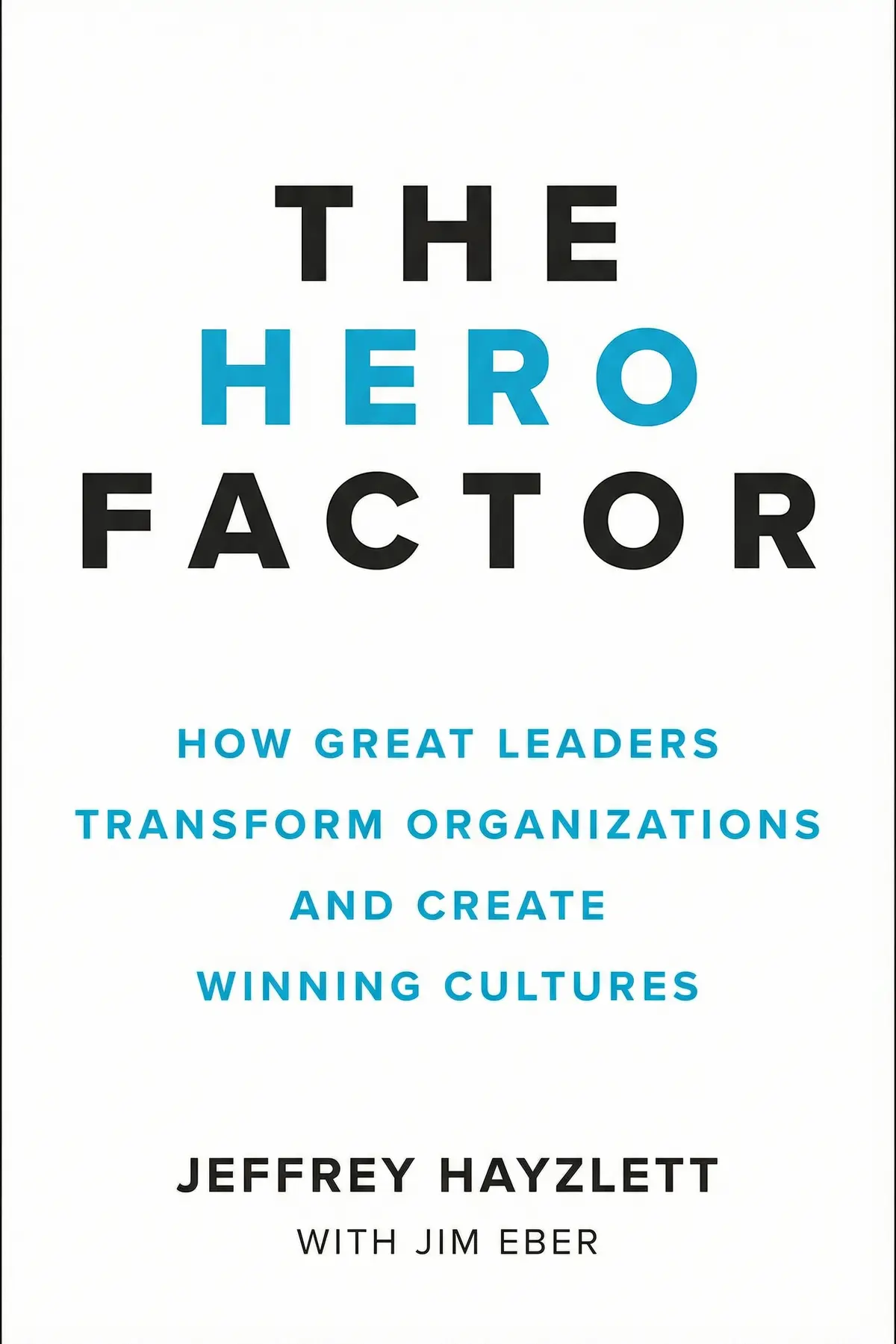
Table of Content
1. Introduction
1 min 09 sec
Many leaders feel squeezed between the numbers they owe the board and the people who actually do the work, and they assume one side has to lose. In The Hero Factor, former Fortune 100 marketing chief Jeffrey Hayzlett, writing with Jim Eber, rejects that trade: asked whether they value profit or people more, heroic leaders answer both. Hayzlett sees a public deeply suspicious of executives, angered by giant bonuses and by the MeToo revelations of power abused. His response is a style of leadership built on commitment and courage, the steady effort to serve employees, communities and the environment while still running a sharp business.
One idea runs through the book. Leaders earn loyalty and lasting results when people can see that the company’s goals and their own point the same way, and that shows up in daily behavior far more than in mission statements. The stories range from a burning plane in the Hudson River to janitors made millionaires, and each one ends in something a manager can try on Monday.
2. Stop trading your people for your profits
1 min 55 sec
Most companies put clients, shareholders and profit figures ahead of the staff doing the work. Hayzlett’s first question to any leader exposes that habit, and the answer he wants surprises most people who hear it.
3. Better decisions come from voices unlike yours
1 min 39 sec
Leaders often fear that admitting a mistake or asking for help will cost them authority. Hayzlett sees that fear as a blind spot, and he names a group of colleagues many teams forget to ask.
4. Make your stated values show up in real work
2 min 06 sec
A 60 percent email open rate and an arrest in a Philadelphia coffee shop share the same root. Both expose a gap that a well-loved brand can spend years building without ever noticing it.
5. Small acts set the standard for everyone
1 min 50 sec
A university nearly quadrupled its students and multiplied its buildings, yet the moment that impressed a visiting executive most was a tiny, wordless act that involved no money at all.
6. Earn lifelong loyalty by putting people before deals
1 min 55 sec
A man survived a plane landing in the Hudson River and went to work the next morning. The single sentence his boss greeted him with cost that company one of its best people.
7. Share the rewards so your people can grow
1 min 57 sec
Two founders chose to share sale proceeds with their staff, one of them promising it from the start, and janitors ended up millionaires. Hayzlett argues the lesson reaches leaders with no fortune to share, if they understand one thing about generosity.
8. Conclusion
1 min 09 sec
Hayzlett’s case comes down to visibility. Employees and the public can tell when a leader’s goals include them, and they can tell just as fast when they don’t, whether through a boss’s question about Michigan or a manager calling the police on two customers waiting for a friend. Heroic leadership, as he describes it, is the habit of making the company’s interests and its people’s interests the same thing, and then proving it in ordinary behavior.
That proof is within reach of any manager, at any budget. Ask yourself the profit-or-people question and refuse to pick only one. Bring someone from a different generation or background into your next big decision. When a teammate returns from a hard week, ask how they are before you ask about the deal. And share what you can, whether a slice of a sale or an hour of your full attention.
None of this needs a crisis or a fortune. A vice president with a candy wrapper in his pocket showed a visiting stranger everything worth knowing about a university. Your team is reading signals like that from you every day.
About this book
What is this book about?
Trust in executives is low. Giant bonuses and the MeToo revelations about abused power have left many workers convinced that leaders take a bigger share every year while staff get by on very little. Jeffrey Hayzlett, a former Fortune 100 marketing chief who later bought the leadership club Hero Partners, believes good leaders can change that story. His answer is heroic leadership: the commitment and courage to keep serving employees, communities and the environment while running a disciplined, profitable business. Asked whether profit or people matters more, Hayzlett's hero says both. With co-writer Jim Eber, he shows what that looks like through cases such as the Starbucks racial-bias crisis, a vice president picking up litter at High Point University, a boss who greeted a Hudson River crash survivor with a question about a deal, and founders who turned secretaries and janitors into millionaires. Readers get a clear picture of how culture shows itself in small daily acts, and practical ways to share rewards whatever the size of the company.
Book Information
Who it's for
Team leads and managers
Team leads and managers who want staff to stay, care and perform without choosing between results and decency.
Founders and business owners
Founders and owners wondering how to share success with employees, even on a tight budget.
Executives worried about values
Executives worried that their company's stated values and daily behavior have drifted apart.
About the Author
Jeffrey Hayzlett
Jeffrey Hayzlett once served as chief marketing officer of a Fortune 100 company and has also worked as a contributing editor for Bloomberg. He is the host of C-Suite with Jeffrey Hayzlett, a television show, and of The HERO Factor Podcast, which airs on C-Suite Radio. A public speaker and a guest judge for three seasons of Celebrity Apprentice, he has been named to five business halls of fame, the Speaker Hall of Fame among them. His other books include Running the Gauntlet, The Mirror Test and Think Big, Act Bigger. Co-writer Jim Eber has written or developed more than 25 books, many on business and leadership.
Ratings & Reviews
Ratings at a glance
What people think
Listeners find this book to be essential reading for leadership, providing fresh perspectives on value-driven management and building a culture of success. The author's approach is well-regarded, with one listener highlighting the author's vast global network of C-Suite Executives. The work earns praise for its logical structure, and one listener points out how reasonable the concepts are.
Top reviews
Moo
The chapter on values really struck a chord with me because it highlights that leading from the heart isn't just a soft skill; it's a competitive advantage. Jeffrey Hayzlett writes with a level of compassion that you rarely see in high-level business literature, proving that supporting your workforce leads directly to better outcomes. While some might find the 'hero' terminology a bit much, the practical pathway he lays out for achieving joy and success is undeniable. In my experience, most leaders ignore the human element in favor of raw data, but this book balances those scales perfectly. You get a step-by-step guide on how to treat people as more than just transactions. It is a refreshing take on the C-suite mindset that actually feels achievable for a mid-level manager too.
Show moreNoppadol
Finally got around to reading Hayzlett’s latest, and it is a masterclass in values-based leadership. He doesn't just talk the talk; he provides a concrete roadmap for creating a culture of success that resonates from the top down. I loved the emphasis on how a leader’s intensity can transform an entire community, not just a single company. The insights gathered from his C-Suite network provide a level of credibility that other business books often lack. It’s rare to find a book that addresses both the financial health of a company and the emotional well-being of its staff with such equal weight. Every entrepreneur needs to read this to understand that being a hero isn’t about ego—it’s about service.
Show moreAisha
As a long-time manager, I’ve seen countless 'revolutionary' systems, but the framework of 'Hero Intensity' vs. 'Operational Excellence' provided here is genuinely useful. The truth is, you can’t have one without the other if you want a sustainable culture that respects the bottom line and the human being. Hayzlett draws from his incredible global network to provide examples that feel grounded in reality, even if the tone is occasionally a bit loud. I found the sections on maintaining values during growth periods particularly insightful for my current role. It isn’t perfect—some of the formulas feel a bit forced—but the core message remains powerful. If you’re looking to boost profits without selling your soul, this is a reasonable place to start.
Show moreRiley
This book provides a solid roadmap for anyone trying to shift their organizational culture toward something more meaningful. Jeffrey Hayzlett has the experience to back up his claims, and his compassion for the worker is evident on every page. I particularly enjoyed the breakdown of how to balance business goals with the personal development of your team members. Some parts are a bit heavy on the 'America' rhetoric, which might not suit everyone, but the underlying advice is sound regardless of geography. It’s a great book about how to lead with purpose. I’m definitely going to implement a few of these strategies in our next quarterly planning session to see how they land.
Show moreNarongrit
Not exactly what I expected given the hype surrounding the author’s C-suite connections. While the book makes some good points regarding the intersection of values and business goals, it feels heavily geared toward a domestic audience. For an international reader, the repetitive focus on a specific American business style can be a bit alienating and limits the book's global applicability. Frankly, the title feels a little cheesy, and I struggled with some of the more 'heroic' metaphors that didn't always land. That said, someone new to leadership or personal development will definitely find nuggets of wisdom here. It’s a decent read for a Sunday afternoon, but don’t expect a ground-breaking paradigm shift if you’ve already read the classics.
Show moreAim
Picked this up during a commute because I wanted to understand how to better value relationships over simple transactions in my startup. The book delivers on the 'why,' but sometimes skips over the 'how' in favor of broad, sweeping statements about leadership virtues. I appreciate the sentiment that people and profits are of equal importance, as that is a philosophy I try to live by daily. However, the writing style can be a bit repetitive, and I found myself skimming through certain chapters that seemed to repeat the same three points. To be fair, the case studies are interesting enough to keep you engaged. It’s a solid three-star effort that serves as a good reminder for seasoned pros.
Show morePing
Ever wonder why some companies thrive while others just exist? This book suggests it’s the 'Hero Factor,' which is essentially the commitment to your workforce and your values. While I agree with the core premise, the book could have been about fifty pages shorter without losing any of its impact. The author’s voice is strong—very loud and very confident—which fits his brand but might be off-putting if you prefer a more academic or analytical approach. I did appreciate the reminders about the importance of being a 'hero' to your community. It’s a reasonable concept for a business book, even if it doesn't reinvent the wheel. It's an okay resource for a quick motivation boost.
Show moreClaire
To be fair, the 'hero intensity' concept is interesting, even if the prose gets a bit flowery at times. I struggled with the cheesiness of the title initially, but the content inside is more practical than the cover suggests. It talks about the right combination of being efficient and being human, which is a balance most of us struggle with. I found the sections on how to avoid compromising health for profit to be the most valuable. However, the book didn't quite provide that 'aha!' moment I was looking for. It feels like a collection of good reminders rather than a totally new philosophy. It's a fine read, just not a life-changing one.
Show morePaiboon
Look, I wanted to love this because I’ve followed the author for a while, but it felt like a lot of fluff. There wasn't much new material here for anyone who has spent more than a year in a leadership position. The 'Hero Factor' concept is fine in theory, but the book relies too heavily on buzzwords and an overly optimistic tone that doesn't always account for harsh market realities. I found the mathematical formulas for 'heroism' to be unnecessary and distracting from the actual advice. To be fair, the examples of operational excellence were okay, but they were buried under layers of cheesy metaphors. It’s probably better suited for someone just starting their first entry-level management job.
Show moreDome
Business books often force you to choose between being a shark or a pushover, and while this tries to find a middle ground, it ends up feeling a bit vague. I was hoping for more granular detail on the C-Suite interactions Hayzlett is famous for. Instead, we get a lot of talk about 'heroism' and 'heart' that lacks the technical depth I prefer in my professional reading. Not gonna lie, I was pretty disappointed by the lack of new insights. The writing is energetic, which I guess is a plus, but energy doesn't always equal substance. If you've read any other modern leadership books, you’ve likely heard these points before.
Show moreQuestions about this book
What is The Hero Factor about?
Jeffrey Hayzlett, writing with Jim Eber, argues that the world needs heroic leaders: people with the commitment and courage to serve employees, communities and the environment while running a profitable business. He shows that heroic leaders value profit and people equally, live their stated values, care in small daily acts, treat staff as relationships and share the rewards of success, using cases from Starbucks, High Point University, Flight 1549, Ascend Communications and Chobani.
What does Hayzlett mean by choosing profit or people?
It is the first question he asks business leaders: which do you value more? His heroic answer is both, equally. Profit comes from operational excellence, meaning growing revenue, superior products, real value for customers and hiring and keeping talent. The people side means aligning the company’s goals with employees’ wish for a decent life and the chance to do their best work.
What happened to Dave Sanderson after the Hudson River landing?
Sanderson survived Flight 1549, was treated for hypothermia and went to his office the next day. His boss’s first question was whether he was going to Michigan the following week, where a deal was pending. US Airways, by contrast, gave him a personal liaison. Sanderson stayed loyal to the airline for life and left his employer, which Hayzlett uses to contrast relationships with transactions.
How can a small business practice heroic leadership?
Hayzlett says generosity is relative. An affluent owner who hands ten employees a $50 bonus every year is hardly a hero, yet a founder who is struggling and offers the odd complimentary coffee, or a private meeting to praise someone’s accomplishments, can be one. Leaders can also listen to people unlike themselves, check that daily work matches the company’s values, and ask about a person before asking about the deal.
Who should read The Hero Factor?
It suits managers, team leads, founders and executives who want loyal, high-performing staff and suspect their company says more about its values than it shows. Readers who believe they must choose between results and decency will find Hayzlett’s argument that the two belong together, backed by concrete stories of leaders who shared fortunes and of brands hurt when staff failed to live up to stated ideals.
Readers also enjoyed




A Year with Peter Drucker: 52 Weeks of Coaching for Leadership Effectiveness
Joseph A. Maciariello





Acting with Power: Why We Are More Powerful Than We Believe
Deborah Gruenfeld
AUDIO SUMMARY AVAILABLE
Listen to The Hero Factor in 15 minutes
Get the key ideas from The Hero Factor by Jeffrey Hayzlett, plus 5,000+ more nonfiction titles.
- 5,000+ titles
- Listen as much as you want
- 7-day free trial
- Cancel anytime









