

14 min 53 sec
Available in: English
The Grid: The Decision-Making Tool for Every Business (Including Yours)
Shows how to judge any business decision by its effect on the whole company, using nine connected elements that decide whether people want your product, whether it earns money and whether the business lasts.
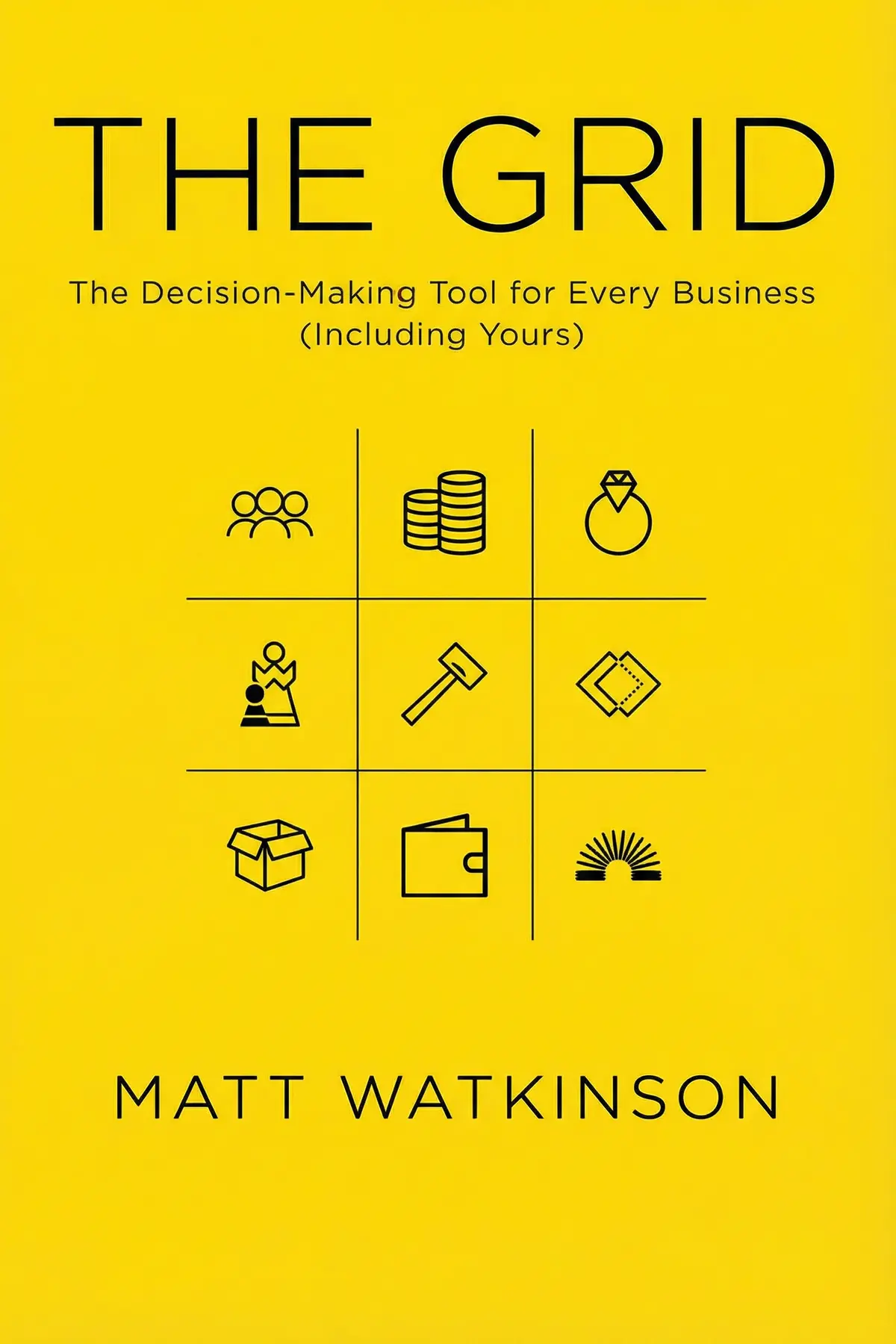
Table of Content
1. Introduction
1 min 01 sec
Most managers fix problems where they show up: a sales dip here, a cost overrun there. In The Grid, consultant Matt Watkinson argues that this is why so many fixes fail, because a company behaves like a body, and the pain often starts far from where it is felt. He offers one map that he says fits any business.
It holds three goals every firm shares, three forces that keep shifting under it, and nine elements that decide whether people want what it sells, whether it earns money and whether it lasts. Every part pushes on every other, so sound decisions come from checking the whole map before acting on any single piece.
The cases include a wheelchair maker priced out of existence, an $18 billion scandal, a candle maker’s pricing math and a supplier that turned into a rival. By the end, your own company or next idea can go through the same nine checks.
2. Examine the whole company before treating one part
1 min 25 sec
A consultant had surgery on both knees and the pain stayed. The expert who finally fixed it looked somewhere else entirely, and her method works on any company with a stubborn problem.
3. Keep demand, profit and staying power in balance
1 min 25 sec
A wheelchair maker found genuine demand and designed exactly what buyers said they wanted. It still went bust. The reason reveals three goals every business shares, and the danger of chasing any one alone.
4. Expect your customers, company and market to shift
1 min 36 sec
In 2008 a major carmaker realized its big engineering bet could not pass American rules. What it chose to do next cost $18 billion and shows the forces every firm has to keep watching.
5. Build demand from beliefs, rivals and identity
1 min 43 sec
An advertising idea from the 1930s changed how one country, and later Japan, thought about proposing marriage. It points to three elements that decide whether anyone wants what you sell.
6. A small price rise beats selling more
1 min 45 sec
Picture a candle maker choosing between ten cents more per candle and 1 percent more candles sold. The gap in profit is startling, and it changes how you should think about growth.
7. Last longer by being known and hard to copy
1 min 48 sec
Two companies started building action cameras in the same year. One made the better product, and that turned out to be the losing bet. Here is what decides whether a business lasts.
8. Spot the hidden cost of a smart-looking saving
1 min 27 sec
A computer maker trusted a supplier to cut its costs, and profits rose. Then that supplier began to pull ahead of it. Watch how one saving can reshape everything around it.
9. Find the real reason your sales stall
1 min 26 sec
A service firm had happy clients and plenty of interested prospects, yet money was running out. The obvious fix would have wasted cash. The real cause sat somewhere nobody had looked.
10. Conclusion
1 min 17 sec
Watkinson’s knees stopped hurting only when someone looked past them to his whole body, and the businesses in his book follow the same rule. The wheelchair maker chose a perfect material and lost its bargaining power. Volkswagen chased a desirable engine and lost its customers’ trust. Dell chased lower costs and created its own rival. Each pushed hard in one place and paid for it somewhere else.
What the Grid adds up to is a habit of looking at everything before treating anything. Customers’ beliefs, rivals’ options, the experience, price, power, costs, awareness, imitation and adaptability all lean on each other, so a decision is only as good as its effect on the whole.
The book points to a few moves worth making this month. Look at your price against the value customers see, remembering that ten cents on a candle beat a 1 percent rise in volume five times over. Before any cost cut, ask what it hands to a supplier. When a number puzzles you, invite an outside pair of eyes and reread your own proposals as a customer would.
A business, like a body, heals when you find where the strain really starts.
About this book
What is this book about?
Most business problems get treated where they hurt: a sales dip gets more marketing, high costs get outsourcing. Matt Watkinson argues that this is why so many fixes backfire. A company works like a body, and the cause of a problem often sits far from the symptom. His answer is the Grid, a single framework he says fits any business. Every firm shares three goals: being desirable, being profitable and lasting. Customers, the organization and the market keep shifting under it. Nine elements, three under each goal, decide the outcome, from customers' wants, rivals' options and the experience on offer to price, bargaining power, costs, awareness, imitation and adaptability. Watkinson brings the framework to life with cases ranging from Volkswagen's emissions scandal and Dell's costly outsourcing to a candle maker's pricing math and a struggling service firm he helped himself. Readers get a way to test a start-up idea, a pricing change or a cost cut against the whole business before committing to it.
Book Information
Who it's for
Founders testing an idea
Founders testing whether a start-up idea can be wanted, profitable and lasting.
Managers weighing a change
Managers and department heads who need to see how a change in their area will hit the rest of the company.
Owners whose fixes backfire
Owners of struggling businesses whose fixes keep creating new problems elsewhere.
About the Author
Matt Watkinson
Matt Watkinson is a consultant, speaker and author who works on customer experience and business strategy. His first book, The Ten Principles Behind Great Customer Experiences, was named Management Book of the Year in 2014 by the Chartered Management Institute. He has led Methodical, a customer experience and strategy consultancy with offices in London and San Francisco, has written for Wired and The Guardian, and has spoken to organizations from Microsoft to the FBI. The Grid, his second book, was published by Random House in 2017.
Ratings & Reviews
Ratings at a glance
What people think
Listeners find this work highly perceptive, with one listener mentioning that it offers a practical foundation for managing business operations. They value its utility for making decisions and regard it as one of the most thorough business guides currently on the market.
Top reviews
Kung
This book provides a masterclass in mental scaffolding for anyone trying to navigate the messy reality of modern business. Watkinson moves beyond the standard siloed thinking by presenting a grid of nine interconnected areas that influence every decision. To be fair, most business books focus on one lever, like marketing or operations, but this framework forces you to see the whole system at once. I found the sections on tradeoffs particularly enlightening because they ground abstract strategy into tangible choice points. While some might find the breadth daunting, the suggested reading list at the end is a goldmine for deeper dives. It’s a complete package for entrepreneurs.
Show moreLillian
Picked this up on a whim after a colleague mentioned it, and I’m genuinely impressed by how grounded it is. Most strategy books are filled with ivory-tower nonsense that doesn't translate to the real world, but this is different. It offers a practical framework that identifies nine crucial areas where things usually go wrong. The chapter on organizational cycles was a standout for me. Look, if you’re tired of "magic bullet" solutions, this is the book you need. It won't give you all the answers, but it will definitely help you ask much better questions about your own business and how it functions as a whole.
Show moreErn
Wow, finally a business book that doesn't treat strategy like a separate department. Watkinson understands that every small change ripples through the entire company. The mental scaffolding provided here is worth the price of admission alone. I especially loved the section on power dynamics—it was spectacular and gave me a fresh perspective on why certain projects stall. Personally, I think every entrepreneur should keep this on their desk. It provides a clear path through complexity. It is easily one of the most complete business books I've encountered in recent years. Highly recommended for those who want a grounded framework.
Show moreCherry
The chapter on organizational cycles alone is worth the price of this book. It's spectacular. While some reviewers complain about a lack of depth in certain areas, they’re missing the point—this is about synthesis, not specialization. Watkinson gives you the map; it’s up to you to explore the terrain. It’s a gem. If you want a grounded, practical framework for approaching business processes, look no further. This is a five-star resource that I will be coming back to again and again as my company grows and the decisions get harder. A must-read for anyone serious about business.
Show moreSomsri
Ever wonder why a great product still fails despite a perfect launch? The Grid argues that it’s because we ignore the hidden interdependencies between different parts of the organization. Think of it like a human body; if one organ fails, the whole system struggles. Frankly, Watkinson's writing style is incredibly accessible and practical, making this a solid decision-making tool for daily use. My only minor gripe is that he skims over complex topics like pricing and cost structures without much depth. However, the overarching hypothesis is spectacular enough to overlook those gaps. It’s a grounded framework that actually works for real-world problems.
Show moreZanya
As someone who has spent years in management, I appreciate how this book echoes the systems thinking of legends like Peter Drucker or Gary Hamel. It’s not necessarily reinventing the wheel, but it organizes the wheel in a way that is actually usable for a modern team. The interconnectivity between departments is the core message here. In my experience, most failures happen in the gaps between teams, and Watkinson bridges those gaps brilliantly. I would have liked more on the concept of immitability, though. It remains a very helpful guide for high-stakes decision-making and should be on every manager's shelf.
Show moreNoah
After hearing Rory Sutherland mention this in a podcast, I had high hopes. The good news is that it mostly delivers on its premise of synthesis. Watkinson recognizes that businesses are interdependent ecosystems, and his 9-area grid is a fantastic way to visualize those links. Gotta say, the tone is professional yet punchy, which keeps the pages turning even during the denser sections. My only criticism is that the pricing section felt a bit thin. You’ll definitely need to use the suggested reading list for that part. Still, as a holistic tool for making tradeoffs, it's incredibly valuable for any leadership team today.
Show moreChanon
Finally got around to reading this and I’m glad I did. It’s a very helpful and practical guide for anyone who needs guidance on handling crucial decisions under pressure. The author’s hypothesis is that synthesis is better than isolation, and he proves it well throughout the text. To be fair, it’s not a perfect book—some of the revenue models could have been fleshed out more effectively—but the overall impact is undeniable. It feels like a joining up of ideas that usually live in different silos. A solid, worthwhile read for the modern professional who values holistic strategy over quick fixes.
Show moreBook
Not what I expected based on the hype surrounding Sutherland’s endorsement. While the premise of a holistic business view is solid, the execution feels like a glorified checklist rather than a deep strategic manual. Truth is, the book reflects on great themes, but it often does exactly what it warns against—getting bogged down in details that don't always add up to a coherent whole. Some chapters, especially on revenue models, felt rushed and lacked the necessary "meat" to be truly transformative. It’s a decent introductory read for a beginner. Experienced leaders might find it a bit too surface-level for their needs.
Show moreBig
I was hoping for more depth, but this felt like a poor attempt at rebranding common sense. It tries to sell a revolutionary way of thinking, yet it ends up being a disjointed collection of themes that never quite join up for me. The "Grid" itself feels more like a forced metaphor than a natural framework for analysis. Not gonna lie, I was looking for a deep dive into organizational power and strategy, yet I received a shallow overview of nine different topics. I'd recommend sticking to the classics if you want real strategic depth. It just didn't live up to the promise for me.
Show moreQuestions about this book
What is the main idea of The Grid by Matt Watkinson?
Watkinson argues that businesses, like human bodies, must be treated as a whole. Every company shares three goals: being desirable, profitable and long-lasting. It faces three shifting forces: customers, its own organization and the market. Nine elements, three per goal, decide its success, and because each affects the others, a fix in one area can cause damage in another. The Grid is his tool for checking a decision against all of them.
What are the nine elements of the Grid?
Under desirability sit customers’ wants and needs, rivalry, and offerings, meaning the experience you give. Under profitability sit price, bargaining power and costs. Under longevity sit the customer base, which depends on awareness, imitability and adaptability. Watkinson illustrates each with a case, such as De Beers reshaping beliefs about diamonds, Taylor Swift pushing Apple to change a policy within 24 hours, and GoPro outlasting its rival Contour through marketing.
Why does The Grid say raising prices beats increasing volume?
Watkinson cites a 2010 McKinsey study in which a 1 percent price rise lifted profits by 11 percent when demand stayed constant. His candle example shows why: with an $8 cost and a $10 price, adding ten cents across a million candles adds $100,000 in profit, while selling 1 percent more adds only $20,000, since extra candles need extra materials. He advises setting prices according to the value customers see in the product.
How can outsourcing hurt a business?
In Watkinson’s account, outsourcing looks good in isolation because it cuts costs and raises profit, yet it can weaken bargaining power and make a company easier to copy. Dell handed production to Asus, a Taiwanese supplier that moved from motherboards to all of Dell’s assembly. Asus then used that knowledge to launch its own computers and began overtaking Dell. One saving had created a strong competitor.
How do you apply The Grid to a struggling business?
Watkinson recommends a fresh pair of eyes and caution about instinct. At one service firm, happy customers rarely returned because the firm only sold one-off projects, so it added a check-up service twice a year. Prospects rarely signed, and more marketing seemed the answer, but the real issue was technical, hard-to-read proposals that hid the benefits. Rewriting them cost less and paid off more.
Readers also enjoyed

A Bigger Prize: How We Can Do Better Than the Competition
Margaret Heffernan





A Year with Peter Drucker: 52 Weeks of Coaching for Leadership Effectiveness
Joseph A. Maciariello



Acting with Power: Why We Are More Powerful Than We Believe
Deborah Gruenfeld
AUDIO SUMMARY AVAILABLE
Listen to The Grid in 15 minutes
Get the key ideas from The Grid by Matt Watkinson, plus 5,000+ more nonfiction titles.
- 5,000+ titles
- Listen as much as you want
- 7-day free trial
- Cancel anytime









