

15 min 07 sec
Available in: English
The Great Leveler: Violence and the History of Inequality from the Stone Age to the Twenty-First Century
Walter Scheidel shows that from the first farms to the twentieth century, the gap between rich and poor shrank mainly through war, revolution, state collapse and plague. He then asks what peaceful tools could do the same.
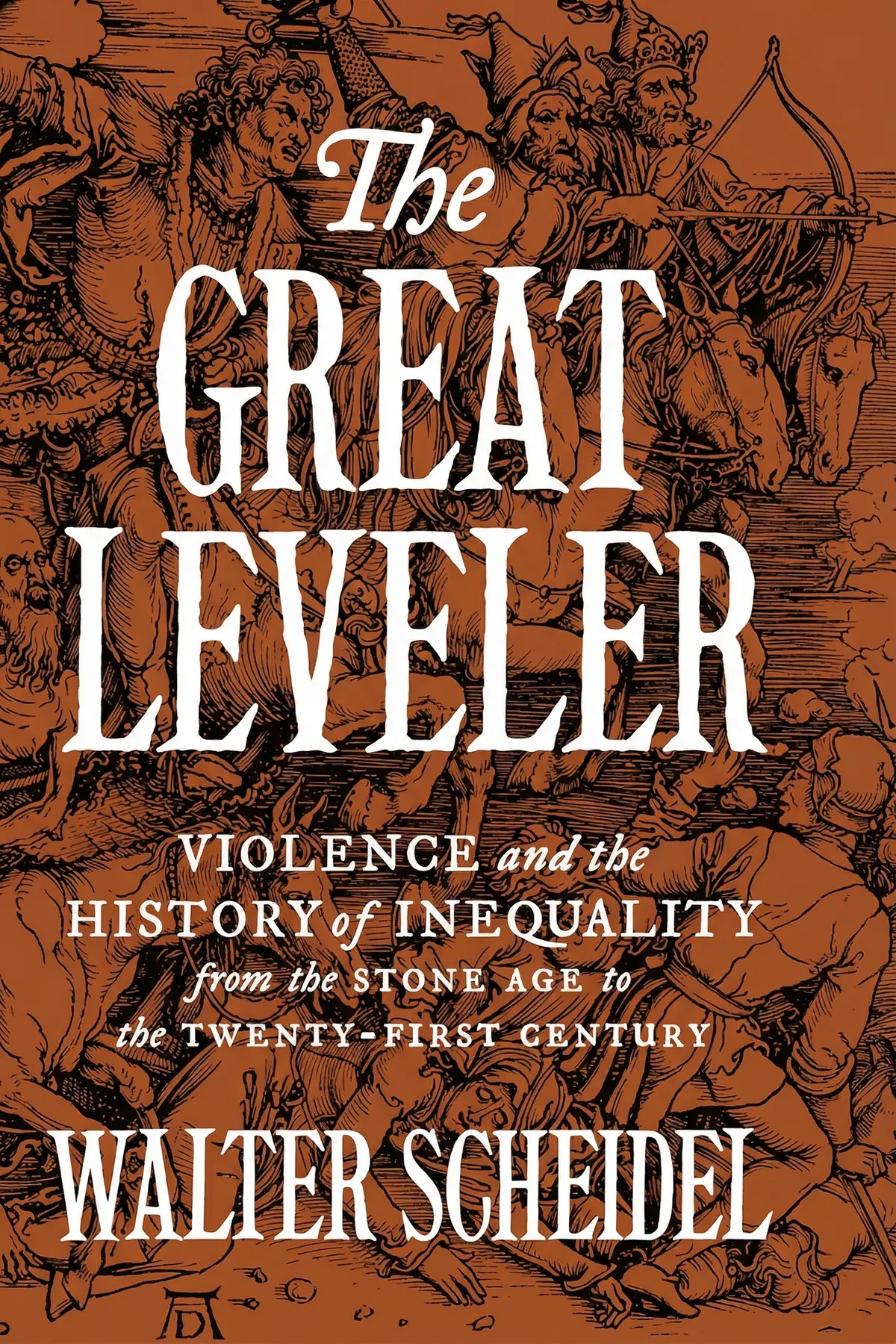
Table of Content
1. Introduction
56 sec
If you assume that democracy and open markets slowly make societies fairer, Walter Scheidel’s history will unsettle you. In The Great Leveler, the Stanford historian argues that the deepest cuts in inequality over thousands of years came from catastrophe: mass war, violent revolution, collapsing states and deadly plague. The rich lost the most when everything around them was falling apart.
That claim runs through all of his evidence, from fish bones in ancient houses to farm wages after the Black Death, the fortunes of Japan’s elite in World War Two and the land seizures of the Bolsheviks. Peaceful politics has a far weaker record. The aim is not to wish for disaster but to see plainly what has worked, and which calmer tools might do the same job. Then, when someone says the gap will close by itself, you can explain why history disagrees.
2. See where the gap between rich and poor began
1 min 37 sec
The end of the last ice age brought milder weather, steady harvests and more food than ever. It also left a strange pattern in the ground, visible in house sizes and in the leftovers of dinner.
3. Spot how debt turns shared land private
1 min 34 sec
The first civilization with written records divided its farms among families and split the harvest fairly. Within centuries the fields belonged to priests and aristocrats, and some former owners belonged to them too.
4. Discover how collapse and plague made workers richer
1 min 39 sec
Ordinary people fear epidemics and failing governments more than anyone. Europe’s history suggests an uncomfortable twist: across the centuries, the poor might have been even worse off if those disasters had never come.
5. Understand how total war flattened Japan's fortunes
1 min 42 sec
An empire that ruled a fifth of humanity lost a war and 2.5 million soldiers, and was struck by two atomic bombs. Its richest families lost something too, and the war narrowed the gap on a scale never seen before.
6. Learn the brutal price of leveling by revolution
1 min 39 sec
A world war killed two million Russian soldiers and left the gap between rich and poor almost untouched. What happened next started the leveling almost at once, and at a terrible human cost.
7. A failed state that left its poor better off
1 min 36 sec
After its government fell, Somalia became a byword for chaos, ruled in places by warlords and militias. Scheidel looks closer at how ordinary people actually lived, and finds a result that cuts against the usual story.
8. Learn why voting alone has not closed the gap
1 min 41 sec
Spreading power to voters should spread wealth too, or so the theory goes. Two large studies spanning decades of data tested that belief and found little to back it, though one other peaceful institution does help.
9. Peaceful tools that could do war's leveling work
1 min 26 sec
Nobody should be hoping for a world war or a climate disaster to shrink the gap. Economists have drawn up calmer alternatives, but even their supporters admit how much remains unknown about cost and results.
10. Conclusion
1 min 17 sec
Scheidel’s history leaves a hard picture. Across most of the record, the gap between rich and poor widened whenever life was settled and narrowed when something terrible broke it open. A Chumash canoe and a Sumerian loan built hierarchies. Roman collapse, the Black Death, total war in Japan and Lenin’s decrees knocked them down. Ballots and party labels, on the evidence he gathers, did much less.
He is not cheering for catastrophe. His real question is whether people can reach the leveling that disasters delivered without paying for it in millions of lives, and nobody has proved yet that they can.
That still leaves things to do. When a new technology or a new kind of credit appears, ask who will end up owning it. Back the unions and local groups that secure basics such as education, health care and internet access, and keep backing them in good times, when their strength usually fades. And when someone says growth and democracy will close the gap on their own, remember 184 countries and fifty years of data that found no such link.
The plague doubled wages by killing the people who earned them. The work now is to raise pay and leave the workers alive.
About this book
What is this book about?
Many people believe that democracy and capitalism have slowly made societies fairer. Walter Scheidel, a Stanford historian of the ancient world, tests that belief against the long record of human history and finds something much darker. Inequality grew whenever life became settled and productive. It fell most sharply when disaster struck. Scheidel follows the gap from its first traces in houses of different sizes about 11,000 years ago, through Sumerian debt and the feudal estates of medieval Europe. He then turns to the shocks that broke elite wealth: the fall of Rome, the Black Death, Japan's total war, the Russian Revolution of 1917 and the collapse of the Somali state in 1991. Next to these, democratic government and left-wing parties have done surprisingly little, according to the studies he cites, although trade unions have helped. Readers come away with a clear account of how inequality forms, what has reduced it in the past and why that record is so uncomfortable. The book ends with the reforms economists such as Anthony Atkinson have proposed, and with the open question of whether any society can level without catastrophe.
Book Information
Who it's for
Testing beliefs about inequality
Readers who assume democracy and markets steadily reduce inequality and want to test that belief against history.
Social science students
Students of history, economics and politics looking for one long view of how wealth gaps form and shrink.
Weighing peaceful remedies
Union members, organizers and policy readers weighing which peaceful tools might narrow the gap.
About the Author
Walter Scheidel
Walter Scheidel, born in Vienna in 1966, is a professor of classics and history at Stanford University, where he holds the Dickason professorship in the humanities and is a fellow in Human Biology. His research covers ancient social and economic history, the population history of premodern societies, and the comparative history of inequality, state formation and human welfare. He has worked at Vienna, Cambridge and Chicago, created the Orbis geospatial model of the Roman world, received a Guggenheim fellowship and is a corresponding member of the Austrian Academy of Sciences.
Ratings & Reviews
Ratings at a glance

What people think
Listeners find the material thoroughly researched and intriguing, with one listener pointing out the depth of historical information. Furthermore, they value its take on political economy and believe it is a worthwhile read. However, opinions on the prose and accessibility are split; some find the text easy to follow, whereas others struggle with the writing. Additionally, listeners are divided over the amount of detail, with one listener describing the specifics as excruciating.
Top reviews
Nannapat
Scheidel has produced a monumental work that demands attention from anyone interested in the mechanics of human civilization. This isn't just another political rant; it's an exhaustive, evidence-based journey from the hunter-gatherer era to the present. The author meticulously demonstrates that inequality is the default state of stable societies once agriculture and property rights take root. I found the chapters on the 'Great Compression' during the 20th century particularly enlightening for understanding our current world. Personally, I think the level of detail is exactly what is needed to prove such a provocative thesis. While the conclusion—that only catastrophe brings equality—is terrifying, the logic behind it appears nearly bulletproof. This book changed how I view the relationship between peace and economic disparity. It is easily one of the most significant works of economic history I have encountered in years.
Show moreSiriporn
Finally got around to reading this, and it’s basically the ultimate reality check for modern political optimism. Scheidel’s core argument is that we’ve been living in a rare, anomalous period of relative equality that is now ending. The 'Four Horsemen' concept is a great way to frame how history actually works. I loved the casual translation of some of the more academic points: basically, if you have a sword, you become king and take the money. It’s a thick, heavy book, but the insights into the origins of property and power are fascinating. Even if you don't agree with his dismal outlook, you have to respect the scholarship. It makes you realize that most of our 'solutions' for inequality are just nibbling at the edges. This is a must-read for anyone who wants to stop being naive about how wealth is distributed. Be prepared for a long haul, but it's worth every minute.
Show moreNoah
The central premise here is as fascinating as it is deeply unsettling. Walter Scheidel argues that throughout the vast expanse of human history, only massive shocks have truly leveled the playing field of wealth. He identifies these as mass mobilization warfare, transformative revolutions, state failure, and lethal pandemics. To be fair, the research is impeccable. He draws on data from ancient Rome to the modern day. You won’t find any easy policy fixes here. This makes the reading experience feel quite grim. Some sections get bogged down in technical jargon and Gini coefficient charts that might test your patience. However, if you can push through the density, the rewards are immense for understanding our current economic predicament. It’s a sobering reminder that our relatively peaceful era might actually be the primary driver of the inequality we complain about.
Show moreMilk
After seeing so much buzz about Piketty's Capital, I found this to be the necessary historical counter-balance. Scheidel goes much further back, proving that the concentration of wealth isn't just a quirk of modern capitalism. It is, instead, a fundamental feature of human social organization itself. The way he breaks down the 'Four Horsemen'—war, revolution, collapse, and plague—is both brilliant and horrifying. I did find the writing style a bit academic at times, which makes it a slow burn. Still, the insights into how the ancient Greeks managed inequality versus the Roman experience were worth the effort. It’s a dense read, but the historical breadth is simply staggering. This book provides a cold, hard look at reality that most politicians would probably prefer to ignore. It is a necessary, if uncomfortable, addition to any bookshelf on political economy.
Show moreJavier
What makes this study stand out is the sheer weight of the evidence provided for the 'Four Horsemen' of leveling. Walter Scheidel doesn't just make assertions; he backs every claim with mountains of archaeological and historical data. I was particularly gripped by the sections on how state collapse in the Roman Empire led to a temporary equalization. It turns out that when the government disappears, the rich have a lot more to lose than the poor. The book is certainly challenging and requires a significant time investment to process properly. Some might find the detail excruciating, yet I found it reinforced the author’s credibility. It’s a refreshing departure from the usual partisan bickering over taxes and spending. This is a scholarly work that forces you to confront the darker patterns of human development. Highly recommended for history buffs who don't mind a little gloom.
Show moreTalia
Ever wonder why the gap between the rich and poor seems like an unbreakable law of nature? This book provides a chilling answer by looking at the last ten thousand years of human experience. Scheidel shows that as soon as we stopped being hunter-gatherers, we started accumulating wealth in the hands of a few. I was amazed to learn that 21st-century wealth distribution isn't that different from ancient Egypt. Frankly, the author’s ability to synthesize so much information into one coherent (if depressing) thesis is remarkable. Some of the technical appendices are a bit over my head, but the main text is accessible enough. My only real gripe is that it feels a bit one-note after a while. Every chapter essentially tells you that things are bad and only get better when everything falls apart. It’s a heavy read, both physically and emotionally, but deeply informative.
Show morePong
Picked this up on a recommendation and found it to be a masterclass in historical analysis. The focus on the 'Great Compression' of the mid-20th century was especially relevant for our current times. Scheidel argues convincingly that the equality of that era was a byproduct of the World Wars, not just good policy. This perspective is a bit of a cold shower for those of us hoping for a peaceful fix to inequality. The book is dense and occasionally repetitive, which might turn off some casual readers. However, the rigor with which he examines the Gini coefficients of pre-modern societies is truly impressive. It’s a sobering, thick volume that refuses to offer the reader any false hope or easy exits. If you want the truth about why the rich stay rich, this is where you’ll find it. Just don’t expect to feel good when you finish the last page.
Show moreAurora
Is it possible for a book to be both incredibly important and a total slog to read? Scheidel's thesis is powerful, but the prose is so dry it often feels like reading a textbook on desert irrigation. I appreciated the deep dive into how the Black Death and World War II were the only real mechanisms for wealth redistribution. However, the sheer volume of statistics and graphs became mind-numbing after the first few hundred pages. Truth is, I had to take several breaks just to maintain focus on the core arguments. It’s a natural follow-up to Piketty, though it takes a much more pessimistic view of our ability to change things through simple legislation. If you have the stamina for academic writing, there is a lot of value here. Just make sure you are prepared for a very long, very data-heavy journey through the darker side of history.
Show moreWaree
Look, the data is undeniably impressive, yet the presentation feels designed to bury the reader under a mountain of Gini coefficients. I struggle to decide if I’m better off for having read it or just more depressed. The idea that only mass-mobilization warfare truly narrows the wealth gap is a tough pill to swallow. Scheidel’s analysis of Japan after World War II was a standout moment for me, though. It showed how total state control and destruction actually worked to reset the economic clock. To be fair, the book is quite repetitive as it moves through different historical eras with the same conclusion. You get the point pretty early on, and then it’s just hundreds of pages of reinforcement. It’s a solid 3-star read because while the information is vital, the delivery is fairly dry. It definitely isn't a page-turner for your summer vacation.
Show moreOwen
I really wanted to like this, but I left the experience feeling utterly hopeless and drained. Scheidel basically argues that we are stuck with extreme inequality unless millions of people die in a war or a plague. While the historical research is clearly extensive, the lack of any practical solutions makes the whole exercise feel a bit futile. Not gonna lie, reading page after page of Gini coefficients for ancient Egypt or the Han Dynasty got tedious very quickly. The author seems to take a perverse pride in dismissing every modern policy tool as useless. It’s more of a data dump than a cohesive narrative, and the tone is incredibly bleak. I understand that history doesn't owe us a happy ending, but the 'all-out nuclear war' suggestion in the final chapter was a bit much. If you want to feel miserable about the future of humanity, this is the book for you.
Show moreQuestions about this book
What is the main argument of The Great Leveler?
Walter Scheidel argues that across human history, large drops in inequality came mainly from violent shocks: mass war, revolution, the collapse of states and plague. Examples include the fall of Rome, the Black Death doubling laborers’ wages, Japan’s elite losing most of its wealth in World War Two and the Bolshevik land seizures of 1917. Democracy and left-wing governments, according to the studies he cites, have done far less.
Does democracy reduce inequality according to Walter Scheidel?
Not reliably. Scheidel cites a 2010 study by Daron Acemoglu and colleagues of 184 democracies from 1960 to 2010 that found no consistent link between democracy and more equal incomes. Powerful interests can capture democratic politics, and growth under democracy is often shared unevenly. A 2016 study by David Stasavage and Kenneth Scheve found left-wing governments only slightly lowered the top one percent’s income share.
How did the Black Death reduce inequality?
The plague killed millions of Europeans over many generations, and working people died in the greatest numbers. With far fewer laborers left, demand for their work rose, and wages in both the countryside and the cities doubled. That shrank the distance between rich and poor, which had been at its widest in the feudal era of roughly AD 1000 to 1300, when nobles and clergy held the land.
What peaceful solutions to inequality does the book discuss?
Scheidel discusses the 2015 proposals of British economist Anthony Atkinson: limiting market power, strengthening organized labor, higher taxes on capital gains and top earners, a livable minimum wage and a basic income for every child. Europe is also debating a universal basic income. These ideas have not been tested in practice, their cost is uncertain, and even Atkinson expected them to leave the UK far less equal than Sweden.
What can I do about inequality after reading The Great Leveler?
The book points to action at a local scale. Support or start a community group that secures basics such as internet access, education and health care. Scheidel also finds that trade unions are the peaceful force with the best record against inequality, though they tend to weaken in good times, so sustaining collective bargaining before a crisis is one practical lesson.
Readers also enjoyed




Adults in The Room: My Battle With Europe’s Deep Establishment
Yanis Varoufakis

A Spy Among Friends: Philby and the Great Betrayal
Ben Macintyre




A Year in the Life of William Shakespeare: 1599
James Shapiro
AUDIO SUMMARY AVAILABLE
Listen to The Great Leveler in 15 minutes
Get the key ideas from The Great Leveler by Walter Scheidel, plus 5,000+ more nonfiction titles.
- 5,000+ titles
- Listen as much as you want
- 7-day free trial
- Cancel anytime









