

15 min 06 sec
Available in: English
 ไทย
EnglishไทยThe Great Influenza: The Story of the Deadliest Pandemic in History
John M. Barry explains how the 1918 influenza became history's deadliest pandemic, as a fast-mutating virus met crowded wartime America, a young medical science and officials who chose silence, with effects reaching all the way to Versailles.
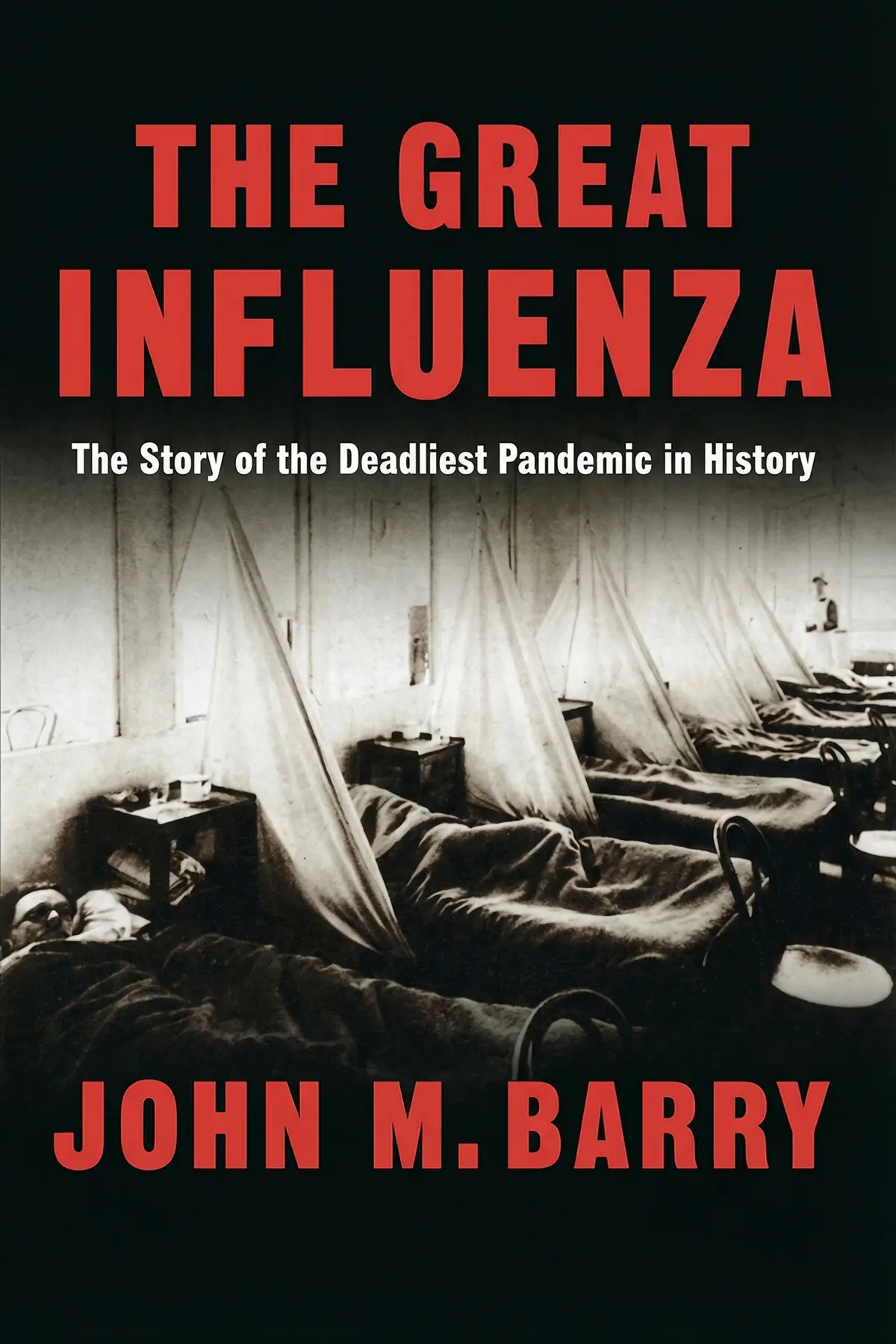
Table of Content
1. Introduction
1 min 04 sec
If 1918 is just a statistic to you, here is the one that matters most: the latest estimate puts the death toll near 100 million, more than 5 percent of everyone alive then. In The Great Influenza, historian John M. Barry argues that the virus alone did not produce that number. In 24 weeks it took more lives than AIDS took in 24 years, and in one year it killed more people than the Black Death killed in a century. Yet a great deal of that dying was made worse by people in charge who looked away.
Barry’s story is a collision. A virus built to change met a nation organized for war, a medical science that had only just grown up, and officials who preferred silence to warning. Follow it from a Kansas farm county to a Philadelphia parade and a peace table in France, and the statistic becomes a chain of decisions, with plain lessons for anyone who ever has to deliver bad news.
2. See how money and rigor remade American medicine
1 min 50 sec
In 1870 a student could fail most of his courses and still leave a famous school as a doctor. Within a few decades that same country was training physicians to rival Europe’s best. What changed?
3. Learn how influenza keeps mutating to beat our defenses
1 min 42 sec
A single infected particle can turn into a flood of copies, and its sloppiness at copying itself turns out to be its greatest weapon. That flaw explains why some strains catch the whole human race unprepared.
4. Spot how a war effort fed a virus
1 min 51 sec
A remote Kansas county, a giant army camp and a newspaper rule in a neutral country all shaped the pandemic’s first months. Then the disease seemed to vanish, which was the most dangerous moment of all.
5. The deadly cost of calming the public
1 min 55 sec
Doctors begged one city official to cancel a single event. He feared panic more than the flu, and within days his city learned exactly what that judgment was worth.
6. Discover how this flu struck down the strongest
1 min 43 sec
Most flu seasons are hardest on the frail. This one hunted people in the prime of life, and the reason lies in the very strength that normally protects us.
7. Trace one virus to a treaty and beyond
2 min 00 sec
The pandemic faded within weeks, yet one infection in the spring of 1919 may have changed the twentieth century. Barry follows the illness from a president’s sickbed to the treaty that ended the war.
8. What a failed race for a cure taught
1 min 53 sec
The finest laboratories in America chased the cause of the flu for years. Most came up empty, one lost everything to a wrong idea, and one stumbled onto something far bigger than influenza.
9. Conclusion
1 min 08 sec
The Great Influenza is about a virus, and even more about the people who decided what to do about it. Once the strain reached humans, Barry argues, nothing could stop it. Its toll, though, was shaped by choices: a parade allowed to go ahead, troop ships that kept sailing, a research request turned down, a president who never acknowledged the dying. The scientists saw clearly and were ignored, and their field was still too young to name what they were fighting.
The book leaves habits worth carrying into any crisis. When a threat is new to human bodies, read an early lull as a warning. When you hold bad news, share it before the parade, because Philadelphia’s false comfort cost far more than the panic it was meant to prevent. And when the evidence turns against a famous idea, follow it as Avery did, even if the reward takes decades to arrive.
Barry’s most lasting image is a wagon rolling through Philadelphia, its driver calling for families to bring out their dead, in a city recently told it had nothing to fear.
About this book
What is this book about?
The 1918 influenza is usually remembered as a number, and the number keeps growing: from 20 million deaths in a 1927 study to around 100 million today. John M. Barry argues that the number hides the real story. The virus was extraordinarily efficient, but much of the dying came from human decisions made while the world was at war. Barry follows the pandemic from a farm county in Kansas through army camps and the crowded streets of Philadelphia to the peace table in France. Along the way he shows how American medicine had only just reached world-class standards, why influenza mutates so well, why this strain killed the young and strong, and how officials who feared panic or delays to the war effort let the disease spread. Readers come away with a clear picture of how pandemics start, why they come in waves and what happens when leaders stay quiet. They also meet the scientists who raced for an answer, some of whom failed and one of whom, in the attempt, helped lay the foundation of molecular biology.
Book Information
Who it's for
Curious about 1918's decisions
Readers who know 1918 only as a death toll and want the human decisions behind it.
Managers and officials
Managers and public officials who must decide when and how to share alarming news.
History and medicine students
Students of history and medicine curious how pandemics start, spread and finally fade.
About the Author
John M. Barry
John M. Barry is an American author and historian who coached football and worked as a Washington journalist before turning to books. The Great Influenza, published in 2004, was a New York Times best seller and won the 2005 Keck Communications Award for science or medicine writing. His earlier book Rising Tide won the Francis Parkman Prize. Barry has advised officials in the Bush and Obama administrations on influenza preparedness and holds a professorship at Tulane University's School of Public Health and Tropical Medicine.
Ratings & Reviews
Ratings at a glance
What people think
Listeners find the book an intriguing experience that flows like a suspense novel, loaded with in-depth facts and exhaustive research. The tone is informal, and listeners like how the author explains the rise of public health systems and offers a comprehensive look at the flu outbreak. Listeners call it an immersive story with a tragically precise narrative, and one listener mentions how the text offers important insights for modern-day crises. The tempo gets a variety of responses, with some finding the progression lively while others suggest it can become dull in certain sections.
Top reviews
Tee
Barry crafts a masterful look into the transformation of the American medical landscape. Before the pandemic even hits the pages, we are treated to a fascinating history of the founding of Johns Hopkins and the rise of scientific rigor. I found the character sketches of men like William Welch to be incredibly perceptive and deeply human. To be fair, some might find the medical history a bit dense, but it is essential for understanding why the country was so ill-prepared. The research is staggering and the prose is elegant. It is rare to find a book that functions as both a definitive historical record and a gripping narrative. If you want to understand how public health evolved into what it is today, this is the book. It’s a compelling story that provides a thorough understanding of a truly devastating era.
Show moreIsabelle
The chapters detailing the emergence of the virus in Haskell County, Kansas, are some of the most engrossing bits of history I’ve ever read. Barry does a phenomenal job of illustrating how a local event spiraled into a global catastrophe. Personally, I found the political analysis of the Wilson administration to be the most shocking aspect. The suppression of truth in the name of the war effort was a secondary plague in itself. This is a massive, epic work that doesn't shy away from the sheer human agony of 1918. The science is explained clearly for the non-expert without ever feeling condescending. Every page feels heavy with the weight of the 50 million people who died. It’s a work of incredible scope that everyone should read to understand our own vulnerabilities.
Show moreBig
Imagine a time when doctors were still using leeches while a modern virus was mutating to kill the young and healthy. That is the world Barry evokes so brilliantly. This book is a triumph of carefully researched history. The focus on the development of public health as a discipline is fascinating. I was particularly moved by the stories from cities like Philadelphia and San Francisco, where the bodies literally piled up in the streets because of government denial. The writing is sharp and the message is clear: the greatest weapon against any pandemic is the truth. It is a compelling story that is as relevant in the 21st century as it was a hundred years ago. It’s one of those rare books that actually changes how you view the world around you.
Show moreLeila
As someone who lived through the COVID-19 era, reading this was an eerie experience. The parallels are almost frightening. Barry explains how the government's desire to maintain wartime morale led to a lethal silence that killed thousands. Truth is, the most valuable lessons in this book aren't about the science, but about the failure of leadership and the loss of public trust. The writing style is conversational enough to keep you moving through the complex biology, though some parts do feel a bit melodramatic for a work of non-fiction. Still, the way he describes the immune system turning against the body like a SWAT team killing a hostage is a brilliant metaphor. It is a sobering reminder that history has a nasty habit of repeating itself when we ignore the experts.
Show moreRiley
Few historians possess the ability to make virology feel like a high-stakes thriller, but Barry largely succeeds here. The book is filled with detailed information that makes you feel like an expert by the final chapter. I particularly enjoyed the sections on how the virus mutated and spread through the close quarters of World War I troop ships. It is a staggering tragedy told with great empathy. My only real gripe is the occasional redundancy where certain facts about the virus are repeated several times across different chapters. Regardless, it remains a fascinating read that outlines the development of modern epidemiology. The human anecdotes—like the Army camp commander who committed suicide—bring a necessary emotional weight to the cold statistics. This is essential reading for anyone interested in the intersection of nature and human hubris.
Show moreChatri
Truth is, I was captivated by the sheer amount of research that went into this. Barry doesn't just tell you what happened; he explains the 'why' behind the biology and the 'how' behind the societal collapse. The detailed information regarding the molecular structure of influenza was surprisingly accessible. I appreciated the conversational tone, which helped balance out the darker, more gruesome descriptions of the disease's physical toll. There are moments where the book meanders into the personal lives of scientists who weren't central to the flu fight, which slowed things down significantly. But when the narrative focuses on the pandemic's sweep across the globe, it is absolutely riveting. It offers a thorough understanding of how thin the veneer of civilization really is during a health crisis.
Show moreSiriporn
Why did I wait so long to pick this up? It reads like a disaster movie, yet it’s all true. The way the author describes the 'keening sound' of mourners across the world really stuck with me. It is a devastatingly accurate portrayal of a world in chaos. I loved the focus on the scientific pioneers who were essentially trying to build a plane while it was already in the air. The pacing receives mixed reactions from some, but I found the deep dive into medical history to be a necessary foundation. It makes the eventual failure to stop the virus feel even more tragic. This book provides such valuable lessons for today's world that it almost feels like a manual we forgot to read. A very smart, very sobering purchase.
Show moreRungrat
Not every book needs to be a page-turner from the first sentence, but once this one gets going, it is impossible to put down. Barry provides a thorough understanding of the 1918 pandemic by looking at it from every possible angle—scientific, political, and social. To be fair, the first 100 pages are basically a history of American medical education, which might bore some readers. But once the flu breaks out in the military camps, the pacing becomes relentless. The descriptions of the 'blue' victims gasping for air are haunting. It is a fascinating read that highlights both the brilliance of our best scientists and the terrifying power of nature. While it can get a bit dry in the technical afterwords, the core narrative is a powerful, devastatingly accurate account of human resilience and failure.
Show morePensuda
My expectations were high given the glowing professional reviews, but the reality was a bit more of a slog. Look, the information is clearly carefully researched, and the science of how the virus jumps from animals to humans is quite enlightening. However, the pacing is all over the map. Barry spends nearly the first third of the book on the history of medical schools before even mentioning the 1918 outbreak. It felt like I was reading two different books that weren't quite stitched together properly. While the middle sections concerning the military camps are harrowing and devastatingly accurate, the narrative often loses its way in the weeds of secondary biographies. It is a smart, detailed work, but it desperately needed a more aggressive editor to trim the repetitive sequences. It’s educational but occasionally boring.
Show moreNora
Quite frankly, the lack of editorial control in this book is maddening. I am shocked that such a repetitive text became a bestseller. Barry seems to thread three or four different books into one, jumping wildly between geography, medical school politics, and actual virology without any definitive breaks. I found myself tallying the number of times he repeated the same key phrases about the immune system. While the subject matter is inherently dramatic, the author relies on manufactured melodrama that feels more like fiction than historiography. There is good information here, but you have to dig through mountains of irrelevant biographical sketches to find it. I honestly think a long Wikipedia article would be a more efficient use of your time. This was a frustrating and disorganized disappointment.
Show moreQuestions about this book
What is The Great Influenza by John M. Barry about?
It tells the story of the 1918 influenza pandemic, which may have killed around 100 million people. Barry follows the virus from Haskell County, Kansas, through army camps and Philadelphia to the peace negotiations in France. He argues that the toll came not only from an extremely efficient virus but from wartime crowding and from officials who denied the danger and kept troops moving.
Why was the 1918 flu called the Spanish Flu?
The name came from the press, not from where the outbreak started. Spain was neutral in the First World War, so its newspapers were the only ones in Europe free of government censorship and could report the epidemic openly. Barry traces the strain’s jump into humans to Haskell County, Kansas, from where it reached Camp Funston and then Europe with American troops.
Why did the 1918 flu kill so many young adults?
Barry explains that in many fatal cases the virus was not the direct killer. While battling the infection, robust immune systems in people aged twenty to thirty-nine filled their lungs with fluid and dead cell debris, which killed the patient, at times within 12 hours of the first symptoms. Pregnant women were especially vulnerable, while ordinary flu mostly kills the very young and very old.
What happened at the Philadelphia parade in 1918?
Public health director Wilmer Krusen let a war-support parade go ahead on September 28 despite doctors’ warnings, and more than 200,000 people attended. Within three days every hospital bed in the city was full. On October 10 nearly 800 people died, and more than 4,500 died that week, compared with a normal weekly toll of about 400.
What lessons does The Great Influenza offer today?
The book suggests that silence in a crisis costs lives, so bad news should be shared early. A calm period after a first wave may mean a virus is growing deadlier. A population’s past exposure shapes its risk. And Oswald Avery’s story shows the value of following evidence against an accepted idea, since his work led to the foundation of molecular biology.
Readers also enjoyed
1491: New Revelations of the Americas Before Columbus
Charles C. Mann
Age of Anger: A History of the Present
Pankaj Mishra

A Life Decoded: My Genome: My Life
J. Craig Venter

1929: Inside the Greatest Crash in Wall Street History--and How It
Andrew Ross Sorkin
Agent Sonya: The Spy Next Door
Ben Macintyre

A Planet of Viruses
Carl Zimmer

A Biography of Loneliness: The History of an Emotion
Fay Bound Alberti
Alexander Hamilton
Ron Chernow

A Short History of Nearly Everything
Bill Bryson
AUDIO SUMMARY AVAILABLE
Listen to The Great Influenza in 15 minutes
Get the key ideas from The Great Influenza by John M. Barry, plus 5,000+ more nonfiction titles.
- 5,000+ titles
- Listen as much as you want
- 7-day free trial
- Cancel anytime









