


14 min 09 sec
Available in: English
The First-Time Manager
A practical guide for newly promoted managers: how to win a team's trust, adjust direction to each person, delegate, hire for attitude, motivate through personal goals and handle underperformers fairly and calmly.
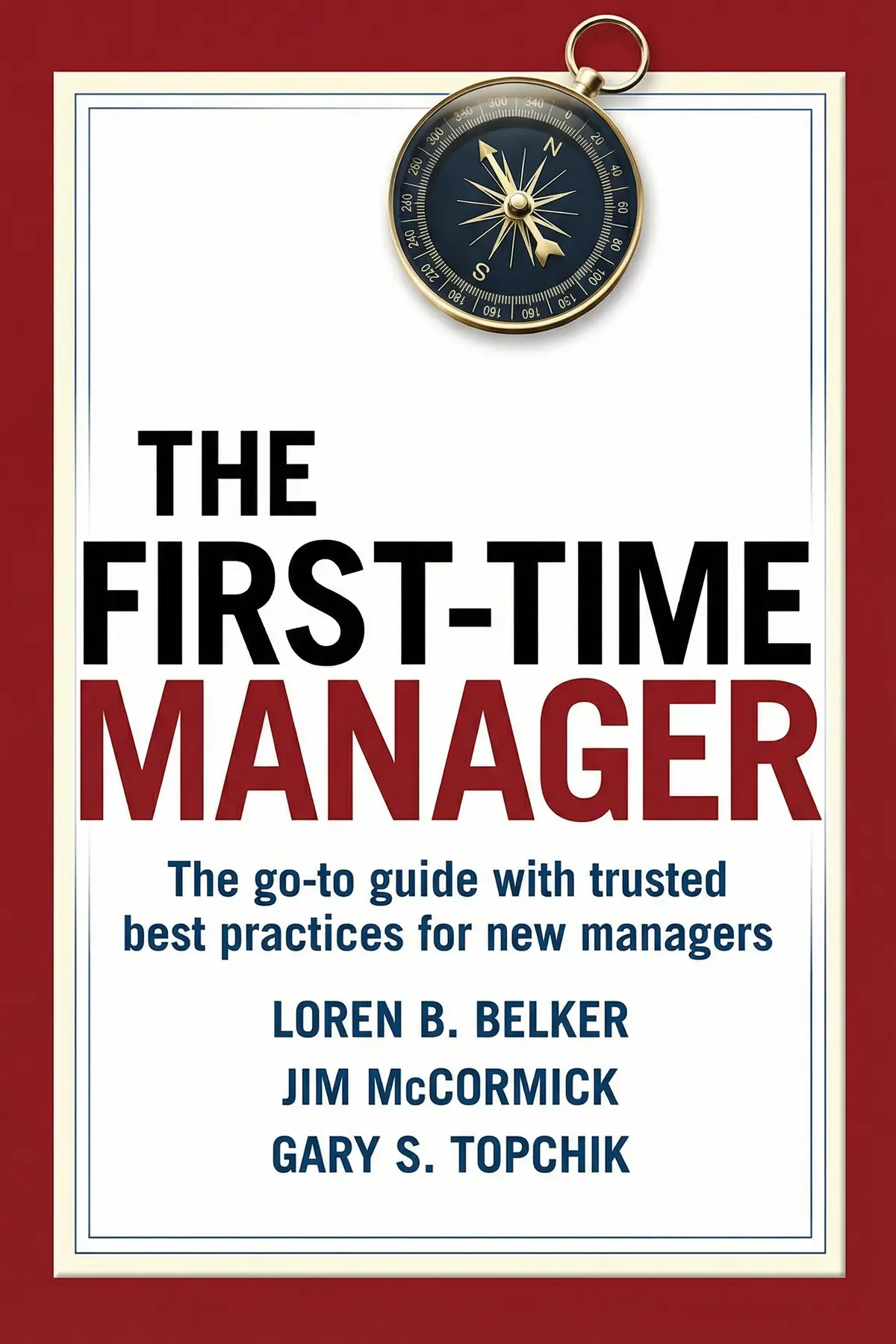
Table of Content
1. Introduction
51 sec
The skills that won your promotion, being fast, expert and reliable on your own, are often not the ones that make a good manager. In The First-Time Manager, Loren B. Belker, Jim McCormick and Gary S. Topchik argue that management rests on people skills, however technical the work, and that new bosses should begin by holding back on their fresh authority.
The authors’ answer runs through the whole job: win trust first, then give each person what they need to do their best work, through how you direct, delegate, hire, motivate and even dismiss. What follows is a playbook for the first months, from what to do in a first one-on-one to the interview question that exposes attitude and the words to tell yourself when someone shouts at you.
2. Earn your team's trust before changing anything
1 min 29 sec
A new title tempts people to prove they deserve it, and many new bosses reach for big gestures in week one. The authors explain why that backfires and what a far quieter first two months looks like.
3. Match your control and support to each person
1 min 40 sec
The bossy autocrat and the consensus-seeking diplomat both have fans. The authors find neither one sufficient and instead suggest weighing each person’s motivation and competency, then adjusting how much control or encouragement you give them.
4. Turn private ambitions into company wins
1 min 33 sec
Most people work hardest for their own reasons, and pretending otherwise gets a manager nowhere. An employee’s wish to learn a language shows how a personal goal can end up serving the whole business.
5. Delegate the work that grows your people
1 min 29 sec
New managers often keep too much for themselves, out of pride or a fear of being outshone. The authors treat handing off work as a training method, with a few jobs that must never leave your desk.
6. Meetings that cost less and hear everyone
1 min 27 sec
A routine two-hour team meeting carries a price tag most managers never calculate. The authors put a number on it, then show how a manager’s own voice can quietly silence the room.
7. Hire the attitude, then train the skills
1 min 35 sec
Résumés reward degrees and years of experience, yet the authors rank something else above both. One simple interview question, and the questions a candidate asks back, can reveal what a polished CV hides.
8. Give a struggling employee a written way back
1 min 36 sec
Firing someone is costly and painful for both sides, yet the authors claim a well-handled dismissal can leave the person grateful. The difference lies in what happens in the weeks before the final conversation.
9. Stay calm when someone shouts at you
1 min 33 sec
Being promoted for managing tasks well leaves many people unprepared for managing feelings, their own included. The authors point to one measure that predicts managerial success better than intelligence, and argue it can be learned.
10. Conclusion
56 sec
The book adds up to one change of scoreboard. As a contributor, you were judged on your own output. As a manager, you are judged on what your people can do, and every tool here, from the first coffee to the signed improvement plan, exists to give them what they need. Even a dismissal, handled with a clear plan and real help, can end with the person better placed than before.
The authors’ advice suggests where to begin. In your first weeks, change little and book an unhurried conversation with each person, then mostly listen. Ask each of them what they want to be doing in three years, and remember the answer when the next project arrives. Before your next meeting, send the agenda days ahead and keep your own opinion until everyone else has spoken.
None of this demands a forceful personality. It asks for attention, patience and a willingness to let others shine. The promotion handed you authority, and only the team can hand you trust.
About this book
What is this book about?
Being promoted to manager often comes with an uncomfortable discovery. The skills that made you a standout individual contributor do little to help you lead others, and few companies give new managers the training they need. Some colleagues may feel they deserved the job, and a strong predecessor can leave a lot to live up to. Loren B. Belker, Jim McCormick and Gary S. Topchik argue that however technical the work, management comes down to people skills. Their advice starts with restraint: avoid big changes, meet each team member, listen and praise sparingly but sincerely. From there they set out an awareness approach that balances control and encouragement for each person, a method for delegating as training, and a technique called dovetailing that ties employees' own ambitions to company goals. The book also covers the harder parts of the job: running meetings that justify their cost, hiring for attitude over credentials, giving a struggling employee a written plan before any dismissal, and building the emotional intelligence and steady self-image that keep a manager calm under pressure. Readers get a set of concrete habits for their first months in charge.
Book Information
Who it's for
Leading former peers
Newly promoted managers who were strong individual contributors and now lead former peers.
Gauging each person's needs
Team leads unsure how much to direct, delegate or praise each person.
Facing first management tests
Managers facing their first hire, first long meeting agenda or first underperformer.
About the Author
Loren B. Belker
Loren B. Belker spent nearly 30 years as an executive at a major insurance company in the midwestern United States; he has since died. Jim McCormick was chief operating officer at Anshen+Allen Architects, served three years in a government post in Washington under President Reagan, holds an MBA from the University of California, Irvine, and founded the Research Institute for Risk Intelligence. Gary S. Topchik is managing partner at SilverStar Enterprises, a consulting firm that develops managers, and the author of Managing Workplace Negativity.
Ratings & Reviews
Ratings at a glance
What people think
Listeners find this management guide to be an essential read for first-time supervisors, offering a thorough breakdown of core principles in a very accessible style. The text is skillfully composed and packed with references, while one listener specifically highlighted its emphasis on daily practical usage. Listeners find the material to be a great value and a high-quality resource, with one listener noting it acts as a helpful prompt for learning to delegate tasks more effectively.
Top reviews
Oat
As someone who just stepped into a lead role at a mid-sized firm, I found this book to be an indispensable mentor in print form. It highlights the importance of aligning an employee's personal interests with organizational goals to foster genuine motivation. Many new supervisors struggle with the 'sink or swim' reality, but this guide provides a life jacket through its clear explanations of diplomatic versus autocratic management. I've already started implementing the tips on how to host more effective meetings, and the results have been immediate and positive. Not gonna lie, I took pages of notes on the delegation strategies alone. This is easily the most comprehensive overview of essential concepts I’ve found so far. If you want to move from directing people to helping them become self-directed, start here. It is well worth the investment of both time and money.
Show moreWipada
I was genuinely surprised by how helpful this was, and I wish I had read it six months ago when I first got promoted. It really takes the mystery out of the 'sink or swim' approach that most companies take with their new leads. The insights into how to handle underperforming staff by aligning their goals with the company's needs were particularly eye-opening for me. In my experience, most management books are either too theoretical or too aggressive, but this one strikes a nice balance. It’s written in a very positive tone that encourages you to motivate your team rather than just controlling them. The flow of the chapters is logical, and the focus on practical application makes it easy to use as a daily reference. Even though it's been updated over the years, the core principles of human interaction remain relevant. This is definitely my top recommendation for anyone looking to improve their leadership skills.
Show moreSkylar
Finally got around to reading this staple after seeing it on every 'new manager' reading list for the last decade. It’s a solid resource that covers the basic mechanics of leading a team without getting bogged down in dense academic jargon. I particularly valued the focus on daily practical applications, like how to transition from being a peer to being the boss. While the tone is conversational and encouraging, some of the sections on recruitment felt a bit thin for today’s competitive market. The advice on delegation is a great reminder that your job is no longer to do the work, but to ensure the work gets done by others. It’s an easy read that serves as a high-level primer for those who feel thrown into the deep end. Just keep in mind that its roots are older, so some scenarios feel slightly dated in a modern tech environment.
Show moreClaire
This book provides a very pragmatic look at what it actually means to be responsible for the output of others. I appreciated the specific 'talks' or scripts provided for different managerial situations, even if they were a bit simplistic. It’s a field-agnostic guide, meaning the advice works whether you are in healthcare, manufacturing, or retail. One of the best reminders was the section on not correcting employees in front of their peers to protect department morale. While some of the recruitment advice feels a bit 'old school,' the core message about building trust is timeless. To be fair, you have to read it with a grain of salt regarding some of its social views. Overall, it functions as a great reference tool for daily challenges. It helped me realize that my primary role is to provide my staff with whatever they need to excel.
Show moreMia
Ever wonder why some bosses are so much easier to work for than others? This book dives into that dynamic by focusing on the move from being a 'doer' to a 'leader.' I liked how the authors emphasized the psychological aspect of management, specifically the idea of helping your team become self-directed. The writing style is easy to digest, which is a relief compared to the dry textbooks I usually have to slog through. One minor criticism is that it can be a bit repetitive in its delivery of the main points. However, that repetition might actually help the concepts stick for a stressed-out new supervisor. It’s a value-for-money purchase because it covers everything from hiring to firing in under 300 pages. It serves as an excellent reminder to step back and let your team grow through delegation.
Show moreChokdee
Picked this up specifically to help with my interviewing skills, even though I am not a manager myself. I wanted to understand the mechanics of the role to better support my own supervisor and carry my load on various projects. The book is well-written and offers numerous references that I plan to explore later in my career. It gives a great overview of the difference between autocratic and diplomatic leadership styles, which helped me identify my own workplace tendencies. My only real complaint is that some of the 'sample speeches' felt a bit stiff and unnatural to deliver in person. Still, the underlying logic of the 'Improvement Seed' talk is a solid way to approach performance issues for any professional. It’s a comprehensive resource that definitely provides more 'pros' than 'cons' for most readers.
Show moreOrm
Personally, I found this book to be exactly what I needed to calm my nerves before my first week as a supervisor. It's an easy and conversational guide that avoids the typical high-brow fluff found in business literature. I especially liked the section on how to handle the transition when you are suddenly managing your former friends and peers. That’s a delicate situation, and the advice to be professional but not cold was spot on. I’ll admit that some of the views on work-life balance are definitely dated and should probably be ignored. But if you can look past those moments, the book is packed with indispensable sage advice to avoid common pitfalls. It’s a great value and serves as a practical roadmap for the long journey of management. I feel much more prepared to provide my staff with what they need to succeed.
Show moreVimolwan
The chapter on recruitment really missed the mark for me, especially the 'attitude' questions which seemed superficial at best. That being said, the book functions as a decent, high-level map for anyone navigating their first ninety days in a leadership role. I appreciate that the authors avoid 'management speak' in favor of a more direct, common-sense style. However, the truth is that a lot of the advice feels like it was written for a corporate world that doesn't quite exist anymore. The suggestions regarding employee personal lives and childcare feel particularly tone-deaf in a post-pandemic landscape. It's a generalist guide that provides a few 'nuggets' of wisdom, but you’ll likely need to supplement it with more contemporary literature. To be fair, reading the ramblings of these authors can be a bit depressing when they try to justify basic emotional intelligence. It’s a mixed bag, offering sage advice alongside some truly archaic perspectives.
Show moreApichat
After hearing several colleagues recommend this, I expected something a bit more profound than what I actually received. It’s a light read, and the lack of management jargon is definitely a plus, but it often borders on being too simplistic. I found the sections on managing change to be particularly lacking in depth for anyone dealing with complex organizational shifts. Look, the book has some great management truths that have stood the test of time, but the implementation strategies are hit-or-miss. I found myself disagreeing with their 'wrong' answers in the sample interviews, as they seemed like caricatures rather than real-world responses. It’s a useful primer for someone who has zero experience, but seasoned professionals will find it repetitive. It’s essentially a collection of common-sense tips bundled together. It’s okay for a quick flight read, but don’t expect it to change your life.
Show moreSarawut
Not what I expected from a book that is supposedly a 'must-read' for modern professionals. Frankly, the advice given is so archaic that it actually became frustrating to finish the later chapters. On page 99, they suggest that parents should have backup plans for sick children to avoid missing work, which is incredibly out of touch with modern family dynamics. It’s clear that this was originally written by men from a different generation who didn’t have to worry about the realities of modern caregiving. The conversational tone can't mask the fact that much of the content is redundant and contradicts the very emotional intelligence it tries to promote. If you work in a progressive field like tech or startups, you will likely find this depressing rather than helpful. There are far better resources out there that don't require you to sift through such outdated social attitudes and repetitive 'talks.'
Show moreQuestions about this book
What is the main idea of The First-Time Manager?
Belker, McCormick and Topchik argue that management depends on people skills, whatever the technical field. A new manager should avoid displays of power, build trust through unhurried one-on-one conversations and sincere private praise, and then give each employee what they need to do their best work, through tailored direction, delegation, motivation, careful hiring and fair handling of poor performance.
What is the awareness approach to management?
It is the authors’ alternative to choosing between an autocratic and a diplomatic style. The manager balances control, meaning assigning, explaining and checking work, with encouragement, meaning motivating, listening and removing obstacles. The mix depends on each person’s motivation and skill: eager beginners need more control, skilled but unmotivated people need more encouragement, and needs change with circumstances, as with Andy struggling on a team project.
What should a new manager look for when hiring?
Attitude, above education, experience and qualifications. The authors argue a well-qualified person with a bad attitude becomes a problem, while someone with a good attitude can be trained into an outstanding employee. Ask what the candidate liked best about their last job and notice whether they mention social events or learning and challenges. Questions about training or promotion are good signs, though questions about insurance or hours are not warnings.
How does The First-Time Manager say to handle an underperforming employee?
Unless the case calls for immediate dismissal, give the person a real chance. Explain current performance, the expected level and how to close the gap, state clearly that the job is at risk, and offer help. Agree on goals and check-in dates, write everything down and get it signed. For example, cut errors from five a day to three by month’s end, reviewing progress and adjusting check-ins.
How can I apply The First-Time Manager in my first weeks?
Avoid major changes in week one, then meet each team member in person within about two months and let them do most of the talking. Praise only when deserved, specifically and privately. Ask people where they hope to be in a few years so you can match their goals to company needs, a technique the authors call dovetailing. In meetings, share your own opinion last.
Featured in
Readers also enjoyed



A Year with Peter Drucker: 52 Weeks of Coaching for Leadership Effectiveness
Joseph A. Maciariello



Acting with Power: Why We Are More Powerful Than We Believe
Deborah Gruenfeld

All In: How Great Leaders Build Unstoppable Teams
Mike Michalowicz


AUDIO SUMMARY AVAILABLE
Listen to The First-Time Manager in 15 minutes
Get the key ideas from The First-Time Manager by Loren B. Belker, plus 5,000+ more nonfiction titles.
- 5,000+ titles
- Listen as much as you want
- 7-day free trial
- Cancel anytime









