
The God Delusion
Richard Dawkins
 English
Shows how seeing evolution from the gene's point of view explains imperfect designs, surplus DNA and animals that serve others, and how a gene's effects reach beyond its body into nests, dams and other creatures.
1 min 00 sec
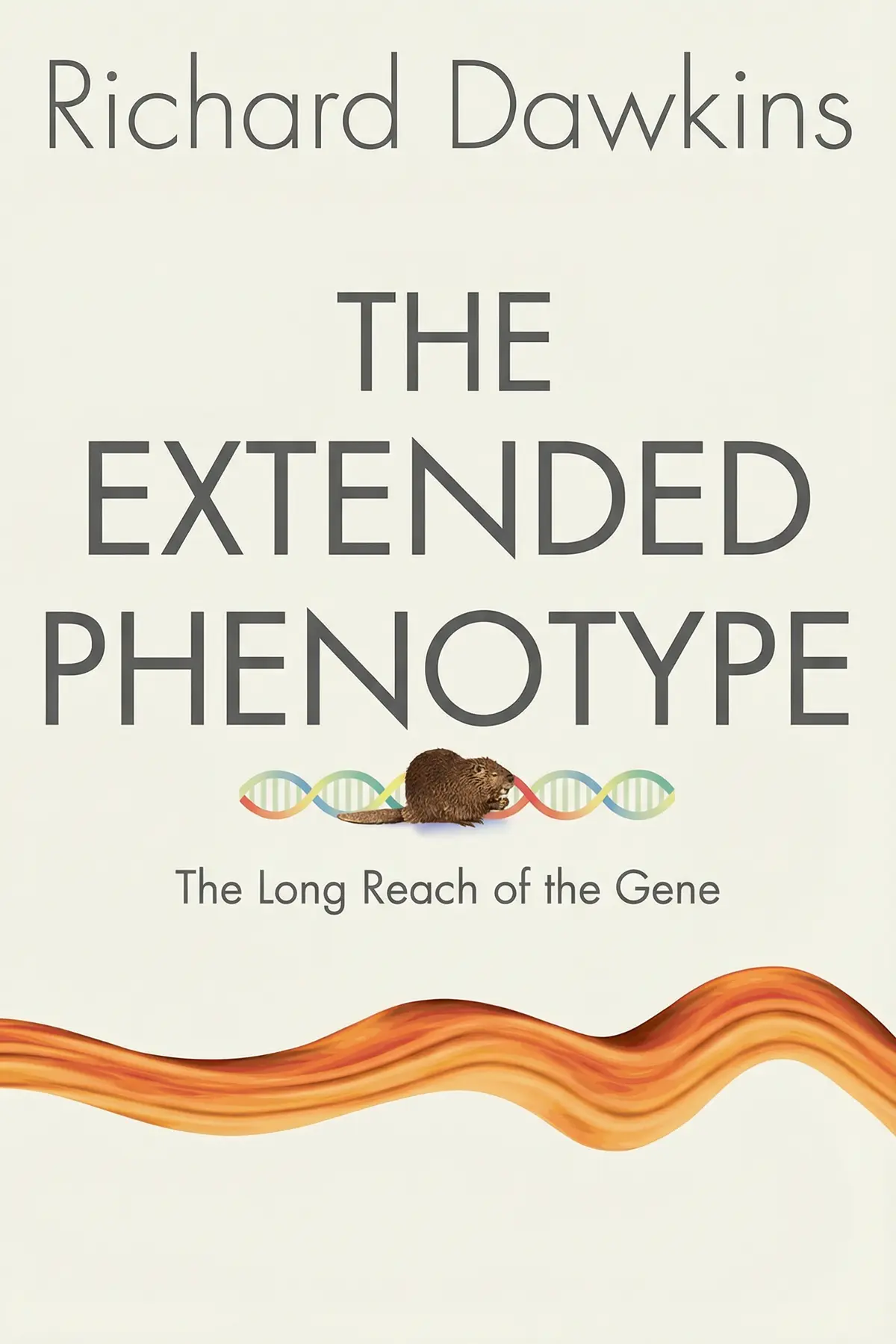
If evolution still sounds like a contest between strong animals and weak ones, you are seeing only half the picture. In The Extended Phenotype, evolutionary biologist Richard Dawkins argues that genes are the real competitors, and that their influence stretches past the bodies carrying them, into a beaver’s dam or a snail’s shell. He does not ask you to drop the familiar view. He adds a second one, just as valid, that answers questions the first cannot.
That is the claim worth following: switching between the organism’s view and the gene’s view explains why living things are often badly designed, why cells carry DNA they do not need, and why one animal can end up working for another. Along the way you will learn why no gene seals your fate, how to tell a copy from a carrier, and how to read a spider’s web or a mouse’s ended pregnancy as genes acting in their own interest.
1 min 41 sec
A simple doodle that most people have drawn in a school notebook hides a lesson about biology. Look at it long enough and it changes, yet nothing on the page has moved.
1 min 39 sec
Tell parents their struggling child carries a gene for poor math and many will stop trying to help. Dawkins thinks they have misheard what scientists mean, and the mistake costs real children.
1 min 43 sec
Evolution produced the color-shifting gecko and the sleek shark, so it is tempting to think it always finds the best answer. A slow armored animal on a busy road suggests otherwise.
1 min 52 sec
A mother who loses a finger does not give birth to a child missing one. That plain fact, Dawkins argues, shows what evolution actually copies and what it merely uses.
1 min 44 sec
Some genes cheat the rules of inheritance, and our cells hold far more DNA than they need. Biologists found both baffling until they asked a different question about who benefits.
1 min 31 sec
A larva’s stone nest, a spider’s web and a beaver family’s dam all sit outside the animal that made them. Dawkins asks whether they still belong to its genes.
1 min 51 sec
A fish with a fishing rod on its head, a snail with an oddly thick shell and a mouse that loses a pregnancy all raise one question: whose genes are really in charge?
1 min 16 sec
The Extended Phenotype hands you a second pair of glasses. The animals, plants and parasites are the same ones Darwin studied. What changes is where you look for the winner. Dawkins keeps the familiar organism view and sets beside it a gene view in which genes are the replicators, bodies are their vehicles, and genetic effects run out into stones, dams, shells and the bodies of other creatures.
The second view earns its place by explaining what the first leaves strange: an armadillo curling up in front of a car, outlaw genes cheating in fruit flies, passenger DNA in every cell, small fish swimming toward a predator’s mouth.
The habits it supports are plain ones. When you meet a claim about a gene for something, hear a nudge in the odds, not a sentence. When a design looks wasteful or self-defeating, ask what is being copied and who gains from the copying. And when an explanation feels finished, flip the cube once and see whether the other face tells a fuller story.
A beaver dam is wood and mud across a river. Through Dawkins’s eyes, it is also a gene reaching out, far beyond the animal that carries it.
Most of us picture evolution as a contest between animals: the strongest, fastest or best hidden survive and pass on their traits. Richard Dawkins does not throw that picture away. He sets a second one beside it, equally valid, in which the real competitors are genes and the bodies they build are vehicles that carry them. That shift answers questions the organism view struggles with. It explains why many creatures are far from perfectly designed, why our cells hold far more DNA than they need, why some genes sabotage their neighbors and why a small fish might swim straight into a predator's mouth. Dawkins then takes his boldest step, the idea of the extended phenotype: a gene's effects do not stop at the skin but reach into a caddis fly's stone nest, a beaver family's dam, a snail's shell thickened by a parasite and a mouse's pregnancy. Readers get a clear way to think about genes without fatalism, a vocabulary of replicators and vehicles, and a habit of asking, whenever something looks wasteful or self-defeating, whose interest it really serves.
Curious readers who know the phrase survival of the fittest and want to understand what is really being selected.
Students of biology who want the gene-centered view explained with clear animal examples.
Anyone unsettled by headlines about genes for traits who wants a calmer way to read them.
Richard Dawkins is an ethologist and evolutionary biologist, born in Nairobi, Kenya, in 1941. He is a Fellow of the Royal Society and an emeritus fellow of New College, Oxford, and from 1995 to 2008 he was the first Simonyi Professor for the Public Understanding of Science at Oxford. His earlier book The Selfish Gene presented evolution from the gene's viewpoint and introduced the term meme. He also wrote The God Delusion and The Magic of Reality, and founded the Richard Dawkins Foundation for Reason and Science.
Richard Dawkins
Richard Dawkins
Richard Dawkins

Listeners consider the book worth the exertion and value the high-quality information, with one listener highlighting how it challenges critics of gene-centered theory. Feedback on readability is varied, as one listener mentions needing to re-read essential passages. The diversity of topics also sparks different responses; one listener finds the variety captivating, while another observes that the subjects seem to transition unpredictably throughout the text.
This book is Dawkins at his absolute peak, though it clearly targets a more academic audience than his previous bestsellers. While The Selfish Gene introduced the revolutionary concept of the replicator, this work pushes that logic to its inevitable, beautiful conclusion. He argues that the phenotypic effect of a gene doesn’t stop at the skin of the organism. Whether it is a beaver’s dam or a parasite's influence on a snail’s shell, the reach of the gene is vast. To be fair, the prose is dense and requires significant concentration to follow the intricate arguments. You might find yourself re-reading entire pages to grasp the nuances of his response to critics. However, the intellectual payoff is immense for those willing to do the heavy lifting. It changes how you perceive the natural world entirely.
Show moreEver wonder where an organism actually ends and the environment begins? This book argues that the line is much blurrier than we think, proposing that artifacts and host behaviors are just as much a part of the phenotype as a limb or an organ. I found the logic behind genetic replicators to be airtight and incredibly persuasive. Daniel Dennett’s afterword is a wonderful addition that helps contextualize why these ideas were so controversial at the time. It’s a deep dive into the mechanics of variation and survival that every student of biology should experience. Some sections on genetic determinism are a bit heavy-handed, but the overall vision of life’s grandeur is undeniable.
Show moreDawkins remains a master of the metaphor even when he’s writing for his peers rather than the general public. His descriptions of parasitic manipulation, where one organism's genes essentially "reach out" to control another, are both terrifying and beautiful. This book serves as a vital bridge between pure genetics and behavioral ecology, showing that everything in nature is interconnected through the survival of replicators. To be fair, you have to be comfortable with a lot of jargon and a very formal writing style. If you can handle the academic tone, you’ll find a wealth of insights that few other science writers can provide. It is a peerless champion of the gene-centered view.
Show moreAfter hearing so much about the 'gene-eye view' of evolution, I felt compelled to tackle Dawkins' most serious contribution to the field. It’s a fascinating exploration of how behavioral traits and artifacts like nests function as extensions of the genetic code itself. The examples of cuckoo eggs and manipulation were particularly enlightening and helped clarify the "how" of natural selection. My only real gripe is that Dawkins spends a lot of time fighting with his critics, which can feel a bit repetitive if you aren't familiar with 1980s academic drama. Still, the information quality is top-notch and provides a rigorous framework for understanding biodiversity. It’s definitely not a light beach read, but it is deeply rewarding.
Show moreNot what I expected based on his other popular science works, but brilliant nonetheless. I've been a fan of Dawkins for years, but this particular volume is incredibly dense and seems written strictly for his colleagues. The vocabulary is highly technical and the sentence structure often requires multiple passes just to extract the basic meaning. I found myself getting lost in the "Ultra-Darwinist" debates and the complex genetic terminology he uses throughout. Frankly, it’s a bit of a chore to get through if you don't have a background in genetics. While the central idea of the extended phenotype is brilliant, the presentation is far too academic for the average reader.
Show moreFinally got around to finishing this monster and I’m glad I did, even if it took me twice as long as usual. Dawkins is defending his ground against those who misunderstood The Selfish Gene, and he does so with a sharp mind and even sharper wit. The discussion on how genes rely on their environment for successful replication is a necessary counter to the idea that he ignores ecological context. It is a tough situation to cope with mentally because it strips away the 'why' of evolution in favor of a cold, precise 'how.' Despite the occasionally abrasive tone toward his detractors, the book is a masterclass in logical argumentation. Highly recommended for the serious student.
Show moreThe truth is, you need a solid background in biology to fully appreciate the brilliance of this text. It isn't just an expansion of his earlier work; it is a total paradigm shift in how we view the unit of selection. By viewing beaver dams and bird nests as phenotypic expressions, Dawkins removes the "vehicle" from the pedestal and places the replicator at the center of everything. I'll admit that the readability fluctuates, and some of the chapters feel like they could have been condensed significantly. However, the information quality is so high that these minor frustrations are easily forgiven. It’s a foundational piece of literature for anyone interested in Neo-Darwinian synthesis.
Show moreAs someone who adored The Selfish Gene, this felt like a bit of a slog through mud at certain points. The core concept—that genes influence the world beyond the body—is absolute genius and makes so much sense once explained. Unfortunately, Dawkins gets bogged down in very specific, technical rebuttals that haven't aged as well as the central theory. I found the organization of the chapters a bit confusing, as if he was trying to address every single critic at once. It’s a great book for those who want to understand his exact reasoning, but it’s probably too much detail for the average person. I'm glad I read it, but I won't be picking it up again anytime soon.
Show moreI honestly found the sections on parasitic manipulation to be the most gripping part of this otherwise difficult read. The way certain genes can induce physical changes in another species' shell or behavior is just mind-blowing. It really challenges the traditional view of the individual organism as a discrete, sovereign entity. While the book is definitely a "serious effort" and can be quite taxing on the brain, the information is worth the effort. My only criticism is that it feels a bit repetitive in its defense against "Ultra-Darwinist" labels. Still, if you want a deep, uncompromising look at evolutionary mechanics, this is the book you need to buy.
Show moreLook, I really wanted to love this, but it felt remarkably disorganized compared to his later books. The way he moves between topics can feel almost random at times, jumping from technical rebuttals to fascinating thought experiments without much warning. If you aren't a professional biologist or an extremely dedicated amateur, the level of detail provided here is likely overkill for your needs. I appreciated the core argument about genes extending into the environment, yet the execution was far too dry for a casual read. It’s certainly a seminal work in evolutionary theory, but for me, the last chapter of his previous book was enough. I'll probably stick to his more accessible titles in the future.
Show moreRichard Dawkins argues that evolution can be seen in two equally valid ways: as organisms competing, or as genes competing. The gene view treats genes as replicators and bodies as vehicles that carry them. Its central theorem is that an animal’s behavior tends to maximize the survival of the genes causing that behavior, even when those genes belong to a different organism, as with a male mouse whose scent ends a female’s pregnancy.
A phenotype is the set of traits and behaviors that genes help produce. Dawkins argues these effects can reach beyond the body. A caddis fly larva’s nest color, a spider’s web and a beaver family’s dam all count, as long as they affect survival or reproduction. A pigeon’s nest qualifies, while the scratch marks it leaves gathering sticks do not. A parasite’s genes can even thicken a snail’s shell.
No. Dawkins calls that idea the gene myth. When biologists speak of a red-eye gene in fruit flies, they mean the gene makes red eyes more likely, depending on the other genes present and on the environment. A child with a genetic difficulty in math could still be helped by a strong tutor. Genes influence us, he argues, much as books and films do, without settling our future.
Both books look at evolution from the gene’s point of view, and Dawkins’s earlier work introduced the selfish gene idea and the term meme. The Extended Phenotype pushes the argument further, contrasting selfish genes with the usual focus on selfish organisms and claiming that a gene’s effects extend outside its own body, into artifacts like nests and dams and into other living creatures.
Read gene headlines as statements about probabilities, not destiny. When a design in nature or an organization looks imperfect, ask whether conditions changed, whether better options ever existed, and whose interest it serves. When something seems wasteful, like surplus DNA, look for hidden competition. And practice describing a situation from two levels, the whole and its smallest parts, as Dawkins does with the Necker cube.




J. Craig Venter

Carl Zimmer

Bill Bryson

Jeff Hawkins


AUDIO SUMMARY AVAILABLE
Get the key ideas from The Extended Phenotype by Richard Dawkins, plus 5,000+ more nonfiction titles.









