A Theory of Justice
John Rawls
1 min 04 sec
When life takes away your job, your standing or your sense of safety, Boethius has a hard answer: those things were never yours to keep. In The Consolation of Philosophy, which he wrote in a prison cell around 523 while waiting to be executed, the former Roman senator gives that argument to a visitor called Lady Philosophy. Wealth, office and reputation, she says, belong to Fortune, who hands them out and takes them back as she pleases.
None of these gifts can keep a person happy for long, because each one is partial and each one can be lost. In her account, only a good that lacks nothing and cannot be taken away brings lasting peace. Her argument works like a course of treatment, starting with gentle remedies and moving to strong ones, and it ends in acceptance rather than rescue. Follow it and you get a practical way to separate what you can lose from what you cannot. You also see why kings and poets kept this small book close for centuries.
1 min 50 sec
He had held nearly every honor Rome could give, and within a year he was in a cell awaiting death. What he wrote there begins with a stranger walking in and sending his poetry away.
1 min 44 sec
Philosophy’s first diagnosis of the prisoner is not kind. She finds a forgotten truth behind his bitterness, and it explains why the wicked look so fortunate to people who are suffering.
1 min 43 sec
Most of us take a sudden loss as a betrayal. Philosophy makes a stranger claim: the bad turn did the prisoner a favor that his years of good luck never could.
1 min 39 sec
Money, beauty, honor and power are what most careers chase. Philosophy examines each one in turn, and a single image about gold and green trees makes her verdict hard to forget.
1 min 50 sec
A man mourning his lost career is pressed into an uncomfortable confession about how he felt at its peak. His answer changes the question, and it leads Philosophy to her strongest cure.
2 min 06 sec
If the universe is ordered, why do the wicked so often go unpunished? The prisoner raises that question, and the book’s ending offers neither escape nor easy reassurance.
2 min 00 sec
A king, a queen and a great medieval poet each translated this prison book into English. One scholar thinks they had a personal reason, and it has to do with what power costs.
1 min 19 sec
The Consolation of Philosophy is a book about sorting. A man who has gone from the halls of power to a cell sits with a patient, demanding teacher. Together they separate what Fortune lent him from what no one can take. The sorting does not save his life. It saves something he came to value more: a mind at peace with the order of things, even with execution ahead.
The argument asks readers to see wealth, office and reputation for what they are. They are borrowed and incomplete, and they can always be taken back. In Boethius’s account, real security rests only on a good that lacks nothing.
The book supports a few habits. When a loss hits, steady yourself first and save the arguments for later, as Philosophy did with her patient. Treat a setback as Fortune taking off her mask, and ask what it has shown you was never secure. Look back at your proudest moments and notice whether they ever felt like enough. And when the anxious voice in your head speaks up, answer it with the calmer one, the way Boethius wrote both parts of his own dialogue.
No one looks for gold in a green tree. In Pavia, the prisoner spent his last months learning to stop looking for happiness in places just as empty.
Boethius had risen about as high as a Roman could. He was a senator by 25, a consul by 33 and chief adviser to King Theodoric. Within a year he was in a cell in Pavia, charged with treason and waiting to die. There he wrote The Consolation of Philosophy, a dialogue between a grieving prisoner and Lady Philosophy, a figure who arrives to heal him. Her treatment comes in stages. First she calms him. Then she rebukes his self-pity and shows him that Fortune is changeable by nature. She goes on to argue that money, beauty, honor and power have no value in themselves, and that every partial good leaves its owner anxious about losing it. The stronger cure is to turn toward the highest good, the one thing that lacks nothing. Later she takes on harder questions: why the wicked seem to go unpunished, and how free will fits with divine foreknowledge. Readers come away with a way to sort what they can lose from what they cannot. They also see why this mix of prose and poetry spoke so personally to rulers like King Alfred and Elizabeth I, who both translated it.
Professionals reeling from a layoff, a demotion or a public setback who need steadier footing than positive thinking.
Leaders and high achievers who reached their goals and still feel something is missing.
Readers curious about Stoic and Christian philosophy who want a classic text explained plainly.
Boethius was born in Rome around 480 and was a senator by the age of 25. He served as a statesman in the Ostrogothic Kingdom and became a personal adviser to King Theodoric the Great. He set out to translate the Greek classics into Latin and to reconcile Plato and Aristotle with Christian theology, and his work helped preserve Aristotle's writings for the Renaissance. Around 523 he was imprisoned after defending the consul Caecina Albinus against a conspiracy charge. He wrote the Consolation in prison and was executed in 524.
Listeners find the text accessible and profound, prompting serious reflection on life. The translation earns high marks, and one listener points out that it contains remnants of Stoicism and Epicurianism. There is also a strong appreciation for its genuine nature; one individual calls it the most honest book they’ve ever encountered. Furthermore, the content is intellectually stimulating, with one review noting how it effectively tackles the concept of selfish grief.
This classic remains a profound testament to human resilience in the face of absolute despair. Written while the author was imprisoned and awaiting a gruesome execution, the text moves between hauntingly beautiful poetry and rigorous prose. I was particularly struck by how Boethius channels Stoic and Epicurean remnants to navigate his own downfall. Lady Philosophy enters his cell not to offer hollow comfort, but to strip away his delusions about fame and wealth. The translation I read was remarkably clear, making the 6th-century logic feel vital and urgent for a modern audience. It’s a deep dive into why we suffer and how the fickle nature of fortune governs our lives. While some of the Neoplatonic arguments in the latter half are dense, the emotional core of the book is undeniably authentic. It really makes you rethink what constitutes a successful life.
Show moreHow can a man facing a brutal execution remain so remarkably calm and focused on the nature of the universe? Boethius manages to transcend his physical chains through a rigorous mental dialogue that feels incredibly raw and honest. This is arguably the most authentic book I have encountered because the stakes were literally life and death for the writer. I appreciated the remnants of Stoicism, especially the idea that our internal state is the only thing we truly control. The way he addresses his own sense of injustice and turns it into a universal inquiry is brilliant. Some of the logical steps are a bit dated, but the emotional resonance is timeless. You can feel his struggle to move beyond his own suffering into a place of higher understanding.
Show moreThe personification of Philosophy as a towering woman with torn clothes is a striking image that stays with you long after the book is closed. This work is a fascinating hybrid of a personal memoir and a formal philosophical treatise. I was surprised by how much Boethius leans on Plato and Aristotle rather than traditional scripture to find his peace. The text deals extensively with the problem of evil and why the wicked often seem to prosper while the good suffer. Personally, I found the arguments about the 'nothingness' of evil to be a bit of a stretch, but the writing is so earnest you can't help but follow along. It’s a short read, but you’ll find yourself stopping every few pages to stare at a wall and think. The translation captures the poetic shifts perfectly.
Show moreWow, I didn't expect a 6th-century text to feel so contemporary in its psychological insights regarding loss and perspective. Boethius is sitting in a dungeon, yet he writes with more clarity than most people living in total comfort. This book is a masterclass in reframing one’s circumstances to find a shred of sanity. The translation is very accessible, which helps because the subject matter—providence, fate, and the nature of time—is quite heavy. Got to say, the absence of specific religious references makes it much more inclusive for a general reader. It’s a profound look at how we often wallow in selfish grief when we should be looking at the larger order of things. This is easily one of the most insightful books on the human condition I’ve ever picked up.
Show moreNot what I expected at all, as I went in looking for a dry theological text but found a moving dialogue about what it means to be human. Boethius writes with a level of vulnerability that you rarely see in ancient or medieval works. The way he struggles with the unfairness of his imprisonment makes his eventual 'consolation' feel earned rather than forced. It’s interesting to see how he reconciles a deterministic universe with the existence of free will. The translation is crisp and doesn't get in the way of the author's voice. Look, if you’re looking for a book that will make you question your priorities, this is definitely the one. It’s a very honest exploration of faith and reason during a time of absolute crisis.
Show morePicked this up after seeing it referenced in several history podcasts, and I wasn't disappointed by the intellectual depth on display. The dialogue between Boethius and Lady Philosophy serves as a bridge between the ancient world and the Middle Ages. I found the discussion of the 'Wheel of Fortune' to be the most relatable part of the entire work. It’s fascinating that he never explicitly mentions Christ, leaning instead on Greek logic to find peace. To be fair, the section on God's foreknowledge versus human free will is a bit of a head-scratcher. However, the author’s honesty about his own 'selfish grief' is what makes this feel like more than just an academic exercise. It is a very readable translation that invites you to ponder the big questions without being overly preachy.
Show moreBoethius delivers a masterclass in rationalizing misfortune, though his dismissal of worldly goods feels a bit extreme given he was literally about to be killed. The structure of the book, alternating between prose and verse, keeps the pace from becoming too bogged down in heavy metaphysics. I loved the Stoic undertones and the way he challenges the reader to look inward for true happiness. There is a certain beauty in his acceptance of the 'Wheel of Fortune' as an inevitable part of existence. My only gripe is that the ending felt slightly abrupt, as if the philosophy couldn't quite resolve the physical reality of his situation. Still, it is a deeply thought-provoking piece of literature. It provides a rare window into the mind of someone who has truly lost everything.
Show moreFrankly, the most impressive part of this work isn't the argument itself but the incredible circumstances of its creation in a prison cell. Boethius is remarkably disciplined, using Lady Philosophy to interrogate his own despair and 'selfish grief.' The book contains fascinating remnants of Stoicism and Epicureanism that are blended into a unique worldview. I found the sections on the fickleness of fate to be particularly insightful for anyone going through a hard time. The translation is excellent, maintaining a sense of gravity without becoming impenetrable or archaic. It is a short but dense read that demands your full attention. Even if you don't agree with every logical conclusion, the bravery of the attempt is something to be admired.
Show moreAs someone who isn't particularly well-versed in Neoplatonism, the second half of this book was quite a slog for me. The premise is incredible—a powerful man losing everything and seeking meaning in a prison cell—but the logic felt circular at times. Boethius spends a lot of time defining 'The Good' in ways that felt more like a mathematical proof than a spiritual consolation. That said, the initial chapters on the fickleness of fate were genuinely thought-provoking and hit home. Truth is, I preferred the interspersed poems to the actual philosophical debates. The translation is modern enough that you don't get lost in the syntax, but the content requires a lot of patience. It’s an important historical document, but it might not be the self-help book some modern readers are looking for.
Show moreAfter hearing so much about this being the most honest book ever written, I found the formal logic quite dated and difficult to engage with. I wanted to feel the weight of his imprisonment, but Boethius quickly retreats into abstract Platonic ideals that felt disconnected from his reality. The poetry is lovely, and the translation is fine, but the core arguments didn't provide much actual consolation to me as a modern reader. It felt more like a technical exercise in logic than a deep emotional journey. To be fair, his situation was horrific, and perhaps this was the only way he could cope. However, I struggled to stay interested during the long-winded sections on the nature of 'The One.' It’s an important classic for history buffs, but others might find it a bit dry.
Show moreBoethius wrote it in prison around 523 while awaiting execution. In the book, a grieving prisoner is visited by Lady Philosophy, who treats his despair in stages. She shows him that Fortune is changeable by nature, that money, honor and power have no value in themselves, and that true happiness comes only from the highest good, which lacks nothing. Later she turns to injustice, free will and divine foreknowledge.
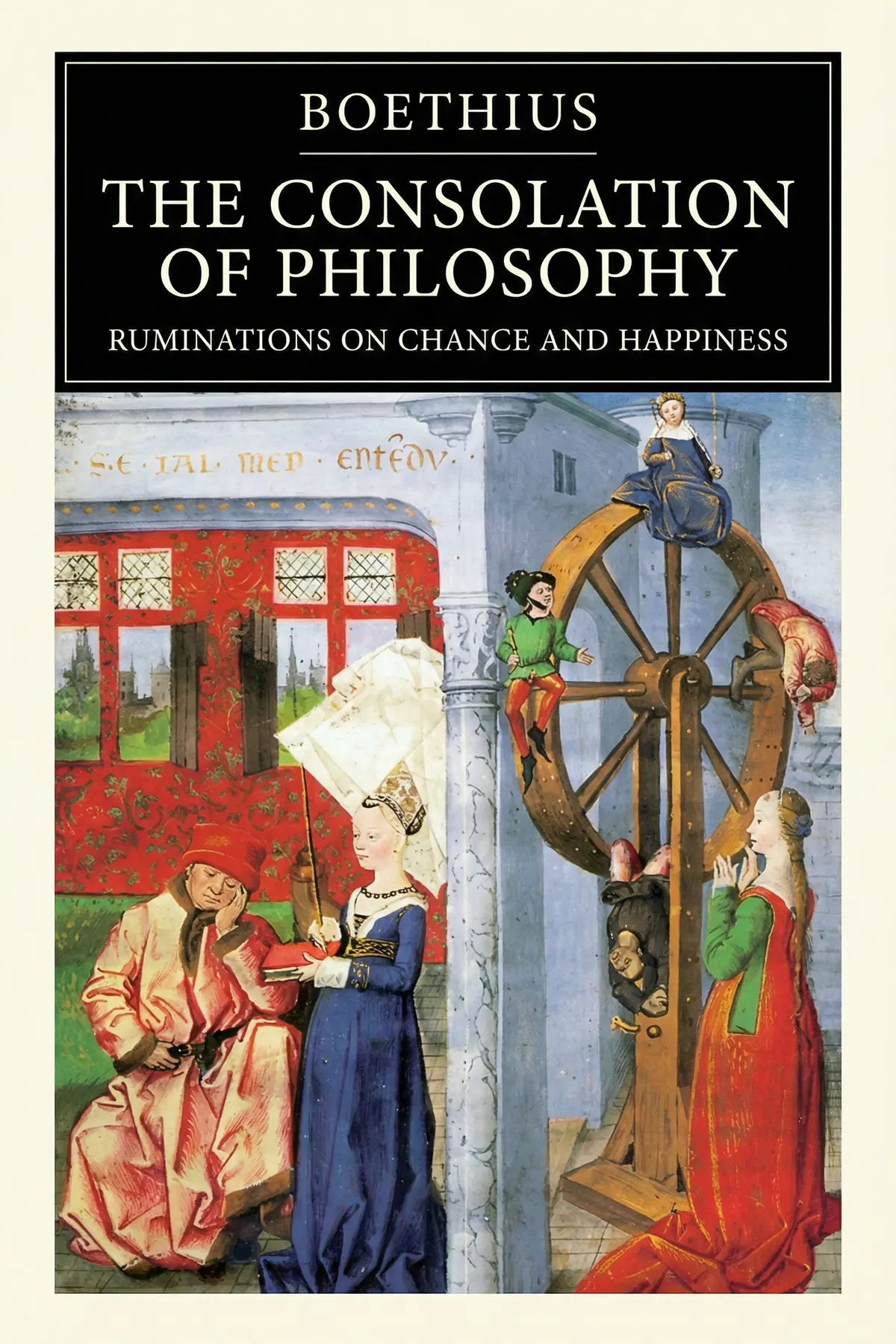
In the book, Fortune is pictured as a fickle woman who gives and takes as she pleases. Wealth, beauty, honor and power are her gifts, and Philosophy argues that each is temporary. Fortune’s desertion should not shock anyone, because inconsistency is her nature. Philosophy even claims that bad fortune does a favor: by changing, Fortune drops her mask and shows what she always was.
Under Philosophy’s questioning, Boethius admits that even at the height of his career he never felt truly happy. Philosophy explains that every lesser good is incomplete and leaves its owner anxious about losing it. Only God, the source of all being, lacks nothing, so only union with that highest good, in thought and action, brings lasting security and happiness.
Use Philosophy’s method on your own setbacks. Calm yourself before you argue with your grief. Treat a loss as information about what was never secure. List what makes you feel successful and ask which of those things would survive a change in luck. When the anxious voice speaks, answer it with a calmer one, as Boethius did by writing both sides of his dialogue.
No. The book does not end with his rescue, and history records that he was executed at about 44, reportedly beaten and then strangled. The Consolation ends instead with a personal deliverance that comes from accepting the divine will. His poems trace that change, moving from the despair of the opening lament toward acceptance of his fate.
John Rawls


William B. Irvine

Nigel Warburton
Colin Ward
AUDIO SUMMARY AVAILABLE
Get the key ideas from The Consolation of Philosophy by Boethius, plus 5,000+ more nonfiction titles.