

A Life Decoded: My Genome: My Life
J. Craig Venter
 English
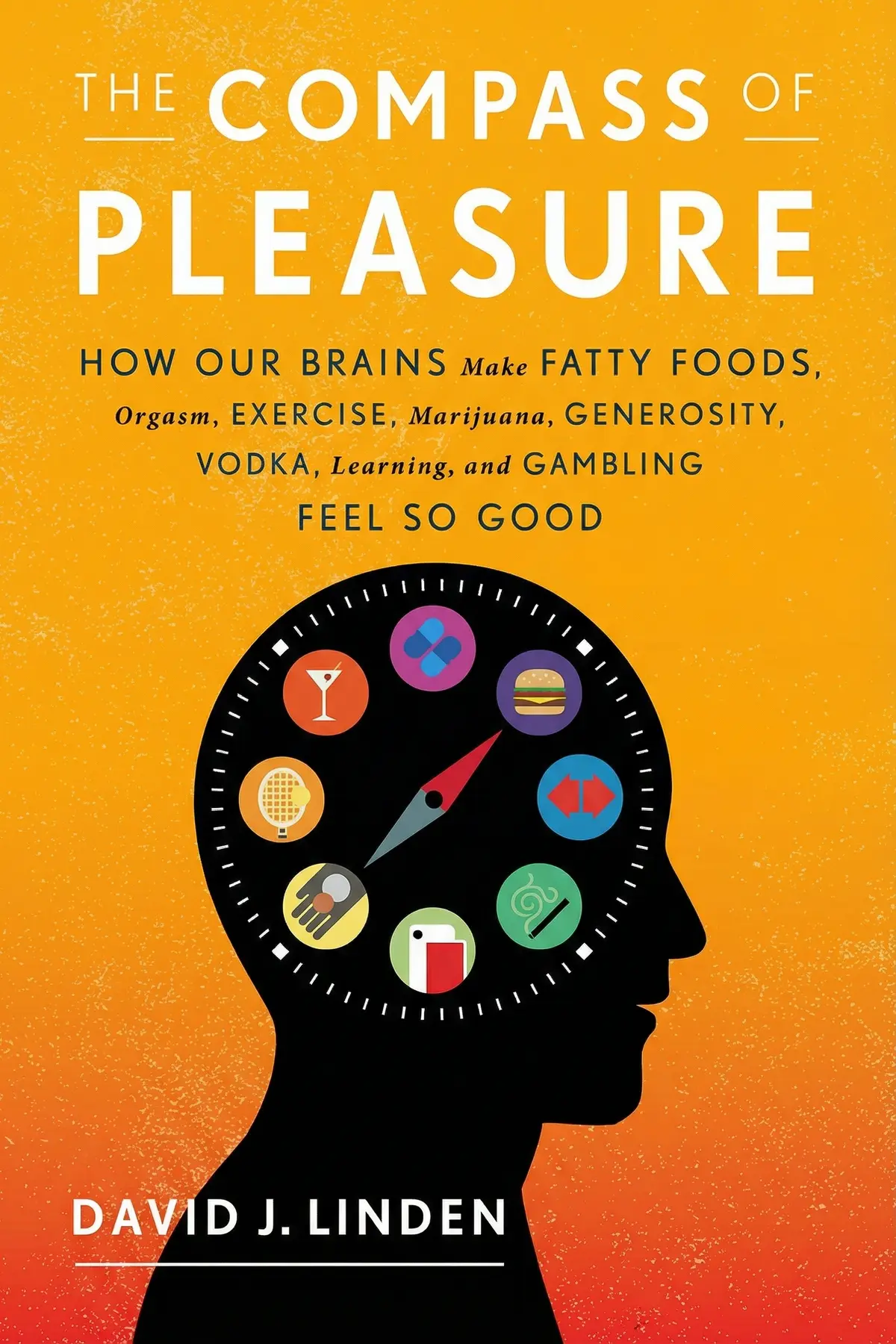
Shows how one brain circuit makes food, sex, love, drugs, gambling, exercise and giving feel good. It explains why some pleasures turn into addictions and how healthier ones can feed the same wiring.
1 min 04 sec
Most of us treat our pleasures as separate worlds: the dessert we earned, the drink after work, the bet, the run, the donation. In The Compass of Pleasure, Johns Hopkins neuroscientist David J. Linden argues that they all light up the same small set of brain structures, a pleasure circuit deep in the forebrain. Chocolate cake, an orgasm and a heroin injection feel very different, yet the brain processes them in much the same way.
That single fact changes how habits, cravings and addictions look. Linden’s case is that the strength, speed and setting of a reward decide whether it stays a treat or rewires us, and that the same circuit can be fed by healthy things too. Follow his argument and you will understand why cigarettes trap more people than heroin, why love clouds judgment, and why uncertainty thrills a gambler. You will also see how a brain that learned an addiction can learn its way back out.
1 min 56 sec
Chocolate cake, an orgasm and a heroin injection seem to belong to different worlds. A small set of brain structures says otherwise, and a contested experiment from the 1970s shows how far that wiring can push behavior.
1 min 52 sec
One drug acts far more strongly on the brain, yet the weaker one traps more than twice as many of its users. The reason lies in how often the reward arrives, and in where you can buy it.
1 min 54 sec
Your body has a built-in system meant to keep your weight steady without any effort from you. Linden explains how it can stop listening, and what pizza and chocolate do to make matters worse.
2 min 04 sec
Brain scans of couples reveal what infatuation switches off, and why an orgasm, oddly, can happen without any pleasure at all. The differences matter for anyone sizing up a new partner.
1 min 58 sec
Can something with no drug in it rewire the brain like one? Monkeys watching a blue light and a gambler raised in betting dens point to two very different sources of the pull.
1 min 48 sec
Pain, taxes and curiosity seem like unlikely rewards. Studies of runners, donors and inquisitive monkeys suggest they reach the same circuit as a vice, without the lasting damage a vice can do.
1 min 10 sec
Linden’s compass points the same way for the gambler, the smoker, the lover and the runner. One circuit hands out the rewards, and a brain that keeps receiving them changes its shape to chase them. That is the uncomfortable part. The encouraging part is that the shaping never stops. A brain flexible enough to learn an addiction is flexible enough to unlearn it.
Linden’s own advice builds on that. When you are trying to quit something, stop replaying its best moments and deliberately recall its worst ones: the frightening high, the hangover that felt like seasickness. Tie the habit to those memories, and the circuit has less to pull you back with.
Beyond that, watch how often a pleasure pays out, since quick and frequent rewards train the brain fastest, which is how cigarettes outrun heroin. And give the circuit better material: the run that ends in a high, the gift that registers like a payday, the question you look up only because you want to know.
Pleasure, in Linden’s account, is a teacher, and you get some say in what it teaches.
Most of us sort our pleasures into separate boxes: treats, vices, romance, exercise, good deeds. Neuroscientist David J. Linden argues that the brain does not. A single pleasure circuit in the medial forebrain responds to all of them, sending dopamine to the parts of the brain that handle emotion and that learn habits. From that starting point, Linden takes on some puzzles. He asks why cigarettes hook more people than heroin, why the body's own weight control fails against sugar and fat, and why falling in love blunts judgment while sex does not. He also explains how gambling can be a true addiction without any drug involved. He uses studies of monkeys waiting on uncertain rewards, rats given cocaine and couples in brain scanners, along with the memoir of a gambler raised in betting dens. Readers get a clear model of why cravings form and why some habits grow so hard to break. They also learn that running, giving and plain curiosity reach the same circuit, and they get one concrete technique for retraining a brain that has learned to want the wrong thing.
People fighting a habit, from smoking to late-night snacking, who want to know why it holds on.
Readers curious about the brain science behind love, gambling and runner's high.
Anyone looking for healthier ways to get the same reward their vices give them.
David J. Linden is a professor of neuroscience at the Johns Hopkins University School of Medicine in Baltimore, where his laboratory has long studied how brain cells store memories. He has served as chief editor of the Journal of Neurophysiology. He is also known for explaining brain science to general audiences, on radio and at college events, and he wrote The Accidental Mind, an earlier bestseller about the biology of behavior.
Listeners find the book offers an educational glimpse into modern neuroscience, with one listener mentioning that the science is described in extremely understandable ways. Furthermore, the writing is skillfully composed and full of humor, and listeners value the exploration of pleasure's neurology, as one review highlights how pleasure circuits interact with memory circuits. However, there are conflicting views regarding its accessibility, as some find it simple to follow while others consider it quite dense.
I never thought I’d be so emotionally invested in the sex lives of prairie voles, but here we are. The chapter on love and bonding was easily the highlight of the book for me, explaining the role of vasopressin and dopamine receptors in a way that felt both clinical and surprisingly moving. Linden’s writing is infused with a dry wit that makes even the most complex anatomical descriptions palatable. Frankly, it’s refreshing to read a science book that doesn’t take itself too seriously while still delivering high-quality research. I learned so much about the "compass" that guides our cravings, from gambling habits to why we can't stop at just one slice of pizza. It’s a total braingasm for anyone interested in the biological roots of human behavior. Highly recommended for the curious reader who likes some humor with their science.
Show moreEver wonder why humans are the only species that can get a dopamine hit from an abstract idea or a religious experience? Linden explores this "superpower" with incredible depth, showing how our pleasure circuitry has evolved to support learning and complex cognition. The way he breaks down the neurobiology of the "Santa-gift" dopamine hits our brains give us for achieving arbitrary goals is nothing short of brilliant. This book isn't just about the dark side of addiction; it's about what makes us uniquely human. The prose is well-crafted, and the insights into how the thalamus regulates our long-term weight regardless of our dieting efforts were eye-opening. It changed how I view my own cravings and the invisible forces that drive my daily decisions. A masterclass in making the complex understandable.
Show moreFinally got around to reading this, and I’m kicking myself for waiting so long. It is an essential read for anyone trying to understand the intersection of biology and behavior. Linden manages to explain why we crave everything from heroin to a high-five, showing that the neural pathways are often the same regardless of the stimulus. The humor is spot-on, particularly when discussing the "messy" reality of monogamy in the animal kingdom. Look, if you want to understand why your brain rewards you for things that are clearly bad for your long-term health, this is the book for you. It’s a fantastic insight into the human mind, delivered with the expertise of a world-class neuroscientist and the flair of a gifted storyteller. Five stars for the clarity and depth provided here.
Show moreDavid Linden has a knack for making neurobiology feel like a dinner party conversation. He dives deep into the VTA and the medial forebrain bundle, but he does it with enough wit to keep a non-scientist from drowning in jargon. I particularly enjoyed how he connects our primal urges—like eating and sex—to the same circuits that get hijacked by narcotics. It’s a fascinating look at why we do the things we do, even when we know they're bad for us. To be fair, some sections on chemical modifications and enzymes like COMT were a bit of a slog, but the overall narrative remains engaging. If you've enjoyed books like "The Accidental Mind," you'll find this to be a worthy successor that balances hard data with genuine human curiosity. The writing is well-crafted and keeps you moving through the dense parts.
Show morePicking this up was a gamble that paid off, much like the Bill Lee anecdote Linden uses to illustrate the highs and lows of the betting world. The book provides a thorough exploration of the addiction axis—tolerance, craving, and the terrifying cycle of relapse—all through the lens of our neural wiring. I was particularly struck by the discussion on how our pleasure circuits interact with memory, making certain triggers almost impossible to ignore. Linden writes with a certain elegance, though he doesn't shy away from the gritty details of how drugs like cocaine and nicotine rewire our gray matter. My only real gripe is that the chapter on exercise felt a bit thin compared to the deep dives into substance abuse. Still, it’s a brilliant, informative read for those wanting to understand the 'why' behind their worst habits.
Show moreAfter hearing about Linden’s work on a podcast, I had to see if the book lived up to the hype. It does. The exploration of how our brains are "accidental" and how the pleasure center acts as a compass for survival is masterfully done. I was especially fascinated by the chapter on eating and the 1.2 million calories Linden tracked; it’s a great reality check for anyone who thinks weight loss is just about "willpower." The science is explained in a way that feels accessible but never "dumbed down." Not gonna lie, some of the animal study descriptions are a bit grim, but they are necessary to illustrate the points about how these circuits actually function. It’s a witty, well-paced journey through the parts of our brain we rarely think about. Definitely worth the read.
Show moreThe way Linden weaves together anecdotes and hard science makes this a standout in the pop-cog genre. I particularly appreciated the discussion on the "pleasure/learning center" and how it can be hijacked by commercial culture to create a Pavlovian society of consumers. It’s a sobering thought, but one that is backed up by fascinating data on synaptic connections and VTA activity. The writing is snappy and the pacing is generally good, though the lack of a strong concluding "call to action" might bother some readers. In my experience, it’s rare to find a scientist who can write this well for the public without losing the nuance of the research. It’s a slim volume but it’s packed with insights that will linger long after you finish the final page.
Show moreWhile the subject matter is undeniably fascinating, I found the execution to be a bit of a mixed bag. Linden is clearly brilliant, and his passion for neuroscience shines through every page, but the technical density is real. Look, I don’t mind a challenge, but when the text starts spiraling into specific protein modifications like DARPP-32, my eyes began to glaze over. It feels like a textbook at times, which might alienate readers looking for a breezy "pop-science" read. Additionally, the research feels a little dated now, especially the sections on video games and exercise, where the science has moved on significantly since 2011. It’s a solid, informative peek into the brain's reward system, but you’ll need some serious stamina to get through the more academic passages. Useful, but definitely dry in spots.
Show moreYet another entry in the crowded field of "brain books," and while it’s better than most, it still suffers from some common tropes. Personally, I found the focus on the dopamine system to be the strongest part of the book, but the sections on gambling and meditation felt like they were treading very familiar ground. Linden’s wit is a plus, and he certainly knows his stuff, but the middle sections felt a bit repetitive. The book describes the science in extremely understandable ways at first, then suddenly dives into the deep end of biochemistry without much warning. It’s an interesting short book if you’re new to the topic, but seasoned readers of neuroscience might find themselves skimming the parts they've already read elsewhere. A decent 3-star effort that lacks a bit of modern punch.
Show moreNot what I expected given the rave reviews I've seen elsewhere. The truth is, this book feels incredibly stuck in its era, and the tone oscillates wildly between being overly simplistic and frustratingly technical. I was hoping for more practical insights into overcoming addiction or understanding my own habits, but instead, I got a lot of descriptions of lab rats and monkeys being poked and prodded. It felt more like a technical manual for a first-year neuroscience student than a book for a general audience. The humor often felt forced, and the lack of a definitive conclusion left me feeling unsatisfied. If you're looking for a modern take on brain science that offers actionable advice, there are better, more recent options available that don't feel quite so dated and clinical.
Show moreDavid J. Linden argues that every pleasurable experience, from fatty food and sex to heroin, gambling, exercise and charity, activates one pleasure circuit in the brain’s medial forebrain. Dopamine released there links enjoyment with learning to repeat it. Depending on how strong, frequent and available a reward is, that learning can turn into addiction, which physically changes the brain. Healthier pleasures can reach the same circuit without the damage.
Linden cites a US study in which 80 percent of people who tried cigarettes became addicted, against 35 percent of heroin injectors who kept using. Legality, availability, peer attitudes and rituals all play a part. So does the pattern of reward: heroin gives one big surge, while smoking gives many small rushes a day, so the brain learns the habit faster, like a dog rewarded for a trick many times daily.
Linden’s advice is to swap the associations you hold with the habit. Instead of remembering its good moments, deliberately recall the bad ones, such as a frightening high or a miserable hangover. Because the brain is malleable, the same flexibility that built the addiction can help undo it. He also shows that running, giving and learning activate the same pleasure circuit, which makes them useful substitutes.
Yes. Linden says both activate the pleasure circuit but in different ways. Falling in love switches off brain centers for judgment and social cognition, which is why a loved one seems better than everyone else; Lucy Brown’s brain scans of couples showed areas responding only to a partner’s photo. Orgasm usually brings a dopamine surge, as Gert Holstege’s scans showed, though it can sometimes occur without pleasure.
J. Craig Venter

Richard Wiseman

Carl Zimmer


Bill Bryson


Jeff Hawkins



Steven C. Hayes
AUDIO SUMMARY AVAILABLE
Get the key ideas from The Compass of Pleasure by David J. Linden, plus 5,000+ more nonfiction titles.









