

A Short History of Nearly Everything
Bill Bryson
 English
A story-driven tour of chemistry's milestones, from bronze and gunpowder to leaded fuel and engineered enzymes. It shows how people used chemicals long before understanding them, and why that gap brought both cures and catastrophes.
1 min 05 sec
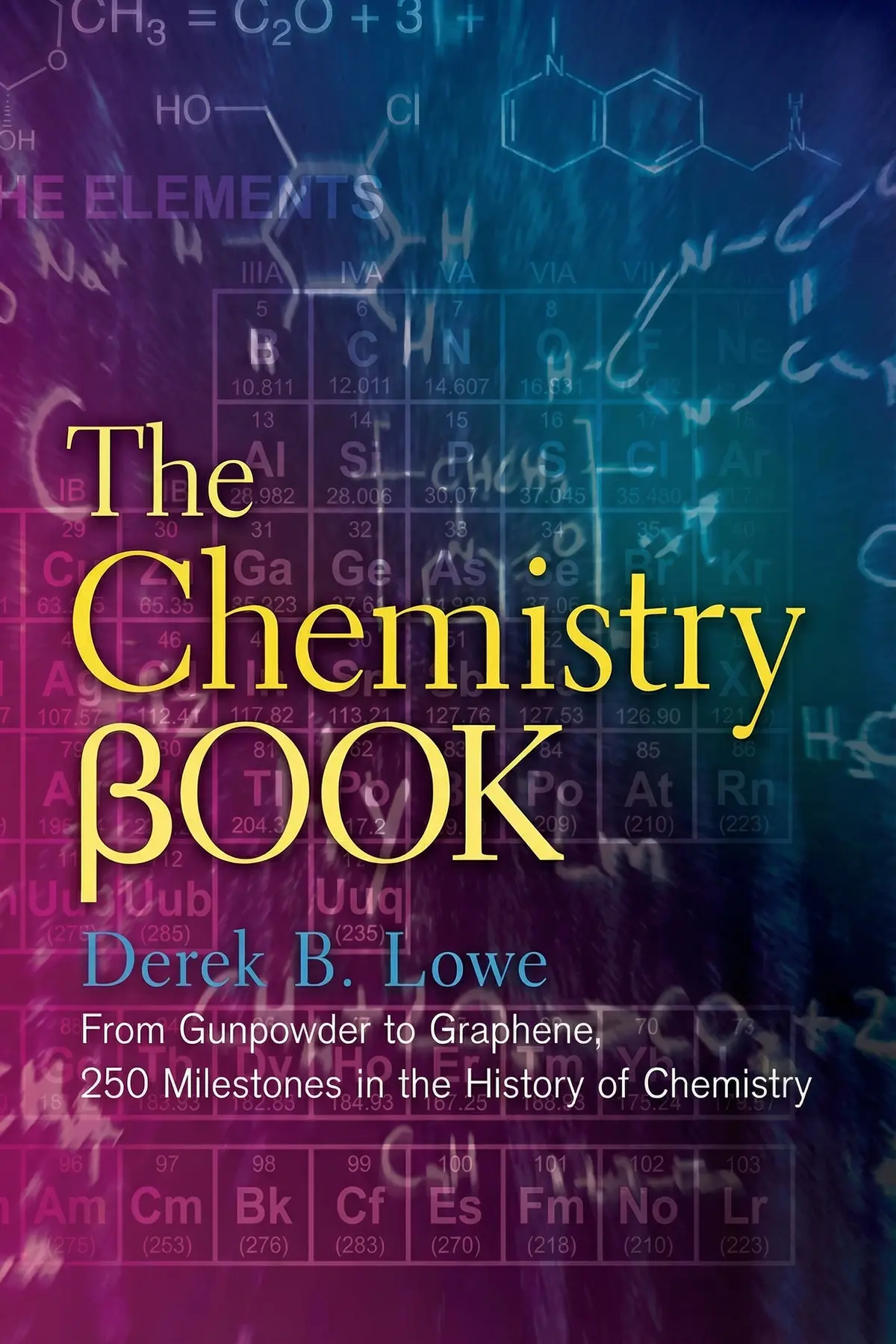
Most of us left chemistry behind after a school exam, yet it lives in the gold on a finger, the blue on a gallery wall and the air after a thunderstorm. Even the word gibberish is chemical: it comes from the coded manuscripts that followers of an eighth-century alchemist wrote in his name. In The Chemistry Book, medicinal chemist Derek B Lowe moves through 250 milestones, from the first bronze to engineered enzymes.
His best stories share one pattern. For most of history, people used chemicals long before they understood them, and that gap produced both chemistry’s greatest gifts and its worst disasters. Alchemists hunting gold found gunpowder. A dye maker aiming for red got blue. A popular tonic killed its loudest fan.
Follow the gap across the centuries and much of the modern world makes sense, along with a sharper instinct for the next product someone swears is safe.
1 min 47 sec
Bronze is harder than iron and resists rust far better, yet iron replaced it. The reason has little to do with quality, and it still explains which materials win.
2 min 00 sec
An emperor built a river of liquid metal for his tomb, and alchemists chased an elixir that could transform metals. Their goals were impossible, yet what they stumbled on changed warfare and surgery.
2 min 05 sec
Europe owned Chinese porcelain for centuries and still could not make it, and a bark from South America cured a disease nobody could explain. Each puzzle took generations to crack.
1 min 50 sec
A contaminated pot of dye and a scorched lab apron both looked like failures. The people involved could have cleaned up and moved on, and history would have lost a famous color and an explosive.
1 min 57 sec
Mirrors, gold jewelry and a fashionable health tonic all carried risks their users never saw. One wealthy believer paid the highest price, and his death changed how products reach the shelves.
2 min 02 sec
A chemist stood before reporters and breathed in his own invention to prove it harmless. It took a scientist measuring the age of the Earth to reveal what that invention was doing to the whole planet.
2 min 07 sec
Computers tested tens of thousands of versions of one enzyme to make a single drug. The same kind of thinking is now aimed at a plant molecule that works strangely slowly.
1 min 07 sec
Lowe’s milestones add up to a story about timing. Chemistry has nearly always run ahead of chemists. People smelted iron, fired porcelain and treated malaria with bark long before anyone could explain why it worked, and that head start brought anesthesia, dynamite and an affordable blue. The same head start put mercury in an emperor’s medicine, radium in a tonic and lead in the air, until patient measurement like Patterson’s caught up.
That pattern changes how you hear a sales pitch. When a new material, supplement or fuel is praised for how well it works, ask the second question: does anyone know what it does over decades, and who has checked? A dramatic demonstration, like Midgley sniffing lead in front of reporters, proves nothing. And notice the small accidents in your own work, since a burning apron and a wrong-colored dye mattered only because someone stopped to look.
Chemistry’s next chapter may depend on a slow plant enzyme. Whether we understand it before we rely on it is still an open question.
Chemistry can feel like a school subject best forgotten. Yet it shapes the metal in a bell, the color on a canvas, the drugs in a medicine cabinet and the air overhead. Medicinal chemist Derek B Lowe tells its history through 250 milestones, from Bronze Age smiths to engineers redesigning enzymes by computer. Running through his stories is a striking pattern. People nearly always put chemicals to work before they understood them. Chinese alchemists chasing metal transmutation and life-extending elixirs likely stumbled onto gunpowder. A contaminated batch of dye produced Prussian blue, whose chemistry took more than 250 years to unravel. The same gap let radium tonics, leaded gasoline and Freon spread for years before anyone measured the damage. Readers get a compact tour of how humanity learned to handle matter. They also get a practical habit of mind: when something works impressively, ask who actually knows why and what it does over time. The book closes on the chemistry that might cut carbon dioxide, from hydrogen fuel to a faster version of photosynthesis.
Curious readers who forgot school chemistry and want its history told through vivid, true stories.
Professionals in health, energy or manufacturing who want perspective on how useful chemicals turned harmful.
Students and teachers looking for memorable cases that bring the history of science to life.
Derek B Lowe is a medicinal chemist who built his career in the pharmaceutical industry, with work at Bayer, Vertex and Novartis. He started the blog In the Pipeline, regarded as one of the first science blogs, which covers the scientific, business and legal sides of drug discovery. He has also written a column for Chemistry World.

Listeners describe this chemistry guide as a superb informational resource, with one listener mentioning that it offers a non-technical overview of major breakthroughs. Furthermore, the work is highly accessible and straightforward, contains beautiful imagery, and listeners praise the author's prose. They also prize the focus on history, with one listener emphasizing its ability to teach children about the background of the field, and view it as a valuable asset for high school collections.
This book is a visual masterpiece that manages to make the "central science" feel approachable and alive. Derek Lowe avoids the dry, textbook jargon that usually puts people to sleep, opting instead for a chronological tour of human curiosity. From the massive gypsum crystals in Mexico to the eventual discovery of synthetic urea, every single page is a self-contained story. Personally, I found the layout perfect for a coffee table because you can just dip in and out without losing the thread of the narrative. To be fair, if you are looking for deep mathematical equations, you might want to look elsewhere. However, for a casual reader who wants to understand how we got from smelting bronze to predicting the future of hydrogen fuel, this is absolute gold.
Show moreThe chapter on Prussian blue was the exact moment I realized I was going to love this book. It’s wild to think that a failed attempt at making red paint accidentally gave us one of the most important pigments in art history. Derek Lowe has a real knack for finding these kinds of ironies, like how the quest for eternal life led to the invention of gunpowder. The writing style is brisk and engaging, making it easy to finish three or four entries in a single sitting before you even realize it. Some of the tragedies, like the Bhopal disaster and the realization of what CFCs were doing to our ozone, serve as sobering reminders of our responsibility. I appreciate that the book doesn’t just celebrate wins but also acknowledges the heavy cost of certain advancements.
Show moreChemistry is often called the central science, sitting right between physics and biology, and this book proves why that title is so well-deserved. From the ancient perfume makers in Babylon to the future of artificial photosynthesis, you can see how chemistry touches every single aspect of human existence. It’s a fascinating journey filled with "happy accidents" that changed the world forever, like the discovery of ether as an anesthetic. I loved how the author included the names and faces of luminaries like Pauling and Watson, giving a human element to the science. The book makes you realize that every modern convenience we have is the result of centuries of trial, error, and sometimes total disaster. It’s an inspiring read that makes me feel optimistic about what the next hundred years of chemistry might bring.
Show moreWow, I never thought a book about chemistry could be this emotional. Seeing the timeline of human achievement—from the first copper tools to the tragic brilliance of the Radium Girls—is a real rollercoaster of a read. Derek Lowe writes with a lot of heart and a clear passion for his subject, making the complex reactions feel like parts of a grand, unfolding drama. I was particularly struck by the entries on the Lydian gold secrets and the "Chinese snow" that became gunpowder. The book is definitely not a technical manual, but it’s a beautiful tribute to the people who risked everything to understand how our world is built. If you have even a passing interest in history or science, you really should check this out.
Show moreEver wonder why your high school chemistry teacher was so obsessed with the periodic table? This volume provides the necessary context by focusing on the colorful characters and tragic accidents that defined the field. I bought this for my teenager, and it has been a fantastic way to introduce the "why" behind the "what" of their science curriculum. The stories about Tapputi, the world’s first recorded chemist, and the strange history of King Croesus’s gold refinement are genuinely gripping. It’s written in a way that doesn’t require a PhD to follow along, yet it never feels like it's talking down to the reader. My only minor gripe is that some of the later 20th-century entries feel a bit rushed compared to the ancient history.
Show moreAs a librarian, I am always on the hunt for science books that can bridge the gap between "too simple" and "impenetrable." This collection of 250 milestones is exactly what our high school section needed to provide some historical weight to the students' lab work. The entry on the Bronze Age alone explains so much about human trade and migration that you wouldn't typically find in a science text. It’s approachable and visually stunning, making it a great "gateway" book for kids who think they hate chemistry. Truth is, the anecdotes about alchemists and their secret Lydian techniques are much more memorable than a list of properties. It’s a sturdy, beautiful volume that should be on every science lover's shelf.
Show morePicked this up on a whim because the cover looked interesting, and I’ve been pleasantly surprised by how much I actually learned. The chronological format means you get to see how one discovery, like the isolation of quinine, eventually paved the way for complex organic synthesis. I especially liked the section on the transition from the Bronze Age to the Iron Age, as it highlighted that availability often beats quality. The book is very easy to read and understand, which is a relief because chemistry can be so intimidating. Some might find the one-page-per-topic limit a bit restrictive, but it keeps the pace moving along at a healthy clip. It's a great choice for anyone who wants a broad overview without getting bogged down in the weeds.
Show moreFinally got around to finishing this after dipping in and out for nearly two months. It isn't the kind of book you rush through; it's much better enjoyed as a daily dose of "did you know?" trivia. The stories about the discovery of mercury's toxicity and the unintended consequences of Freon were particularly eye-opening for me. I also really appreciated the forward-looking chapters on reducing carbon dioxide and the potential for clean hydrogen energy. It's rare to find a science book that covers such a massive span of time—from 3300 BCE to the year 2030—without losing its focus. While it might be a bit too heavy to carry around on a commute, it’s a wonderful addition to any home library.
Show moreIn my experience, most science "survey" books tend to be either overly academic or way too simplified for an adult reader. Derek Lowe manages to strike a decent balance here, though I found myself wishing for a bit more organizational structure beyond just the timeline. Because each milestone is a single page, you sometimes miss the cumulative logic that connects these breakthroughs together. For instance, the leap from Robert Boyle’s atomic theories to modern toxicology could have been tied together more explicitly. Still, the quality of the writing is high, and the images are genuinely compelling to look at while you're drinking your morning coffee. It’s a solid 3-star read that functions better as a reference guide than a cover-to-cover narrative.
Show moreNot what I expected at all, especially considering the title and the price tag. While the descriptions of the 250 milestones are decent enough, the claim of being "lushly illustrated" is frankly a bit of a stretch. You get one stock photograph per entry, but there isn't a single chemical structure or diagram to be found in the entire book. How can you have a book about chemistry without showing the actual molecules or the mechanisms behind the reactions? It feels like a history book that just happens to be about chemicals rather than a science book. If you're looking for a serious reference or something to help with your studies, this is going to be a major disappointment. It’s okay for a quick browse in a waiting room, but it lacks the technical depth I was hoping for.
Show moreIt traces 250 milestones in chemistry, from Bronze Age metalworking and Chinese gunpowder to leaded gasoline, engineered enzymes and hydrogen fuel. A clear pattern runs through the stories: people usually used chemicals long before they understood them. That gap gave the world porcelain, quinine and anesthesia, but it also let mercury medicines, radium tonics and Freon spread before anyone grasped the harm they caused.
Charles Kettering of General Motors and chemist Thomas Midgley Jr. developed tetraethyl lead in 1921 to make fuel burn more evenly. Midgley publicly declared it safe, even holding it under his nose, while already recovering from lead poisoning. Geological chemist Clair Cameron Patterson later showed with worldwide samples that leaded fuel had become the planet’s main source of lead pollution, and many countries banned lead in gasoline, paint and pipes.
Several did. Johann Jacob Diesbach tried to make a red dye in 1706 and, because his reagents were contaminated, produced Prussian blue. Christian Friedrich Schönbein wiped up an acid spill with his cotton apron, which burst into flame by the fire and led to guncotton. Chinese alchemists searching for life-extending elixirs found gunpowder instead. In each case, someone paid attention to an unexpected result.
Lowe looks to chemistry that cuts carbon dioxide. Hydrogen burns to only water vapor, but it is hard to store because its tiny molecules seep into metal; he expects that problem solved by around 2025. He also places artificial photosynthesis around 2030, possibly built on a faster version of Rubisco, a plant enzyme that manages only three molecular changes per second.
It suits curious readers with no chemistry background who enjoy history told through people and surprises, from an imprisoned alchemist cracking porcelain to a steel magnate killed by a radium tonic. It also serves professionals and students who want to understand how substances such as cyanide, Freon and methyl isocyanate became useful, dangerous or both, and what that history suggests about trusting new products.
Bill Bryson

Philip Freeman

Jeff Hawkins



Michael Axworthy


Tom Standage

AUDIO SUMMARY AVAILABLE
Get the key ideas from The Chemistry Book by Derek B Lowe, plus 5,000+ more nonfiction titles.









