

14 min 42 sec
Available in: English
The Case for Good Jobs: How Great Companies Bring Dignity, Pay, and Meaning to Everyone's Jobs
By Zeynep Ton
Zeynep Ton shows why paying only the market rate keeps companies stuck in expensive turnover, and how better pay combined with four operating choices lets firms serve customers well while staying profitable.
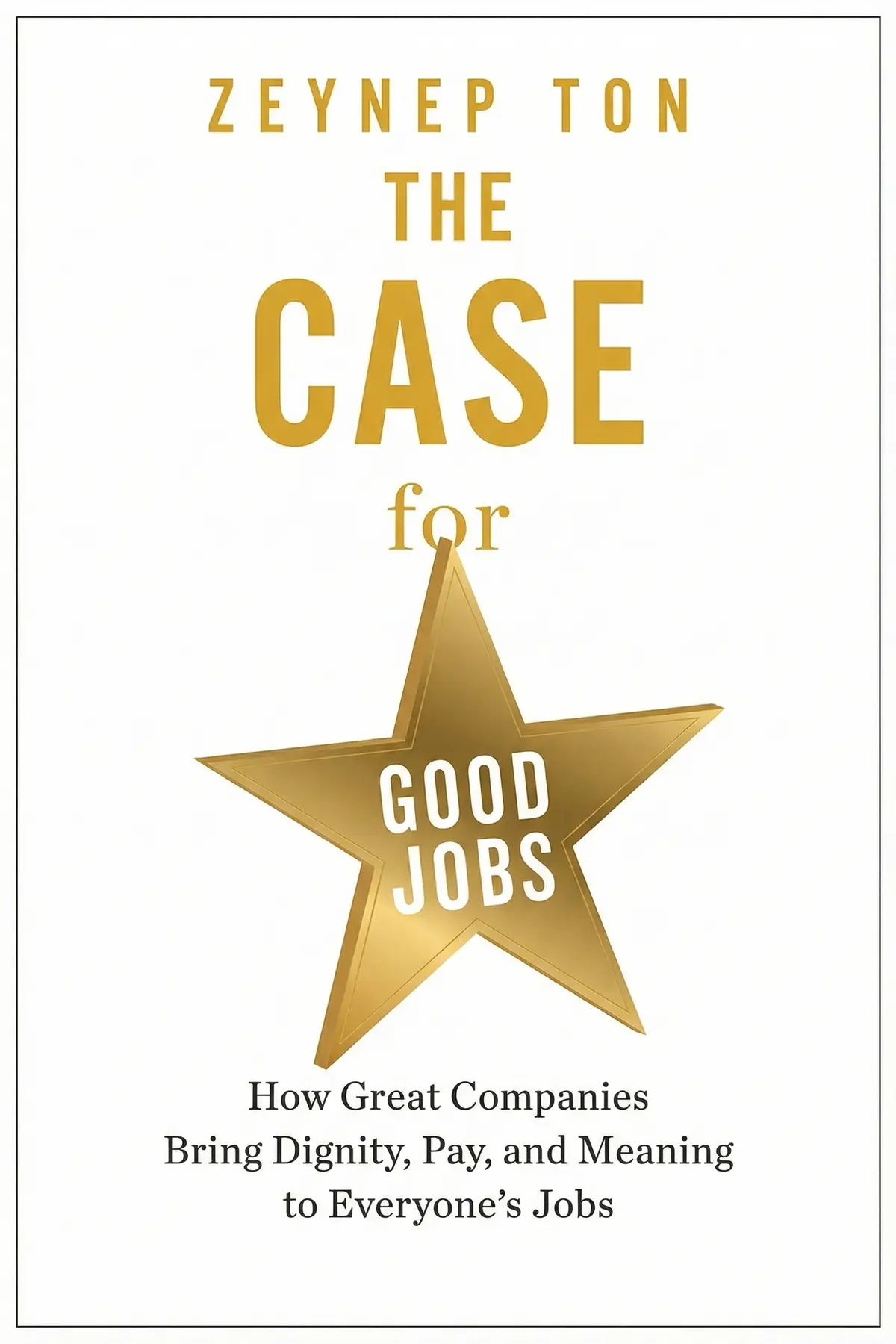
Table of Content
1. Introduction
58 sec
If you run a team or a company, you have probably been told that paying the market rate is the responsible choice. In The Case for Good Jobs, MIT Sloan professor Zeynep Ton argues that this rate can be a trap: it often fails to cover basic needs, and the company pays for that gap many times over through turnover, errors and lost sales. At PayPal, a firm built to bring financial services to everyone, leaders learned that some staff on market pay were eating at soup kitchens.
Ton’s case is that good jobs are a business design, and a profitable one. Pay people enough to live, then reshape the work so each person contributes more, and a company escapes the cycle of understaffing and churn while serving customers better. Ahead are the real price of low pay, the four operating choices behind firms like Costco and Mercadona, and a practical order for making the switch inside your own organization.
2. Check whether your pay covers a real life
2 min 07 sec
A company devoted to making money easier for ordinary people found its own employees in money trouble. The gap behind that discovery reaches far beyond one firm, and it quietly shapes how well people can do their jobs.
3. Low pay already costs more than a raise
2 min 04 sec
Finance teams usually see a wage increase as money leaving the building. One insurer added up a different set of numbers and found it was spending far more by standing still.
4. Stop blaming workers for a broken system
2 min 03 sec
When service slips, managers tend to look for the careless employee. Ton points to something larger that turns willing people into poor performers, and to a habit of thinking that keeps leaders from seeing it.
5. Four design choices that make better pay affordable
2 min 07 sec
One company raised wages and barely dented its turnover. Others cut it by half. The difference lay in changes most leaders never think of as part of a pay decision.
6. Low prices and good jobs can share a store
2 min 04 sec
Executives often admire generous employers but assume the model would sink their margins. A warehouse club, a Spanish grocer and a lab company tell a story that does not fit that assumption.
7. Make the switch by winning customers first
2 min 08 sec
Leaders who believe in better jobs often stall at the first budget meeting. Ton’s advice on where to begin, and who must lead, is not what most change programs look like.
8. Conclusion
1 min 11 sec
Ton’s argument comes down to where a company chooses to spend its money. Every low-wage, high-turnover firm already pays for bad jobs, in overtime, rework, lost sales and managers who never stop fighting fires. Good jobs companies spend that money on purpose: on wages people can live on, and on work designed so each person adds more. Costco’s markup caps and Mercadona’s tiny turnover show that discipline and decent pay can live in the same business.
For a leader, the first move is a calculation. Set the full yearly cost of turnover beside the cost of a livable base wage, the way Aetna found $120 million on one side and $10.5 million on the other. Then look for the work your front line should never have to do, the billing error behind a third of the calls. And spend real time in a frontline role before deciding what the people there need.
For anyone who works on that front line or manages it, the book offers a different reading of the bad days: it is usually the system, rarely the person. A caregiver who cannot reach a resident for 45 minutes is not failing at her job. Her job was designed to fail her.
About this book
What is this book about?
Many companies pay the going rate, staff as thinly as they can and blame poor results on unreliable workers. Zeynep Ton argues that this approach is far more expensive than it looks. Low pay drives turnover, and turnover leaves managers fighting fires, headquarters distrusting the front line and customers getting worse service. Firms pay for it all in overtime, rework, errors and lost sales, often without ever adding up the bill. Ton, who teaches at MIT Sloan, builds her case on companies such as Aetna, PayPal, Costco, Mercadona, QuikTrip and Quest Diagnostics. She shows that wages people can live on become affordable when they come with a redesign of the work itself: focus and simplify, standardize and empower, cross-train and operate with slack. Together these choices make each employee more productive. The book follows her earlier The Good Jobs Strategy and adds what that book lacked: a practical route for moving an existing company from the vicious cycle to a good jobs system. Leaders get a way to measure what bad jobs really cost, a design to replace them and an order of steps for making the change stick.
Book Information
Who it's for
Running high-turnover teams
Founders and operators running low-wage, high-turnover teams who suspect lean staffing is costing them customers.
Needing the business case
HR, operations and L&D leaders who need numbers to argue for better pay and job design.
Managers tired of firefighting
Frontline managers tired of firefighting and blaming staff for problems the system creates.
About the Author
Zeynep Ton
Zeynep Ton joined the faculty of the MIT Sloan School of Management in 2011 after teaching at Harvard Business School, and both schools have given her teaching awards. Her research looks at how companies create value when they invest in the people who work for them. She makes the case that well-designed jobs raise both productivity and customer satisfaction, a theme at the center of The Case for Good Jobs.
Ratings & Reviews
Ratings at a glance
What people think
Listeners find the text impactful, with one listener depicting it as a hands-on manual for putting a good jobs system into practice. The book also earns praise for its advantages regarding output, as one listener observes results in sustainable profit-growth. Finally, listeners value its accessible writing style, and one listener identifies it as a must-read for leadership in any sector.
Top reviews
Luckana
Zeynep Ton makes an ironclad case for why underpaying staff is a strategic failure rather than a cost-saving measure. This book functions as a practical guide for implementing a system that actually works for everyone involved. By focusing on productivity benefits and sustainable profit growth, she moves the conversation away from mere altruism toward cold, hard business logic. I was particularly impressed by the deep dive into the 'virtuous cycle' where raising pay and expectations leads to better customer service and lower turnover. It’s a must-read for managers in any sector because it challenges the 'vicious cycle' of firefighting and understaffing that plagues modern retail. Truth is, most execs think they are saving money by cutting labor, but Ton proves they are just leaving money on the table. The writing is punchy and accessible, making it easy to digest even for a busy professional.
Show moreTanawan
Wow, this was a refreshing departure from the typical corporate-speak you usually find in the business section. Ton surprised the hell out of me by arguing that employee autonomy and better wages actually drive higher margins. It’s a counterintuitive take for many, but the research she presents regarding the NUMMI experience and call centers is incredibly persuasive. Personally, I think the most valuable part was the discussion on 'operating with slack.' Most companies are so lean they break at the slightest pressure, but Ton shows how having extra capacity allows for better customer service. This book isn't just about being nice; it’s about being smart. The readability is excellent, and the logic is easy to follow. If you are a leader who feels stuck in a loop of high turnover and low morale, pick this up immediately.
Show moreRungtip
The transition from a 'firefighting loop' to a virtuous cycle is the core challenge of modern business, and Ton explains it brilliantly. I found her focus on 'standardize and empower' to be the most helpful takeaway. It sounds like a contradiction, but she shows how standard processes actually give workers the freedom to solve problems for customers. The book is highly readable and moves at a fast pace. I’ve already recommended it to several colleagues who are struggling with labor supply issues. The truth is, the current way of doing things—low pay, high turnover, constant chaos—is just too expensive in the long run. Ton provides a way out that benefits the bottom line and the human beings doing the work. This is easily one of the most impactful business books I’ve read in years.
Show moreAmy
This book functions as a blueprint for leaders who want to move beyond the 'vicious cycle' of low-wage labor. Zeynep Ton presents a very powerful case for why paying more can actually result in lower costs and higher productivity. I particularly liked the section on why companies are afraid to bet on people, specifically how our accounting systems are rigged against human capital. It’s a very economically aware book that doesn't shy away from the complexities of the U.S. labor market. The case studies are diverse, ranging from convenience stores to Quest Diagnostics, proving that these strategies are broadly applicable. Even if you don't agree with every single conclusion, the questions she raises about customer value and employee dignity are essential. If you want sustainable growth, you have to read this.
Show moreEleanor
Finally got around to reading this after seeing it on several 'best of' lists, and it lived up to most of the hype. Ton does a phenomenal job explaining why employers need to stop looking at industry standards when setting wages. Instead, they should look at the high cost of turnover and the 'trust loop' that occurs when employees are empowered. The case studies involving Quest Diagnostics and various grocery chains were particularly enlightening for me. I’ll admit, she sometimes drifts into the 'it’s the right thing to do' moral argument, which can weaken the purely economic case she builds so well. However, the actionable advice on how to match labor supply with demand is gold. It’s not rocket science, but it’s the kind of old-school management wisdom that has been lost in the era of hyper-optimized cost-cutting.
Show moreSomsak
As someone who has worked in retail management for a decade, this book hit close to home. Managers are often completely unaware of how mediocre their systems are because they are too busy putting out fires. Ton identifies this 'firefighting loop' perfectly. She argues that providing good jobs isn't just about the paycheck; it’s about dignity and the ability to do one’s job well. My only quibble is that the book can be a bit repetitive regarding the 'vicious cycle' mechanics. Still, the transition to the 'virtuous cycle' through raising expectations and improving schedules is laid out clearly. It is refreshing to see an academic who isn't just kissing the butts of C-suite executives but actually fighting for the frontline workers. This is an essential read for anyone looking to build a more resilient and profitable organization.
Show moreDimitri
After hearing so much about the 'Good Jobs Strategy' on the FT summer reading list, I had high expectations. Ton delivers a solid argument for why the 'corporate disability' of being unable to hire or train well is a choice, not a destiny. The book focuses heavily on the service industry, but I found the lessons applicable to white-collar environments too. You truly get what you pay for. The way she breaks down why investors and boards are often the biggest hurdles to these changes was eye-opening. Frankly, it’s a bit depressing how many companies are afraid to bet on people simply because they can’t quantify the benefit in a spreadsheet. While the writing is a bit conversational for my taste, the message is vital. It’s a call to action for a more humanistic and social form of management.
Show moreThanit
Ever wonder why service at some stores is consistently terrible while others thrive? This book provides the answer. It’s not just about the people; it’s about the system they are forced to work within. Ton’s approach toward salary discussion is unusual because she ties it directly to the peace of mind and dignity of the worker. I loved the emphasis on centering the journey around the customer to clarify value propositions. Not gonna lie, I was skeptical at first that this would just be another 'be kind' manifesto, but the economic awareness is sharp. She handles the implementation risks honestly. While it might not offer a magic wand for your margins overnight, the ideas on motivating cash flow through employee value are solid. It’s a great piece of non-fiction for anyone tired of the status quo.
Show moreMind
The premise here is certainly noble and supported by existing research, but I struggled with the lack of new, independent data provided by the author. At times, the book reads more like a casual conversation or a long-form advertisement for Ton’s consulting practice rather than a rigorous academic work. It felt like a solid blog post that was stretched and stretched until it reached book length. While I agree with the core idea that focusing and simplifying operations helps employee engagement, the evidence presented often felt anecdotal rather than comprehensive. For instance, citing a tiny sample size of clients to support massive industry shifts didn't quite pass muster for me. That said, the four pillars—focus, standardize, cross-train, and operate with slack—are useful frameworks for any business leader. It’s worth a skim, but don't expect a deep scientific breakthrough.
Show morePreeda
Look, I appreciate what the author is trying to do here, but the fatal flaw is one common to many business books: picking a conclusion and then hunting for anecdotes to support it. Ton concludes that retailers stocking fewer products increases engagement, then finds two retailers who do it and calls it proof. This is not academic-level research that stands up to scrutiny. To be fair, the 'four pillars' are decent common-sense advice, but I found the book lacked a real blueprint for implementation. It’s full of surface-level platitudes when what we really need is a granular guide to navigating the accounting systems that disfavor good jobs. It felt like a collection of success stories without enough variable isolation to prove her points. It’s an okay read for a flight, but don't expect a rigorous manual for change.
Show moreQuestions about this book
What is the main idea of The Case for Good Jobs?
Zeynep Ton argues that paying only the market rate, which often cannot cover basic living costs, traps companies in a vicious cycle of turnover, understaffing, mistrust and poor service. She shows that firms already pay heavily for that cycle. Pairing a livable wage with four operating choices, focus and simplify, standardize and empower, cross-train and operate with slack, makes workers more productive and lets the company win with customers.
How much does employee turnover really cost a company?
Far more than most executives assume, according to Ton. At Aetna, voluntary turnover cost $27 million a year directly and $120 million once absenteeism, rework, overtime and errors were counted, while a $16 base wage would have cost $10.5 million. At one financial services call center with 40 percent turnover, the direct cost of that churn equaled 45 percent of total payroll.
What are the four operating choices in the good jobs system?
Focus and simplify means cutting excess products and promotions so every decision helps the front line serve customers. Standardize and empower means clear standards that employees help write, plus authority to fix problems. Cross-training lets people handle both customer-facing and back-of-house work. Operating with slack means scheduling slightly more labor than the minimum, so staff can absorb busy periods and improve how work is done.
How can a company start moving to good jobs?
Ton advises framing the change around winning with customers, benchmarking against exemplary firms such as QuikTrip, and starting with triage: competitive pay, predictable schedules, clear expectations, career paths and enough time to do the work. Make upstream changes and pay investments early, remove unnecessary tasks while raising pay, and use pilots to learn how to change. The biggest transformations she has seen were led by the CEO or COO.
Readers also enjoyed




A Year with Peter Drucker: 52 Weeks of Coaching for Leadership Effectiveness
Joseph A. Maciariello





Acting with Power: Why We Are More Powerful Than We Believe
Deborah Gruenfeld
AUDIO SUMMARY AVAILABLE
Listen to The Case for Good Jobs in 15 minutes
Get the key ideas from The Case for Good Jobs by Zeynep Ton, plus 5,000+ more nonfiction titles.
- 5,000+ titles
- Listen as much as you want
- 7-day free trial
- Cancel anytime









