

12 min 56 sec
Available in: English
The Blueprint: 6 Practical Steps to Lift Your Leadership to New Heights
A six-step method for building your own leadership model: define your purpose, mine your experience, learn from leaders you admire, then turn it all into repeatable habits and a five-day plan to start.
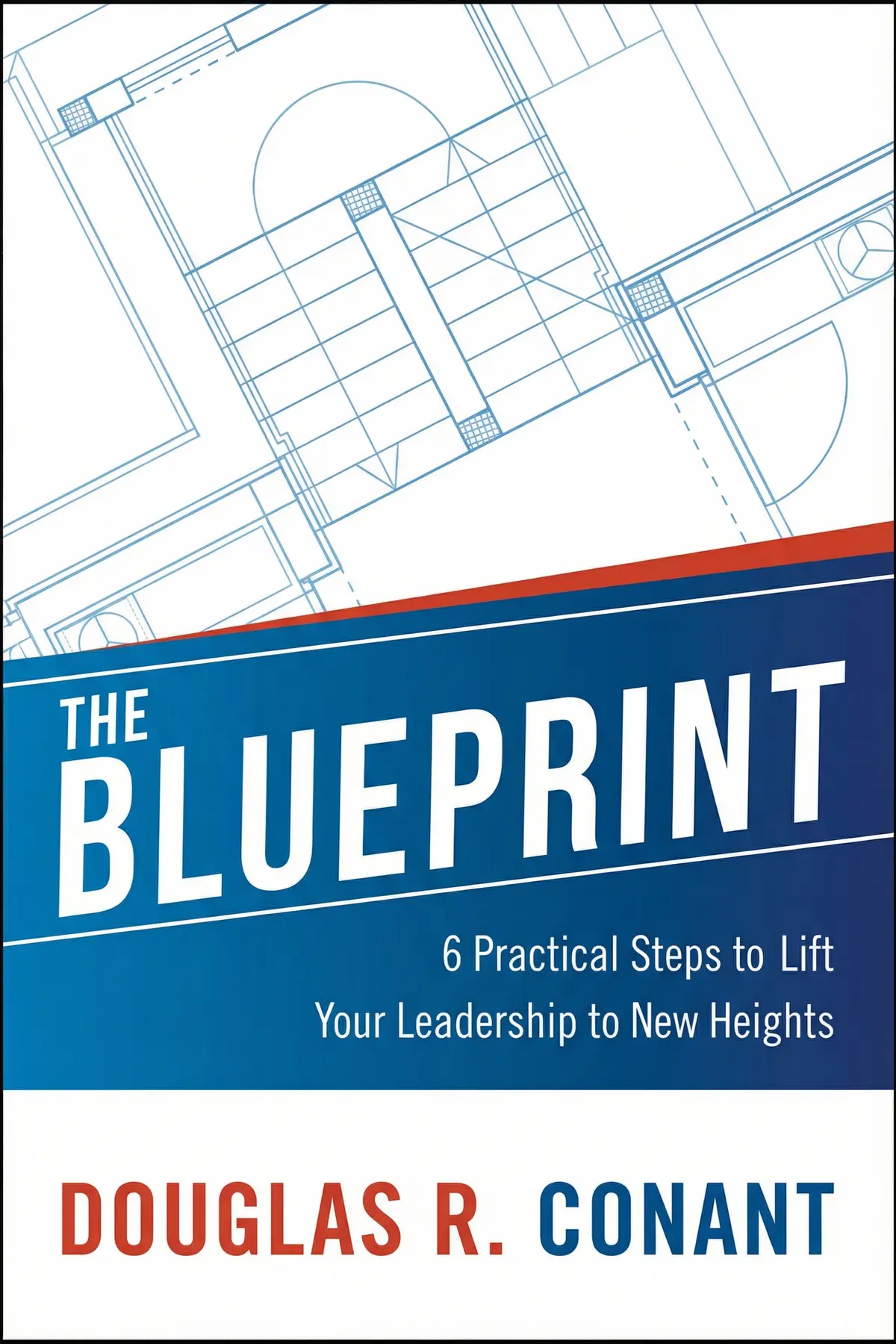
Table of Content
1. Introduction
1 min 06 sec
Many managers spend their days reacting. They answer the next email and fix the next fire, and they hope a leadership style forms somewhere along the way. In The Blueprint, Douglas Conant, the former chief executive of Campbell Soup Company, argues that a deliberate style can be built instead, and that it starts with a written purpose statement, one that evolves over time, naming why you lead, what you promise and the values you hold.
From there his method moves through six steps: envision, reflect, study, plan, practice and improve. None of them asks for a dramatic overhaul. Each one is small, repeatable and meant to fit inside a crowded working week.
The idea running through the whole book is that good leadership is designed from the inside out and then proven in daily habits. Follow the steps and you will be able to write down what you stand for, borrow the best of leaders you admire, turn both into a model with a handful of routines, and start testing it within five days.
2. Write a purpose statement that anchors your decisions
1 min 35 sec
Most leaders could describe their job but not their reason for doing it. Three short questions change that, and the answers become a test you can apply every time two priorities fight for your afternoon.
3. Turn your own past into leadership beliefs
1 min 40 sec
You have probably led for years without saying out loud what you believe about leading. Conant thinks those beliefs are already there, hidden in moments you have half forgotten, waiting to be found.
4. Learn faster by studying six leaders you admire
1 min 29 sec
Nobody has to invent good leadership from scratch. Conant’s answer is a small, hand-picked group whose habits you study closely, including the mistakes they make, and the number he chooses is very specific.
5. Give your beliefs a shape people can see
1 min 34 sec
A pile of good intentions is hard to remember under pressure. Conant suggests arranging your grouped ideas in a simple shape, such as a flywheel, a house or a path, so your whole approach hangs together in one clear form.
6. Turn each belief into one repeatable habit
1 min 31 sec
A beautiful strategy means little if nobody can see it in your behavior. Conant’s fix starts with something as small as a sheet of paper and a pen, and it limits how many habits you should keep.
7. Improve your leadership in thirty-day loops
1 min 24 sec
Leaders often set growth goals so large they quietly fade by spring. Conant shrinks the horizon to one month and ties every goal to an action specific enough that you will know whether you did it.
8. A five-day start that fits a busy week
1 min 36 sec
Most leadership plans die somewhere between reading and doing. Conant closes that gap with one small task a day, and the fourth day’s task only pays off three months later.
9. Conclusion
1 min 01 sec
The Blueprint’s real argument is that leadership can be designed, the way a house is drawn before anyone moves in. Conant’s six steps follow a deliberate order. First you decide what you stand for. Then you test it against your own past and against six leaders you admire. Then you give it a shape, and only after that do you turn it into daily behavior and set fresh thirty-day goals. The method asks for honesty, a few pages of writing and a lot of repetition.
The fastest way to test it is small. Answer the three purpose questions in rough form, even if the first draft feels clumsy. Choose one belief and attach one repeatable action to it, the way a value like respect can become a steady habit of handwritten thank-you notes. Then tell a trusted colleague what you are trying to do, so someone besides you is paying attention.
Three months from now, the letter you wrote to yourself on day four will be waiting. What it says depends on what you begin this week.
About this book
What is this book about?
Plenty of capable people end up leading by reflex. They react to whatever the day brings and hope a clear style will emerge along the way. Douglas Conant, who ran Campbell Soup Company for about a decade, argues that leadership can instead be built on purpose, through small steps that fit a busy working life. His method has six stages. Envision and Reflect turn the focus inward and produce a written purpose statement, a personal leadership vocabulary and a set of beliefs. Study turns outward: you learn from six admired leaders, a group he calls an Entourage of Excellence. Plan organizes everything into one model with a simple shape, such as a flywheel or a house. Practice attaches a repeatable action to each part of that model, and Improve sets thirty-day goals before the cycle starts again. Readers get concrete exercises at every stage. A Five-Day Action Plan puts the model to work right away, with an audit of what your organization expects, a talk with a trusted colleague, one practice tested and logged, a letter to your future self and a journal.
Book Information
Who it's for
New managers
New managers who lead by reflex and want a clear, written idea of how they mean to lead.
Leaders whose style drifted
Experienced leaders whose style has drifted and who want a structured way to reset it.
Looking for team exercises
Team leads and trainers looking for practical exercises they can run with others.
About the Author
Douglas R. Conant
Douglas Conant is an American businessman who served as president and CEO of Campbell Soup Company for about ten years, retiring in July 2011. At Campbell he made employee engagement a priority, and Gallup's measures showed it climbing from among the weakest in the Fortune 500 to world-class. His other roles have included president of Nabisco Foods Company and chairman of Avon Products, and he began in marketing at General Mills before holding marketing and strategy posts at Kraft. He co-wrote the bestseller Touchpoints with Mette Norgaard and founded ConantLeadership, where he teaches leadership.
Ratings & Reviews
Ratings at a glance

What people think
Listeners find the text accessible and informative, and one individual notes that it offers a helpful method for improving leadership skills.
Top reviews
Somsak
Douglas Conant’s approach is a refreshing departure from the usual high-level fluff found in corporate leadership manuals. While some might find the heavy emphasis on self-reflection tedious, I believe the "Envision" and "Reflect" steps are vital for anyone trying to lead with actual integrity rather than just following a script. The book essentially functions as a guided workshop, pushing you to uncover how your personal history informs your professional presence. I particularly resonated with the idea that your life story is your leadership story. It’s not a quick read if you actually do the exercises, but the insights into Conant’s time at Campbell Soup provide a proven backdrop for his theories. Frankly, the workbook style helps ground the abstract concepts into daily habits. Even though some of the 'Study' advice felt a bit basic, the overall framework for building a 'leadership model' is robust enough to justify the effort.
Show moreMind
Finally got around to reading this, and the timing couldn't have been better as I step into a new management role. Conant’s central thesis—that we must treat leadership as a craft—completely changed my perspective on my daily routine. I've been struggling to find my voice. The 'Practice' step helped me identify small, manageable actions to build trust with my team. The truth is, many of us lead by accident, but this book forces you to lead with intention. I loved the section on the 'Entourage of Excellence' because it gave me a framework to learn from my past bosses without just copying them. Some might find the prompts a bit long, yet the effort pays off when you see your leadership model take shape. This isn't just a book to read; it's a manual for becoming a more authentic version of yourself at work.
Show moreNaomi
Ever wonder what actually makes a leader resilient in a crisis? Douglas Conant answers that by focusing on the "Foundation." I’ve been an admirer of his work for a while, but few books are this practical. The "Improve" step, which discusses the growth mindset, is essential for today’s fast-paced environment. I was really struck by the story of the Campbell Soup turnaround; it’s one thing to talk about employee engagement, but it’s another to actually deliver it. The book helps you realize that your leadership is a work in progress, not a destination. Simply put, I think every new MBA should have this on their shelf. It’s a readable and enlightening guide that avoids most of the toxic 'hustle culture' tropes while still demanding high performance. Truly a masterclass in authentic leadership that actually works.
Show moreTaw
Picked this up on a recommendation from my mentor, and I was pleasantly surprised by how much I enjoyed the structure. Most leadership books are just long-winded stories, but Conant provides a literal blueprint that demands active participation. I spent a lot of time on Step 3, which involves building an 'Entourage of Excellence.' The concept of studying leaders you admire to create a personal advisory board is brilliant and highly practical. Honestly, the writing isn’t flashy, but it’s clear and purposeful. My only real gripe is that the focus on 'abundance mentality' can feel a bit optimistic when you’re dealing with real-world budget cuts and corporate politics. Still, the emphasis on balancing performance with a genuine care for people is a message that needs to be heard. It’s a valuable resource for anyone looking to refine their leadership profile with intentionality.
Show moreSam
As someone who has followed Doug Conant’s career for years, I was eager to see his wisdom distilled into a single volume. The book delivers a very systematic approach to what is often a very messy subject. I found the Five-Day Action Plan at the end to be particularly useful for immediate implementation. It forces you to stop theorizing and start doing. My favorite part was the distinction between the 'art' and 'science' of influence. My only criticism is that the tone can be a bit dry at times, almost like a textbook. However, the substance is there. If you are willing to do the hard work of Step 2 (Reflection), you will walk away with a much clearer understanding of your values. It’s an enlightening read that provides a solid foundation for anyone looking to improve their impact.
Show moreGai
Wow, I didn't realize how much I needed to sit down and actually define my leadership values until I started this. The "Blueprint" is exactly what it says: a structural guide for your career. Step 1 (Envision) asks some really tough questions about why we choose to lead in the first place, and those answers aren't always easy to face. I found the transition from reflection to planning in Step 4 to be the most helpful part of the journey. It’s all about creating a model that balances performance and people, which is harder than it sounds. Gotta say, the emphasis on 'having fun' as a building block was a nice touch. The book can feel a bit repetitive in its structure, but the message is consistently powerful. Highly recommended for mid-level managers who feel like they are just spinning their wheels.
Show moreRose
After hearing Conant speak on a podcast, I decided to dive into the full 6-step method. The "Reflect" step was eye-opening because it forced me to look at my failures as well as my wins. I like how the book doesn't just focus on the 'glamour' of being a CEO; it gets into the weeds of daily practice and building trust. My team actually noticed a difference when I started implementing the 'how can I help' mindset. Not gonna lie, the section on building an 'Entourage of Excellence' felt a bit like networking advice I've heard before, but the overall framework is solid. It's a great tool for anyone who feels stuck or stagnant in their current role. Not every chapter is a goldmine, but there’s more than enough here to make it worth the investment of time.
Show morePensri
Is this book groundbreaking? Look, I think it depends on where you are in your career. For a seasoned executive, much of the six-step process—Envision, Reflect, Study, Plan, Practice, and Improve—might feel like things you’ve already internalized or heard in dozens of seminars. I found myself skimming the early sections because the prompts felt a bit repetitive. However, I did appreciate the second half of the book more, where Conant shares actual anecdotes from his forty-year career. The Campbell Soup turnaround is a legendary case study for a reason, and hearing it from the man himself adds a layer of authenticity that the dry exercises lack. It’s a solid, readable guide, but I’m not sure it offers anything revolutionary for those who have already done significant deep-work on their management style. It’s okay, just not essential.
Show moreGor
The chapter on 'Envisioning' was the highlight for me, though the rest of the book felt a bit hit-or-miss. I think the "Study" step is important, but the way it was presented felt a little redundant if you already read a lot of business literature. To be fair, Conant’s emphasis on humility and 'how can I help' is a great reminder for any leader. However, the middle section of the book dragged quite a bit for me. I appreciated the specific examples from Kraft and Campbell Soup, but I wanted more of those and fewer abstract exercises. It’s a decent book with some very strong sections on integrity and trust, but it’s not something I’d necessarily read twice. If you’re a fan of workbook-style business books, you’ll like it more than I did. It’s a readable approach, just a bit repetitive.
Show moreKaen
Not what I expected based on the hype. While I respect Doug Conant’s track record, this book felt more like a homework assignment than an inspiring leadership guide. The six steps are incredibly labor-intensive, and personally, some of the self-reflection questions felt a bit too 'touchy-feely' for my taste. I struggled to get through the first few chapters because it felt like I was back in a grad school organizational behavior class. I understand the need for a foundation, but the 'Growth or Die' mindset mentioned in the later steps feels a bit aggressive in today’s burnout-prone environment. If you love filling out charts and writing in journals, you’ll probably get something out of this. In my experience, I was looking for more high-level strategy and fewer worksheets. It just didn’t click for me, even though the intent is clearly good.
Show moreQuestions about this book
What is the main idea of The Blueprint by Douglas Conant?
Conant argues that leadership can be built deliberately through small, repeatable steps instead of left to chance. You start by defining your purpose and beliefs, then learn from leaders you admire, organize everything into a personal leadership model and turn each part of it into a habit. A final step keeps the model improving in short cycles, and the whole process then begins again.
What are the six steps in The Blueprint?
The steps are Envision, Reflect, Study, Plan, Practice and Improve. Envision produces a purpose statement from three questions about motivation, strengths and values. Reflect turns your experience into a leadership vocabulary and written beliefs. Study draws lessons from six admired leaders. Plan groups everything into a model with a simple shape. Practice gives each part of the model a repeatable action, and Improve sets thirty-day goals.
What is the Entourage of Excellence?
It is Conant’s name for a group of six leaders whose qualities you want to develop. You study them closely, note their best practices and their mistakes, and turn what you learn into a list of leadership Dos and Don’ts. The step adds outside perspective to your self-reflection and gives you a network of possible mentors, so leading feels less isolated.
What is the Five-Day Action Plan in The Blueprint?
It is a quick start for using your leadership model at work. Day one audits what your organization expects of leaders. Day two shares your model with a trusted colleague for feedback. Day three tests one practice and logs the results. Day four is a handwritten progress report to read in three months, and day five starts a journal tracking how the model plays out.
Who should read The Blueprint?
It suits managers and team leads who feel they lead by reacting and want a clearer, written approach. It also fits experienced leaders whose style has drifted and trainers who need structured exercises. The method is practical, built on short written tasks such as a purpose statement, a Practice Treasury of three to ten habits and thirty-day improvement actions.
Readers also enjoyed




A Year with Peter Drucker: 52 Weeks of Coaching for Leadership Effectiveness
Joseph A. Maciariello



Acting with Power: Why We Are More Powerful Than We Believe
Deborah Gruenfeld

All In: How Great Leaders Build Unstoppable Teams
Mike Michalowicz

AUDIO SUMMARY AVAILABLE
Listen to The Blueprint in 15 minutes
Get the key ideas from The Blueprint by Douglas R. Conant, plus 5,000+ more nonfiction titles.
- 5,000+ titles
- Listen as much as you want
- 7-day free trial
- Cancel anytime









