
14 min 43 sec
Available in: English
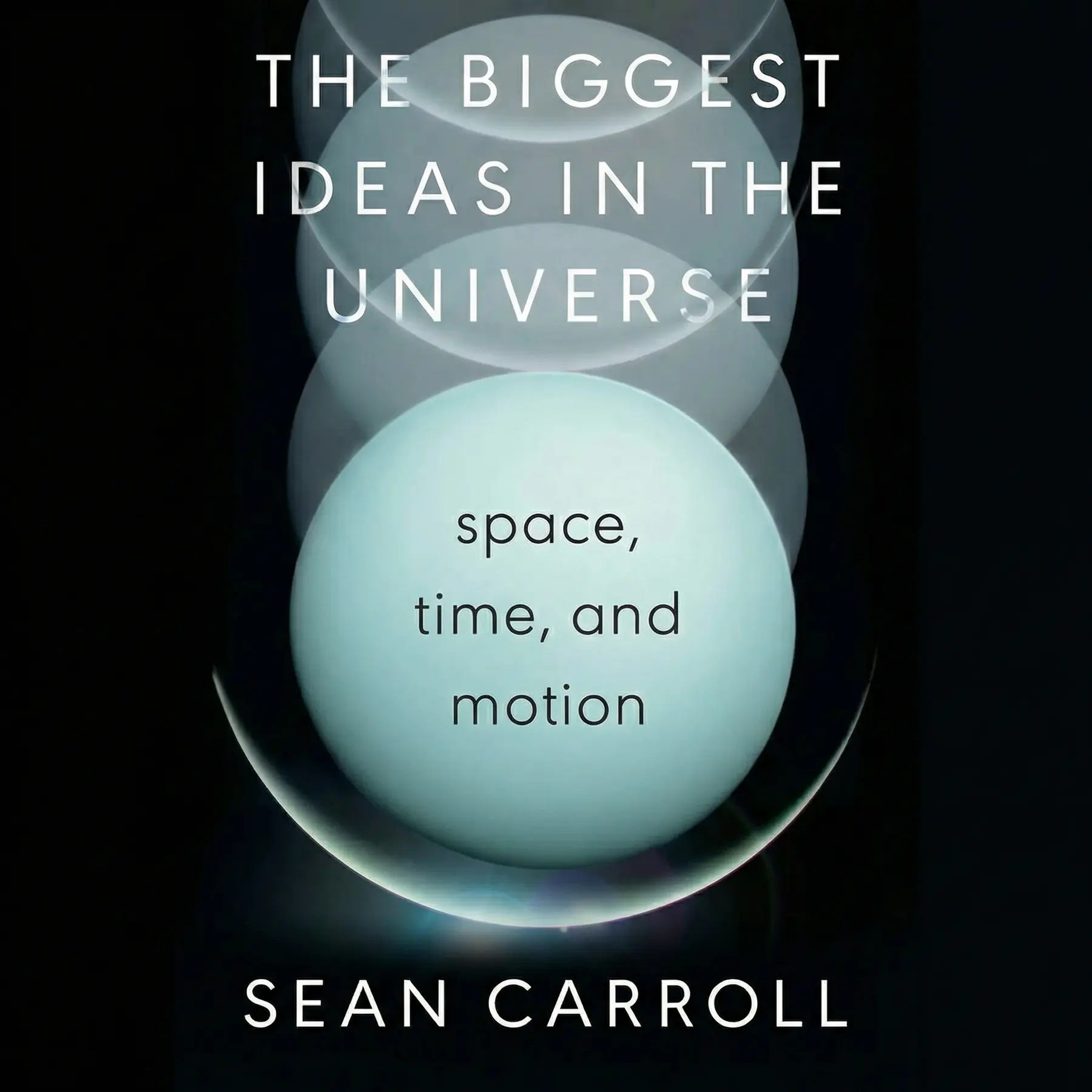
The Biggest Ideas in the Universe: Space, Time, and Motion
By Sean Carroll
Shows readers with only high school algebra how to read, without solving, the real equations of physics, from momentum and calculus to spacetime, the twin paradox and gravity as curved spacetime.
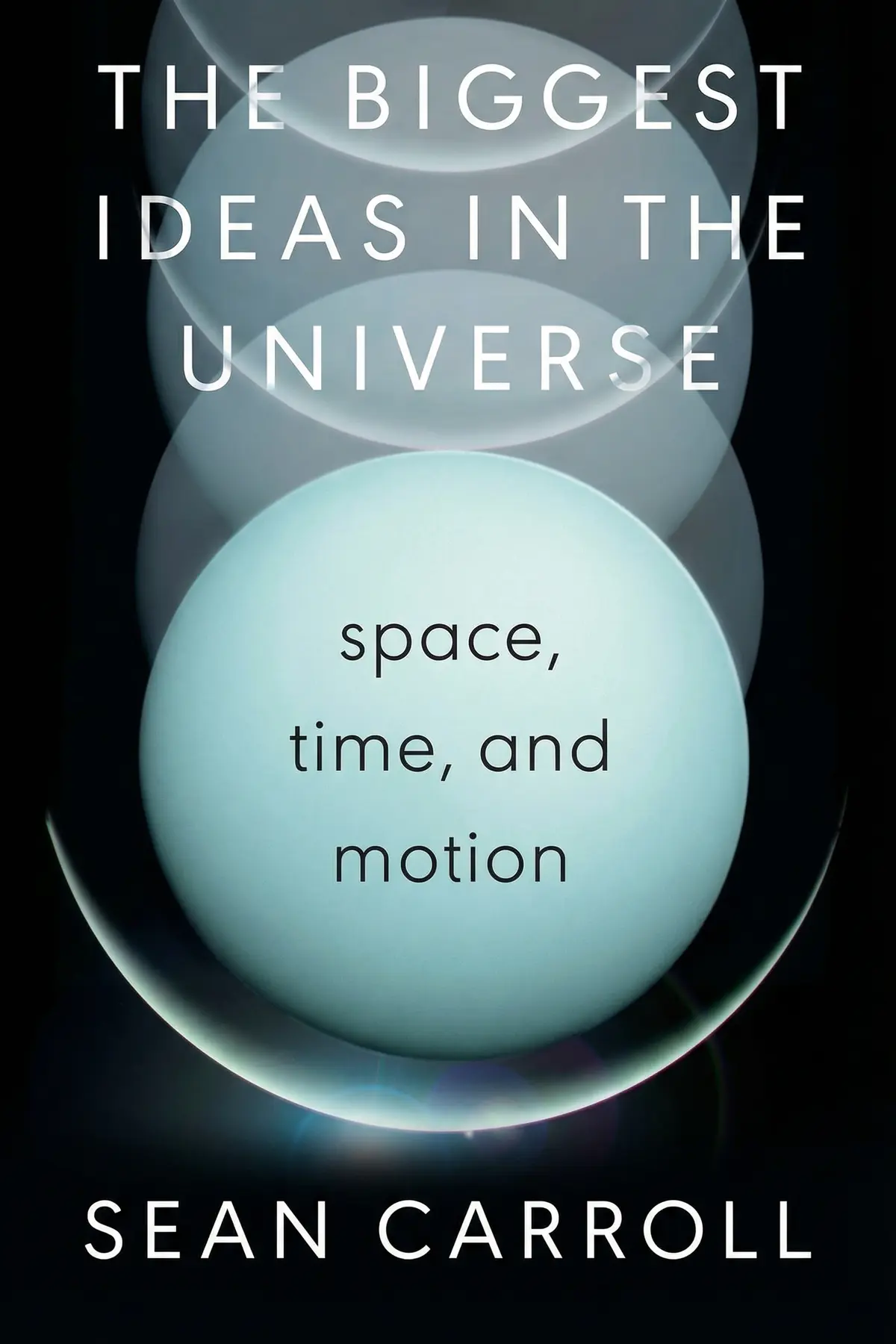
Table of Content
1. Introduction
1 min 04 sec
Most people who enjoy science meet physics through pictures and metaphors and skip the mathematics those pictures stand in for. In The Biggest Ideas in the Universe: Space, Time, and Motion, physicist Sean Carroll argues that this is a choice, not a limit: anyone with high school algebra can learn to read real physics equations without ever solving them.
The equation he wants you to reach is Einstein’s field equation for general relativity, a far bigger prize than the famous E equals mc squared. Along the way, reading physics in its own language reveals a stranger world than the metaphors suggest. Space becomes a physical thing, time a direction we cannot stop moving along, and gravity the curved shape of spacetime itself. By the end you can explain why a twin who travels near light speed comes home younger, why gravity fades with the square of distance, and how a soldier’s calculation in 1915 turned out to predict black holes.
2. Read physics equations without having to solve them
1 min 49 sec
Popular books hide the math, and textbooks demand that you master it. Carroll marks out a third path between them, and he believes a reader with high school algebra can follow it all the way to Einstein.
3. Small changes explain how the planets move
1 min 59 sec
Before Einstein can make sense, something more basic has to: what stays the same while everything moves. Newton needed a new kind of mathematics to answer that, and Carroll gives readers the same tools.
4. Treat empty space as a real, physical thing
2 min 01 sec
Three hundred years ago, two camps fought over whether space is something or nothing. A handful of pencils and the sun itself settle more of that argument than you might expect.
5. Three ways to decide which moments are real
2 min 09 sec
Nobody doubts that places in space exist. Moments in time are another matter: thinkers split into three camps over them, and a river in ancient Greece is still at the center of the quarrel.
6. The straightest path through spacetime takes the longest
2 min 16 sec
A walk to the café takes thirty minutes on the kitchen clock, yet the time on your wrist depends on the route. A pair of twins shows how far that strange rule can stretch.
7. See gravity as the curve of spacetime itself
2 min 10 sec
Einstein spent a decade trying to fit gravity into his new picture of the universe. When it finally fit, a soldier serving in wartime found something in the math that no one was ready to believe.
8. Conclusion
1 min 15 sec
The field equation that looks like gibberish in the opening is the one the whole book works toward, and by the end it frames gravity as curved spacetime and underlies Schwarzschild’s wartime solution, which physicists later accepted as predicting black holes. That is what Carroll’s book adds up to. The distance between a metaphor and the real thing is shorter than most people assume, and high school algebra plus patience is enough to cover it. The publisher describes equations as meaningful poems about warped spacetime and powerful forces. Carroll’s achievement is teaching the alphabet those poems are written in.
You can begin small. The next time an article explains gravity with a picture, look for the equation behind it and read it as a sentence, one side at a time, before you skip ahead. Tie three pencils at right angles and try to fit a fourth. And when someone at dinner says time is relative, tell them about the twins, and about the clock on your wrist, which counts differently depending on the route you walked to the café.
Carroll wants a world where people argue about physics at the pub. After this book, you could be the one who starts the argument.
About this book
What is this book about?
Most popular physics books give readers vivid images and comparisons and leave the mathematics out. Textbooks go the other way and expect students to solve equations line by line. Sean Carroll, a physicist at Johns Hopkins, writes for the reader in between: someone who knows high school algebra, is willing to work, and wants to understand what the equations of physics actually say without having to solve them. This first volume of his series covers classical physics. It starts with conservation, momentum and the calculus Newton needed to explain planetary orbits, then moves through the Lagrangian and Hamiltonian ways of describing motion. From there it asks what space really is, why time seems to run only one way, and how the two merge into spacetime, where a twin who travels comes home younger than the one who stayed. The destination is Einstein's field equation, which Carroll shows early and teaches readers to read by the end. Along the way they see why gravity can be understood as the curvature of spacetime, and how Karl Schwarzschild's 1915 solution came to predict black holes. Reviewers warn that some of the math is demanding. The reward is a real grasp of how modern physics thinks.
Book Information
Who it's for
Inquisitive minds wanting equations
Curious readers tired of physics metaphors who want to see the real equations behind them.
Introductory physics students
Students starting introductory physics who want calculus and relativity explained before the exams arrive.
Professionals ready for math
Professionals with high school algebra who are willing to work through demanding ideas about space and time.
About the Author
Sean Carroll
At Johns Hopkins University, Sean Carroll is Homewood Professor of Natural Philosophy, and he is also affiliated with the Santa Fe Institute. He earned his Ph.D. at Harvard in 1993 and works on quantum mechanics, gravitation, statistical mechanics and cosmology. He wrote the graduate relativity textbook Spacetime and Geometry, as well as popular books including The Particle at the End of the Universe and The Big Picture. He has recorded lecture courses for The Great Courses and has hosted the Mindscape podcast since 2018.
Ratings & Reviews
Ratings at a glance
What people think
Listeners appreciate the book's ability to translate intricate physics themes into plain speech while delivering a thorough look at mathematical foundations. They consider the material educational and approachable for novices, with one listener highlighting how historical narratives are woven into the scientific theories. The prose is highly regarded, and listeners see the author as an adept instructor. While some find the content engaging, others argue it is extremely tough to digest, and the mathematical portions draw divided opinions, with several listeners noting the technical details were hard to keep up with.
Top reviews
Jack
This book is the bridge I didn’t know I needed between fluffy popular science and intimidating academic textbooks. Sean Carroll attempts something incredibly bold here by actually showing the math instead of hiding it behind vague metaphors. Most authors treat equations like something that will scare readers away, but Carroll argues that you can't truly grasp the universe without them. I appreciated the deep dives into Hamiltonians and Lagrangians, concepts usually reserved for upper-level physics students. While the introduction claims you only need high school algebra, the truth is that you’ll need some serious mental stamina to keep up once the calculus starts flowing. It is refreshing to see a physicist trust his audience enough to explain how a metric tensor actually works. If you are tired of being coddled by analogies about rubber sheets and want to see the real machinery of General Relativity, this is the perfect starting point.
Show moreMarco
Sean Carroll has a gift for making the most abstract concepts feel tangible and exciting. I felt like a sixteen-year-old version of myself again, discovering the 'Deep Magic' that makes the world run. The way he explains Hilbert spaces and manifolds is far more intuitive than any classroom lecture I’ve ever sat through. I loved the little footnotes, especially the one about his contribution to the Thor movie—it added a human touch to a very technical subject. The book doesn't treat you like a child; it treats you like a curious adult who is willing to put in the work. It is a big gulp of information, and I will likely need a second read to fully digest the math. This is a must-have for anyone who feels unsatisfied by typical 'pop' physics that avoids the technical details.
Show moreDao
Wow, what a ride through the fabric of reality. I have always been physics-curious, but most books either talk down to you or are completely impenetrable. Carroll finds the sweet spot. He explains the 'Biggest Ideas' with a clarity that only a true master of the subject could manage. I particularly enjoyed learning about the history of conservation laws and how they evolved into our modern understanding of the universe. Not gonna lie, the math is challenging, and I had to put the book down several times just to process a single page. But when that 'aha' moment finally hits, it is incredibly rewarding. It’s educational, bold, and surprisingly funny at times. If you are willing to look at an equation and actually think, this book will open up a whole new world for you.
Show moreMoo
As someone who has always been 'physics-curious,' I’m tired of being coddled by analogies. I want to see what the equations actually look like, and this book finally delivers on that front. Carroll is a skilled teacher who knows how to break down complex vectors and time-reversal invariance into pieces that a dedicated amateur can handle. The book is a nice guided tour through the essentials of classical physics and relativity. I liked how he didn't just dump the math on the page; he explained the logic behind the symbols. It is definitely not for everyone, but for those of us who want a bit more 'meat' on the bones of popular science, it is a triumph. I am already looking forward to the next two books in the trilogy to see where he takes us next.
Show moreAom
After hearing Sean Carroll on a podcast, I decided to dive into this ambitious project. It is clearly the first part of a larger trilogy, and the scope is impressive. The way he intermingles the history of scientific discovery with the actual concepts makes the physics feel like a living, breathing story. I particularly enjoyed the sections on conservation laws and Noether’s theorem, even if the math got a bit hairy toward the middle. Frankly, some of the transitions between 'this is simple algebra' and 'here is a complex tensor' felt a bit abrupt. You might find yourself reaching for a pencil and paper to follow along. However, the clarity of his prose helps bridge those gaps. It is a guided tour of the universe's internal logic that doesn't shy away from the difficult parts. Definitely worth the effort for those who want a deeper look.
Show moreLucia
Finally got around to reading this, and as someone who hasn't looked at a physics equation in twenty years, it was quite a workout. Carroll’s 'One Weird Trick'—the idea that you can understand equations without necessarily needing to solve them—actually works to some degree. I felt like I was being initiated into the secret language of the universe. The chapter on special relativity was a highlight for me, as it finally made the concept of spacetime intervals feel concrete. Look, it’s not exactly a beach read. You have to be willing to sit and think deeply about what each symbol represents. My only minor gripe is that he occasionally glosses over certain assumptions that would help a layman understand the 'why' behind the 'how.' Still, as a refresh on the essentials of physics, it is leagues ahead of most popular science books.
Show moreLaor
Comparing this to Susskind’s 'Theoretical Minimum' is inevitable, and Carroll holds his own quite well. While Susskind’s work feels like a transcribed lecture series, this feels like a carefully crafted narrative of ideas. The writing quality is exceptional, and Carroll’s voice is that of a patient, brilliant mentor. I found the explanation of how gravity pulls you into black holes to be one of the most lucid I've ever read. However, the difficulty curve is very steep. You start with basic momentum and suddenly you’re staring at partial differentials. I appreciate that he doesn't use the 'everything is a trampoline' analogy for gravity, but some of the mathematical explanations still feel a bit rushed. It is a magnificent attempt to democratize physics, even if it doesn't quite reach every reader. For the science-oriented, it’s a goldmine.
Show moreChatri
Ever wonder if a book can be too smart for its own good? I am a well-educated person, yet I struggled immensely with the explanations of vector addition early on. The author says it is easy to just imagine placing the end of one vector at the start of another, but the diagrams and text simply didn't click for me. I spent hours re-reading pages 11 through 15 and still felt lost. To be fair, my math background is a bit rusty, but the introduction promised that high school algebra would suffice. It doesn't. Once we moved into partial differentials and more complex dynamics, I felt like I was drowning in notation. There are some interesting historical nuggets and Carroll is a gifted writer, but the technical barrier is much higher than advertised. It is a dense read that requires a level of mathematical intuition I simply don't possess.
Show moreWitthaya
Who exactly was this book written for? At times, the author explains that 'momenta' is the plural of momentum, which feels very basic. Then, two pages later, he is manipulating metrics and tensors as if I do this every day. The tonal shifts are jarring. I do feel like I understand spacetime and black holes marginally better now, but I’m not sure the equations were the reason why. The prose is much better at explaining the concepts than the math is. Gotta say, I felt more glimmers of understanding during the historical anecdotes than during the technical derivations. It’s a very dense book that might be too hard to be a satisfying read for a true layman. If you aren't prepared to study the diagrams like a student, you might find yourself skipping half the content.
Show moreCharlotte
To be fair, the ambition here is admirable, but the execution fails to serve its supposed audience. Who is this book actually for? Professional physicists will find the 'half-truths' and simplified expressions frustratingly imprecise, while the average reader will be baffled by the sudden appearance of tensors and metrics. I found the section on the energy-momentum tensor particularly problematic, as it skips over the energy problem in general relativity entirely. The author claims this is for people with only algebra skills, but then he dives into calculus almost immediately. It feels like a textbook that forgot to include the practice problems. If you want a descriptive book, go elsewhere; if you want a technical one, buy Taylor and Wheeler. This middle ground ends up being a confusing no-man's-land that left me more frustrated than enlightened by the time I finished the final chapter.
Show moreQuestions about this book
What is The Biggest Ideas in the Universe: Space, Time, and Motion about?
Sean Carroll teaches classical physics, Einstein’s relativity included, by showing readers the real equations instead of metaphors. The book moves from conservation, momentum and calculus through the Lagrangian and Hamiltonian views of motion to space, time, spacetime, curved geometry and black holes. Its goal is Einstein’s field equation for general relativity, which Carroll shows early and teaches readers to read by the end.
Do I need advanced math to read Sean Carroll's book?
Carroll says you need only high school algebra and a willingness to look at an equation and think about what it means. He never asks readers to solve equations, only to understand them. He admits the ideas are hard by nature, though, and reviewers agree: Kirkus warned that some of the math will baffle readers, while a Johns Hopkins reviewer called the book ideal for introductory physics students.
What does the twin paradox show in The Biggest Ideas in the Universe?
Tom stays on Earth while his twin Barbara flies near light speed and returns, younger than him. At 99 percent of light speed, each year she lives matches seven for Tom. Carroll uses this to show that elapsed time depends on your route through spacetime, and that the straight path takes the longest time. Experiments with elementary particles confirm that the effect is real.
Why does Carroll describe gravity as curved spacetime?
After ten years of work, Einstein concluded that spacetime can bend and that its curvature is what we feel as gravity. Carroll explains that gravity is unusual among the four forces because it acts on everything universally, in the same way. That universality lets physicists treat gravity as a feature of spacetime itself instead of a force moving within it.
How can I apply the ideas in this book?
Read equations as sentences instead of skipping them, asking what each side says about the world. Use the spherical cow habit of simplifying a messy problem until it can be handled. Try tying pencils at right angles to see why space has three dimensions. And when someone says time is relative, explain that elapsed time depends on the route you take through spacetime.
Readers also enjoyed

A Thousand Brains: A New Theory of Intelligence
Jeff Hawkins




Alien Earths: The New Science of Planet Hunting in the Cosmos
Lisa Kaltenegger




A Life Decoded: My Genome: My Life
J. Craig Venter
AUDIO SUMMARY AVAILABLE
Listen to The Biggest Ideas in the Universe in 15 minutes
Get the key ideas from The Biggest Ideas in the Universe by Sean Carroll, plus 5,000+ more nonfiction titles.
- 5,000+ titles
- Listen as much as you want
- 7-day free trial
- Cancel anytime









