
14 min 08 sec
Available in: English
Teams That Work: The Seven Drivers of Team Effectiveness
Shows that teamwork is a learnable skill and explains the seven drivers research ties to team performance, with practical ways to spot which one your team is missing and how to build it.
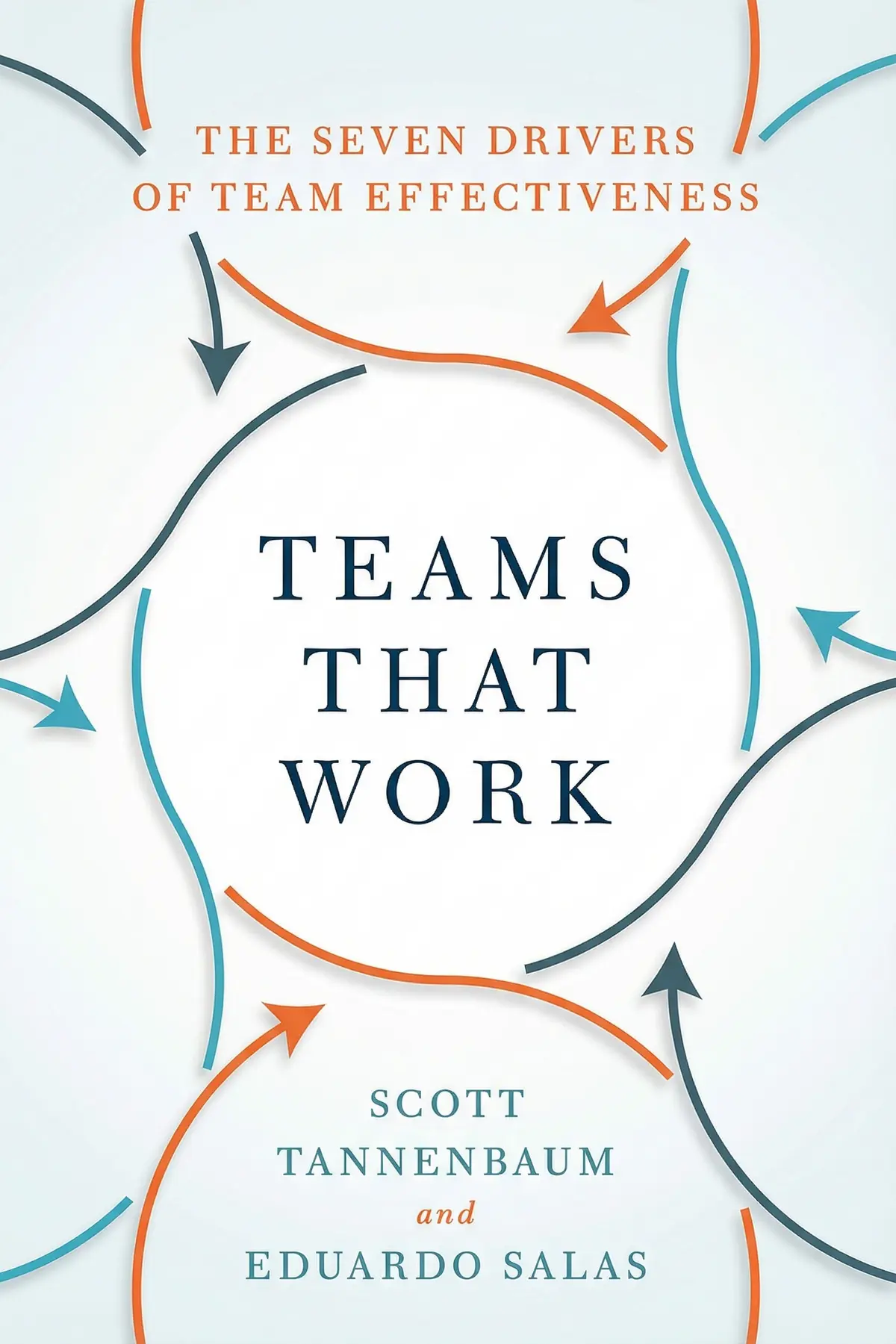
Table of Content
1. Introduction
1 min 02 sec
When a team keeps falling short, most people blame bad chemistry or the wrong mix of personalities. In Teams That Work, Scott Tannenbaum, who heads the Group for Organizational Effectiveness, and Rice University psychologist Eduardo Salas argue that teamwork is a skill, and like any skill it can be learned, trained and hired for. The pair have spent more than 30 years helping over 600 organizations, from executive suites to military units and hospitals.
Their case is that team performance rests on seven drivers that research connects to results, and that each one can be checked and strengthened by anyone on the team, whatever their title. The evidence runs from a deadly afternoon on Mount Everest to a hushed kitchen in Las Vegas and a department store where a salesman faked a phone call. Follow the drivers and a struggling team stops looking like bad luck. It becomes a short set of specific gaps you can name and fix one at a time.
2. Hire and train for teamwork skills too
1 min 31 sec
A team full of spirit can still lose badly, and a team full of stars can still disappoint. The authors explain why both happen, and what kind of skill most hiring managers forget to look for.
3. Build the safety that lets people speak up
1 min 50 sec
On a famous mountain, experienced climbers followed their leader upward despite serious doubts, and five people never came home. The belief that was missing that day decides how teams perform in offices and hospitals too.
4. Smooth handoffs come from three learnable behaviors
1 min 42 sec
Two salespeople pass a customer between them so smoothly that it feels like mind reading. The authors take the scene apart and find nothing magical in it, only habits any team could practice.
5. Say less, and confirm what was heard
1 min 40 sec
One of the busiest fine-dining kitchens in Las Vegas is strangely quiet, and in hospitals, words gone wrong have cost lives. The authors show why more talking rarely helps, and what to do instead.
6. Prepare your team to adapt without a huddle
1 min 42 sec
Halfway through a big client presentation, the client’s face says it is failing, and there is no chance to step out and regroup. Whether the team recovers was decided long before that meeting started.
7. Fix the conditions that stop teammates helping each other
1 min 53 sec
The same helpful salesman who once rescued a customer later pretends to take a phone call to avoid one. The authors witnessed it firsthand, and the cause had nothing to do with his character.
8. Turn every teammate into a part-time leader
1 min 42 sec
The last driver is usually pinned on one person with a title. The authors spread it across the whole team, and their version doubles as a quick audit any group can run in one meeting.
9. Conclusion
1 min 06 sec
What Tannenbaum and Salas offer is a way to stop treating a team’s performance as a mystery. A struggling group is rarely cursed with bad chemistry. Somewhere among the seven drivers it is missing something specific: a skill, a belief, a behavior, a way of talking, a shared plan, a fair setting or someone carrying a leadership function. Each of those can be named, and once it has a name, it can be built.
The authors’ most concrete advice is the debrief. Teams that debrief perform about 20 percent better, on average, than teams that skip it. Hold short ones during a project as well as at the end, and put them on the calendar so they actually happen. Talk about what is going well and what to change next time. If you lead the team, let the others speak before you, then name one thing you will do better yourself.
That last move costs a leader a little pride, and it shows everyone else that saying what went wrong is safe. On a mountain or in a meeting room, a team that can say so out loud is a team that can still turn around.
About this book
What is this book about?
Many people believe a team either clicks or it doesn't, and that chemistry or star talent decides the outcome. Scott Tannenbaum and Eduardo Salas reject that idea. After decades of work with hundreds of organizations, they argue that teamwork is a skill like any other, one that can be learned, trained and hired for. They break team effectiveness into seven drivers: the right capabilities, beliefs that support cooperation, coordinating behaviors, quality communication, shared understanding, favorable conditions and leadership functions that keep everything in place. Each driver comes with a vivid case, from a fatal day on Mount Everest to a nearly silent Michelin-starred kitchen and a salesman who faked a phone call to dodge a customer return. Readers get a diagnostic map for any team they lead or belong to, plus concrete tools such as closed-loop communication, contingency training and regular debriefs, which the authors link to roughly 20 percent better performance.
Book Information
Who it's for
Team leads and managers
Team leads and managers whose capable people still deliver average results together.
Founders, HR and trainers
Founders and HR or training staff designing hiring, incentives and development for teams.
Professionals in high-stakes teams
Professionals in high-stakes groups, such as healthcare, operations or client service, who want handoffs and communication that hold up under pressure.
About the Author
Scott Tannenbaum
Eduardo Salas is a psychologist specializing in industrial and organizational psychology and human factors. He holds the Allyn R. and Gladys M. Cline Chair in psychological sciences at Rice University and was earlier a senior research psychologist at the Naval Air Warfare Center's Training Systems Division. Scott Tannenbaum is president of the Group for Organizational Effectiveness. The two have worked together for more than 30 years, supporting over 600 organizations worldwide, including more than a third of the Fortune 100, in settings from executive teams to the military and healthcare.
Ratings & Reviews
Ratings at a glance

What people think
Listeners find the book highly practical, as one person notes it delivers tools for real-world team application. Furthermore, the quality of information is praised, with one listener emphasizing the well-indexed content and another pointing to its use of meta-analyses. Listeners also enjoy the book's readability and thought-provoking style, while one review specifically commends its comprehensive breakdown of team dynamics.
Top reviews
Maksim
This book is effectively a masterclass in organizational psychology, condensed into a format that doesn't feel like a chore to get through. Most business books rely on anecdotal evidence, but Tannenbaum and Salas ground everything in actual meta-analyses. It feels rigorous yet accessible. To be fair, I initially worried it would be too dry given the Oxford Press label, but the inclusion of high-stakes examples—like deep-sea diving teams—keeps the momentum going. It's a strategic guide that bridges the gap between scholarly research and the fast-paced reality of modern corporate life. If you're leading a team that feels stuck, the drivers mentioned here provide a clear roadmap for cohesion.
Show morePridi
Finally got around to reading this after seeing it on several must-read lists for managers. It’s rare to find a book that uses examples from sports and extreme environments to teach business lessons without it feeling gimmicky. The authors clearly know their stuff, utilizing decades of research to highlight what actually drives performance. Truth is, I’ve worked in oil and gas for years where teamwork is a matter of safety, and this resonated deeply with my experiences on the ground. The layout is top-tier; the chapter summaries make it easy to digest. It’s a definitive resource for anyone serious about team effectiveness.
Show moreSurasit
The chapter on the drivers of team effectiveness is worth the price of admission alone. Most authors just tell you to 'communicate better,' but Tannenbaum and Salas break down the actual components of that communication. Frankly, the level of detail regarding the psychological safety of teams was eye-opening. I appreciated the specific tips tailored for both team leaders and the members themselves. It’s not just about what the boss does; it’s about the collective. The formatting—with the summarizing highlights—makes it easy to jump around as needed for urgent access during projects. This is a must-have for any modern professional's collection.
Show moreChai
After hearing my mentor rave about the 'new teamwork bible,' I had high expectations. It did not disappoint. The way it encapsulates complex tactics into succinct charts is brilliant. I particularly enjoyed the sections on how to foster shared leadership within a hierarchy. It’s a dense read, sure, but the information quality is unmatched. Most of these 'blog-style' books are forgotten in a week, but this one has staying power. It feels like a genuine investment in your professional development. I’ve already bought a few copies for my department heads to get everyone on the same page. Truly excellent work from Salas and Tannenbaum.
Show moreRungrat
Picked this up for a graduate-level course, but I’ve kept it on my desk ever since. The research citing meta-analyses gives it a level of credibility you just don’t see in the airport bookstore variety of leadership guides. It provides a rigorous framework for thinking about why teams fail to click. I loved the practical examples—from NASA to healthcare teams—that illustrate the drivers of effectiveness. While it’s slightly lengthy, every page feels necessary. It’s a tactical guide that actually answers the 'how' of leadership rather than just the 'why.' For any manager looking to level up their squad, this is essential reading.
Show moreSawit
Truth is, most leadership books are just one good idea stretched over 200 pages. This is the opposite. It’s packed with insights from sports, firefighting, and various high-stakes industries. I found the section on team resilience particularly thought-provoking, especially given the current global climate. To be fair, it’s not a quick weekend read. You have to sit with it. You have to engage with the tools and the framework provided. But if you're willing to do the work, the payoff for your team cohesion is massive. It’s practical, documented, and moves way beyond the usual 'icebreaker' suggestions we have all seen.
Show morePriya
Ever wonder why some 'dream teams' fail while others thrive under pressure? I picked this up hoping for more than just generic platitudes, and the authors delivered with a comprehensive breakdown of team dynamics. The tables and charts are incredibly helpful for quick reference during a busy workday. Look, the book is a bit on the long side, and some of the data points might feel redundant if you're already well-versed in organizational development literature. However, the 'How-To' sections are gold. It addresses the 'but how?' questions that usually get ignored in leadership seminars. Definitely worth the time if you want something tactical.
Show morePakinee
As someone who manages a remote engineering crew, finding actionable advice is usually a struggle. This wasn't just another fluff piece. The focus on shared leadership and team cohesion provided me with a tactical framework I could implement immediately. Not gonna lie, I was skeptical about the 'bible' claims, but the depth of the meta-analyses changed my mind. It’s well-indexed, making it a perfect desk reference when you need to troubleshoot a specific conflict. My only gripe is that it requires a significant time investment to truly absorb the density of information provided. Still, it is much better than the blog-style books flooding the market.
Show morePita
Gotta say, the way this book handles the 'science' of teams is incredibly refreshing. It avoids the usual belabored scientific journal tone while maintaining a very high bar for evidence. The authors use a framework that actually makes sense in a fast-moving business environment. I’ve been a consultant for fifteen years and this is the first time I’ve seen such a precise guide to team dynamics. The index is phenomenal, which makes it a great reference tool for when you’re in the middle of a client intervention. While it is slightly lengthy, the depth provided ensures you aren't just getting surface-level advice. Highly recommended.
Show moreNum
Not what I expected given the rave reviews. While the research is undeniably solid and the authors are clearly experts, I found the writing style a bit too academic for a casual read. In my experience, business leaders want the 'meat' faster than this book provides. There’s a lot of space dedicated to validating the data, which is great for a classroom, but maybe less so for a frantic manager. To be fair, the appendices are great and the 'at-a-glance' tables help salvage it. It’s a 3-star for me because it felt a bit like a textbook disguised as a guide. Good info, but a heavy lift.
Show moreQuestions about this book
What is the main idea of Teams That Work?
Scott Tannenbaum and Eduardo Salas argue that teamwork is a learnable skill, not a matter of luck or chemistry. They name seven drivers of team performance that research supports, namely capabilities, a cooperative mindset, coordinated actions, high-quality communication, common understanding, supportive conditions and leadership functions. A team that underperforms is usually missing one or more of these, and each can be built deliberately by leaders and members alike.
What is closed-loop communication?
It is a three-step technique the authors recommend for making sure a message was understood. The sender gives the information in a call-out. The receiver does a check-back, repeating what they understood. Then the sender closes the loop by confirming or correcting it. The authors note it also works for opinions and feelings, which helps build trust and shared understanding within the team.
Why does psychological safety matter so much for teams?
The authors describe it as feeling free to voice disagreement, own up to an error or request help without fear of punishment or harsh judgment. Research they cite ranks it among the top predictors of team performance, from hospital emergency rooms to Google. Its absence helps explain the 1996 Everest tragedy, where climbers with doubts did not challenge a leader who had made clear he would not tolerate dissent.
How can I apply Teams That Work to my own team?
Start with debriefs, which the authors link to about 20 percent better performance. Hold them during projects as well as at the end, let team members speak first, and name one improvement you will make yourself. Then check the incentives: if people are rewarded only for individual results, expect them to avoid shared work, as salespeople at one large retailer did until reviews also counted helping coworkers.
Who should read Teams That Work?
It suits team leads, managers and founders whose groups work hard but deliver uneven results, as well as HR and training professionals shaping hiring and incentives. The authors write for any setting where people depend on each other, drawing on cases from mountaineering, aviation, restaurant kitchens, retail floors and cruise ships, and they stress that any team member, not only the formal leader, can take on leadership functions.
Readers also enjoyed

A Bigger Prize: How We Can Do Better Than the Competition
Margaret Heffernan





A Year with Peter Drucker: 52 Weeks of Coaching for Leadership Effectiveness
Joseph A. Maciariello



Acting with Power: Why We Are More Powerful Than We Believe
Deborah Gruenfeld
AUDIO SUMMARY AVAILABLE
Listen to Teams That Work in 15 minutes
Get the key ideas from Teams That Work by Scott Tannenbaum, plus 5,000+ more nonfiction titles.
- 5,000+ titles
- Listen as much as you want
- 7-day free trial
- Cancel anytime









