
Alcoholics Anonymous
Alcoholics Anonymous World Services
1 min 08 sec
If every day feels like a fight you have to win, the Tao Te Ching offers an odd and useful alternative: get more done by forcing less. This ancient Chinese text, attributed to Lao Tzu, calls the idea wu wei, or nondoing, and it treats softness, emptiness and restraint as sources of strength. Its 81 short poetic chapters describe the tao, the way, as both the force behind everything that exists and a manner of living in tune with it.
The thread through all of them is simple to state and hard to practice. Whatever pushes and grasps will rise, harden and fall, while whatever yields and steps back endures. That holds for a single person, for a ruler in an age of war and for anyone running a team today.
What follows explains how the text was put together, what its central paradoxes mean and how its ideal leader turns into habits you can try: leading without being felt, finishing without claiming credit and bending before you break.
1 min 54 sec
Readers often notice that this short classic seems to say the same thing twice, sometimes in opposite words. That oddity is a clue to where the text came from, and to the best way to read it.
1 min 40 sec
The central word of this philosophy describes something the text itself says cannot be described. Understanding that paradox explains why the book asks readers to give up a habit most of us practice every hour.
1 min 45 sec
Why does the harder you push, the more the world seems to push back? The text answers with a picture of a drawn bow and a surprising case for weakness over strength.
1 min 47 sec
In an era of endless war, these sayings pictured a ruler whose people barely noticed being ruled. That ideal sounds passive, but it sets a harder standard for any leader than giving orders ever does.
1 min 33 sec
The moment of victory is when the danger begins, according to these old sayings. Their warning about wealth and position was written for a violent age, and it still fits the modern climb.
1 min 31 sec
Few people today want to be called submissive. The text makes its case for that word with a growing plant, an aging body and a stream running downhill, and the case is hard to dismiss.
1 min 07 sec
The Tao Te Ching was gathered more than twenty centuries ago, and its picture of the world still runs against modern habits. It describes a nameless, formless force behind heaven and earth, and asks people to live in tune with it. In practice that means accepting that every rise invites a fall, that pressure produces resistance, and that the soft and low tend to outlast the hard and high.
Its most usable figure is the Sage, the ruler whose people barely notice being led and who walks away from finished work without asking for thanks. You do not need a throne to try that. You can lead a meeting by asking more than you tell, and hand the credit to the people who did the work. You can notice when a win tempts you to grab for more, and step back while it still stands. And when a week turns into a fight, you can ask what water would do.
Water never strikes hard. It keeps moving, feeds what it touches and settles where others refuse to go, and in time it reaches everywhere.
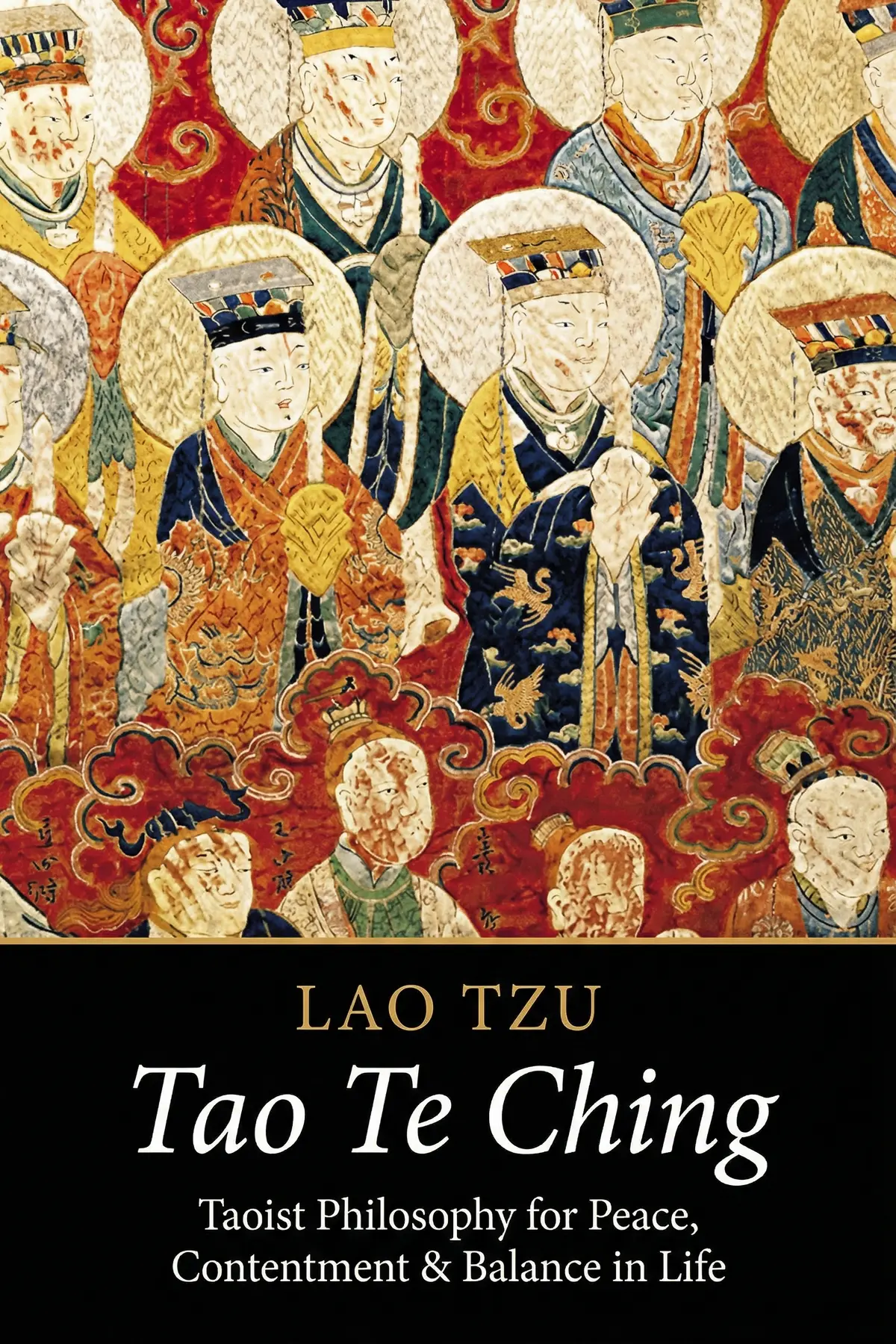
Many people live as if every day were a fight: push harder, use every minute, never let up. The Tao Te Ching offers another way. Its short poetic chapters describe the tao, the way, as the creative force behind heaven and earth and as a manner of living in harmony with that force. Living that way means acting without strain, a practice the text calls wu wei, or nondoing. The book is attributed to Lao Tzu, though it may be a collection of sayings gathered from many old masters over a long period. Its lessons return again and again to the same pattern. Things that climb too high come down, hard things break, and the soft and low endure. Much of it was written with rulers in mind, during a long era of war in China, and it portrays the ideal leader as a near invisible presence who takes no credit. Readers get a clear guide to a famously puzzling text, and a set of ideas they can test at work and at home: lead lightly, stop at the right moment, and bend before you break.
Professionals worn out by a push-harder approach to work who want a calmer way to get results.
Team leads and managers curious about leading without control, ego or the need for credit.
Readers who find the Tao Te Ching puzzling and want its core ideas explained plainly.
Lao Tzu, also written Laozi, is the traditional name of a philosopher from ancient China. The name means old master or old one and is usually read as a title of respect. Tradition places him in the 6th century BCE as a keeper of records at the Zhou court and an older contemporary of Confucius, though scholars disagree about whether he was a single historical person. He is regarded as a founder of Taoism, and in Taoist religion he came to be honored as a deity.

Listeners find the Tao Te Ching an accessible read and enjoy the provided introduction, though one listener points out the history-dense content. The underlying philosophy is seen as deeply enlightening, and listeners depict the volume as attractive and durable, with one listener reporting it arrived with no bends or significant wear. Feedback regarding the translation quality and overall clarity is varied, as some consider it well-translated while others judge it to be poor.
The D.C. Lau translation is a rigorous entry point for anyone wanting to avoid the fluff of more modern, liberal interpretations. This edition is particularly history-dense, providing a necessary scholarly framework that places Lao Tzu’s verses within the chaotic Warring States period. I found the philosophy highly illuminating, especially the recurring metaphors of water and the 'uncarved block.' Unlike the flowery versions that dominate gift shops, this text feels grounded and authentic. To be fair, the introduction is quite long and might be intimidating for casual readers, but the depth it adds to the 81 chapters is indispensable. The physical book itself is surprisingly sturdy and well-bound, making it a permanent fixture on my bedside table. If you want to understand the origins of Taoism without the 'hippie' filters, this is the version to get.
Show moreThis slim volume feels less like a book and more like a mirror for the soul. I was struck by how the Tao Te Ching exalts feminine yin energy—softness, stillness, and the river basin—over the aggressive masculine yang that dominates our modern world. The idea of 'action through inaction' or wu wei is profoundly counter-intuitive but strangely liberating once you stop fighting the natural flow of things. In my experience, these poems offer a way to empty the mind of clutter and replace it with a quiet, unforced wisdom. The translation I read was crisp and avoided unnecessary jargon, making the paradoxical riddles feel accessible rather than frustrating. It’s the kind of text that changes every time you return to it, revealing new layers of meaning based on your current state of mind. Truly a masterpiece of spiritual minimalism.
Show moreLao Tzu manages to say more in eighty-one short poems than most modern self-help gurus do in five hundred pages. This is an 'every person' book because its wisdom is universal, regardless of your religious background. I particularly loved the phrase about not being free of yourself to become yourself—it’s a perfect summary of the internal struggle we all face. The writing style is laconic and punchy, making it easy to memorize favorite passages. It doesn't demand your belief; it just invites you to observe the world. Frankly, it’s the most inclusive spiritual text I’ve ever encountered, focusing on harmony rather than a list of 'thou shalt nots.' Every time I feel overwhelmed by work or social expectations, I open this book to a random page and immediately feel more centered.
Show moreAs a staunch atheist, I usually find religious texts irritating or exclusionary because they rely so heavily on dogmatic 'eye in the sky' threats. The Tao Te Ching is a refreshing departure from that. It offers folk wisdom that functions perfectly well without a deity. You don't have to believe in a supernatural force to see the practical value in not overfilling your cup or sharpening your knife until it blunts. The book seeks harmony by removing judgmental thinking and greed, which is a goal anyone can get behind. Mitchell’s translation is poetic and smells like patchouli in the best way possible. It’s more of a philosophical toolkit than a scripture. If I had been raised with this instead of the Ten Commandments, I might actually still go to 'church.'
Show moreStephen Mitchell’s version is certainly a pleasure to read, but you have to take it with a grain of salt. It is essentially a translation of various translations rather than a direct rendering of the original Chinese characters. This leads to some beautiful poetry, but the truth is that much of the technical nuance is lost in favor of aesthetic 'sparkle.' For example, his interpretation of the first line in Chapter 3 changes 'contention' to 'powerlessness,' which shifts the meaning significantly. Still, the book is incredibly easy to read and serves as a fantastic introduction for those who prioritize emotional resonance over scholarly accuracy. It’s a beautiful object to hold, and the layout is clean. Just keep in mind that you are reading Mitchell’s spiritual intuition as much as you are reading Lao Tzu’s ancient wisdom.
Show morePicked this up on a whim after seeing so many quotes on social media and I’m glad I did. The Barnes & Noble edition I purchased is quite sturdy and looks lovely on the shelf, with no bends or wear despite multiple readings. While some of the chapters felt a bit disjointed—almost like a brain dump of ancient observations—the core messages about humility and frugality really hit home. I appreciated the introduction which cleared up the mystery surrounding whether Lao Tzu was even a real person or just a composite of many sages. Some sections on governance and ruling a nation felt a bit dated and hard to apply to modern life, but the personal advice is timeless. It's a quick read but requires a lot of pausing to actually digest what you've just looked at.
Show moreWhy do we always assume power must be loud and aggressive? Lao Tzu argues the opposite, suggesting that the most submissive things, like water, eventually overcome the hardest obstacles. I found the sections on the 'feminine of the world' in Chapter 61 to be incredibly progressive for a text written thousands of years ago. The translation was generally well-done, though some of the more abstract chapters left me scratching my head. Look, it’s not a narrative with a beginning and an end; it’s a collection of aphorisms that challenge your ego. My only minor gripe is that the structure can feel repetitive at times, as the same themes of 'doing nothing' are hammered home in almost every chapter. However, the overarching sense of peace the book provides is worth the occasional confusion.
Show moreEver wonder why modern politics feels like such a chaotic mess of over-regulation? Lao Tzu’s thoughts on governance are surprisingly relevant, comparing the ruling of a state to boiling a small fish—the more you handle it, the more you ruin it. This anti-legislative stance and the emphasis on leading through 'not-knowing' is a fascinating counterpoint to our information-obsessed culture. The book is easy to read, but the concepts of 'non-action' take a lifetime to actually master. I did find some of the anti-intellectual leanings a bit extreme, especially the idea that people should be kept ignorant to be happy. Still, the critique of wealth and 'dressing in fineries' while others starve feels like it was written yesterday. It’s a challenging, paradoxical, and ultimately rewarding piece of literature.
Show moreTo be fair, the wisdom here is undeniable, but the lack of cohesive flow made it a struggle for me to finish in one sitting. The messages felt very disparate and disorganized, almost as if the author was throwing ideas at a wall to see what stuck. I understand this is the nature of ancient texts, but I would have preferred a version that grouped the poems by theme—like governance, self-reflection, or nature. Some of the translation quality felt poor in the version I had, with sentences that were so vague they became meaningless. I appreciate the historical significance and the 'be like water' metaphors, but I think the book is better used as a daily calendar of quotes rather than a front-to-back reading experience. It's illuminating in small doses, but frustrating as a whole.
Show moreFrankly, I am appalled by how much meaning is stripped away in these 'liberal' interpretations that are so popular today. I bought the Mitchell version because of the high ratings, but his arrogance in the back of the book is staggering. Claiming an 'umbilical connection' to the author to justify changing the actual words is not translation; it’s fan fiction. He completely ignores the last chapter’s warning that 'true words aren't eloquent,' opting instead for 'sparkle' and aesthetic beauty over the gritty truth of the original Chinese. This version misleads newcomers who want to understand actual Taoist philosophy. If you want something authentic, go for the D.C. Lau translation or look up the original Wang Bi text online. This particular edition might be 'easy to read,' but it’s a hollow shell of the real Tao Te Ching.
Show moreThe text describes the tao, the way, as the nameless creative force behind heaven and earth and as a manner of living in harmony with it. Living that way means wu wei, or nondoing: acting without strain or force. Because the tao moves in cycles, whatever climbs too high falls, so the text favors softness, emptiness and restraint over hardness and grasping.
Wu wei means nondoing. In one verse, the Tao does nothing at all, and still there is nothing it fails to accomplish. The text illustrates it through the ideal ruler, a shadowy presence whose efforts the people hardly feel. When the work is finished, they believe it happened naturally. It is less about doing nothing and more about acting so lightly that results seem to arise on their own.
Tradition has credited Lao Tzu with writing the work for a very long time, though evidence that he actually lived is slim, and his name roughly translates as old man. Its repetitions, rhyming verses followed by blunter commentary and ordering by recurring words lead some scholars to see it as an anthology of sayings from many old masters, gathered over a long period.
Its ideal leader, the Sage, shares two traits with the tao: wu wei, nondoing, and wu ming, being without name. The Sage guides so gently that people do not feel led, takes no credit for success and values others’ happiness and peace over personal glory. The text also warns leaders to step back once a task is done instead of growing arrogant with wealth and position.
In one chapter, supreme goodness is compared to water. It moves along with no strain, feeds all that lies in its course and gathers in humble low spots that nobody desires, placing the many before itself. It captures the text’s preference for the pliant over the rigid, the same reason it notes that living bodies and plants are supple while dead ones turn stiff and brittle.
Alcoholics Anonymous World Services


William B. Irvine



Daniel Goleman
Nigel Warburton


John Rawls
Eckhart Tolle
AUDIO SUMMARY AVAILABLE
Get the key ideas from Tao Te Ching by Lao Tzu, plus 5,000+ more nonfiction titles.