

12 min 16 sec
Available in: English
Sun Tzu and the Art of Business: Six Strategic Principles for Managers
Shows managers how to apply Sun Tzu's ancient military strategy to modern competition: protect the value of the market you want, study rivals in depth, hit their weak points, use surprise and outpace bigger players.
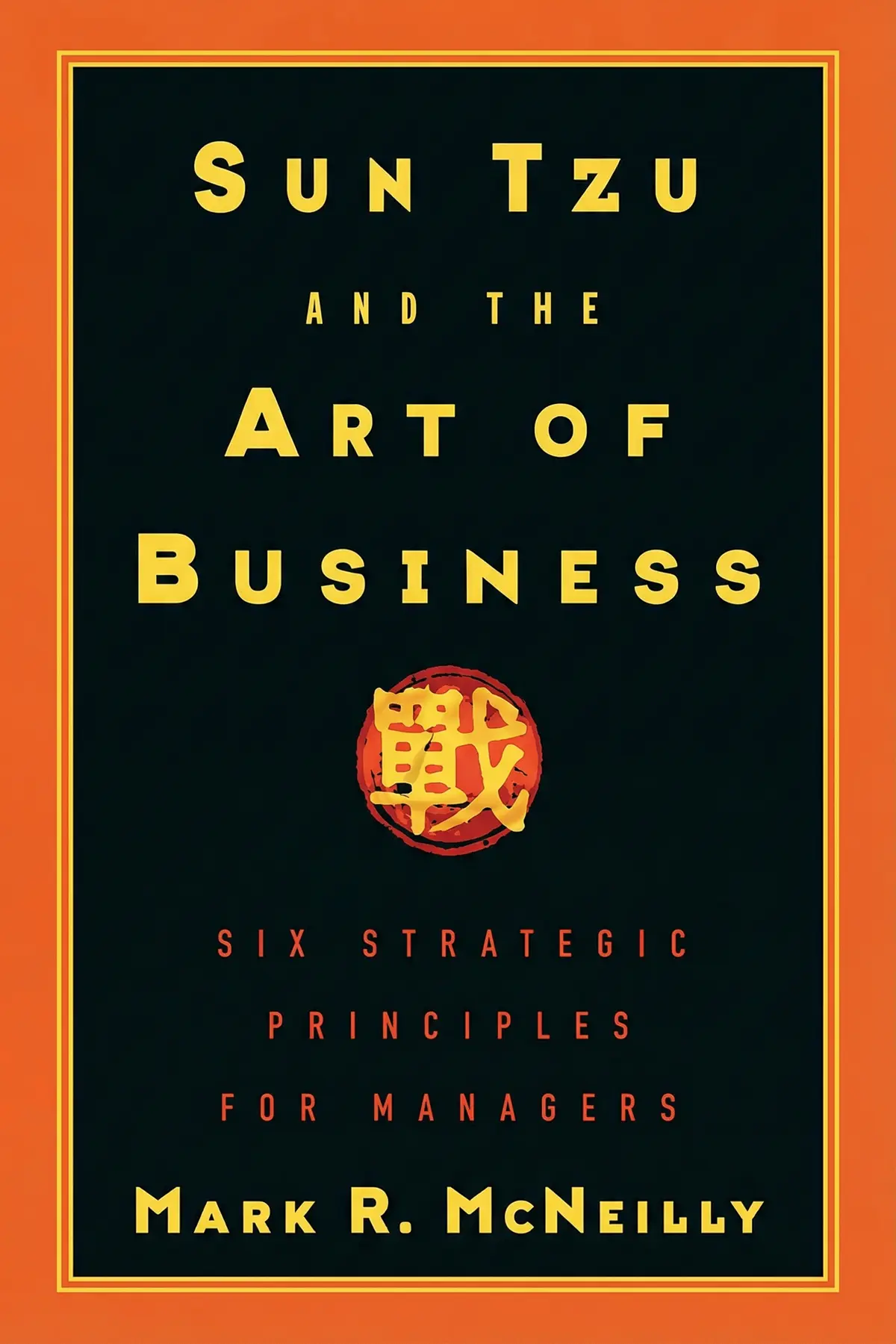
Table of Content
1. Introduction
1 min 03 sec
If your company keeps trading blows with a bigger competitor, cutting prices and copying features, Mark R. McNeilly suggests you are fighting the wrong war. In Sun Tzu and the Art of Business, he argues that the ancient Chinese general’s advice applies directly to markets: the winner usually avoids a rival’s strongest point and hits where it is weak. McNeilly, who worked in strategy and marketing at IBM and Lenovo, reads The Art of War, written more than 2,000 years ago, as a manual for managers.
His argument comes down to one line. Lasting success means taking a market without ruining it, and that requires knowing your rival, aiming at soft spots, using surprise and speed, and having a certain kind of leader in charge. The cases range from a cigarette price war that hurt everyone, to an airline that won by striking where nobody was looking, to a memo about French fries. Each one ends in a question you can put to your own competitive plans this week.
2. Win the market without wrecking its profits
1 min 45 sec
A famous brand cut its price by a fifth to crush cheaper rivals, and in a narrow sense it held its ground. Yet the whole industry ended up worse off. Sun Tzu’s ancient advice explains what went wrong.
3. Read a rival's next move before it comes
1 min 48 sec
Revenue figures and head counts tell you little about what a competitor will do next. A fast-food rivalry over French fries shows the kind of knowledge that lets you get ready before the attack arrives.
4. Avoid copying your strongest rival and save your resources
1 min 45 sec
Imitating a rival’s winning move feels like the safe bet. A communications giant with a leading research lab and deep pockets tried it in the 1980s, and the bill ran to billions.
5. Hide your real attack behind an obvious one
1 min 31 sec
Two airlines looked locked in a simple fight over cheap fares in California. One of them was using that fight as cover for a very different move that its rival never saw coming.
6. Beat bigger rivals by moving faster
1 min 36 sec
A sales team that works four times faster needs far fewer people. Factory and retail numbers from IBM and Walmart suggest that pace may matter more than size when you are the smaller player.
7. Build the five traits a winning leader needs
1 min 43 sec
Sun Tzu listed five traits of a winning commander and several that ruin one. The most surprising danger on his list is a quality that most people would happily call a virtue.
8. Conclusion
1 min 05 sec
McNeilly’s reading of Sun Tzu turns competition from a contest of size into a contest of judgment. The Philip Morris price war and AT&T’s computer venture failed the same way: both chose the obvious, head-on fight and paid for it in profit, money and jobs. The winners in the book, from Toyota to Southwest, decided where to fight before they decided how hard.
That suggests a short discipline before your next competitive move. First, ask whether it will leave the market worth owning, or start a race to the bottom like the Marlboro cut. Then check what you really know about the rival’s leaders and culture, beyond its revenue. Look for the weak link they are not guarding, and plan the visible response that keeps their eyes elsewhere. Finally, measure how fast you can act, remembering that IBM won market share by turning a five-day process into an eight-hour one.
Sun Tzu’s river never fights the mountain. It finds the way down, and it gets there first.
About this book
What is this book about?
Many companies compete by copying their strongest rival or starting price wars, and they often end up with lower profits, lost money and tired teams. Mark R. McNeilly argues that a general who lived more than 2,000 years ago already explained why. In Sun Tzu and the Art of Business, he turns The Art of War into a set of strategic principles for managers. McNeilly's case is that the best competitors avoid head-on fights. They aim to dominate a market without draining its profits, learn everything they can about rivals and their leaders, push where a competitor is weakest, distract with one attack while landing another, and use speed to make up for smaller resources. He closes with the leadership qualities Sun Tzu prized and the traits he warned against. The cases come from familiar companies: Philip Morris and its Marlboro price cut, AT&T's costly move into computers, McDonald's defending its fries against Burger King, Southwest Airlines outflanking United, and IBM and Walmart winning on speed. Readers get a set of strategic principles drawn from Sun Tzu to weigh against any competitive move before making it.
Book Information
Who it's for
Facing a bigger competitor
Managers and founders facing a bigger competitor and tempted to answer with price cuts or copycat products.
Strategists and marketers
Strategy and marketing professionals who want a simple frame for studying rivals and choosing where to compete.
Team leads
Team leads who want to test their own leadership against a clear list of strengths and pitfalls.
About the Author
Mark R. McNeilly
Mark R. McNeilly has written two books on Sun Tzu's Art of War and one on George Washington and business leadership. He worked in marketing, strategy and management at IBM and Lenovo, holds an MBA with honors from the University of Minnesota and teaches marketing at the University of North Carolina. He served as a reserve officer in the US Army National Guard from 1981 to 1987, has spoken on strategy across the US, Europe and Asia, and appeared as a guest analyst on a 2009 History Channel special on the Art of War.
Ratings & Reviews
Ratings at a glance

What people think
Listeners view this book as a beneficial guide for managers, specifically those who didn't study business. It also earns praise for being accessible, with one listener describing it as a perfect supplement to Sun Tzu's original treatise. Additionally, listeners are pleased with the specific translations and explanations provided within the work.
Top reviews
Wit
McNeilly does a fantastic job of translating ancient military wisdom into a language that modern corporate leaders can actually use. For those of us without an MBA, the way he breaks down complex strategies into readable, actionable steps is a godsend. Truth is, most business books are fluff, but this acts as a legitimate companion to the original text. I particularly liked the focus on winning without direct, resource-depleting conflict. It is a manual for long-term prosperity rather than just short-term gains. If you want to understand the competitive landscape, start here.
Show moreEli
The chapter on capturing territory without destroying it changed my entire approach to my startup's expansion strategy. It’s easy to get caught up in the "war" for customers and forget that you need a functional market once the battle is over. Mark McNeilly avoids the cheesy tropes usually found in these types of crossover books. Instead, he offers a sharp, disciplined look at how to be a more humane and wise leader. Not gonna lie, this is one of the few business books I plan on revisiting every single year for inspiration.
Show moreSuphan
After hearing about this book in a strategy seminar, I picked it up to see if the hype was real. The wisdom regarding leadership qualities—specifically boldness and discipline—is something every entrepreneur needs to hear repeatedly. It’s a great book for anyone wanting to better adapt their strategies to conquer more market share without fighting a war of attrition. The way McNeilly connects the battlefield to the marketplace is genuinely insightful and very easy to follow. It’s definitely a valuable resource that makes the ancient texts feel surprisingly relevant today.
Show moreWanida
Ever wonder why some companies thrive while others burn through cash in useless marketing wars? This book answers that by focusing on Sun Tzu’s principle of attacking where the enemy is not. The author explains that rushing head-on into a rival’s strength is a recipe for disaster. While some of the corporate examples feel a little bit like a stretch, the underlying logic is sound. It’s a very thoughtful analysis of how to use speed to compensate for limited resources. If you are responsible for strategy, you need this.
Show moreBam
As a project manager with no formal business background, I found this incredibly accessible compared to other dry strategy guides. The book focuses heavily on the five key qualities of a leader, emphasizing wisdom and sincerity over raw power. Frankly, the interpretation of the 'Art of War' here is much easier to digest than trying to decode the original manuscript on your own. My only minor gripe is that the writing can feel a bit repetitive in the middle chapters. However, the concrete examples of market capture make the concepts stick.
Show moreTim
This book provides a much-needed bridge between ancient philosophy and the cutthroat reality of today's market. McNeilly emphasizes that the ultimate goal is to conquer territory without destroying the very infrastructure you want to inherit. That's a vital lesson for anyone involved in mergers or acquisitions. Gotta say, the section on conducting in-depth research into competitors was particularly illuminating for my current role. It’s not just about fighting; it’s about knowing when the circumstances are shifting in your favor. A solid resource for any entrepreneur's shelf.
Show moreYongyut
Finally got around to reading this one, and I was pleasantly surprised by the depth of the case studies provided. Many books try to adapt Sun Tzu, but this one actually provides a deep-dive analytics approach rather than just quoting the famous lines. In my experience, the chapters on surprise attacks and engaging the enemy in two places at once are the most practical. The tone is mostly analytical, which helps keep the focus on strategy rather than just motivational fluff. It definitely serves as a high-quality manual for securing market supremacy.
Show moreTar
To be fair, the core concepts here are brilliant because they stem from one of the greatest military minds in history. However, McNeilly’s adaptation feels like it could have been trimmed down by about fifty pages without losing any real substance. The repetition of "avoiding strength and attacking weakness" starts to feel a bit stale by the end. Still, the translations are quite good and the modern context helps visualize the battleground of the business world. It’s a decent read for beginners, though seasoned strategists might find it a bit basic.
Show moreVera
Look, if you have already read 'The Art of War' multiple times, you might find this book a bit redundant. It follows the source material so closely that it occasionally fails to carve out its own identity as a business text. Personally, I think the author did a good job with the interpretations, but some of the specific examples are starting to feel dated. The world of business has changed significantly since this was first published. It’s still a useful companion, but don't expect it to revolutionize your entire worldview.
Show moreTariq
Not what I expected given the high praise from colleagues who suggested this was a "must-read" for managers. While the initial premise is interesting, the analytics felt quite out of date for the current digital landscape. I expected a more modern take on the principles, but it felt like a direct port of ancient tactics without enough adaptation for today's speed. The truth is, you could probably just read the original Sun Tzu text and get the same value in half the time. It was way too repetitive for my taste.
Show moreQuestions about this book
What is the main idea of Sun Tzu and the Art of Business?
Mark R. McNeilly argues that Sun Tzu’s military strategy applies directly to business competition. Companies should aim to dominate a market without destroying its profitability, study rivals in depth, attack their weaknesses instead of their strengths, combine a visible attack with a hidden one, and use speed to make up for smaller resources. He adds the five leadership qualities Sun Tzu valued and the traits he warned against.
Why does McNeilly say you should not imitate your competitors?
Copying a rival’s success sends you straight at its strongest point, which McNeilly compares to a river trying to flow uphill. AT&T tried it in the early 1980s by building computers like IBM and Hewlett Packard. Even with a top research center and enormous resources, it gained no meaningful market share, and by eight years on the company had lost billions of dollars along with thousands of jobs.
What is the direct and indirect attack in Sun Tzu and the Art of Business?
A direct attack is the obvious, head-on move that holds a competitor’s attention. The indirect attack hits the flank, the part of the business left exposed. When United Airlines undercut Southwest in California’s short-haul market, Southwest cut its own costs in response, then began offering long-haul flights, United’s profitable segment. United ended up fighting on several fronts and lost money in several key markets.
How can I apply Sun Tzu's ideas to competitor research?
McNeilly suggests going well beyond revenue and head count. Buy and dismantle a rival’s products to estimate their costs, read its executives’ interviews in the press and trade journals, and study the backgrounds of its senior leaders to judge whether they take risks or play safe. McDonald’s used this kind of knowledge to learn of a Burger King attack on its fries and prepare in advance.
Who should read Sun Tzu and the Art of Business?
It suits managers, founders and strategy professionals who compete against larger or more established rivals and want an alternative to price wars and imitation. Its cases, from Philip Morris and AT&T to Southwest, IBM and Walmart, show what happens when companies fight head-on versus when they pick their ground. Team leads also get Sun Tzu’s lists of leadership strengths and warning signs.
Readers also enjoyed

A Bigger Prize: How We Can Do Better Than the Competition
Margaret Heffernan





A Year with Peter Drucker: 52 Weeks of Coaching for Leadership Effectiveness
Joseph A. Maciariello



Acting with Power: Why We Are More Powerful Than We Believe
Deborah Gruenfeld
AUDIO SUMMARY AVAILABLE
Listen to Sun Tzu and the Art of Business in 15 minutes
Get the key ideas from Sun Tzu and the Art of Business by Mark R. McNeilly, plus 5,000+ more nonfiction titles.
- 5,000+ titles
- Listen as much as you want
- 7-day free trial
- Cancel anytime









