

15 min 20 sec
Available in: English
Strangers Drowning: Grappling with Impossible Idealism, Drastic Choices, and the Overpowering Urge to Help
Through portraits of people who help strangers at great personal cost, MacFarquhar shows what extreme altruism gives, what it takes from helpers and their families, and how to tell generous help from help that harms.
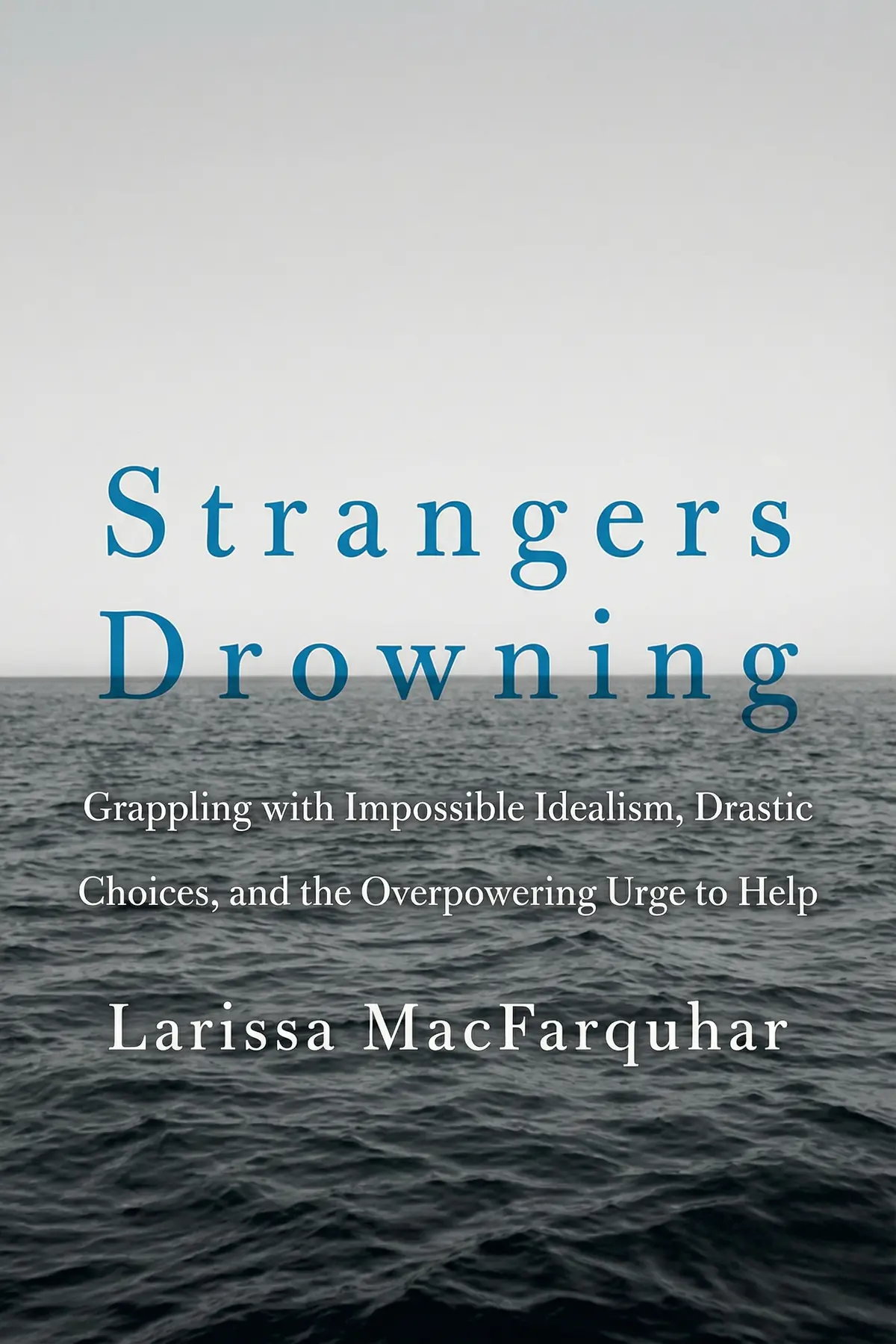
Table of Content
1. Introduction
55 sec
Most of us would risk a great deal for a sister or a close friend and far less for someone we have never met. A small number of people do not draw that line at all. In Strangers Drowning, New Yorker staff writer Larissa MacFarquhar follows several of them: a nurse who treated her enemies, a lawyer who left his career for a leper clinic, a manager who gave a kidney to a woman he found online.
Her portraits make a case worth hearing. The urge to help strangers is real and is not selfishness in disguise. It can save lives, sometimes the helper’s own. It also sends a bill, paid by the helper or by the people who love them.
Along the way you get a sharper sense of where your own line sits, a way to tell generous help from help that does harm, and a reason to stop assuming that every kind act hides a motive.
2. Help without taking sides, and it may protect you
1 min 44 sec
An elderly nurse in a war zone faced a wounded man whose face told her he had killed people. Many of her staff felt the clinic should treat only Sandinistas. What she did next changed what happened to her clinic.
3. Test your spending against a drowning child
1 min 45 sec
A thought experiment about a pond and a pair of expensive clothes leads to an uncomfortable verdict on everyday shopping. Push the logic one step further and it reaches the person you love most.
4. Weigh what meaningful work costs the people you love
1 min 50 sec
A respected lawyer gave up wealth and status to clean wounds in a small town, and he was happier for it. Then his wife fell seriously ill, and he had to choose between her and his patients.
5. Expect an empty stretch after a big gift
1 min 56 sec
A business manager read a newspaper ad and chose to give a kidney to the first stranger he found online. His surgeon cried. His family pushed back. Then the operation was over, and something unexpected happened.
6. Set limits so your help can last
1 min 49 sec
A Buddhist monk found a cause his country badly needed, and people answered faster than he could cope. His doctors’ warning forced a choice about how much of himself he could keep giving.
7. Spot when helping becomes a need to be needed
1 min 57 sec
The woman who stood by her husband through years of heavy drinking should have been overjoyed when he finally got sober. Coming to terms with that reaction, she saw that she needed help herself, and from it she created a support group.
8. Kindness gets mocked, yet a sociologist found it real
2 min 09 sec
Great novels turn their do-gooders into reluctant workers, lonely grouches or fools, and Darwin’s theory made helping look like a clever trade. One survivor’s question about the people who hid him changed the picture.
9. Conclusion
1 min 15 sec
MacFarquhar’s helpers do not fit easily into the boxes of saint or fool. Granada, Baba, Paul and Nemoto each followed an urge that most of us keep inside the circle of family and friends, and each paid for it somewhere: in danger, in a sick wife’s hard journey, in a flat season after surgery, in a body close to giving out. Lois Wilson shows the other edge, where helping turns into a need to be needed and to feel in charge. Oliner’s rescuers answer the oldest doubt. Some help comes with no hidden deal attached.
The book’s own advice is modest. Offer small help often, to whoever needs it, without waiting to be asked and without wanting anything back: directions for a lost tourist, a door held for someone whose arms are full. If you take on a bigger cause, pick one that fits your gifts and set the limits Nemoto nearly learned too late. And if you find you need someone’s trouble more than they need your help, look first at yourself.
For most of us, the drowning stranger stays a thought experiment. These people met that stranger every day and kept wading in.
About this book
What is this book about?
Most people would take big risks for family and friends and far smaller ones for strangers. A few people refuse to draw that line. They treat enemies, give organs to people they have never met and leave good careers to care for the sick. Others tend to see them as saints, as fools or as people quietly serving themselves. Larissa MacFarquhar looks closely at these helpers. She tells the stories of an 80-year-old nurse in Nicaragua, a lawyer who opened a leper clinic, a business manager who gave a kidney to a woman he found online and a Japanese monk who counseled people thinking of suicide. Alongside them she sets the philosopher Peter Singer's drowning-child argument, the darker case of Lois Wilson, and the long suspicion of do-gooders in novels and in Darwin's thinking. Readers come out with a clearer view of where their own line between loved ones and strangers sits. They learn the costs that giving puts on helpers and on the people around them, and how to spot when helping turns into a need to be needed. They also get evidence that some people really do help with nothing to gain.
Book Information
Who it's for
Pulled to help others
People who feel pulled to help others and wonder how much is too much.
Helping professionals near burnout
Caregivers, nurses and counselors close to burnout, or stuck rescuing a partner.
Considering work with purpose
Anyone weighing a move from a comfortable career to work with a purpose.
About the Author
Larissa MacFarquhar
Larissa MacFarquhar is an American writer, born in London in 1968, who moved to the United States at 16. She has been a staff writer at The New Yorker since 1998, profiling figures such as Barack Obama, Hilary Mantel, Derek Parfit and Aaron Swartz. Before that she was a senior editor at Lingua Franca and an advisory editor at The Paris Review. Strangers Drowning, published in 2015, is about why some people take the urge to help others to extreme lengths.
Ratings & Reviews
Ratings at a glance
What people think
Listeners find the book accessible and thoroughly investigated, particularly valuing its in-depth examinations of radical selflessness. It is described as mentally stimulating, with one listener mentioning how it encourages contemplation of these individuals, and many deem it truly motivating. The storytelling is captivating, as one listener notes that every chapter provides a compelling story. While the caliber of the writing earns favorable remarks, the stylistic approach to the narrative draws varied responses from listeners.
Top reviews
Roydao
Larissa MacFarquhar has a staggering ability to strip away the veneer of normal life to reveal the uncomfortable machinery of our morals. This book isn't just a collection of profiles; it’s a deep, philosophical interrogation of what we owe the world. I was particularly struck by the stories of the couple adopting twenty children and the monk in Japan running a suicide prevention site. By removing all physical descriptions of her subjects, MacFarquhar forces you into an uncomfortable intimacy with their thoughts. You aren't distracted by what they look like, only by what they do. Some might find the clinical tone off-putting, but I found it essential for the subject matter. It keeps the focus on the weight of their choices. This is easily one of the most challenging books I’ve read in years, making me question every frivolous purchase I make. It is a brilliant, unsettling look at the limits of human empathy.
Show moreSarocha
Ever wonder what happens when someone actually takes 'loving your neighbor' to the extreme? Strangers Drowning provides the answer, and it isn't always pretty or comfortable. These are people who don't just feel bad about the drowning child in the pond; they feel responsible for every drowning child on the planet. I was deeply moved by the case studies, especially the leper colony in the jungle. MacFarquhar writes with a quiet grace that allows the drama of these lives to speak for itself. Her research is clearly exhaustive, yet the narrative never feels bogged down by dry facts. Instead, it moves like a series of intense, short films. To be fair, I felt a massive amount of guilt while reading, which I suppose was the point. It’s an inspiring read that doesn't offer easy answers. Highly recommended for anyone who thinks they're doing enough for the world.
Show moreSupaporn
Wow, I am still reeling from the story of the couple who adopted twenty children. MacFarquhar captures the sheer chaos and the incredible commitment required for that kind of life without making it look like a fairytale. This is what makes the book so authentic; it shows the grime, the exhaustion, and the domestic strain that comes with radical kindness. The structure of the book, alternating between these intense lives and chapters of historical context, works perfectly. It gives you a chance to breathe and process the 'moral extremity' being described. The research into how psychology has viewed altruism over the years was a total eye-opener. I’ve never thought about 'do-gooding' as a form of rebellion before, but this book makes a compelling case for it. Truly inspiring and masterfully written.
Show moreScarlett
The most striking thing about these profiles is the intentional absence of physical descriptions. At first, it bothered me, but then I realized it was a clever narrative trick to prevent us from judging these 'do-gooders' on a superficial level. The book explores that thin line between incredible altruism and what some might call pathology. Why do these people feel a duty that the rest of us simply ignore? The storytelling is engaging, and the research into the history of altruism in literature was a highlight for me. However, I did find the chapters on philosophy a bit dense compared to the vivid personal stories. Sometimes the transition between the character sketches and the academic theory felt a little jarring. Still, the questions raised about our responsibilities to strangers will haunt me. It’s a well-researched, thought-provoking piece of journalism that avoids being preachy.
Show moreSamuel
Finally got around to this after seeing it on several 'best of' lists, and it certainly lived up to the hype. MacFarquhar’s profiles are less like standard journalism and more like deep psychological x-rays. She presents these lives without an ounce of judgment, which is impressive given how extreme some of their choices are. The discussion on Peter Singer’s drowning child experiment was particularly well-handled. It really makes you look at your own life through a different lens. My only minor gripe is that the book feels a bit repetitive toward the end. After the seventh or eighth profile, the 'extreme sacrifice' theme starts to lose a bit of its initial shock value. But the writing is undeniably sharp and the insights into the 'moral narcissist' were fascinating. It’t a solid, intellectual read that demands your full attention.
Show morePairot
As someone who has always felt a nagging guilt about global poverty, this book was a gut punch. It asks the terrifying question: if you can save a life, why aren't you doing it right now? MacFarquhar doesn't let the reader off the hook. The storytelling is dramatic and the case studies are selected for maximum impact. I appreciated the lack of authorial presence; she stays out of the way and lets the subjects' inner minds take center stage. Truth is, it’s a bit of a heavy read. You can't exactly breeze through it because every few pages you have to stop and re-evaluate your own moral compass. I gave it four stars instead of five only because the ending felt a bit abrupt. I was looking for a final synthesis that never quite came. Regardless, it’s a vital piece of work.
Show moreRod
Gotta say, I didn't expect to be this gripped by a book about ethics. The narrative style is unique, focusing on the internal logic of people who live for others. It’s fascinating to see how they justify their sacrifices, often at the expense of their own families or personal happiness. The conflict between 'duty' and 'attachment' is the heart of the book. One moment you admire these people, and the next you find them completely alien. This push-and-pull is what makes the reading experience so engaging. MacFarquhar’s prose is understated but powerful, avoiding the sensationalism that usually accompanies stories about 'saints.' It’s a well-rounded exploration of a very niche human experience. It definitely makes you think about what it means to be a 'good' person in a world full of suffering.
Show moreSomrutai
To be fair, the research here is impeccable, but I found myself struggling to connect with the subjects. The author’s choice to leave out physical details made everyone feel a bit like ghosts or abstract concepts rather than real people. I understand the goal was objectivity, but for me, it just created a sense of detachment that made the reading experience a bit dry. The stories themselves are wild—the woman donating a kidney to a stranger is especially intense—but I wanted more 'flavor' in the prose. Also, the chapter on how novelists hate do-gooders felt like it belonged in a different book. It was very academic and broke the flow of the personal narratives. It’s definitely a thought-provoking work, and I can see why it’s highly praised. It just didn't fully click with my personal taste for more grounded, descriptive non-fiction.
Show moreDimitri
Truth is, I have very mixed feelings about this collection of 'do-gooders'. On one hand, the case studies are undeniably fascinating and the writing is clear and accessible. On the other hand, the tone is so neutral that it almost feels cold. I found it hard to stay invested in the philosophical interludes, which felt a bit like being back in a college seminar. The book is definitely thought-provoking, but it also felt a bit repetitive after a while. Every subject seems to have the same origin story involving a non-functional parent and a childhood sense of responsibility. By the end, I felt like I was reading the same psychological profile over and over. It's an interesting read for sure, but I don't think I'd call it life-changing. A decent look at a strange subculture, but maybe a bit too long for the points it was making.
Show moreHenry
Look, I appreciate the effort, but focusing on these isolated 'saints' felt like a massive missed opportunity. The book treats altruism as a solo sport, ignoring the systemic and political ways we actually solve global problems. Reading about individuals living on peanut butter to save money for bed nets is fine, I guess, but it felt more like a study in eccentricity than a guide to doing good. The writing style is also incredibly sparse—almost to a fault. Without physical descriptions or much dialogue, the subjects started to blend together in my mind. I found the whole thing a bit depressing and, frankly, quite annoying at times. These people are described as heroes, but they often seem like they’re just suffering from extreme guilt. It lacked the philosophical rigor I was expecting from a New Yorker writer. Not my favorite.
Show moreQuestions about this book
What is Strangers Drowning by Larissa MacFarquhar about?
It looks at people who carry the urge to help others to extremes: an 80-year-old nurse treating enemy fighters in Nicaragua, a lawyer who opened a leper clinic, a man who gave a kidney to a stranger and a monk counseling people thinking of suicide. MacFarquhar argues that their altruism is real and not secretly selfish. She also shows its costs to the helpers and to the people who love them.
What is the drowning child argument in Strangers Drowning?
It comes from the philosopher Peter Singer. Nobody would let a child drown in a pond to save expensive clothes, yet children die every day for lack of food and medicine. Singer argues that spending on things we do not need, instead of helping them, is the same choice made from far away. Strict utilitarianism even says you should save two strangers over your own spouse.
Is altruism just selfishness in disguise?
Western thinkers long suspected so. Darwin explained helping as mutual benefit, since the person you help may help you back. MacFarquhar points to sociologist Samuel Oliner’s 1990 study of non-Jewish people who saved Jews during the Holocaust. They gained nothing socially, and the people they hid could not repay them. Oliner concluded that some people help just because someone needs it.
When does helping others become unhealthy?
Through Lois Wilson, who created Al-Anon, MacFarquhar shows that helping can become a need to be needed. When her alcoholic husband got sober, Lois felt anger because she no longer felt needed or in charge. Therapist Robin Norwood found in 1985 that people devoted to addicted partners often draw their self-worth from the partner’s illness, and most grew up with an addicted parent.
How can I apply the ideas from Strangers Drowning?
Start with small, frequent acts of help given without expecting anything back, such as giving a tourist directions or holding a door for someone carrying heavy bags. For bigger commitments, pick a cause that fits your time and talents, and set limits the way the monk Nemoto did when his health failed. After a big act of giving, expect a dip once the sense of purpose fades.
Readers also enjoyed


A Guide to the Good Life: The Ancient Art of Stoic Joy
William B. Irvine


A Little History of Philosophy
Nigel Warburton

A Theory of Justice
John Rawls

Anarchism: A Very Short Introduction
Colin Ward
AUDIO SUMMARY AVAILABLE
Listen to Strangers Drowning in 15 minutes
Get the key ideas from Strangers Drowning by Larissa MacFarquhar, plus 5,000+ more nonfiction titles.
- 5,000+ titles
- Listen as much as you want
- 7-day free trial
- Cancel anytime









