

15 min 06 sec
Available in: English
Soonish: Ten Emerging Technologies That’ll Improve and/or Ruin Everything
A tour of emerging technologies, from spaceplanes and fusion to printed organs and brain implants. It shows how close each one is, what still blocks it and what it could break.
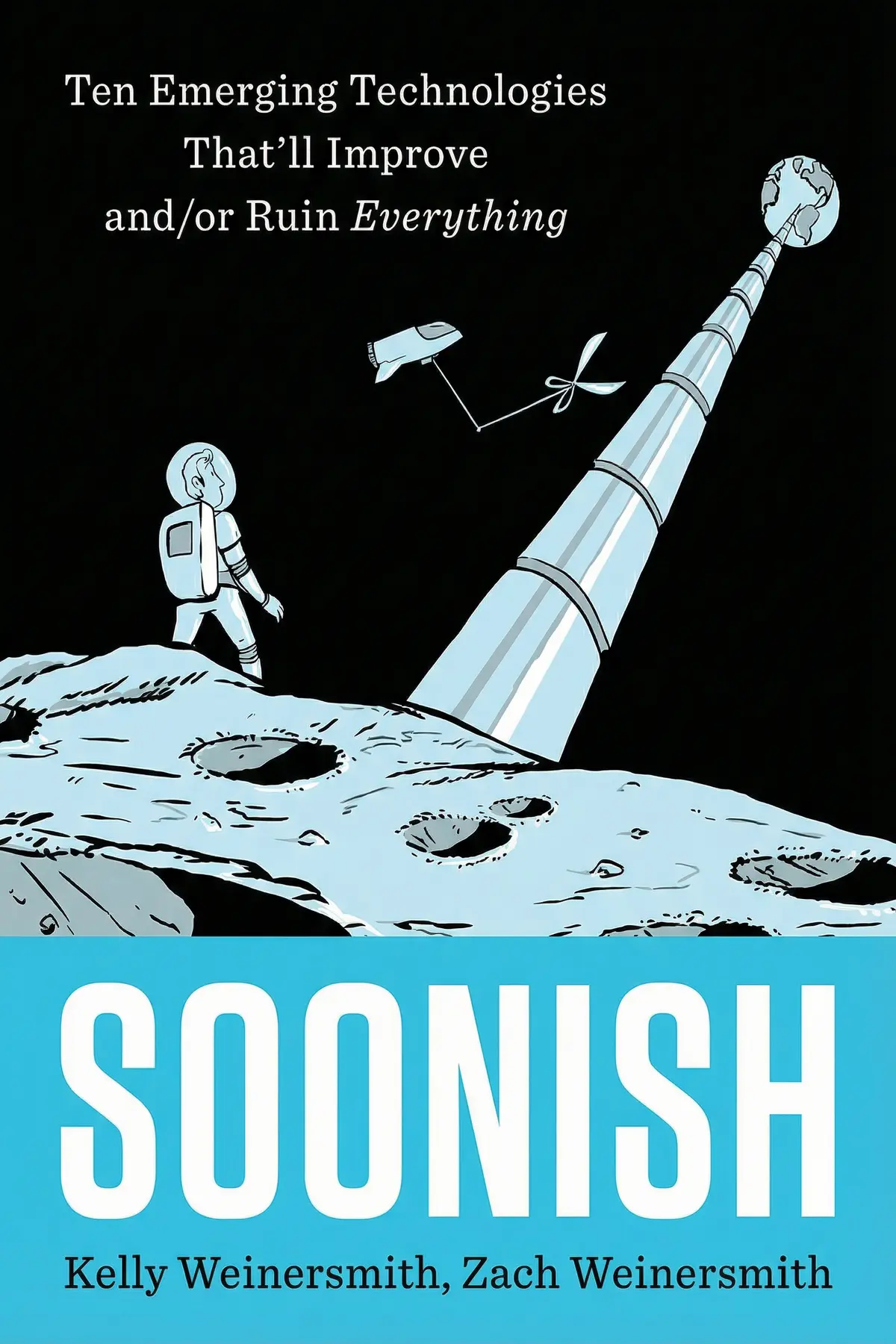
Table of Content
1. Introduction
1 min 04 sec
If science news reaches you as a blur of hype and letdowns, you probably underestimate how close some strange technologies already are. In Soonish, biologist Kelly Weinersmith and cartoonist Zach Weinersmith report that a truck can already print the molds for concrete houses, and that a helmet showing virtual instructions cut trainees’ errors by 94 percent. They survey ten emerging fields, from spaceplanes to brain implants. Their title is an honest forecast for most of them: it will happen, just a little later than you would like.
One thread runs through the book. Each technology is further along than the headlines suggest. Each is held back by one stubborn practical problem. And each brings an ethical question worth facing before it arrives. Follow that thread and you gain a simple way to read any story about the future: find the bottleneck, then ask who carries the risk when things go wrong.
2. Spot the real barrier to living in space
1 min 31 sec
People walked on the Moon more than half a century ago, so why are we still mostly stuck on the ground? The obstacle is plainer than physics, and the proposed fixes range from clever to wild.
3. Judge fusion news by energy in versus out
1 min 32 sec
Fusion power has been just around the corner for decades. One giant machine in the United States and a 35-nation project explain why, and give you a single test for every headline that follows.
4. Understand the bucket of goo that raises hard ethical questions
1 min 30 sec
Robots made of pig intestine and wood that reshapes itself in damp weather sound charming. Follow the same idea to its logical end, though, and you reach an object that would raise hard new questions for lawmakers.
5. Printed houses could be cheaper, sturdier and stranger
1 min 44 sec
Robots have been making things for us for years, yet houses are one area they have not entered. A Chinese company and a self-driving American truck are changing that, and the people who build houses today will feel it first.
6. Weigh augmented reality's speed against its privacy cost
1 min 36 sec
A helmet that shows you how to do a job made trainees dramatically faster and almost error-free. A popular phone game and a face-scanning app reveal what the same technology could cost everyone around you.
7. Discover how edited mosquitoes could end malaria
1 min 41 sec
A single gene released into mosquitoes might do what eradication efforts so far could not. So why are scientists holding back, and what else could the same tools let parents choose?
8. Medicine built around your own molecules and organs
1 min 42 sec
A clinic visit that diagnoses you instantly and a printer that makes the organ you need both sound distant. The building blocks, from blood molecules to Instagram photos to a printed ear, already exist.
9. Expect brain implants to repair before they enhance
1 min 38 sec
Movies promise skills downloaded straight into the head. Real brain technology is heading somewhere more modest and more moving, letting paralyzed people move robot arms and deaf people hear again.
10. Conclusion
1 min 08 sec
Soonish leaves you with a calmer way to read the future. The breakthroughs are real and already in labs: a self-driving truck printing concrete molds, a helmet that removed almost every training error, an ear printed at Princeton. Yet each one waits on a single stubborn limit, whether a cable material that does not exist, a fusion machine that eats more energy than it makes, or blood vessels too fine to print. And each raises ethical questions still to be worked out, from a bucket of goo that could become a gun to a gene meant to spread quickly through a region’s mosquitoes.
The Weinersmiths’ message is that the best time to think about these dilemmas is now, while the technology is still soonish. The next time a big announcement reaches you, look for the bottleneck. Then ask who answers when it fails: the maker, the user, or as yet nobody. That habit turns you into the person who can tell a lab demonstration from a delivery date, and who raised the hard question while there was still time to answer it.
About this book
What is this book about?
Science news tends to arrive as a blur of big promises and quiet letdowns, so most people have little idea how far fields like bioprinting, programmable matter or brain-computer interfaces have actually come. Kelly and Zach Weinersmith, a biologist and a cartoonist, set out to fix that with a lively survey of ten technologies that could arrive soonish: not today, not tomorrow, but within reach. Their method is to report on the research already under way in labs and companies. They look at Sandia's Z machine and the 35-nation ITER fusion project, MIT origami robots made of pig intestine, a self-driving truck that prints molds for concrete houses, a helmet that cut training errors by 94 percent, malaria-resistant mosquitoes and a human ear printed at Princeton. For each technology, readers learn what already works, the obstacles still in the way and the ethical questions it raises, from programmable goo that could become a weapon to AR software that identifies strangers. The result is a practical way to read any future-tech headline: find the bottleneck, then ask who carries the risk.
Book Information
Who it's for
Professionals skimming tech news
Curious professionals who skim tech headlines and want to know which breakthroughs are close.
Weighing emerging technologies
Founders and investors weighing fusion, 3D printing, AR or biotech, who want the real bottlenecks.
Students and teachers
Students and teachers looking for a lively, honest map of emerging science and its ethics.
About the Author
Kelly Weinersmith
Kelly Weinersmith is a biologist on the BioSciences faculty at Rice University, where she studies parasites that change their hosts' behavior, and co-hosts the podcast Science...sort of. Her work has been covered by The Atlantic, National Geographic, Science and Nature. Zach Weinersmith created the award-winning webcomic Saturday Morning Breakfast Cereal and co-founded the sketch group SMBC Theater. The married pair also wrote A City on Mars together.
Ratings & Reviews
Ratings at a glance

What people think
Listeners consider the work to be meticulously documented and charming in its coverage of upcoming scientific breakthroughs. They value the accessible explanations and witty prose, with one listener highlighting how it strikes a good balance between depth and readability. Listeners view it as an entertaining and stimulating experience, as one review notes it takes the inquiring mind on a journey. The tempo of the book draws varied opinions, with some considering it smart while others feel it can be a bit dumb at times.
Top reviews
Divya
After hearing so much about the Weinersmiths' work, I finally dove into this exploration of tomorrow's tech. It is incredibly refreshing to find a popular science book that doesn't treat the reader like they have a PhD or, conversely, like they're a total idiot. Kelly’s expertise shines through every chapter, providing a solid backbone of research that makes even the wildest ideas like asteroid mining feel plausible. Zach’s illustrations add a layer of whimsy that breaks up the dense discussions on orbital mechanics and genetic engineering. While some might find the humor a bit much, I thought it kept the pacing snappy and prevented the 'dry textbook' syndrome. It’s a thought-provoking journey that manages to be both informative and genuinely delightful. If you’ve ever been curious about why we aren’t living on Mars yet, this book provides the nuanced, multi-faceted answers you’ve been looking for without the boring jargon.
Show moreGun
The chapter on programmable matter alone is worth the price of admission. I’ve read a lot of futurist manifestos that are either too utopian or too doomsday-focused, but Soonish strikes a perfect middle ground. It’s a well-researched, delightful romp through the labs of 'mildly crazy' people trying to build the future. The Weinersmiths have a gift for taking high-level concepts like brain-computer interfaces and stripping away the fluff to reveal the actual mechanical problems. Is it funny? Yes, mostly, though your mileage may vary depending on your tolerance for nerd-culture references and puns. I found it to be a refreshing change of pace from the typical, self-important tech non-fiction that litters the 'New Releases' shelf. It’s the kind of book you can leave on your coffee table and pick up for twenty minutes at a time, always walking away with a new conversation starter for your next dinner party.
Show moreHassan
Wow, I didn't think a book about fusion power and synthetic biology could make me laugh out loud while actually teaching me something substantial. The Weinersmiths are a powerhouse duo here. Kelly brings the rigorous scientific background, and Zach brings the sharp, observational wit that fans of his comics will recognize. It’s a brilliant investigation into why the future hasn't arrived yet. The section on 'The road to Mars is paved with small discounts' was particularly insightful, highlighting the economic realities that often get ignored in favor of flashy headlines. Every page feels like it was written by people who genuinely love the search for knowledge. It’s an easy-to-understand masterpiece of science communication that manages to be both incredibly funny and deeply thought-provoking. If you want to feel better about the state of the world while learning about 3D printed organs, buy this book immediately.
Show moreMaria
Ever wonder why we don’t have space elevators yet? Soonish takes that question and runs with it, exploring the massive material science hurdles we still face. I loved how they structured each section: starting with the dream, moving to the current reality, and then looking at the 'ruin everything' potential. It’s a very clever way to frame progress. The writing is snappy, though I’ll admit a few of the jokes felt a bit forced or aimed at a much younger demographic. Still, the breakdown of fusion power was one of the clearest explanations I’ve ever encountered. Personally, I think it’s rare to find a book that balances legitimate skepticism with genuine wonder about the future of humanity. It’s not just about the gadgets; it’s about the 'why' behind the delays. Definitely worth a read if you want a tech overview that isn't just a dry Wikipedia summary.
Show moreBoss
Picked this up on a whim because the cover looked like a fun comic, and I wasn't disappointed by the depth of the actual content. It’s a fantastic bridge for people who love science but hate the academic slog. The authors tackle ten major technologies, from 3D organ printing to augmented reality, and they don't shy away from the gritty details of why these things are taking so long. Frankly, the chapter on 'cheap' access to space was eye-opening because it crushed some of my sci-fi fantasies while replacing them with more interesting realities. The illustrations are sparse but effective at illustrating the more abstract concepts that text alone struggles to convey. My only real gripe is that technology moves so fast that a few sections already feel a bit behind the curve. However, as an introductory text for the inquisitive mind, it really succeeds in making complex systems feel approachable and exciting.
Show moreAnong
As someone who usually finds physics books a bit dry, this was a breath of fresh air. The way the authors explain the intricacies of fusion power without making my eyes glaze over is nothing short of a miracle. I appreciated the honesty about how 'soonish' these things actually are—hint: not very. It’s a rare tech book that admits most of our cool future stuff depends on us getting really good at 'arranging carbon atoms into little straws.' The prose is conversational and energetic, making it easy to devour in just a few sittings. Even the more 'out there' topics like medical nanobots were handled with a level of skepticism that kept the book grounded in reality. While the humor is definitely geared toward a specific internet-savvy crowd, it worked for me. It’s a smart, accessible guide for anyone who wants to know what the next fifty years might actually look like.
Show moreKanokporn
Truth is, the authors have a very specific 'smartass' voice that might rub some people the wrong way, but I found it quite charming. It’s like being at a party with two geniuses who also happen to be incredibly funny and a bit self-deprecating. They take these massive, world-altering concepts—like brain-machine interfaces—and break them down into digestible, relatable chunks. The cartoons are definitely a distinct style, and while they aren’t 'high art,' they serve their purpose of lightening the mood during heavy discussions on the ethics of genetic engineering. I did feel that the chapter on construction robots was a bit weaker than the others, lacking the same 'wow' factor. Nevertheless, the book as a whole is a fantastic primer on the tech that will shape our lives. It’s balanced, well-researched, and doesn't take itself too seriously, which is exactly what popular science needs more of these days.
Show moreJirapat
To be fair, the science here is top-notch, but the delivery felt like a bit of a mixed bag for me. I’m a fan of the SMBC comics, yet somehow the transition to a long-form book felt clunky in places. The humor is very hit-or-miss—sometimes it’s a witty observation about human nature, and other times it’s just a juvenile pun that derails the technical explanation of bioprinting. I felt like I was constantly alternating between being fascinated by the potential of nanobots and being annoyed by a 'smartass' tone that felt slightly condescending. The research is obviously there, and I appreciate the deep dives into the history of these technologies, but the execution left me wanting something more mature. It’s a good starting point for a layman, but if you’re already well-read in tech circles, you might find the 'wacky' presentation more of a distraction than a benefit.
Show moreAhmed
Look, keeping up with emerging technology is a losing battle for any printed book, and this one is no exception. While published a few years ago, some of the specific 'current status' sections on reusable rockets already feel a bit dated. However, the foundational science and the explanation of the hurdles remain incredibly relevant. I enjoyed the 'ruin everything' sections because they offer a grounded look at ethics and unintended consequences. My main issue was the pacing; some chapters felt deeply investigated while others, like the one on augmented reality, felt a bit more superficial. The writing style is definitely 'pop-sci,' so don't expect deep equations or white-paper levels of detail. It’s a light refresher for those who already know the basics, but it could have benefited from a slightly more serious tone to match the weight of the topics being discussed. Three stars for the effort and the clear passion.
Show morePranee
Not what I expected given the hype surrounding the authors. I went into this hoping for something akin to 'Filmish,' where the illustrations and the text work in a tight, sophisticated harmony to explain complex history. Instead, what I got was a text-heavy book interspersed with what I can only describe as amateurish doodles. The humor frequently falls flat, leaning into a 'look how quirky we are' vibe that becomes exhausting after the third chapter. To be honest, I found myself skipping the cartoons entirely just to get to the actual science, which is the only redeeming quality here. The information on asteroid mining and robotics is accurate and well-explained, but it’s buried under so much 'smartass' filler that it’s hard to stay engaged. It feels like it’s trying too hard to be the 'cool' science teacher who makes too many bad jokes. I’d recommend just reading a dedicated technical blog instead.
Show moreQuestions about this book
What is Soonish by Kelly and Zach Weinersmith about?
Soonish surveys ten emerging technologies, including cheaper space access, fusion power, programmable matter, robot-built houses, augmented reality, synthetic biology, precision medicine, bioprinting and brain-computer interfaces. For each, the authors explain what already works, what still blocks progress and which ethical questions it raises. Their key message is that much remarkable research goes unnoticed in daily news, and that thinking about these futures now helps us prepare for their dilemmas.
What ethical concerns does Soonish raise?
The authors flag questions in nearly every field. A programmable Bucket of Stuff could become a weapon, and a malfunctioning programmable car raises the question of who is at fault. Robot construction could widen pay gaps. AR apps like Recognizr could identify strangers without consent. Gene editing could let parents choose a child’s traits, and releasing engineered mosquitoes into the wild needs more testing first.
How close is fusion power according to Soonish?
Not yet close. At Sandia Labs, the Z machine used in the MagLIF project still uses far more energy than its fuel releases, and the team hoped to break even by 2020. The authors see more promise in ITER, a 35-nation project that holds plasma in a donut-shaped chamber with magnetic fields. Despite delays and budget overruns, there was hope for a working reactor by 2027.
Can we 3D print human organs yet?
Not whole working organs. The authors explain that an organ holds a dozen or more cell types, each needing its own bio-ink, and the tiny blood vessels are the hardest part. Progress is real, though: Dr. Jordan Miller’s team at Rice University has printed some thicker vessels, cartilage and heart valves have been printed, and a Princeton University group printed a human ear.
How can I apply the ideas in Soonish?
The book offers a way to read technology news. For any announcement, look for the one practical limit still standing, such as cost for space travel or energy balance for fusion. Then ask who carries the risk if it fails, a question the authors raise for programmable cars, AR privacy and gene editing. For brain-boosting claims, remember that repair works today while enhancement data remains inconclusive.
Readers also enjoyed



A Life Decoded: My Genome: My Life
J. Craig Venter
21 Lessons for the 21st Century
Yuval Noah Harari

A Planet of Viruses
Carl Zimmer


A Short History of Nearly Everything
Bill Bryson


A Thousand Brains: A New Theory of Intelligence
Jeff Hawkins

AI 2041: Ten Visions for Our Future
Kai-Fu Lee
AUDIO SUMMARY AVAILABLE
Listen to Soonish in 15 minutes
Get the key ideas from Soonish by Kelly Weinersmith, plus 5,000+ more nonfiction titles.
- 5,000+ titles
- Listen as much as you want
- 7-day free trial
- Cancel anytime









