

10 min 46 sec
Available in: English
Remote, Not Distant: Design a Company Culture That Will Help You Thrive in a Hybrid Workplace
Shows managers and teams how to build a strong culture without sharing an office. Its tools are deliberate design, a purpose backed by real rewards, psychological safety, asynchronous collaboration and clear hybrid ground rules.
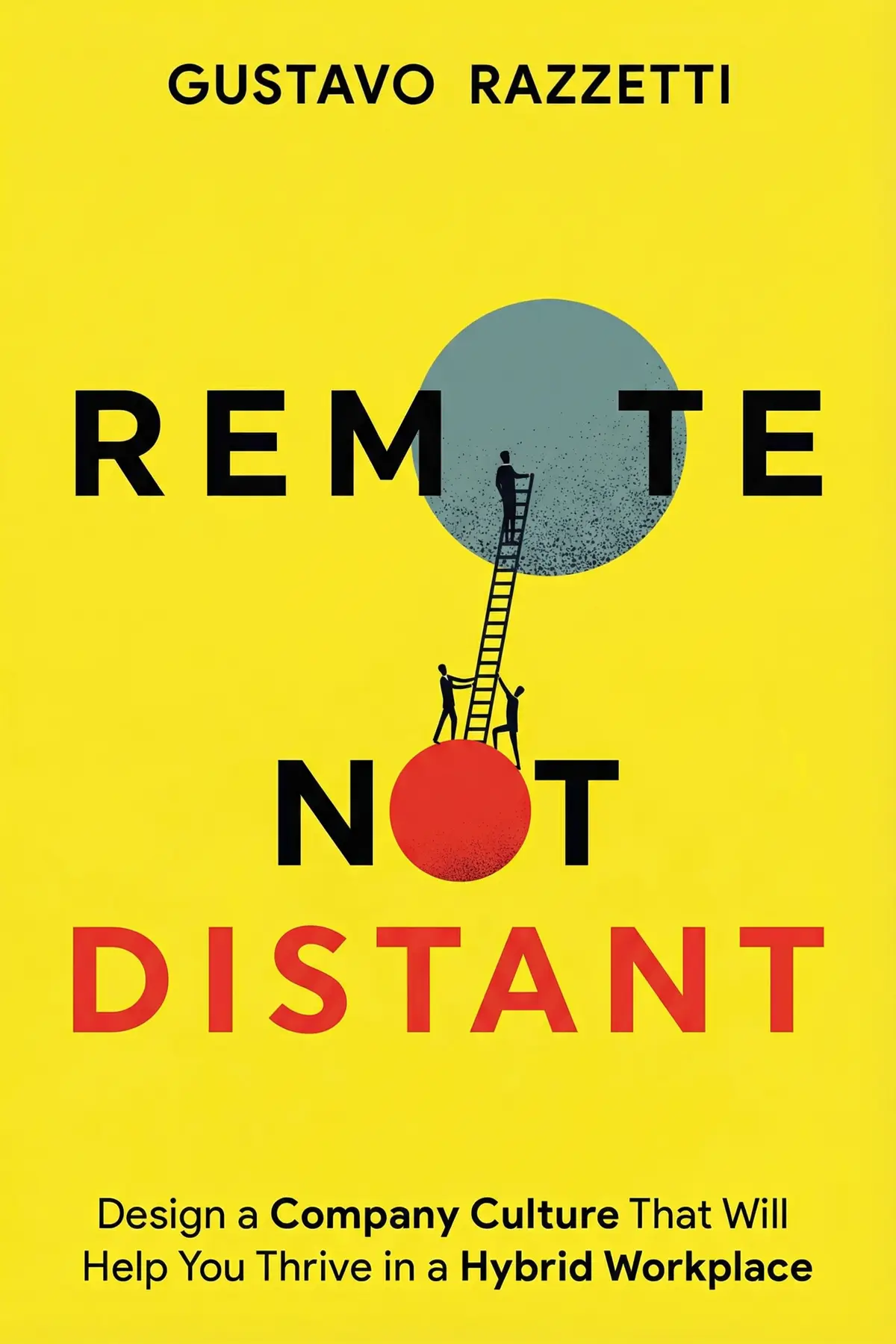
Table of Content
1. Introduction
1 min 01 sec
Many teams that left the office kept its worst habits: endless video calls, managers counting hours, and people who feel watched yet alone. In Remote, Not Distant, culture consultant Gustavo Razzetti argues that the office was never what held a team together. Culture lives in what a company rewards, how safe people feel to speak and how work gets coordinated, and all of that can be designed from anywhere.
The perks people link with culture, like a free gym or drinks after work, are only the surface. What counts is an environment where people do strong work and see it matter. Razzetti’s case is that a hybrid team stays close when its culture is built on purpose and never left to chance. That means a shared purpose that behavior backs up, a safe place to speak, collaboration that does not need everyone online at once, and ground rules the team helps write. Each of those becomes a concrete change a manager can try with the team.
2. Measure your team by the results it delivers
1 min 34 sec
Long days and a full outbox still feel like proof of commitment. Razzetti thinks they measure the wrong thing, and he names the habits of mind that have to change before any hybrid policy can work.
3. Rewarded behavior defines your culture more than stated values
1 min 42 sec
Almost every company publishes values about trust and experimentation. Employees mostly ignore them, and Razzetti points to the place they look instead to learn what the culture really expects of them.
4. Make it safe to speak up on camera
1 min 50 sec
Dark cameras and silent faces on a call are rarely an accident. A few small habits at the start of meetings and in how feedback flows decide whether people feel free to say what they really think.
5. Fewer meetings, deeper work and clearer records
1 min 42 sec
A full calendar looks like a team working closely together. Razzetti argues it can do the opposite, and he lays out a different rhythm that gives people back the hours they need for real work.
6. Set hybrid rules that your team truly owns
1 min 51 sec
Most hybrid arrangements break down over questions nobody asked out loud. Razzetti lists the choices a team has to settle early, from who comes in on which days to who gets the final say.
7. Conclusion
1 min 06 sec
Remote, Not Distant takes apart a common fear: that once the office empties, the culture leaves with it. Razzetti’s reply is that the office was carrying less weight than anyone thought. The free gym and the drinks after work were never the culture. The culture was in what people were rewarded for, whether they could speak without fear, and how clearly the rules of working together were set. All of that travels.
What changes is that none of it happens by accident anymore. A hybrid team has to choose its culture out loud, test it, and adjust when an approach fails.
The book supports a few concrete moves. Judge the past month by results and leave hours out of it. Look at what happened to the last person who tried something new and failed, because that story is your real statement of values. Open meetings with a check-in, and stop making decisions without the people they affect. Then put the hybrid model, the response times and the decision rules in writing, and let the team revise them.
Distance is a fact of hybrid work. Feeling distant is a matter of design, and it can be designed out.
About this book
What is this book about?
When teams left the office, many leaders feared the culture would leave with them. Gustavo Razzetti argues the opposite. In his view, culture was never the free gym membership or the drinks after work. It is the set of behaviors a company rewards, the safety people feel to speak, and the way work gets coordinated, and all of that can be designed for people who rarely sit in the same room. Razzetti, who runs a culture consultancy, sets out five changes in thinking for hybrid work: design culture on purpose, judge people by impact, accept the messiness of working from home, collaborate at different times, and let teams shape their own policies. He then turns each into practice. Readers see how to give a team its own purpose, run meetings where people feel safe to speak, cut meetings in favor of documented written work, and choose among five hybrid models. The result is a practical guide for anyone responsible for a team that is spread out. It shows the decisions to make early, the habits to start in meetings and the rules worth writing down.
Book Information
Who it's for
Remote and hybrid managers
Managers leading hybrid or remote teams who feel the group drifting apart.
Leaders writing hybrid policy
Founders and HR leaders writing a hybrid policy and unsure which model to choose.
Teammates stuck in calls
Team members stuck in back-to-back calls who want a better way to work together.
About the Author
Gustavo Razzetti
Gustavo Razzetti founded Fearless Culture, a consultancy that helps teams design their workplace culture, and created the Culture Design Canvas, a framework teams use to map, assess and design how they work. He has led more than 1,500 workshops for teams at organizations including Mars, Microsoft, Merck, Globant and the Inter-American Development Bank. A bestselling author whose books also include Forward Talk, he writes regularly for Psychology Today, and The New York Times, BBC and Forbes have covered his ideas.
Ratings & Reviews
Ratings at a glance
What people think
Listeners find this guide packed with actionable steps and practical guidance, making it essential reading for team managers. They appreciate the focus on virtual work and distributed groups, with one listener highlighting how it helps establish culture in those environments. The material earns praise for its tools, with one listener noting its usefulness for companies. They also value the strategies for collaborating during and post-COVID.
Top reviews
Benjamin
As someone who transitioned to a fully remote lead role last year, I found this roadmap incredibly grounding. The 'stinky fish' exercise is genius—we used it in our last retreat to clear the air about our communication bottlenecks, and it worked wonders. Razzetti emphasizes that being remote doesn’t have to mean being distant, which is a distinction many leaders miss. The focus on psychological safety and treating feedback as a gift resonated deeply with my team's current needs. It’s a must-read if you want to move beyond just surviving Zoom calls and actually start building a meaningful culture that empowers people. The advice is packed with steps that are easy to follow and implement immediately.
Show moreSelin
The chapter on psychological safety alone makes this a worthwhile investment for any manager. Razzetti understands that remote work isn't just a logistical challenge—it's a human one. I loved the practical tips for starting meetings with check-ins and the emphasis on treating mistakes as learning opportunities rather than failures. The QR codes leading to printable diagrams are a life-saver for visual learners like me. In a world where many bosses are demanding a return to the office, this book provides the evidence-based arguments we need to prove that hybrid models can actually be superior. It is highly recommended for anyone leading a distributed team. The focus on inclusivity in the evolving world of work is exactly what we need right now.
Show moreSook
Wow, a business book that actually provides actionable exercises instead of just vague philosophy. I’ve read dozens of these types of books, and most are all fluff. Not this one. The strategies for silent brainstorming and keeping meetings small are things I could implement the very next day. It highlights how physical presence is no longer a prerequisite for a robust culture, which is a message more CEOs need to hear right now. The documentation of interactions ensures that no one is left out of the loop, regardless of their location. It truly changed how I view my role as a facilitator. In my experience, this is the most practical guide on the market for distributed teams.
Show moreDylan
Finally got around to reading Razzetti’s take on the hybrid era. It’s a solid, practical guide for managers struggling to keep their teams connected across different time zones. I particularly appreciated the focus on intentional culture design; it’s not just about where we work, but how we decide to work together. The QR codes were a nice touch, allowing me to download diagrams for our next planning session. While some sections felt like a retread of basic management theory, the specific frameworks for asynchronous collaboration provided fresh air. To be fair, the shift from tracking hours to measuring actual results is a hurdle my company still faces, and this book gives me the language to advocate for that change. It is a very useful tool for anyone in a leadership position.
Show moreBoy
Ever wonder why your team feels disjointed despite being 'connected' all day on Slack? This book dives into the 'why' behind that friction. Gustavo Razzetti makes a compelling case for asynchronous collaboration, arguing that we don't all need to be online at the same time to be productive. I’ve started implementing the 'impact over input' mindset with my direct reports, and the shift in morale is already visible. There’s a lot of talk about intentionality, which can feel a bit buzzword-heavy at times, but the actual exercises provided make it feel more tangible. It's a useful toolkit for the post-pandemic reality. Frankly, every team leader should at least skim the chapters on team empowerment.
Show moreTanawan
Picked this up on a recommendation from my HR director during our hybrid transition. It’s a very practical manual. The book does a great job of defining different hybrid models and setting protocols for decision-making that don't rely on everyone being in the same room. I’ll admit the 'Impact Over Input' section was a bit of a reality check for my old-school management style. The writing is clear and the chapters are short enough to digest during a commute or a lunch break. It’s not a revolutionary manifesto, but it is a very solid 'how-to' guide for the modern workplace. It definitely helps bridge the gap between physical location and team value.
Show moreCameron
Not what I expected, but it has its moments of clarity. My main gripe is that the tone feels a bit too corporate for a small startup environment like mine. The advice seems geared toward companies with hundreds or thousands of employees and established HR departments. That being said, I did appreciate the clear structure and the fact that it didn’t drag on unnecessarily. The section on blurring work-life boundaries was an interesting take, though I’m still not entirely sold on the idea of normalizing personal interruptions during the workday. It’s a decent overview of collaboration methods, just not particularly groundbreaking for my specific situation.
Show moreEllie
To be fair, Razzetti writes well, but much of this territory feels familiar if you've already devoured Harvard Business Review articles or other culture-focused management books. It reads like a very well-organized summary of existing best practices rather than a collection of original insights. I liked the focus on intentional culture design, but I was hoping for more case studies from smaller, non-corporate businesses. If you’re new to the concept of organizational culture, this is a fantastic starting point. If you’re a seasoned pro, you might find yourself skimming through most of the chapters to find the few 'hidden gems' of advice. It’s helpful, but definitely not groundbreaking.
Show moreWatcharee
Look, the transition to hybrid work is messy, and this book tries its best to map out the chaos. Personally, I found the 'stinky fish' exercise a bit hokey, but my team actually enjoyed the vulnerability it encouraged. The book is well-structured, but the physical presentation—huge margins and large font—makes it feel a bit padded to justify the price point. The core message of team empowerment and trust is vital, though not exactly a new concept in management circles. It’s a helpful resource if you need a structured approach to culture, but don't expect it to reinvent the wheel. It's a nice summary for those who haven't kept up with the buzz on remote work.
Show moreRodrigo
This book feels like it could have been a series of blog posts or a long LinkedIn article. I was frustrated by the layout; the font is massive and the margins are so wide it feels like the author was trying to hit a page count. Most of the 'new' models presented are just renamed versions of things we’ve been doing since 2020. If you are a complete beginner to remote work, you might find some value here. However, for those of us who have been in the trenches for years, it’s a bit too generic. It lacks the deep, academic rigor I was hoping for. It’s well-structured enough, but the substance just isn't there for a seasoned professional.
Show moreQuestions about this book
What is the main idea of Remote, Not Distant?
Gustavo Razzetti argues that a strong workplace culture does not require a shared office or perks like free gym memberships. Culture comes from what a company rewards, how safe people feel to speak, and how work is coordinated. A hybrid team stays close when leaders design these things on purpose: valuing results over hours, giving the team a real purpose, building psychological safety, collaborating at different times and setting clear ground rules together.
What are the five mindset shifts in Remote, Not Distant?
Razzetti names five changes in thinking for hybrid work. Design culture intentionally, with employee input and room to experiment. Judge people by impact instead of hours or email volume. Drop rigid work-life boundaries and accept interruptions and casual clothes at home. Collaborate asynchronously, since people keep different timetables. And let teams make decisions about their own hybrid-work policies, which builds ownership and trust.
What hybrid work models does Gustavo Razzetti describe?
He describes five. Office-first means people mostly work on site with occasional days at home. Fixed hybrid assigns some groups to remote work and others to the office. Partly remote adds set collaboration days when everyone comes in. A flexible model lets each employee decide when and whether to come to the office. Remote-first makes remote work the default for everyone. Razzetti says a company should name its model clearly before anything else.
How do you build psychological safety in a remote team?
Razzetti recommends that Zoom meetings open with a round of check-ins, that you use your camera on purpose, and that you weigh perspectives different from your own. Invite everyone to speak, respect different participation styles, refuse interruptions and include affected people in decisions. Raise difficult topics directly. Treat mistakes as learning, use low-pressure methods like silent brainstorming in small groups, and give feedback in every direction, focused on what to do next.
Who should read Remote, Not Distant?
It suits managers, founders and HR leaders responsible for teams that work partly or fully apart, especially those designing a hybrid policy for the first time. Team members overwhelmed by meetings will also find practical help, such as cutting meetings, documenting decisions and agreeing on response times. Its tools are concrete steps a team can put into practice.
Readers also enjoyed

A Bigger Prize: How We Can Do Better Than the Competition
Margaret Heffernan





A Year with Peter Drucker: 52 Weeks of Coaching for Leadership Effectiveness
Joseph A. Maciariello



AUDIO SUMMARY AVAILABLE
Listen to Remote, Not Distant in 15 minutes
Get the key ideas from Remote, Not Distant by Gustavo Razzetti, plus 5,000+ more nonfiction titles.
- 5,000+ titles
- Listen as much as you want
- 7-day free trial
- Cancel anytime









