

A Thousand Brains: A New Theory of Intelligence
Jeff Hawkins
 English
 ไทย
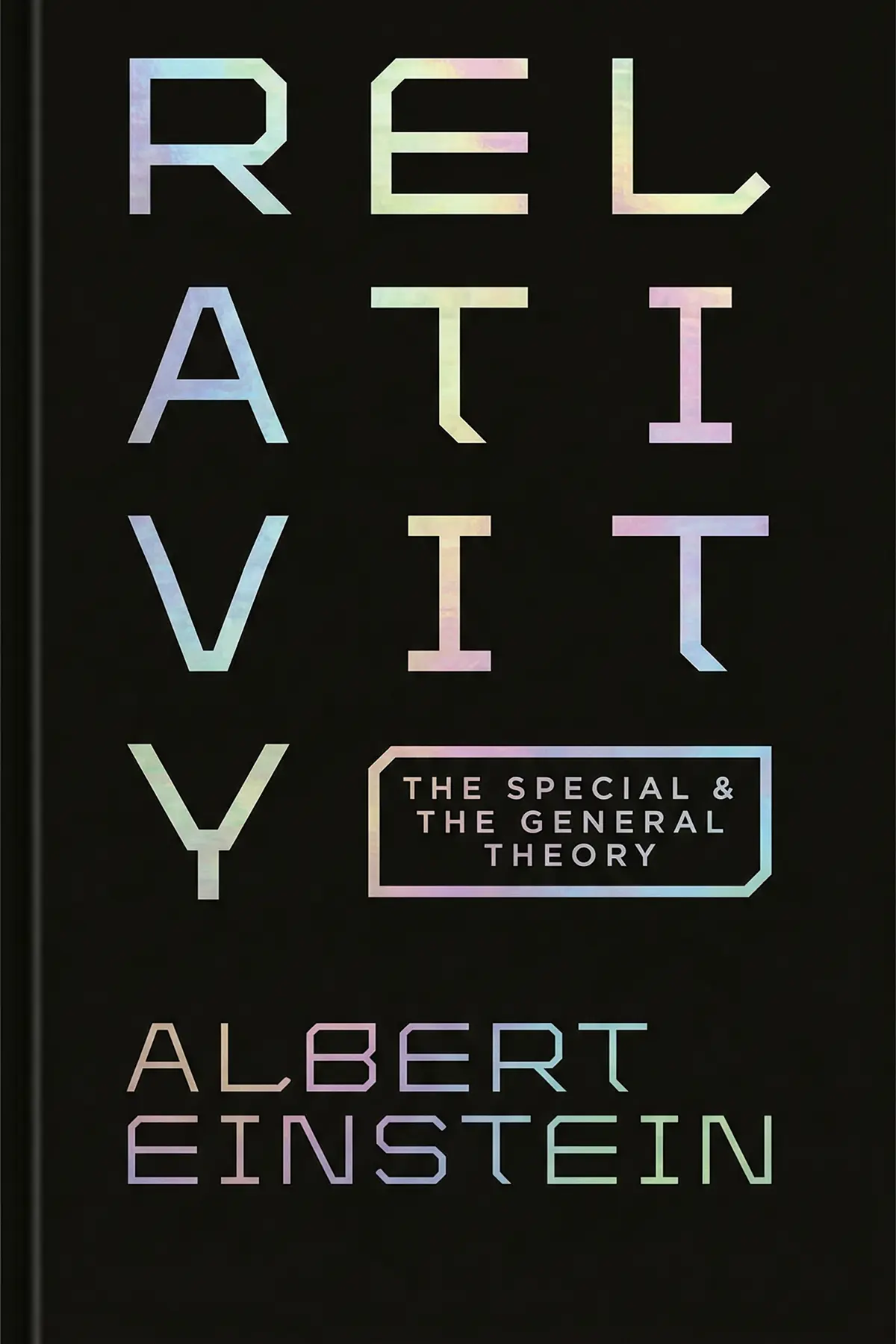
Shows how one stubborn fact, that light moves at the same speed for everyone, forces time to slow, lengths to shrink and gravity to become the curvature of space and time.
1 min 02 sec
Most of us carry a picture of the universe in which time ticks the same for everyone and gravity is a pull between objects. In Relativity: The Special and the General Theory, Albert Einstein takes both ideas apart, starting from one stubborn experimental fact: light moves at the same speed for every observer, however that observer is moving. Einstein, who published special relativity in 1905 and general relativity in 1915, shows how much follows once that single fact is accepted in full.
His throughline is easy to state and hard to absorb. Space and time, in his account, form a single fabric that motion stretches and matter bends, and that fabric shapes everything from a passing train to the fate of the cosmos.
Follow the argument and you will be able to tell a friend why a moving clock runs slow, why Mercury’s orbit puzzled astronomers for so long, and how a universe can be finite without an edge anywhere.
1 min 39 sec
Two physicists measured light again and again, expecting the moving Earth to change the result each time. It never did, and the way Einstein chose to read that failure reshaped physics.
1 min 52 sec
Two friends start their stopwatches at the same instant, one standing on a platform and one on a speeding train. Their watches soon disagree, and neither watch is broken.
1 min 45 sec
Locked in a box with no windows, you feel yourself pressed to the floor. Einstein claimed you could never learn the true cause from inside, and that claim changed what gravity means.
1 min 41 sec
For a long time one planet refused to move the way the accepted physics of the day said it should. The tiny error looked like a nuisance until it became a verdict.
1 min 37 sec
A pilot who never steers left can still end up back at the starting point. That simple flight explains how planets move and how something finite could have no edge.
1 min 49 sec
A tight bedsheet, a sagging one and a saddle stand for three possible universes. Which one we live in may decide whether everything expands forever, and Einstein wondered what such laws leave for chance.
1 min 13 sec
Einstein’s argument runs on one discipline: take a strange fact seriously and follow it wherever it leads. A measurement of light that refused to change led to slow clocks and shortened trains. A windowless elevator turned gravity into geometry. A wobble in Mercury’s orbit matched the idea’s predictions, and the combined weight of all the matter in existence became a question about the shape and future of the universe. At each step, something that seemed fixed turned out to bend.
The ideas are easy to carry with you. The next time you look at the night sky, picture the stars as dents in a single fabric of space and time, and remember that their light reaches you at the same speed it would reach anyone, however fast they moved. When a conversation turns to time travel or the edge of the universe, you can describe the space traveler who comes home having aged less, and the globe that has no edge yet is still finite.
And when evidence you trust contradicts something everyone takes for granted, try Einstein’s choice first. He did not assume the experiment had failed. He assumed the world was stranger than people thought, and the world agreed.
Most people picture time as a clock ticking identically everywhere and gravity as an invisible pull between objects. Albert Einstein's Relativity takes both pictures apart, starting from late nineteenth-century measurements showing that light always travels at the same speed, however the Earth beneath the instruments is moving. Einstein accepted that result in full and followed it. Moving clocks run slow and moving objects shorten, so space and time join into a single fabric called spacetime. A thought experiment with a windowless elevator suggests that gravity and acceleration cannot be told apart, which leads to gravity as the bending of spacetime by massive bodies. The idea passes a real test by explaining a puzzling shift in Mercury's orbit that Newton's laws could not account for. The argument then widens to the whole cosmos: a universe that may be finite yet have no edge, a shape set by how much matter it holds, and Einstein's reflections on determinism and what scientific theories are for. Readers gain a clear mental picture of relativity they can explain to someone else.
Curious readers who have heard of relativity but could never picture what it actually says.
Students meeting time dilation, spacetime or curved space for the first time and wanting a clear mental model.
Professionals who enjoy big ideas and want to explain Einstein's physics in plain words.
Albert Einstein was born in Ulm in 1879 and died in 1955. He studied in Zurich and worked at the Swiss Patent Office in Bern before moving to Berlin in 1914. In 1905 he published four papers, including special relativity and the equivalence of mass and energy, and in 1915 he presented general relativity, which brought gravitation into his physics. He won the 1921 Nobel Prize in Physics for his work on the photoelectric effect and became an American citizen in 1940.

Listeners find the book educational and value the non-technical method used to explain relativity. Additionally, the writing is simple to follow, with one listener highlighting its clarity. However, the philosophical side of the work draws mixed reactions from listeners.
Ever wonder how the smartest man in history explains his own ideas? This book is a remarkably clear window into a mind that reshaped our entire understanding of reality. Einstein avoids burying the reader in impenetrable math, opting instead for thought experiments involving trains and lightning bolts. Truth be told, seeing how he builds upon the foundations laid by Newton and Galileo is fascinating. It’s not just a physics lesson; it’s a masterclass in logical progression. I found the section on the curvature of space-time particularly striking, even if visualizing four dimensions remains a bit of a headache. For anyone who thinks they can't understand physics, this is the place to start.
Show moreThis book is surprisingly accessible for something written by a physicist of such stature. Einstein writes with a humility that makes the complex shift from absolute to relative time feel almost intuitive. Looking at the concept of 'simultaneity' through his eyes changed how I perceive my own watch. The way he describes the four-dimensional 'world' of Minkowski is brilliant, even if my brain struggles to map it out. Personally, I appreciated that he wrote this specifically for the layperson. It isn't exactly a beach read, but it’s far more digestible than any modern textbook I’ve encountered. Truly a foundational piece of literature for the modern age.
Show morePicked this up because I wanted to go straight to the source rather than reading a second-hand interpretation. It’s amazing how well Einstein communicates his revolutionary ideas without the need for fancy diagrams or jargon. The discussion on the deflection of light by gravitational fields was particularly gripping. It makes you realize just how much our modern technology, like GPS, relies on these very principles. I gotta say, the writing style is surprisingly humble for a man who changed the world. If you can get past the initial shock of the concepts, the internal logic is flawless. It’s a slim volume, but it packs more intellectual weight than books triple its size.
Show moreThe chapter on the structure of space really blew my mind. Einstein manages to explain the transition from Euclid's geometry to a non-Euclidean universe in a way that feels revolutionary even a century later. I loved the appendices that detailed the experimental confirmations, like the displacement of spectral lines. It’s one thing to have a theory, but seeing the evidence laid out makes it real. In my experience, most people are intimidated by the name Einstein, but his writing here is inviting. He treats the reader as an equal, walking them through the steps of his discovery. It’s an essential addition to any science lover’s collection.
Show moreWow, reading Einstein’s own words is like watching a master craftsman explain his tools. There’s a certain rhythm to his logic that you just don't get in popular science books written by others. The way he navigates the Maxwell-Lorentz theory to arrive at Special Relativity is just beautiful. No point of view is preferred, and time itself becomes a flexible thing—it's mind-bending stuff. The book is surprisingly thin, yet it manages to cover the entire scope of his two major theories. I found the section on the Redshift particularly interesting. It’s a profound reminder that our perception of the world is only one of many possible truths.
Show moreFinally got around to reading this classic, and I must say the clarity of the prose is its greatest strength. Einstein manages to strip away the intimidating layers of the Special and General theories to reveal their core logic. I was particularly impressed by how he gives credit to his predecessors, like Lorentz and Minkowski, showing that science is a collaborative evolution. The appendices are actually quite helpful if you want a peek at the math, but the main text stands on its own. It’s a bit dry in spots, especially when he dives into the philosophical implications of space, yet the importance of the work is undeniable. A must-read for any curious soul.
Show moreFrankly, I expected a dense textbook, but what I found was a guided tour through the cosmos. Einstein’s intention to reach the broader public is evident on every page. He uses simple, everyday examples to illustrate why two observers might not agree on the time. The transition from Special Relativity to the General Theory is handled with such grace that you almost don't realize how much your worldview is shifting. My only minor gripe is that some of the philosophical conclusions felt a little detached from the physical evidence. Still, the historical significance and the sheer elegance of the logic earn this a solid recommendation for anyone's library.
Show moreLooking back at high school physics, I wish we had started with this text instead of the dry chapters on pulleys and levers. Einstein makes the universe feel alive and dynamic. He doesn't just throw laws at you; he explains the 'why' behind the curvature of space-time. The mention of the perihelion of Mercury as experimental proof was a great touch in the appendix. Truth is, the book demands focus, but the payoff is a profound sense of awe. Some parts about the cosmic ether felt like a relic of the time, but they help show the progression of thought. It’s a lean, mean, scientific machine of a book.
Show moreTo be fair, while the science is groundbreaking, the philosophical tangents felt a bit dated and abstract for my taste. Einstein is a genius, no doubt, but the 'simplified' equations still require a decent grasp of algebra to truly appreciate. I struggled with the later chapters regarding the structure of space as a whole. It’s easier to understand the concepts than it is to actually visualize the four-dimensional continuum he describes. The book is definitely informative and avoids most technical jargon, but it’s still a heavy lift for a casual reader. I’m glad I read it for the historical context, but I probably won’t be revisiting it anytime soon.
Show moreNot what I expected; the 'simplified' examples still felt like they required a PhD to fully grasp. I know this is meant for the general reader, but I found myself lost by the time we reached the Lorentz transformations. Perhaps my math skills are just too rusty, but the logic didn't feel as 'straightforward' as others have claimed. The philosophical musings at the end were particularly confusing and seemed to raise more questions than they answered. I respect the man’s brilliance, but as a teaching tool for the average person, this fell short for me. It’s historically important, sure, but it wasn't the easy read I was promised.
Show moreEinstein starts from the finding that light travels at the same speed for every observer, however they move. Accepting that fact forces time and space to change: moving clocks run slow, moving objects shorten, and space and time merge into one fabric called spacetime. In the general theory, massive bodies curve that fabric, and the curvature is what we experience as gravity.
Time dilation means time passes more slowly for something moving fast compared with something at rest. One way to picture this uses two friends: Alice on a platform and Bob on a bullet train. Measured from the platform, Bob’s stopwatch ticks more slowly than hers, while Bob notices nothing unusual. A traveler who flew near light speed and returned would find less time had passed for them than for those at home.
Through a sealed elevator. Feeling pressed to the floor could come from Earth’s gravity or from a spaceship accelerating the elevator through empty space, and Einstein argued no test inside could tell them apart. From that equivalence he concluded that gravity is the curving of spacetime by massive objects such as planets and stars, and that bodies follow the shortest paths through those curves.
Mercury’s orbit around the Sun shifts slightly on every circuit, a precession that Newton’s laws could not explain. Astronomers were baffled by this small, persistent wobble. General relativity treats the space around the Sun as curved by its mass, and when Einstein applied the theory, its predictions matched Mercury’s unusual motion closely, turning a long-standing puzzle into evidence for the new physics.
It suits curious readers and students who want to understand what relativity claims, from slow clocks and shrinking trains to curved space and a universe that may be finite without any edge. It also rewards anyone interested in how scientists think, since Einstein reflects on determinism and on theories as attempts to grasp the order underlying the universe.
Jeff Hawkins




Lisa Kaltenegger




J. Craig Venter
AUDIO SUMMARY AVAILABLE
Get the key ideas from Relativity by Albert Einstein, plus 5,000+ more nonfiction titles.









