


13 min 07 sec
Available in: English
Red Team: How to Succeed by Thinking Like the Enemy
By Micah Zenko
Shows how armies, spy agencies, airports and companies find their hidden weaknesses by paying experts to attack them. It also explains why leaders so often ignore those warnings, and how to set up critics who actually get heard.
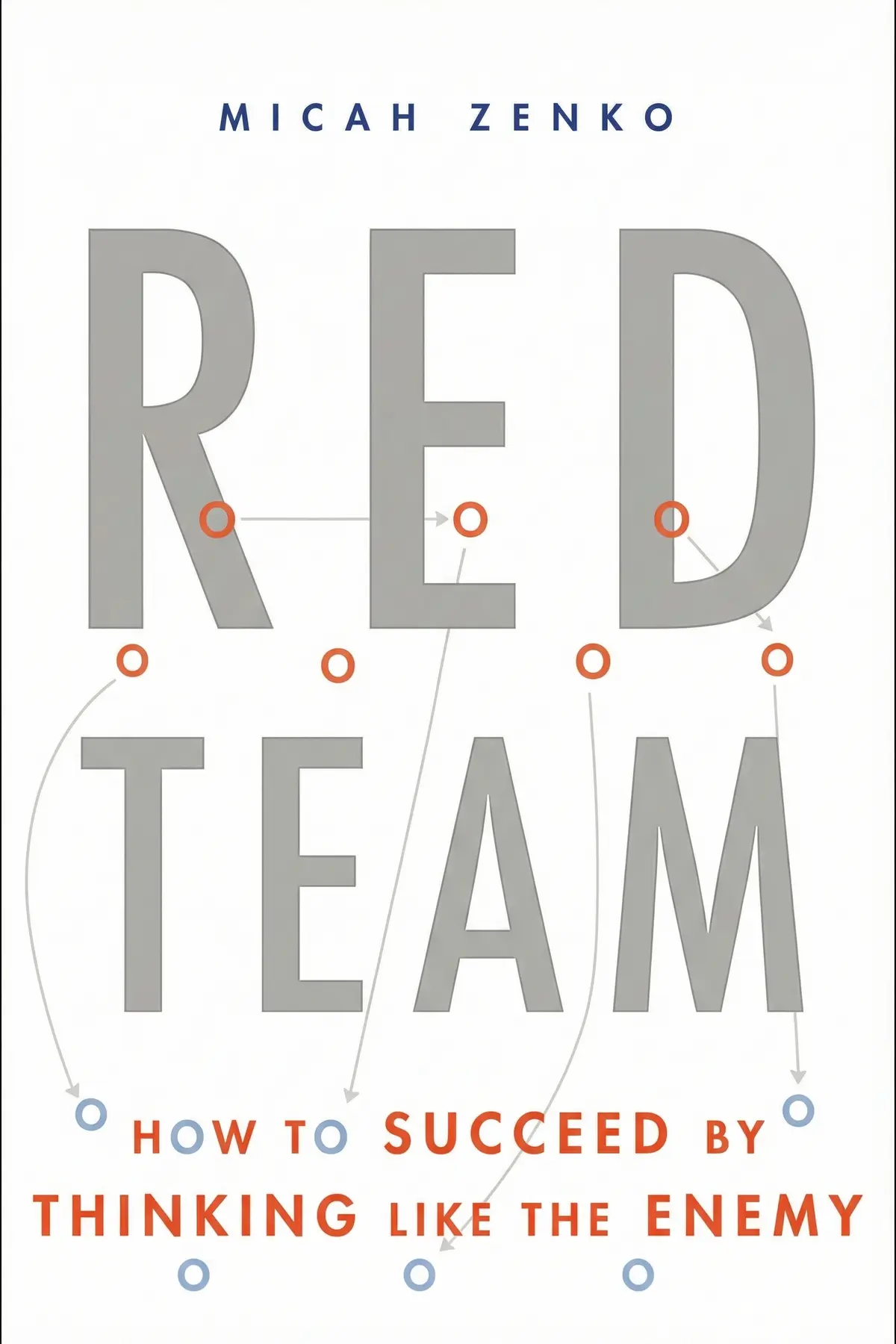
Table of Content
1. Introduction
1 min 00 sec
Organizations are worst at spotting one kind of mistake, and it is the kind that matters most: their own. In Red Team, political scientist Micah Zenko shows how armies, spy agencies, airports and companies pay people to attack them on purpose, so that a real enemy finds nothing left to exploit. These red teams plan the bomb, the break-in or the hack before anyone else gets the chance.
Zenko’s case is that red teaming works, but only under conditions most leaders resist. Someone has to invite the critics in, choose the right ones, point them at the decisions that matter and then act on what they find. Many of his stories are about that last step failing. In 1996 a red team at Frankfurt’s airport got a mock suitcase bomb past security in all 60 of its attempts, and nothing changed.
By the end, you will know how to build a small group that argues against your biggest plan, and how to make sure its warnings get acted on instead of filed away.
2. Spot the flaws your own team cannot see
1 min 43 sec
A deadly airline bombing came before one powerful official agreed to let outsiders test his security. Zenko explains why leaders put off the critics they need most, and what happens when those critics are everywhere at once.
3. Pick red teamers who think like the enemy
1 min 54 sec
The best critics share a rare mental habit, an actor’s talent for disappearing into a role, and a willingness to watch someone else take the credit. Few talented people have all three.
4. Turn warnings into action before the crisis
1 min 44 sec
The US military made red teaming official after a costly lesson in Iraq. Years later, a team in Afghanistan found a better crop for local farmers, and learned how little a good answer is worth when nobody wants it.
5. Keep rank from silencing the right answer
1 min 55 sec
America’s spy agency once misjudged when the Soviets would build a bomb, and later US officials bombed a plant that, contrary to its intelligence, had no link to bin Laden. Both mistakes trace back to how information moves through a hierarchy.
6. Find the gap before an attacker does
1 min 45 sec
One security test at a major European airport succeeded every time it was tried, and was then ignored. Another, near New York, pinpointed the most likely spot for launching a missile at planes. The difference was who was listening.
7. Protect your business the way a thief would attack it
1 min 49 sec
A red team on a television show revealed how easily a car dealership could be robbed, and hackers walked off with millions of card numbers from a major retailer. The fix starts with paying someone to break in first.
8. Conclusion
1 min 17 sec
Zenko’s book is finally about building humility into a structure. Militaries, spy agencies and companies keep making the same avoidable mistakes because their decisions travel up a hierarchy that rewards agreement. A red team breaks that pattern by giving someone permission, and a paycheck, to be the enemy. The stories show it works whenever leaders let it, as in Queens, where a cemetery with a view of the runways was found and dealt with. They also show how often it is wasted, as at Frankfurt, where 60 successful mock attacks led nowhere.
His practical advice is deliberately narrow. Save red teaming for your biggest decisions, and only those. Zenko recommends that the White House assemble a temporary red team before any critical decision goes ahead, made up of people who were not part of the planning and so have no stake in defending it. The same move fits a team, a company or a government office. Before a major plan launches, give a few outsiders the job of breaking it, keep them away from routine work so nobody feels watched, and commit in advance to acting on what they find.
Someone will study your weak points either way. Make sure the first person to do it is on your side.
About this book
What is this book about?
Every organization has blind spots, and the people running it are usually the last to see them. Plans that look solid from the inside can fail the moment a real opponent tests them. Micah Zenko, a political scientist who specializes in national security and military strategy, looks at the people hired to find those failures first: red teams, specialists who plan the bomb, the break-in or the hack before anyone else does. Zenko follows red teams through the US military in Iraq and Afghanistan, the CIA, airport security in Frankfurt and New York, and private companies facing thieves and hackers. Again and again the red team finds the problem. What decides the outcome is whether leaders, often protected by rigid hierarchy and tradition, are willing to listen. Readers learn what makes a good red teamer, why hierarchy silences accurate warnings, where red teaming has prevented harm and where it was wasted, and how to use a small, temporary team of outsiders to challenge their own biggest decisions.
Book Information
Who it's for
Wanting big plans tested
Founders and executives about to commit to a major plan who want it tested before a competitor tests it.
Team leads and managers
Team leads and managers whose staff see problems that never reach the decision.
Security, risk, strategy pros
Security, risk and strategy professionals curious how armies, spy agencies and airports use red teams.
About the Author
Micah Zenko
Micah Zenko is an American political scientist whose expertise covers conflict prevention, US national security and military strategy. He has been the Whitehead Senior Fellow at Chatham House and has written a column for ForeignPolicy.com. At McChrystal Group he led research and learning on judgment and decision making. His first book, Between Threats and War, was published in 2010.
Ratings & Reviews
Ratings at a glance
What people think
Listeners describe the work as an intriguing study that offers solid historical context alongside practical uses. Its utility as a guide for red teaming is highly regarded, with one listener specifically pointing out the inclusion of six guiding principles for Red Teaming. The material earns praise for being intellectually stimulating, with one review mentioning how the examples drawn from actual events leave a strong impression.
Top reviews
Carter
This book is a masterclass in understanding how systems fail from the inside out. Micah Zenko provides a comprehensive overview of how institutions can protect themselves from their own internal biases through the use of alternative analysis. I was particularly impressed by the six guiding principles for red teaming, especially the idea that the 'boss must buy in' for any of this to work. Truth is, without executive support, these exercises are just theater. The historical examples ranging from military wargaming to corporate security are both fascinating and terrifying. While some might find the prose a bit dense in the middle sections, the intellectual payoff is well worth the effort. It’s a vital resource for anyone trying to navigate organizational confirmation bias. If you want to understand why 'fearless skeptics with finesse' are your most valuable asset, read this now.
Show morePawinee
The chapter on the origins of the Devil's Advocate was worth the price of admission alone. I never realized how deeply rooted these concepts are in historical institutions. Zenko illustrates perfectly how red teams test security—both online and offline—and the uphill battle they face when trying to bring weaknesses to management's attention. I love the idea of 'outside and objective, while inside and aware.' It’s a delicate balance that most companies get wrong. Not gonna lie, I’ve already started applying some of these concepts to my own team meetings to see where we might be suffering from groupthink. The book is full of impactful examples from real-world events that make the theory feel urgent. It’s a stimulating read that provides plenty of food for thought for anyone in a leadership position. Highly recommended for those who value critical thinking over conformism.
Show morePichaya
Wow, I didn't realize how much I was missing by ignoring the potential of 'fearless skeptics' within my own organization. Zenko has managed to capture real creative thought in this volume, which is no mean feat. Red teaming is incredibly hard because it requires challenging heartfelt convictions and entrenched mores. This book gives you the vocabulary to explain why that friction is actually a good thing. I even found myself sharing the historical anecdotes with my family—the stories are that engaging. From the importance of being 'willing to hear bad news' to the necessity of having an outside perspective, the lessons here are universal. Whether you are running a multinational corporation or just trying to improve a small project, the principles of alternative analysis apply. This is a five-star read for anyone who wants to stop being blindsided by their own biases. Truly a service to the field.
Show moreAroha
Finally got around to Zenko’s work on red teaming, and it’s a solid resource for anyone in the security or corporate strategy space. Having followed his drone expertise at the Council on Foreign Relations, I expected a high level of integrity and research, and he certainly delivered. Personally, I think the most valuable part is the exploration of how red teaming is evolving within the cyber community. The book does a great job illustrating how difficult it is to incorporate disruptors into a rigid organizational culture without them being captured by that same culture. My only minor gripe is that the tone can be a bit dry at times, almost like reading a long-form white paper. However, the insights into organizational blind spots are too important to ignore. It’s a thought-provoking look at the necessity of institutionalized dissent.
Show moreJoy
As someone who deals with groupthink on a daily basis, Zenko’s exploration of organizational blind spots resonated deeply with me. The book makes a compelling case that the larger an organization is, the more dangerous its filters become. I particularly enjoyed the sections on how humility and critical thinking must go hand in hand for a red team to be effective. Pride and arrogance are indeed rewarded by a special kind of blindness, as the author notes. The historical enthusiasts will find the military strategy examples enlightening, while corporate leaders can learn a lot from the six guiding principles. Look, the book isn't perfect—some of the case studies feel a bit dated—but the core message is timeless. It challenges you to seek out feedback that contradicts your perceptions. That is the only way to see a problem clearly.
Show moreDome
After hearing about red teaming from a few colleagues in the tech sector, I picked this up to see what the fuss was about. Gotta say, it’s a solid deep dive. Zenko explains that red teaming is essentially focused alternative analysis directed toward understanding a problem more clearly. I liked that he didn't just praise the practice but also acknowledged its weaknesses and limits. The six principles he provides are a great framework for anyone looking to start an internal program. My only minor complaint is that there could have been a few more contemporary business examples, as the military stuff tends to dominate the narrative. Still, the lesson that conformism provides opportunities to the enemy is one that every CEO should take to heart. It’s a solid read that will definitely provide food for thought for many days to come.
Show moreGrace
Ever wonder why major corporations and military outfits keep making the same catastrophic mistakes despite having the best analysts in the world? Zenko answers this by diving into the concept of cognitive blind spots, showing how our brains naturally filter out inconvenient data. I appreciated the deep dive into the history of the practice, but I have to be fair: the book is quite repetitive. It feels like a succession of anecdotes that all lead to the same conclusion: red teaming found a problem, management ignored it, and then disaster struck. I was hoping for more of a 'how-to' guide with specific tools for breaking through these biases. Instead, it’s more of a high-level theoretical justification for the field. It's a solid read, but it could have been half the length and still conveyed the core message effectively.
Show moreLucas
To be fair, the case studies provided are incredibly detailed and offer a fascinating look at institutions like the US Military. However, I felt like the book struggled to find its identity. Is it a business book? A history book? A security manual? It tries to be all three and ends up feeling a bit spread thin. I appreciated the 'big bag of tricks' principle, but I wish the author had actually shared more of those tricks! Instead, we get a lot of talk about why red teaming is good without enough detail on the actual methodology. The writing is clear enough, but the pacing is uneven. Some chapters fly by while others feel like a slog through bureaucratic history. It’s a decent introduction to the field, but I think there are more engaging books out there on strategy and adversarial thinking.
Show moreNarut
I found the title 'How to Succeed by Thinking Like the Enemy' to be a bit of a bait-and-switch, unfortunately. Frankly, I was expecting a practical manual on red teaming techniques—tools to actually break through security or simulate an adversary's mindset. What I got instead was a history of red teaming. While the stories about the US Military and the CIA are interesting in a vacuum, they don't actually teach you how to do the work. There is almost no discussion on the technical tools or specific frameworks used to 'think like the enemy.' It felt more like a series of case studies for a political science seminar than a guide for practitioners. If you want a history book, this is fine. If you want to learn the tradecraft of a red teamer, look elsewhere. Disappointing purchase for my needs.
Show moreBam
Not what I expected given the hype around this being a definitive guide on adversarial thinking. To be honest, I found it to be a bit of a yawn. I had to stop and return to it several times because the writing style just didn't grab me. The truth is, the book lacks a wider theory to tie all the examples together; it just felt like one story after another without enough synthesis. While I acknowledge the importance of the subject matter, the execution felt sluggish and overly academic. I was looking for actionable strategies to use in a business context, but most of the examples were so high-level that they didn't feel applicable to my daily work. It’s an okay history of the concept, but it fails to be the 'how-to' guide the subtitle suggests. I struggled to get through it.
Show moreQuestions about this book
What is the main idea of Red Team by Micah Zenko?
Zenko argues that organizations are blind to their own weaknesses, and that red teams, experts hired to think and act like the enemy, can expose them. His cases from the US military, the CIA, airport security and private companies show red teams finding real problems again and again. Whether that helps depends on leaders, who are often protected by hierarchy and tradition and too often ignore what their critics find.
What makes a good red teamer?
Zenko describes several qualities. A good red teamer resists existence bias, the tendency psychologist Scott Eidelman showed of assuming things are fine as they are. They have a sharp eye for what could be improved, and they can immerse themselves in an adversary’s mind, much as CIA analyst Rodney Faraon compares them to method actors. They also accept that the decision maker, not the red team, gets the credit for success.
Why do red teams often fail?
Mostly because their advice is ignored. Before the 2003 Iraq invasion, warnings about an insurgency were dismissed. In Afghanistan, a Marine colonel rejected a red team’s case for quinoa over wheat. A 1996 test at Frankfurt’s airport smuggled a mock bomb past security in all 60 attempts, and nothing was done. Authoritarian leaders and rigid hierarchies, Zenko argues, are the usual obstacle.
How can I use red teaming in my company or team?
Zenko advises using red teams only for your biggest decisions. Bring together a temporary group of people who were not involved in the planning, so they have no stake in defending it, and ask them to find the plan’s weak points before it launches. Keep them out of routine work so staff do not feel constantly watched. For security, companies can hire white-hat hackers to test their IT systems.
Who should read Red Team?
It suits leaders who make high-stakes decisions and want them tested before reality does it, managers who suspect useful warnings are getting lost in the hierarchy, and readers interested in national security, intelligence and corporate security. Its stories range from the CIA’s 1949 misjudgment of Soviet bomb timing to a reality show crew dismantling a car dealership’s defenses.
Featured in
Readers also enjoyed

A Bigger Prize: How We Can Do Better Than the Competition
Margaret Heffernan





A Year with Peter Drucker: 52 Weeks of Coaching for Leadership Effectiveness
Joseph A. Maciariello



Acting with Power: Why We Are More Powerful Than We Believe
Deborah Gruenfeld
AUDIO SUMMARY AVAILABLE
Listen to Red Team in 15 minutes
Get the key ideas from Red Team by Micah Zenko, plus 5,000+ more nonfiction titles.
- 5,000+ titles
- Listen as much as you want
- 7-day free trial
- Cancel anytime









