
14 min 55 sec
Available in: English
Rebel Ideas: The Power of Diverse Thinking
By Matthew Syed
Shows why groups of bright people who think alike miss what matters most, and how to build, run and join teams whose different ways of thinking actually shape the decision.
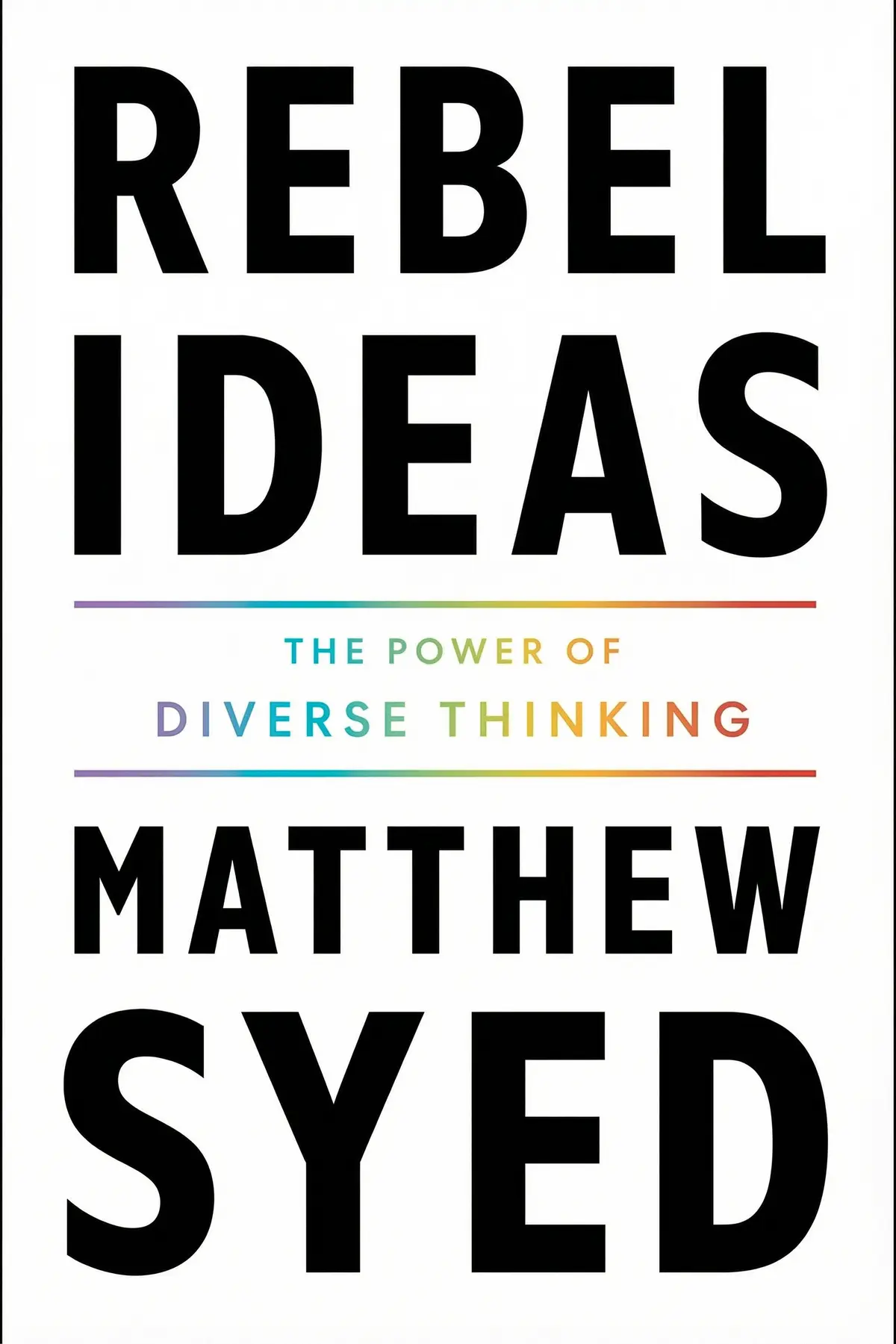
Table of Content
1. Introduction
1 min 01 sec
Most teams fail at hard problems because their bright people all think the same way. In Rebel Ideas, journalist and former Olympic table tennis player Matthew Syed argues that clever people who see the world alike share the same blind spots, and individual intelligence cannot fix that. The CIA, with thousands of officers and a huge budget, misread Osama bin Laden for exactly this reason.
Syed’s case is that complex problems need teams that differ in how they think, and that this difference pays off only when it is built on purpose and given a voice. His evidence runs from codebreakers at Bletchley Park to an airliner that ran dry on its way to Portland, blind orchestra auditions and a bread experiment with no average answer. By the end, you will know how to staff a team that sees more, run a meeting where quiet ideas surface, and stretch your own thinking past its usual borders.
2. Spot the blind spots a like-minded team shares
1 min 45 sec
Given two equal candidates, most leaders pick the one who agrees with them. It feels safe and sensible. A powerful intelligence agency made that choice for decades, and paid for it in a way nobody predicted.
3. The right mix of minds beats the smartest one
1 min 50 sec
Cloning the fastest sprinter would give you the best relay team. So cloning the best forecaster should give you the best forecasting team. Syed says that logic collapses, and a wartime codebreaking story shows exactly where.
4. Blind auditions and young advisers reveal hidden talent
1 min 45 sec
For years, orchestras believed they simply hired the best players. A curtain proved otherwise. A fashion house learned a similar lesson from its youngest staff, while a rival that ignored them watched profits fall.
5. Get every idea heard in your meetings
1 min 45 sec
An engineer in a cockpit knew exactly what was going wrong and said almost nothing. The reason had nothing to do with skill, and the same force shapes who speaks up in ordinary office meetings.
6. Think like an outsider without leaving home
1 min 41 sec
Several of America’s best-known entrepreneurs share one background detail that has nothing to do with money or schooling. Syed explains why it sharpens the mind, and how anyone can borrow the effect.
7. Opposing views can harden your own beliefs
1 min 51 sec
Hearing the other side should make people more open. Online, it often does the reverse. A college friendship that began with an unlikely invitation shows what actually moves a deeply held belief.
8. Results improve when work fits the person
1 min 51 sec
Two people of the same height and weight can still not share clothes. That small puzzle explains why one workshop at Google paid off so well, and why a popular diet may do nothing for you.
9. Conclusion
1 min 26 sec
Rebel Ideas is finally an argument about where intelligence lives. For problems one person can handle alone, talent, skill and commitment still win. The problems we face now are too complex for that, and the answers sit in the gaps between people: the officer who might have read the cave correctly, the engineer who did not speak up about the fuel in time, the young advisers whose digital insights gave Gucci its edge. A team of clones, however brilliant, shares one set of blind spots. A team of different minds, given a voice, sees what each member alone would miss.
The practice starts with ordinary choices. When you hire, notice the pull toward the candidate who agrees with you, and give real weight to the one who sees things differently. In meetings, let people write ideas down anonymously before the most senior person speaks. Syed also recommends designing for chance encounters: opening up cubicles that close people off, seating different departments near each other, even placing shared facilities where teams cross paths. It may look inefficient. It is how ideas from different heads meet.
The smartest person in the room was never the goal. What counts is how many ways of seeing the room holds, and whether each one gets heard.
About this book
What is this book about?
Most organizations hire for intelligence and then wonder why clever teams still miss the obvious. Matthew Syed argues that on complex problems, raw talent is not enough. When everyone in a group thinks the same way, they share the same blind spots, and nobody can see what all of them are missing. Syed calls the remedy cognitive diversity: differences in models, methods and life experience, not only in demographics. He follows it from the CIA's misreading of Osama bin Laden to the codebreakers of Bletchley Park, a cockpit where nobody dared contradict the pilot, blind orchestra auditions, Gucci's board of young advisers and a bread experiment where the average result hid every individual one. Readers get a practical case for building teams that see more, along with tools to make it work: brainwriting to surface quiet ideas, habits that stretch your own thinking across fields, a way past echo chambers through real relationships, and office layouts that help people from different departments meet by chance.
Book Information
Who it's for
Stuck with like-minded hires
Managers and founders who hire for talent but keep getting teams that think alike.
Team leads
Team leads whose meetings are dominated by a few voices while good ideas stay unspoken.
Wanting to think originally
Professionals who want to think more originally and escape their own echo chamber.
About the Author
Matthew Syed
Matthew Syed, born in 1970, played table tennis at the top level in England, represented Great Britain at the Olympic Games in Barcelona in 1992 and Sydney in 2000, and won the Commonwealth men's singles title three times. He has written for The Times since 1999 and contributes to television and radio. His bestselling books on mindset and high performance include Bounce and Black Box Thinking, and he co-founded Matthew Syed Consulting, which helps organizations build growth mindset cultures.
Ratings & Reviews
Ratings at a glance

What people think
Listeners find this work highly insightful, especially for those managing teams, and they enjoy the quality of the prose and its accessibility. They value the emphasis on diversity, with one listener remarking that it provides fascinating viewpoints on that subject.
Top reviews
Eli
Matthew Syed has a gift for synthesizing complex psychological concepts into narratives that stick. In "Rebel Ideas," he dismantles the myth of the lone genius by showcasing how cognitive diversity—not just demographic box-ticking—is the engine of true innovation. The breakdown of the CIA’s "blind spot" regarding 9/11 was particularly chilling and served as a powerful cautionary tale about the dangers of homophily. Truth is, we often hire "clones" because they make us feel comfortable, but Syed proves that comfort is the enemy of progress. My only minor gripe is that some sections feel a bit repetitive, but the core message is too important to ignore. If you’re a leader trying to build a resilient team, this is an essential addition to your shelf.
Show moreKob
Finally got around to reading this after seeing it everywhere on LinkedIn lately. I've been a fan of "Black Box Thinking," and while this has a different focus, it is just as insightful for anyone in management. The concept of "echo chambers" and "information bubbles" is explored with such clarity that you start seeing them everywhere in your daily news feed. Syed’s writing style is punchy and accessible, making even the more academic theories feel like an engaging conversation over coffee. Some might find the political undertones a bit much, but I felt he handled the science of diversity with a lot of nuance. It’s a solid read that will definitely spark some "rebel" thoughts in your next board meeting.
Show moreYindee
Wow, this completely changed how I look at my workplace and my own social circles. The way Syed explains "dominance dynamics" through the lens of the 1996 Everest expedition was a total lightbulb moment for me. It’s scary to think how often we stay silent in the face of authority even when we know something is wrong. I especially loved the section on Shadow Boards and how Gucci used them to skyrocket their revenue. It’s rare to find a business book that is both emotionally resonant and practically useful for a corporate environment. If you want to understand why your team is stagnating, look no further than these pages; it's a game-changer.
Show moreSkylar
The chapter on the 1996 Everest disaster is worth the price of admission alone. Syed uses that tragedy to perfectly illustrate how "dominance hierarchies" can stifle the very information needed to save lives. It's a gripping read that balances high-stakes storytelling with deep psychological insights into how groups function—or fail. I found the discussion on "cyberbalkanization" and how we trap ourselves in online echo chambers to be incredibly relevant to our current social climate. The writing is sharp, the research feels solid, and the conclusions are genuinely thought-provoking. This isn't just a book for managers; it's a book for anyone who wants to think more clearly in a complex world.
Show moreMatteo
Ever wonder why some 'genius' teams still fail miserably while motley crews succeed? Syed answers this by exploring how we’ve evolved to learn from each other and why "cognitive fingerprints" are the secret sauce of success. The way he ties together the CIA, crossword puzzles, and evolutionary brain volume is nothing short of brilliant. This book is a refreshing departure from the usual dry business literature, offering a vibrant and well-written defense of outlier thinking. I finished it in two sittings and immediately started rethinking our hiring process. It’s insightful, urgent, and arguably one of the most important books on collaboration I’ve ever read.
Show moreSook
This book should be mandatory reading for anyone involved in recruitment or HR. We often talk about diversity in very surface-level terms, but "Rebel Ideas" digs much deeper into the "collective brain" theory. The comparison between the "Pale, Male, and Yale" CIA and the eclectic, crossword-solving geniuses at Bletchley Park was fascinating and well-researched. I appreciate how Syed takes the politics out of the diversity debate and focuses on the objective benefits of varied perspectives. To be fair, the middle section drags a little when he goes into evolutionary biology, but the payoff is worth the slog. It's a readable, smart, and timely reminder that we are stronger together than apart.
Show moreTeng
Picked this up after a colleague recommendation and I’m glad I did. The actionable advice on "cross-pollination" is something I'm already trying to implement in my office layout. Syed makes a compelling case that even the smartest individuals can suffer from collective blindness if they aren't challenged by differing views. Look, it’s not a perfect book—some of the "rebel" examples feel a bit cherry-picked to suit the narrative—but the readability is high. It’s the kind of non-fiction that keeps you turning pages because the anecdotes are just so well-told. Definitely worth your time if you're interested in team dynamics and avoiding the trap of groupthink.
Show moreSakura
As someone who manages a small creative team, I found Syed's take on "unconscious bias" and its impact on collective intelligence to be a real eye-opener. He doesn't just preach about diversity; he explains the mechanics of how it actually improves decision-making and sparks innovation. The story of Derek Black’s transformation from a white supremacist to an anti-racism advocate was a powerful example of how "epistemic walls" can be broken down. My only minor complaint is that the tone can get a bit repetitive when he hammers home the "clones" metaphor. Still, it provides a wealth of material for anyone looking to foster a more inclusive and high-performing culture.
Show moreCooper
While the core message about cognitive diversity is undeniably vital for modern success, I found the execution here somewhat lacking compared to Syed's earlier books. Frankly, it felt like a very long magazine article that relied too heavily on anecdotal evidence rather than rigorous, quantitative data. The stories about the Everest tragedy and Bletchley Park are engaging, but I’m not entirely convinced they "prove" his theories as definitively as he suggests. At times, the theorizing feels a bit farfetched, leaving me wanting more actionable "how-to" and less abstract "what-if." It’s an interesting perspective on the topic, but it didn't quite live up to the hype for me. I’d recommend it as a primer, but don’t expect a deep scientific dive.
Show moreWyatt
Not what I expected based on his previous work, which I absolutely loved. "Rebel Ideas" feels a bit "mid" to me because it touches on so many topics I’ve already seen covered in other popular non-fiction books. If you’ve read any Gladwell or Grant, you might find some of these examples—like the Enigma code-breaking—to be a bit recycled. I also felt the author's personal political views peeked through the scientific veneer a bit too often for my taste. It’s a decent summary of why we need different perspectives, but it lacks the fresh, "aha!" moments I was hoping for. It’s an okay read for a train journey, but maybe borrow it from a friend instead.
Show moreQuestions about this book
What is the main idea of Rebel Ideas by Matthew Syed?
Syed argues that complex problems are too hard for individuals or for groups of people who think alike. A team of bright clones shares the same blind spots, as the CIA did before September 11, 2001. What wins is cognitive diversity, meaning different models, methods and experiences, combined with an environment where every member feels safe to speak and people stay open to views unlike their own.
What is cognitive diversity according to Rebel Ideas?
Cognitive diversity means differences in how people think, not only in gender, race, age or religion. Syed’s example is two economists: if they use the same model, they reach the same forecast whatever their backgrounds. If they use different models, they bring different data, questions and assumptions. At Bletchley Park, a mixed team cracked German codes by guessing that operators used girls’ names or swear words.
How can I apply Rebel Ideas at work?
Start by noticing the pull to hire people who agree with you. In meetings, try brainwriting, recommended by Leigh Thompson of the Kellogg School: everyone writes ideas anonymously, then the group votes. Give overlooked groups a formal voice, as Gucci did with its shadow board of young advisers. Syed also suggests arranging offices so people from different departments meet by chance.
What does Rebel Ideas say about echo chambers?
Syed explains that when an opposing view enters an echo chamber, it often polarizes people further, an effect called the epistemic wall. Emma Pierson saw it in 2014 in tweets about the death of Michael Brown. What breaks the wall is a real relationship: Matthew Stevenson invited Derek Black, a white supremacist, to Shabbat, built trust, and Black eventually abandoned his beliefs.
Who should read Rebel Ideas?
It suits leaders who build teams, hiring managers, and anyone whose meetings are run by a few loud voices. It also helps individuals who want to think more creatively, with ideas such as reading across fields the way Darwin moved between botany, zoology, geology and psychology. Readers interested in why standardized systems, from job roles to diets, often fail individuals will find it useful too.
Featured in
Readers also enjoyed



A Bigger Prize: How We Can Do Better Than the Competition
Margaret Heffernan






A Year with Peter Drucker: 52 Weeks of Coaching for Leadership Effectiveness
Joseph A. Maciariello

AUDIO SUMMARY AVAILABLE
Listen to Rebel Ideas in 15 minutes
Get the key ideas from Rebel Ideas by Matthew Syed, plus 5,000+ more nonfiction titles.
- 5,000+ titles
- Listen as much as you want
- 7-day free trial
- Cancel anytime









