

14 min 07 sec
Available in: English
Radical Humility: Be a Badass Leader and a Good Human
By Urs Koenig
Shows leaders how to trade top-down control for a confident humility: finding their blind spots, building trust that makes hard feedback land, sharing purpose and information, and creating teams unafraid to speak up and fail.
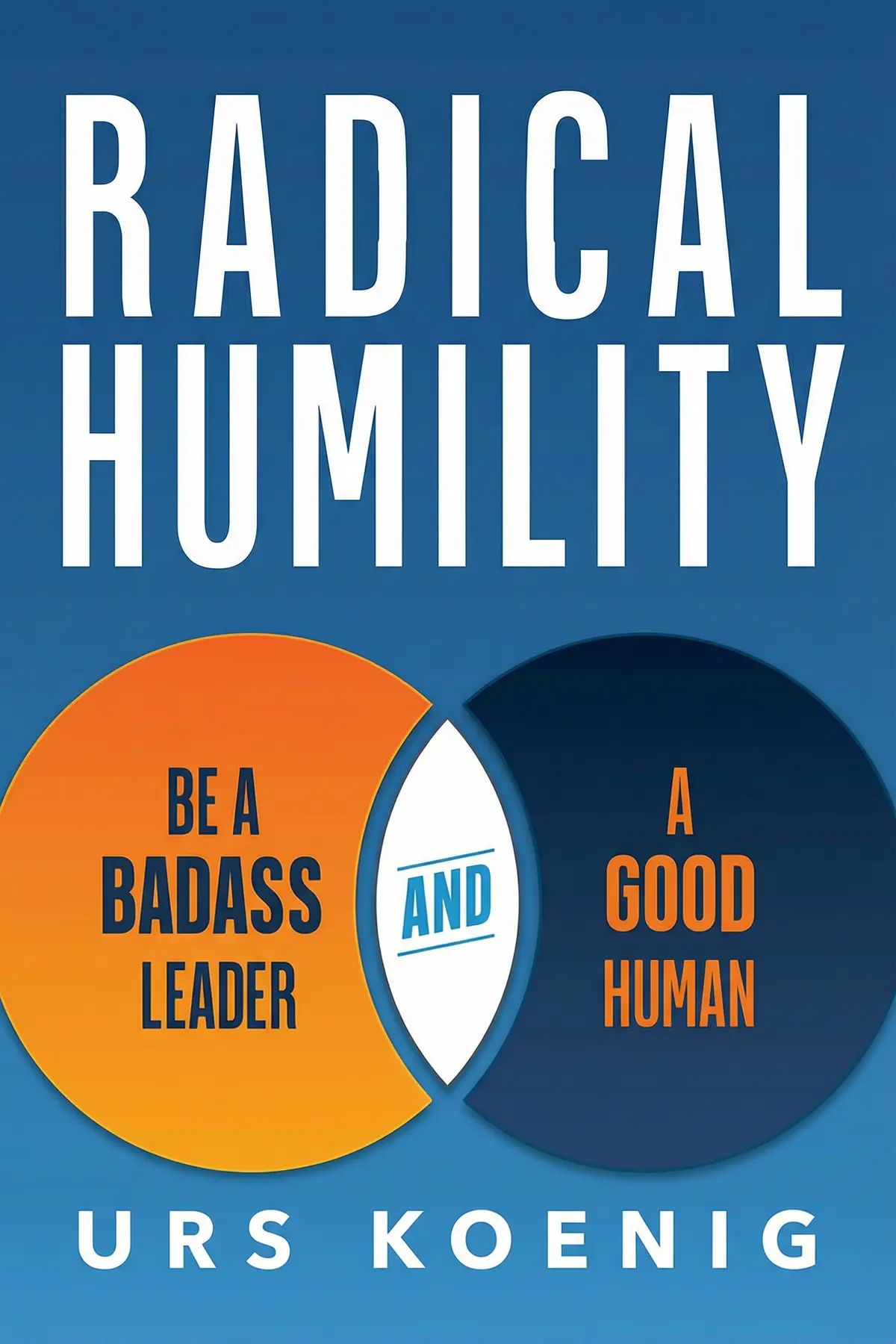
Table of Content
1. Introduction
1 min 06 sec
Leaders who rise by having the answers often hit a wall when their team knows more than they do. In Radical Humility, former NATO peacekeeping commander and executive coach Urs Koenig argues that this is exactly the moment to stop commanding and start learning. Humility, in his telling, has nothing to do with being timid. A humble leader can be ambitious, confident and assertive, and still be the first to say I don’t know.
Koenig’s case is that the old command-and-control style was built for factories, while a fast, uncertain world rewards leaders who know themselves, invest in people and make it safe to speak up. He sets out five shifts in mindset, each with tools you can try next week: a feedback survey that looks forward, a four-letter routine for failure, a team purpose short enough to remember, and a spaghetti tower that kindergartners build better than business students. By the end, humility stops sounding soft and starts looking like the most practical leadership skill on the list.
2. Be humble and still lead with confidence
1 min 59 sec
Many leaders fear that humility will make them look weak or unambitious. Koenig thinks that fear comes from a style of leadership built for a world of factories, and that the world it was built for has already gone.
3. Find your blind spots before your team pays
2 min 04 sec
The people around you can already see the weaknesses you can’t. Koenig offers a way to hear about them that points forward instead of back, plus a short routine for the moment a failure makes you doubt yourself.
4. Get close to people so tough feedback lands
1 min 56 sec
Taking the team to lunch can look like time stolen from real work. Koenig argues it is what lets you jumpstart the response when a system crashes and give someone candid feedback that builds them up.
5. Point the way, then let your team steer
2 min 01 sec
A bank, a group of CEOs and a two-person race team each run on a single sentence. Koenig explains why stepping back from the details can make a leader’s influence larger, not smaller.
6. Admitting mistakes earns you more trust
1 min 56 sec
Most leaders guard their errors to protect their authority. Koenig argues that this habit is exactly what makes a team stop taking risks, and a social media company that publishes every salary shows how far openness can go.
7. Build a team as fearless as kindergartners
1 min 54 sec
Put business students and five-year-olds in a race to build the tallest tower, and the children keep winning. What they lack turns out to be what most teams need, and Koenig shows how to rebuild it.
8. Conclusion
1 min 11 sec
Koenig’s book adds up to a trade. The leader gives up the role of sole expert and gets back something better: a team that tells the truth, decides on its own and keeps learning when conditions change without warning. Every shift points the same way. A forward-looking survey, a shared one-line purpose, a salary list open to all and a thank-you for bad news each lower the cost of honesty, first for you and then for everyone around you.
That is why Koenig treats humility as a working method for a VUCA world, where teams often know more in their specialties than the person at the top.
A start can be small. Ask a handful of colleagues what you should do differently from here on, and meet them again in a month to show what changed. In your next meeting, name one mistake of your own before you ask about anyone else’s. And when the next failure lands, sort it first: a preventable one earns a good catch and a fix, an intelligent one earns a reward and a close look at what it teaches.
The kindergartners with their spaghetti had no title to protect, and that is exactly why their towers stood taller.
About this book
What is this book about?
Many leaders were promoted for having the answers, then find themselves running teams of specialists who know more than they do, in conditions that change faster than any plan. Urs Koenig argues that the old command-and-control style belongs to the industrial age and cannot keep up with what the US Army War College calls a VUCA world: volatile, uncertain, complex and ambiguous. His alternative is radical humility, and he insists it has nothing to do with being timid. A humble leader can be ambitious and assertive while knowing their weaknesses, caring about their people and learning without pause. Koenig lays out five shifts: dig into your own blind spots, get tough on results but not on people, lead like a compass, embrace transparency and build a fearless culture. Each shift comes with tools you can use straight away, including a forward-looking 360-degree survey, a four-step routine for handling failure, one-line team purposes and simple exercises in admitting what you don't know. Along the way come Buffer's open salaries, Taco Bell's executive onboarding and a spaghetti-tower contest that kindergartners keep winning against business students.
Book Information
Who it's for
Managers of specialists
New and experienced managers leading specialists who know more than they do.
Founders and executives
Executives and founders who sense that command-and-control is slowing their teams down.
Team leads facing silence
Team leads whose people stay quiet in meetings and hide mistakes until they grow.
About the Author
Urs Koenig
Urs Koenig served as a United Nations military peacekeeper and as a commander in NATO peacekeeping. He has spent more than three decades as an executive coach and keynote speaker, working with hundreds of leaders and dozens of executive teams across four continents, with talks reaching teams at Starbucks and Microsoft. He is also an ultraendurance champion and a widely published professor, with a doctorate in geography and a science master's from the University of Zürich and an MBA from the Australian Graduate School of Management.
Ratings & Reviews
Ratings at a glance
What people think
Listeners consider this work a compelling guide to leadership, providing usable methods and thought-provoking questions for those in management. Furthermore, the material is highly functional and easy to understand, with one listener mentioning its talent for simplifying intricate subjects. Listeners also value the emphasis on empathy and humility, with one review pointing out that it stays away from scholarly terminology. The progression of the book is well-received, as one listener characterizes it as a sequential guide to growing as a leader.
Top reviews
Fatima
After hearing Urs Koenig on a podcast, I knew I had to pick up 'Radical Humility.' It’s a powerful treatise on how to balance being a 'badass' while maintaining genuine empathy for your team. The book is incredibly practical, offering a step-by-step path to leadership development that feels accessible even for those of us in the corporate trenches. I particularly connected with the idea of being 'tender on people' while remaining 'tough on results.' It’s a delicate balance, but Koenig provides the mental models and the courage to make it happen. The pacing is excellent, and unlike many business books, it avoids drowning the reader in academic jargon. Instead, you get actionable techniques that you can implement during your next team meeting. Truly a refreshing take on what it means to lead with integrity in a post-pandemic world.
Show moreNiphon
The Swiss military perspective alone makes this worth the price of admission. Koenig’s stories about NATO missions and peacekeeping provide a visceral backdrop for his theories on 'Radical Humility.' Truth is, many leaders are afraid that being humble makes them look weak, but this book proves it’s the ultimate form of courage. I loved the focus on self-awareness and the 'I am because we are' philosophy inspired by Zulu culture. It’s a human-centric guide that feels deeply relevant to the challenges we face today. The exercises are concrete and easy to follow, allowing you to bridge the gap between theory and practice immediately. If you want to be a better human while driving world-class results, this is your blueprint.
Show moreKwame
Wow, just finished 'Radical Humility' and it’s a total game-changer for my management style. It’s rare to find a book that is both inspiring and highly practical, but Urs Koenig manages to thread that needle perfectly. The focus on 'shifting from heroic to humble' resonated with me deeply as I transition into a more senior role with more responsibility. I’ve already started using the reflection questions in my one-on-ones, and the response from my team has been incredible. This isn't just theory; it’s a survival guide for the modern workplace. It’s accessible, well-paced, and filled with 'badass' insights that actually work in real-world scenarios. Highly recommended for anyone who leads people.
Show moreSebastian
Finally, a leadership book that doesn't feel like a lecture from a mountaintop. Urs Koenig writes with a groundedness that likely comes from his time in the military and endurance sports. He isn't just talking about being 'nice'; he's talking about the discipline required to put the team first. I found the stories about his father to be particularly moving and a great anchor for the book's philosophy. The 'badass' element is what sets this apart—it acknowledges that leadership requires strength and courage, but redefines what that looks like in the 21st century. It’s a motivating, unforgettable contribution to the field. I’ll be recommending this to everyone in my professional network.
Show moreFon
Ever wonder why 'command and control' still fails in modern offices despite everyone knowing better? Koenig explains why the 'Heroic' model is so seductive and offers a realistic way to break the cycle. I've read quite a bit on psychological safety, but the way it’s framed here as a competitive necessity is very compelling. The book is accessible without being simplistic, and the focus on being 'good humans' is a breath of fresh air. Not gonna lie, I was skeptical of the title at first, but the content is pure gold. It’s a vital guide for any leader who wants to navigate the complexities of today's work culture with both grit and grace. 5/5 stars for sure.
Show moreElan
This isn't your typical fluff-filled business manual; it’s a data-driven framework for modern leadership. Urs Koenig draws from his time as a Swiss peacekeeper and elite athlete to show that humility is actually a competitive advantage. Personally, I found the 'Five Shifts' to be the meat of the book, providing a clear roadmap from the old-school heroic style to a more collaborative approach. The author has clearly done his homework, as evidenced by a bibliography that takes up nearly twenty percent of the book. While some sections felt a bit list-heavy and the acronyms got a little repetitive, the core message about psychological safety is undeniable. It’s an insightful read for anyone who wants to build a more cohesive, high-retention team without sacrificing excellence.
Show moreVimolwan
How do you stay tough on performance while remaining a decent human being? That is the central question Koenig tackles, and for the most part, he nails it. Frankly, I’ve worked for too many 'heroic' leaders who destroyed morale in the name of results. This book offers a much-needed alternative by focusing on vulnerability and relationship building. The step-by-step path to developing transparency is particularly useful for those of us navigating complex office cultures. My only gripe is that it can be a bit challenging for introverts who might find the 'family-style' workplace connections a bit draining. Still, the data on retention and productivity is hard to argue with. A solid 4-star read that I'll keep on my desk for reference.
Show moreDimitri
As a middle manager in a high-stress government role, I found the sections on building rapport and trust particularly enlightening. Koenig's background is incredibly diverse, which gives his advice a level of credibility you don't often see in the 'soft skills' genre. I appreciate how he defines leadership as a set of cooperative relationships rather than just managing tasks. To be fair, implementing 'radical transparency' in a bureaucratic environment is easier said than done, but the book provides the tools to start the conversation. It’s a thoughtful treatise on empathy that doesn't ignore the need for accountability. The bibliography is a goldmine for further reading, too, if you want to dive deeper into the science of teams.
Show moreChamnong
To be fair, the research backing this framework is incredibly impressive and well-sourced. I appreciated the nod to giants like Amy Edmondson and Ray Dalio, which helps ground the 'humility' concept in hard science. However, the book gets quite repetitive toward the end, and I found myself skimming some of the later chapters. It’s a bit of a pet peeve of mine when authors use too many acronyms to describe simple concepts. I think there’s a fantastic 150-page book hidden inside this 300-page one. If you can push through the density, there are some great nuggets on how to be 'tender on people' without losing your edge. Not bad, just a bit long-winded.
Show morePetch
Look, I really wanted to love this, but it felt like three books mashed into one. While the concept of being a 'badass leader and a good human' is great, the execution was a bit much for me. There are just too many acronyms and repetitive lists that make the later chapters feel redundant. In my experience, a great leadership book should be compact and punchy, but this one is far denser than it needs to be. I also found the constant 'Remember Chapter 2?' references quite distracting for the flow of the text. There is definitely some gold buried in here—especially the parts on psychological safety and his father's influence—but you have to dig through a lot of repetition to find it. It's a 5-star concept with 2-star editing.
Show moreQuestions about this book
What is the main idea of Radical Humility by Urs Koenig?
Koenig argues that top-down, command-and-control leadership suited the predictable industrial age but fails in a volatile, uncertain world. Leaders now do better with radical humility: knowing their strengths and blind spots, building strong relationships, learning constantly, sharing purpose and information, and creating a culture where people feel safe to take risks and speak up. He stresses that humility of this kind is fully compatible with ambition and confidence.
Does being a humble leader mean being less confident?
No. Koenig calls that a misconception. In his view a humble leader can be ambitious, confident and assertive. The difference lies in how that confidence is used: to admit mistakes, say I don’t know, ask for input and coach people toward bigger roles without fearing being overtaken. He argues it takes more self-confidence, not less, to face failures and hard feedback openly.
What is the ABCD model in Radical Humility?
It is Koenig’s routine for handling failure. A is the adversity, described objectively. B is the unhelpful belief it sparks, such as thinking you are not a good leader. C is the consequence, how that belief makes you feel. D means dispelling the unrealistic belief and treating the setback as a chance to grow. The goal is to shift from blaming to choosing a better response.
How can I build psychological safety on my team?
Koenig offers four steps. Reframe failure, celebrating the good catch behind a preventable mistake and rewarding intelligent failures that teach something. Encourage speaking up by owning your knowledge gaps and asking open questions. Thank every contribution, even rejected ideas. And learn together through shared experiences, from cooking a team meal to Taco Bell’s practice of having new executives work a week in a restaurant.
Readers also enjoyed



A Year with Peter Drucker: 52 Weeks of Coaching for Leadership Effectiveness
Joseph A. Maciariello



Acting with Power: Why We Are More Powerful Than We Believe
Deborah Gruenfeld

All In: How Great Leaders Build Unstoppable Teams
Mike Michalowicz


AUDIO SUMMARY AVAILABLE
Listen to Radical Humility in 15 minutes
Get the key ideas from Radical Humility by Urs Koenig, plus 5,000+ more nonfiction titles.
- 5,000+ titles
- Listen as much as you want
- 7-day free trial
- Cancel anytime









