

13 min 47 sec
Available in: English
Profit from the Positive: Proven Leadership Strategies to Boost Productivity and Transform Your Business
Shows managers how small, specific, positive habits, from concrete plans and mood control to strength talk and better meetings, raise a team's output without extra hours, budget or anyone's permission.
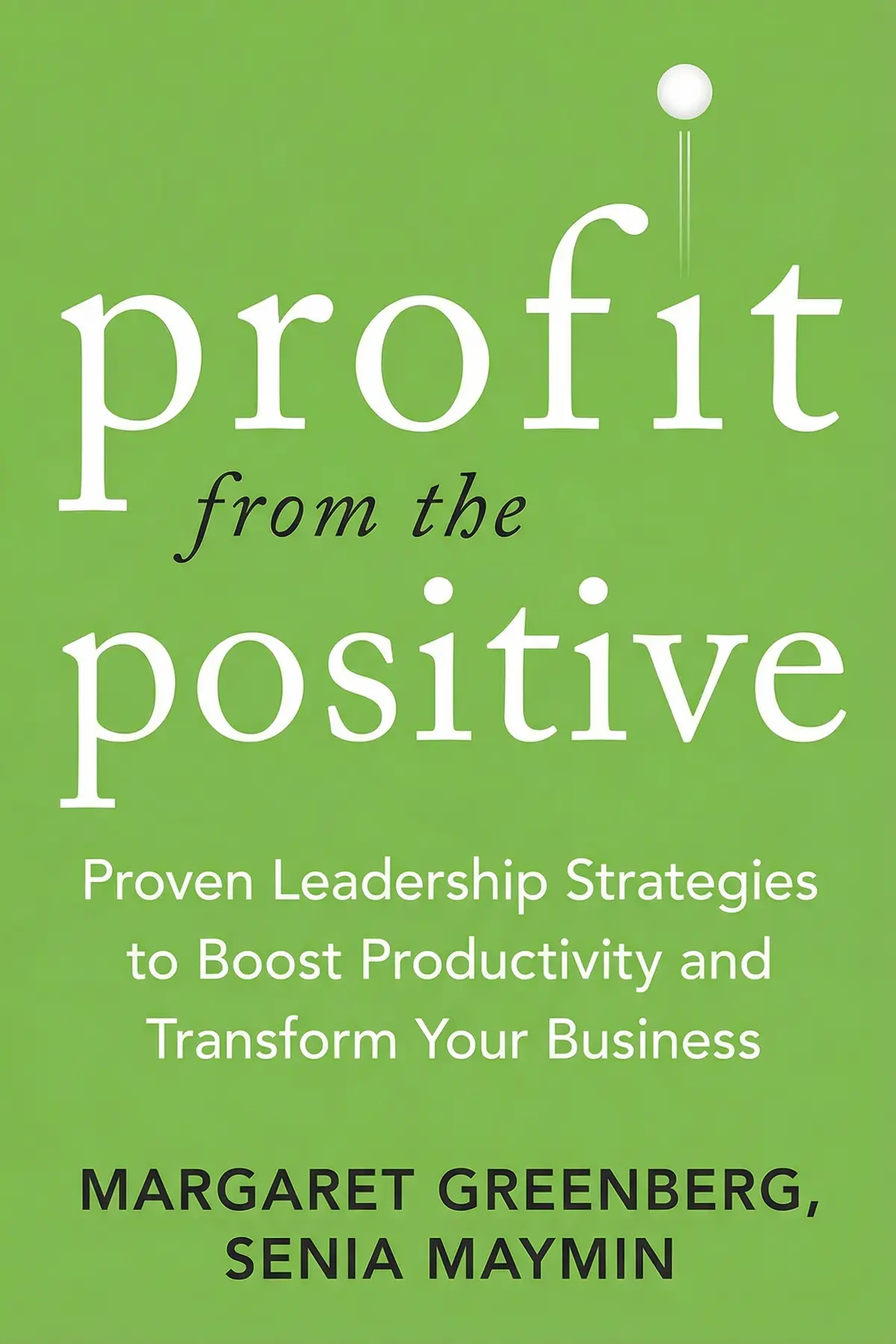
Table of Content
1. Introduction
1 min 00 sec
Most managers try to raise output by pushing harder. Yet in one study, students asked to pin down exactly when and where they would do an assignment turned it in on time more than twice as often. In Profit from the Positive, executive coaches Margaret Greenberg and Senia Maymin build a full leadership toolkit from findings like that one. Their argument is that a leader gets more from a team through small, specific, positive moves than through pressure. None of these moves needs a budget, a title or a boss’s approval, and they work whether you run a team of four or a company of 40,000.
The tools reach into the parts of the job that drain managers most: a mood that sours the room, a lost client, a bad hire, a tense annual review, a meeting where nobody listens. Each one comes with a step you can try tomorrow, and one needs nothing more than a pen.
2. Get work done by deciding when and where
1 min 41 sec
Two groups of students got the same holiday assignment and the same deadline. One group added a tiny extra step, and its on-time rate more than doubled. The same step fits into almost any request you make.
3. Stop your bad mood from infecting the team
1 min 43 sec
Your mood reaches your team faster than your emails do, and it shows up in their sales figures. Getting out of a bad one can take a few breaths, a short walk or an ordinary pen.
4. Faster recovery after a lost client
1 min 42 sec
Losing a client stings, and the sting can grow into a belief that you always fail. A three-word framework and two shifts of perspective keep one setback from rewriting the story you tell yourself.
5. Build your team around what people do best
1 min 55 sec
One sales team spent forty minutes on an exercise the other skipped, then outsold it by a clear margin. The exercise points managers toward a question most business reviews never ask.
6. Avoid a hiring mistake that costs five salaries
1 min 36 sec
A single bad hire can cost several times that person’s salary. Google, Zappos and Rackspace each guard against it in a different way, and one of them does it with a single odd question.
7. Turn the annual review into a preview
1 min 40 sec
Annual reviews leave many people tense and unmoved. A researcher in Toronto found what makes goals drive effort, and the authors add a twist that sends the conversation forward a full year.
8. Meetings people look forward to attending
1 min 26 sec
Nine in ten people admit their minds wander in meetings. A study of doctors and a sheet of paper with a circle on it show how to win back the room.
9. Conclusion
1 min 04 sec
What Greenberg and Maymin offer is a different picture of where a leader’s influence lives. It sits less in authority than in small things a team notices every day. It shows in the way a request is worded, the face you bring in at nine in the morning, the question you ask after a failure and the first two minutes of a meeting.
That is also why the authors insist nobody needs permission. You do not need a budget, the HR department or your boss on board. Pick a few techniques and use them today, perhaps a slice of cake and a compliment to open this afternoon’s meeting. Explain them in plain words. Tell people to decide where and when they will do a task, and skip the research labels, which make suggestions sound arrogant and get them ignored.
Expect resistance, and do not fight it. When people push back on something new, it usually means they have pain points of their own to address, so give them time. Resistance, the authors suggest, is often the first sign that something has started to change.
About this book
What is this book about?
Many managers try to lift performance by pushing harder: longer hours, tougher reviews, stricter rules. Margaret Greenberg and Senia Maymin are two executive coaches who work in positive psychology. They argue that small, specific and positive moves get more from people, and that any leader can start using them today without a budget or a boss's approval. The book turns research and company examples into a practical toolkit. A study of students shows how naming the time and place for a task lifts follow-through. Work on social contagion shows how a leader's mood reaches the whole team within minutes. A strength assessment given to a sales team and a study of leaders who focused on employees' strengths show why attention to what people do well pays off. Readers learn how to plan work so it gets done and how to recover from a bad mood or a lost client. The book also covers focusing a team on its strengths, avoiding costly hiring mistakes, turning annual reviews into a look ahead and running meetings people do not dread. It closes with advice on introducing these habits: start small, speak plainly and expect some resistance.
Book Information
Who it's for
Managers wanting better teams
New and experienced managers who want better team performance without longer hours or a bigger budget.
Team leads under pressure
Team leads facing tense reviews, dull meetings or a hire they cannot afford to get wrong.
Coaches and HR staff
Coaches and HR professionals looking for simple, research-backed tools they can teach.
About the Author
Margaret Greenberg
Margaret H. Greenberg has coached senior business leaders for about thirty years. She works with organizations, associations and universities around the world on applying positive psychology at work, and she studied in the first Master of Applied Positive Psychology class at the University of Pennsylvania. Senia Maymin is an executive coach to entrepreneurs and CEOs and was the featured coach on the PBS program This Emotional Life. She holds a doctorate and an MBA from Stanford, a master's degree from the University of Pennsylvania and an undergraduate degree from Harvard.
Ratings & Reviews
Ratings at a glance
What people think
Listeners find this book full of actionable suggestions and written in clear, accessible language, marking it as essential reading for managers. They admire the way it turns scientific research into practical resources, with one listener pointing out the remarkable job it does in this regard. Additionally, the text earns high marks for its no-nonsense style and its success in elevating professional productivity. Listeners appreciate the uplifting material, including one review that highlights its methods for unlocking human potential, while another mentions its inventive tools for company application. The book also receives acclaim for its management advice, with one listener noting how it assists in developing a workplace culture centered on employee engagement.
Top reviews
Samuel
Picked this up because our HR department has been struggling with morale, and frankly, the shift from traditional to-do lists to the "tadaa" lists mentioned in this book was a total mindset shift for me. This isn't just fluffy feel-good advice; the authors do an incredible job of bridging the gap between academic positive psychology and the daily grind of management. I found the section on hiring for attitude especially refreshing because too many leaders prioritize hard skills while ignoring the toxic ripple effect of a bad vibe. Even though some of the case studies feel a little too perfect for the real world, the specific tools provided are easy to implement right away. You can tell they understand the pressures of leadership. It’s written in such a straightforward, accessible style that I finished it in two sittings and immediately started auditing our meeting dynamics to check for that 3:1 positivity ratio.
Show moreChatchai
Finally got around to reading this and I’m kicking myself for waiting so long to dive in. The interview questions they suggest, like asking what people like or dislike about their current office environment, are way more revealing than the standard "tell me about a time you failed" prompts. We have completely shifted our hiring process to prioritize attitude over raw skill sets, and the difference in our team culture is already palpable. It's fascinating how the authors translate complex research into simple, actionable tools for the workplace. Look, I know some people think positive psychology is just "woo-woo," but the data here on employee engagement is hard to argue with. The book is an easy-to-access resource that avoids the usual academic dryness. I’ve already recommended it to several colleagues who are struggling with micromanaging their departments and killing team initiative.
Show morePhimwan
After hearing Margaret Greenberg speak on a podcast, I had to grab the book, and it did not disappoint. The way they take dense research findings and turn them into useful, everyday tools is nothing short of incredible. I've started implementing the "feedforward" technique instead of traditional performance reviews, and my staff is much more receptive to growth when it’s framed as a future opportunity. This is an inspirational read that doesn't sacrifice substance for style. Not gonna lie, the emphasis on building jobs around individual strengths rather than forcing people into rigid roles is the future of work. It’s a must-read for anyone in a leadership position who feels like they’re hitting a wall with their team’s productivity. The tools are creative, the language is accessible, and the results in my office have been very real.
Show moreAdam
If you're hunting for a way to stop high turnover and boost low engagement, you need to read this immediately. The authors are adamant that people shine brightest when they use their strengths, and the data they present on the productivity gap is genuinely eye-opening. I love that they give you specific interview questions and techniques to spot the right attitude before you even hire someone. It’s such an inspirational book that actually gives you the tools to change your company culture from the ground up without needing a massive budget. The writing is clear and avoids all the annoying corporate buzzwords that usually plague this genre. Since reading it, I’ve stopped focusing on what my employees are doing wrong and started looking at how to amplify what they’re doing right. It’s a total shift in perspective that actually works in the real world.
Show morePornpimon
Ever wonder why your team’s energy tanks the second you walk into the room? This book highlights how the boss’s mood is practically contagious, which was a huge wake-up call for my own leadership style. I loved the breakdown of the 42% productivity gap regarding frequent recognition—it’s a staggering statistic that makes a strong case for changing how we handle praise. Instead of just saying "good job," we're now focusing on the specific processes and effort our staff puts in. Truth is, most leadership books are just full of empty jargon, but Greenberg and Maymin provide actual creative tools that can be used by anyone. The suggestion to leave "loose ends" at night to spark momentum the next morning has already helped me beat my 9 AM procrastination. It’s a very practical, well-written guide for anyone wanting to build a culture where people actually want to show up and perform.
Show moreGin
As someone who has always leaned toward micromanaging, this book was the gentle kick in the pants I needed to start giving my team more autonomy. The authors make a compelling case for how hovering kills initiative and risk-taking, which eventually hurts the bottom line. Gotta say, the concept of the "peak-end effect" was my favorite takeaway because it’s such a simple way to change the vibe of a boring weekly sync-up by ending on a punchy, positive note. I did find a few of the chapters to be a bit repetitive, and the tone is occasionally a little too "cheerleader" for my taste, but the core advice is solid. It’s well-written and focuses on bringing out the best in people through specific, process-oriented praise. This isn't just about making people happy; it’s about making them productive and engaged, which is what every business owner wants.
Show moreWanida
Wow. This really changed how I view the difference between just having "happy" employees and having truly "engaged" ones. The 3:1 positivity-to-negativity ratio is a game changer for our brainstorming sessions, preventing us from spiraling into a pit of negativity where no new ideas can survive. In my experience, most business books are 300 pages of fluff, but this is a quick read that stays focused on implementation. I particularly appreciated the advice on focusing on what’s working during reviews—the "feedforward" approach—rather than just dwelling on past mistakes. Sometimes the scenarios feel a bit like they belong in a perfect world where everyone is inherently motivated, but the underlying psychology is sound. The writing style is very conversational, making it easy to digest during a commute. It’s a refreshing take on management that prioritizes human strengths over corporate metrics.
Show moreSayan
The chapter on feedback versus "feedforward" really stood out, but overall, the book felt a bit too introductory for someone who has been in management for over a decade. While I appreciate the 3:1 positivity ratio for meetings, trying to maintain that in a high-stress manufacturing environment feels like an uphill battle. To be fair, the authors write in a very clear, everyday language that makes the research findings easy to grasp without needing a PhD. I did enjoy the idea of the "peak-end effect" to wrap up meetings on a high note, but I wish there was more depth on handling truly difficult employees who don't respond to positive reinforcement. It’s a decent entry point for leaders looking to boost engagement, though some of the scenarios feel overly idealized compared to my daily reality. Still, it's a quick read with a few nuggets worth keeping.
Show moreHenry
This book is a decent mix of positive psychology and structured management advice, though it felt a bit light on the technical side. It's an easy-access intro for those who are new to the field, but if you've read similar titles, you might find some of this redundant. I did think the idea of leaving "loose ends" at the end of the day was clever, as it definitely helps with that morning mental block. To be fair, the authors do a good job of keeping the tone upbeat and the chapters short enough for busy professionals. My only real gripe is that some of the solutions seem a bit too simplistic for complex, multi-layered corporate environments. It’s a good book for a quick boost of inspiration, but you’ll probably need to supplement it with more robust strategic frameworks if you're dealing with serious organizational issues.
Show moreSven
Not what I expected given the high praise, as I found the majority of the advice to be fairly common sense wrapped in fancy psychology terms. It felt a bit boring at times, and I struggled to stay engaged with the overly optimistic anecdotes that didn’t seem to account for real-world budget cuts or corporate politics. Personally, I found the "tadaa list" concept a bit childish for a professional setting, even if the research supposedly supports it. While there are some okay points about focusing on strengths rather than weaknesses, the book borrows so heavily from other sources like StrengthsFinder that it doesn't feel particularly original. If you’ve never read a management book before, this might be a fine start, but experienced leaders will likely find it too basic. I was hoping for more rigorous strategies rather than just being told to smile more.
Show moreQuestions about this book
What is the main idea of Profit from the Positive?
Margaret Greenberg and Senia Maymin argue that leaders get better results through small, specific, positive moves than through pressure. They draw on positive psychology research, such as a study where students who named when and where they would write a report were far more likely to hand it in on time. Their tools cover productivity, moods, setbacks, strengths, hiring, reviews and meetings, and none of them needs a budget or a boss’s approval.
What is the Me-Always-Everything Framework?
It is a way to analyze a failure from three angles. Me asks whether you caused it, outside events did, or both. Always asks whether it keeps happening to you or is a one-time setback. Everything asks whether it will affect other areas of your life or stay contained. The authors use it to help leaders find the real cause of a loss and prepare better for the next project.
How do you turn a performance review into a preview?
Ask the employee to imagine meeting you a year from now. Ask them to lay out how a successful year would appear and the exact actions they took to achieve their goals, and then have them put it in writing. The authors pair this with strength-based praise and with specific, challenging goals, which goal researcher Gary Latham found lead to better performance. They also recommend revisiting goals more than once a year.
Who should read Profit from the Positive?
It suits managers at any level, whether they lead four people or 40,000, who want more from their teams without longer hours. It is especially useful for team leads facing difficult reviews, unproductive meetings or an important hire, and for coaches who want simple tools to share. The authors stress that readers need no expertise, budget or permission to begin using the techniques.
Readers also enjoyed



A Year with Peter Drucker: 52 Weeks of Coaching for Leadership Effectiveness
Joseph A. Maciariello



Acting with Power: Why We Are More Powerful Than We Believe
Deborah Gruenfeld

All In: How Great Leaders Build Unstoppable Teams
Mike Michalowicz


AUDIO SUMMARY AVAILABLE
Listen to Profit from the Positive in 15 minutes
Get the key ideas from Profit from the Positive by Margaret Greenberg, plus 5,000+ more nonfiction titles.
- 5,000+ titles
- Listen as much as you want
- 7-day free trial
- Cancel anytime









