

14 min 27 sec
Available in: English
Private Government: How Employers Rule Our Lives (and Why We Don't Talk about It)
Shows why most jobs place workers under an unelected government with wide powers over their lives, why quitting rarely solves it, and how unions, codetermination and co-ops could give workers a real say.
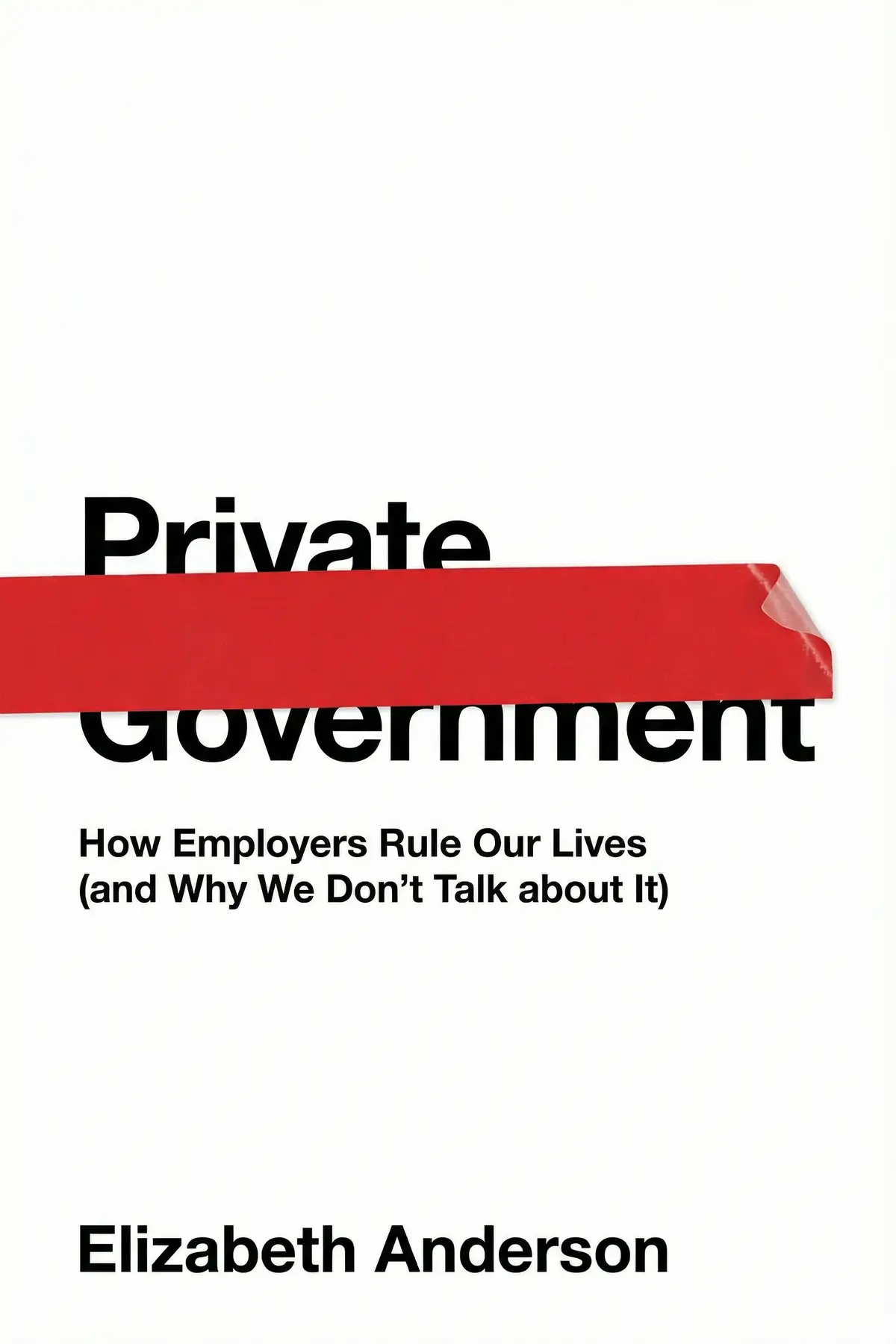
Table of Content
1. Introduction
54 sec
If you have a job, someone you never voted for can probably read your work email, set rules about your hair and end your income over a Facebook post you write off the clock. In Private Government, philosopher Elizabeth Anderson argues that this is simply how most workplaces are designed. They are governments, and most of them run as dictatorships.
We seldom say so, she adds, because we still picture work through an old story about free and equal markets, written when large-scale manufacturing barely existed. Her throughline is that bosses may be unavoidable, while bosses who answer to no one are a choice, and that workers can be given a real voice.
Follow her case and you gain words for the power you meet at work every day. You also see why the right to quit is a thin kind of freedom, and what workplaces governed another way could look like.
2. Read your company's org chart as a constitution
1 min 59 sec
Swap three words in the description of a dictatorship and you get a fair portrait of an ordinary office. Anderson’s comparison sounds extreme at first, so she tests it against the strongest objections.
3. Your employer's reach goes far past your desk
1 min 38 sec
Most bosses only want the work done, the usual defense goes. Anderson lists what employers are legally allowed to demand, on the job and off it, and the list is longer than most employees imagine.
4. Understand the limits of your right to quit
1 min 46 sec
Don’t like your job? Find another one. Anderson grants the right and then counts what using it actually costs, and the bill can be heavier than being fired.
5. Look at work from the bottom of the ladder
1 min 34 sec
A national government that controlled bathroom breaks and hairstyles would face outrage. The same rules at work barely draw comment, and Anderson finds part of the reason in who gets to describe the workplace.
6. Retire the market story written before factories
1 min 48 sec
The textbook labor market, where worker and employer meet as equals, once described something real. Adam Smith’s famous pin factory holds a clue to when that stopped being true.
7. Tell a public government from a private one
2 min 00 sec
Someone has to be in charge, or nothing gets done. Anderson agrees, and then moves the argument to a different question, borrowing a word that once described parents, schools and husbands.
8. Learn how workers can win a voice at work
1 min 40 sec
If the problem is a government closed to the people it rules, the remedy almost names itself. Anderson points to arrangements that already exist, one of them common across Europe.
9. Conclusion
1 min 08 sec
Anderson gives a name to something many working people feel and few say aloud. The office, the warehouse and the poultry line are governed spaces, with rulers, rules, surveillance and the threat of exile, and the people living under those rules mostly have no vote. The old market story, true enough in the age of ten-person workshops, keeps that fact hard to see.
Once you see it, the questions change. Whether your manager is decent matters less than what your company is allowed to do and who can check it. The right to quit gets measured against what quitting would really cost. The view from the bottom of the economy becomes the test case, because there the powers others keep on the shelf are already in use. And unions, codetermination and worker co-ops stop sounding like utopias and start sounding like ordinary designs for a workplace government.
A kind ruler does not turn a dictatorship into a democracy. Anderson’s real question is whether the people who do the work should have a say in who governs it.
About this book
What is this book about?
Most people earn a living through a job, and we are told this is a free bargain between equals: you sell your work, your employer pays, and either side can walk away. Elizabeth Anderson argues that this picture no longer describes reality. Inside most companies, an unelected few give orders, watch employees, set rules that reach into their private lives and punish disobedience with dismissal. Anderson, a philosopher, calls this private government. She shows how far employer power reaches, especially in the United States, from firing people over social media posts to denying bathroom breaks. She explains why the freedom to quit protects so little, and why people higher up the economic ladder rarely notice any of it. She also traces our blindness to an old idea of the market that made sense in Adam Smith's world of small workshops and stopped making sense once factories took over. Her answer is to keep workplace hierarchy but make it accountable. Readers get a clear vocabulary for power at work and a sketch of democratic alternatives: unions, shared governance between workers and managers, and worker co-ops.
Book Information
Who it's for
Employees sensing company overreach
Employees who sense their company controls more of their life than their contract suggests.
Managers and team leads
Managers and team leads who want to understand the power they hold and use it more accountably.
Into economics or politics
Readers interested in economics or politics who want a sharp case for democracy at work.
About the Author
Elizabeth Anderson
Elizabeth Anderson has taught philosophy and women's studies at the University of Michigan, Ann Arbor, since 1987, where she designed the Philosophy, Politics and Economics major and served as its first director. Her research covers democratic theory, equality, racial integration, the ethical limits of markets and social epistemology, and she has studied how jobs are organized today and how life for workers could improve. Her books include Value in Ethics and Economics and The Imperative of Integration, which won a 2011 Joseph B. Gittler Award from the American Philosophical Association.
Ratings & Reviews
Ratings at a glance
What people think
Listeners find the book intellectually stimulating and appreciate how readable it is. Insights are perceived differently, as some find the material profound while others point out that the work is a compilation of various essays.
Top reviews
Leo
Elizabeth Anderson presents a chillingly effective argument that our workplaces are essentially communist dictatorships operating within a democratic state. The way she traces the history from Adam Smith’s optimistic free-market vision to the soul-crushing reality of the Industrial Revolution is eye-opening. Most of us assume that 'government' only exists in the public sphere, but Anderson proves that bosses exert more control over our lives than any elected official. Truth is, the anecdotes about poultry workers forced to wear diapers due to lack of bathroom breaks should be required reading for every labor lawyer. While the academic responses included in the back are a bit dry, Anderson’s own writing is sharp, accessible, and deeply necessary for the modern era. This book shifted my entire perspective on what it means to be 'free' at work.
Show moreKai
Ever wonder why we lose our basic constitutional rights the moment we clock into work? Anderson tackles this head-on by exposing the myth of the 'free' labor market. She makes a compelling case that the workplace is a site of arbitrary authority where workers have almost no voice. I particularly enjoyed the section where she dismantles the idea that 'quitting' is a sufficient solution to workplace abuse. Leaving a job isn't always an option when your healthcare and survival are tied to it. The writing style is surprisingly punchy for a philosopher, and she doesn't mince words when describing the indignities of modern labor. This is a vital contribution to the conversation about democracy and why it shouldn't stop at the office door.
Show moreLillian
Wow, the final section where Anderson responds to her critics is worth the price of admission alone. She absolutely eviscerates the notion that workers are 'free' just because they can walk away from a job. Her use of data regarding sexual harassment and wage theft provides a necessary reality check to the more theoretical arguments. The book is incredibly thought-provoking and challenges the very foundation of how we view corporate power. I’ve been recommending this to everyone in my union because it perfectly articulates why collective bargaining is a matter of liberty, not just wages. It is readable, urgent, and deeply researched. Even if you don't agree with every conclusion, you can't ignore the evidence she presents about the lack of dignity in the modern workplace.
Show moreAlice
After years of feeling like my office was a small fiefdom, this book finally gave me the vocabulary to explain why. Elizabeth Anderson is a genius for identifying the 'private government' that exists under the guise of private property. She reminds us that the pioneers of the free market, like Adam Smith, would be horrified by the modern corporate structure. The examples of surveillance and control over workers' private lives are genuinely terrifying. This book isn't just about economics; it's about the fundamental human need for autonomy and respect. It is a short read but packs a massive punch. If you’ve ever felt like your boss owned your soul, you need to read this to understand the systemic reasons why. It's a game-changer for political theory.
Show moreChamp
Picked this up after hearing about the comparisons between modern bosses and dictators, and it did not disappoint. The chapter on the Skylab astronauts who went on strike in space was a fantastic example of how micromanagement backfires. Anderson is remarkably good at explaining why we’ve accepted a lack of autonomy as the 'natural' state of employment. She argues that we’ve basically traded our liberty for a paycheck, which is a hard pill to swallow but feels accurate. My only gripe is that the book is quite slim and structured as a collection of essays rather than a cohesive narrative. It makes the pacing feel a bit disjointed at times. Still, the insights regarding the 'public-private' divide are incredibly sharp and worth your time.
Show moreJoshua
As a long-time manager in the corporate world, I found Anderson’s perspective on 'private government' incredibly validating and uncomfortable. We often pretend that employment is a simple contract between equals, but the reality is much more lopsided. This book highlights how employers use their power to regulate off-duty behavior, from social media posts to political affiliations. I found the historical analysis of pre-industrial markets fascinating, specifically how the dream of self-employment was crushed by large-scale manufacturing. Some of the academic rebuttals in the second half are a bit dense and pedantic. Nevertheless, the central thesis remains strong and very readable for a non-academic audience. It definitely makes you rethink the ethics of the standard 9-to-5 hierarchy.
Show moreAna
Not what I expected from a political philosophy book, but in a good way. It's rare to find a thinker who can connect 18th-century economic theory to the fact that people are literally denied bathroom breaks in 2024. Anderson’s ability to deconstruct the 'ideology of the market' is impressive. She shows how we’ve been brainwashed into thinking that only the state can be tyrannical. Gotta say, the responses from the other professors were a mixed bag, but Anderson’s final rebuttal was a masterpiece of rhetoric. She really knows how to defend her positions against the usual 'just quit' arguments. It is a quick, punchy read that will make you look at your supervisor in a completely different light. Highly recommended for anyone interested in labor rights.
Show moreAva
Why does this book feel like a classroom lecture that never quite hits the pavement of real life? I appreciated the core concept of 'private government,' and I definitely agree that many employers act like petty tyrants. However, the author spends an exhausting amount of time on the Levellers and 17th-century English history. If you are looking for actionable solutions to fix toxic management or improve labor laws, you will likely walk away disappointed. It is a brilliant piece of political philosophy, but it lacks the 'how-to' for the average employee struggling under a bad boss. The middle section featuring various academic responses felt like filler that slowed down the momentum. It is a thought-provoking read for sure, but it is too theoretical for my taste.
Show morePing
Frankly, the structure of this book is a bit of a mess, even if the ideas are gold. It starts with two lectures, then gives you four different critiques, then a final response from the author. It feels more like a bound journal than a proper book. I loved the first forty pages where she explains how companies function as private governments. That part is brilliant and easily five-star material. However, the momentum dies once the other academics start bickering about definitions and historical interpretations. It's a bit of a slog to get through the middle sections just to get back to Anderson’s final thoughts. If you can handle the disjointed format, there are some truly profound insights about the nature of modern coercion here.
Show moreAmy
To be fair, the premise had me excited, but the execution was bogged down in dusty historical trivia that felt disconnected from today. I was hoping for a modern critique of tech companies or the gig economy. Instead, I got a deep dive into the 1600s and the philosophical musings of John Lilburne. The book is very short, yet it still manages to feel repetitive because it repeats the same three points in different ways. Also, the inclusion of several other authors' critiques makes it feel like I’m reading a transcript of a faculty lounge debate. It’s too academic for the casual reader and too light on data for a serious policy wonk. If you want a history lesson, this is fine, but it’s not the radical call to action the title suggests.
Show moreQuestions about this book
What is the main idea of Private Government by Elizabeth Anderson?
Anderson argues that most workplaces are governments in the older sense of the word: one group holds the power to command another and to punish disobedience. Because workers cannot choose, remove or challenge those who rule them, she calls this private government. We overlook it, she says, because we still believe a pre-industrial story of free and equal markets. Her remedy is to give workers a democratic voice.
Why does Anderson compare companies to communist dictatorships?
She points to three features. A company’s leaders own and control all the tools and resources workers use, small groups plan in detail what gets produced and how, and employers can monitor email, calls, social media and belongings. The CEO and managers are unelected as far as workers are concerned, and the ultimate punishment is a kind of exile: being fired. She uses the comparison deliberately to provoke a second look.
Why isn't the freedom to quit enough, according to Private Government?
Jobs are scarce, especially for marginalized groups or people with a criminal record or disability, and non-compete clauses can block work with rivals. In the United States, quitting can also mean losing income, unemployment insurance, health coverage, retirement benefits and even immigration status. Anderson adds that the option to leave does not make you free while you stay, just as emigration did not make Mussolini’s Italy free.
What solutions does Elizabeth Anderson propose for workplace authoritarianism?
She proposes making workplace government public, meaning democratic. One route is union representation, where collective bargaining and the possibility of a strike force managers to listen. The other is direct participation: workers and managers governing together, as in Germany’s codetermination system, or co-ops owned and managed by their workers. She leaves the details open; her point is that alternatives to both dictatorship and anarchy exist.
Who should read Private Government?
It suits employees who feel their employer reaches too far into their lives, managers who want to think about how their authority is checked, and readers of politics and economics curious about why democratic ideals stop at the office door. The examples are mostly American, from at-will employment to bathroom-break rules at Tyson, but the argument about who governs work applies wherever people earn a living through jobs.
Readers also enjoyed


A Promised Land
Barack Obama

A River in Darkness: One Man’s Escape from North Korea
Masaji Ishikawa

A Theory of Justice
John Rawls



A Warning
Miles Taylor


AUDIO SUMMARY AVAILABLE
Listen to Private Government in 15 minutes
Get the key ideas from Private Government by Elizabeth Anderson, plus 5,000+ more nonfiction titles.
- 5,000+ titles
- Listen as much as you want
- 7-day free trial
- Cancel anytime









