
14 min 01 sec
Available in: English
Predictable Success: Getting Your Organization on the Growth Track – and Keeping it There
By Les McKeown
Shows leaders why some companies hit their goals every year while others lurch between boom and crisis, and how to read your company's growth stage and avoid the trap each stage sets.
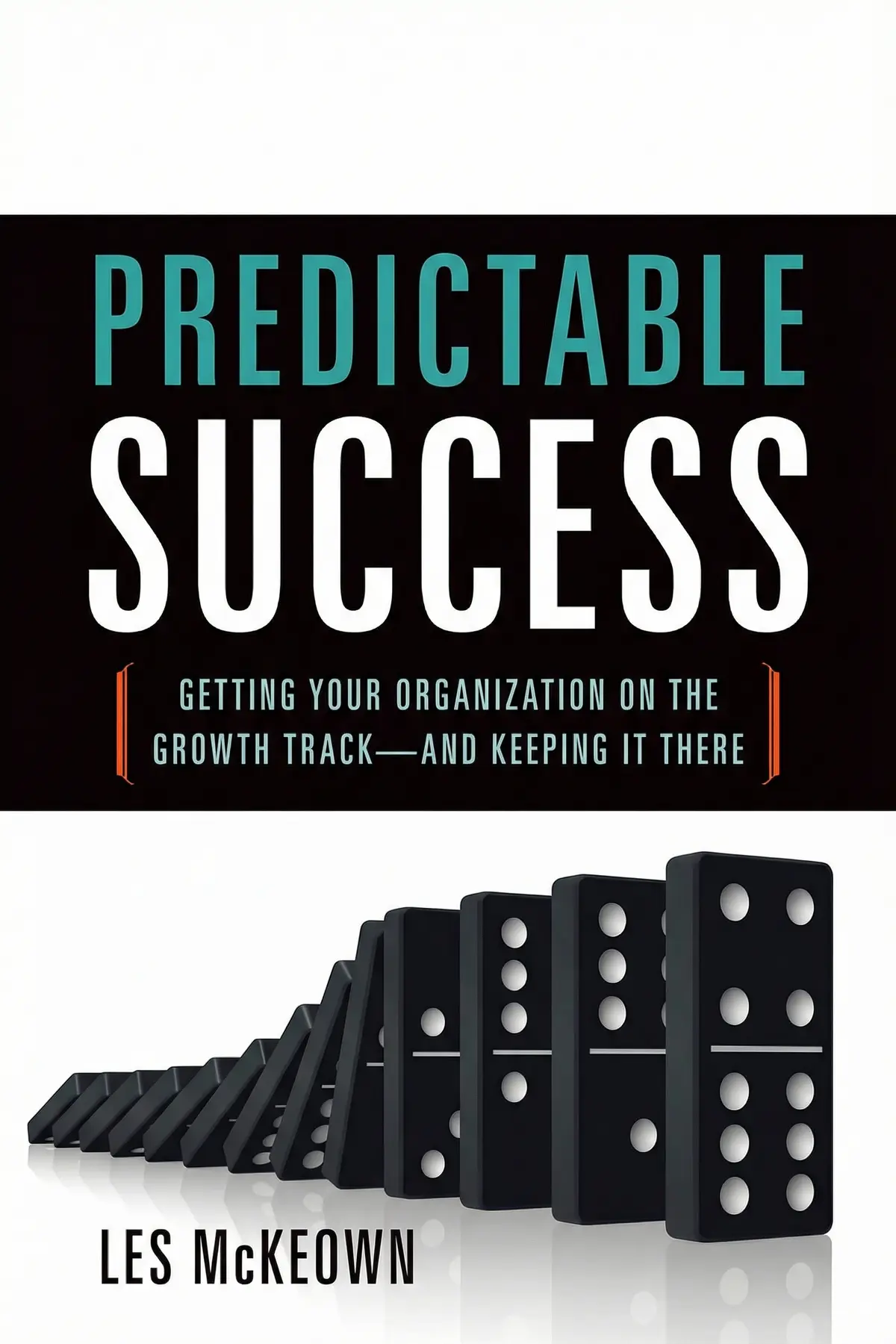
Table of Content
1. Introduction
1 min 06 sec
Most growing companies hit their targets one year and miss them the next, and their leaders blame luck. In Predictable Success, growth adviser and serial founder Les McKeown argues that steady results depend on management rather than on age, size or a deep bank balance. Consistency comes from knowing where your company stands on a well-worn path and what that stage demands.
McKeown maps seven stages, from a hard start through a turbulent stretch he calls whitewater to the sweet spot he calls predictable success, followed by three stages of decline. His throughline is that every stage sets a known trap, and leaders who see it coming can step around it.
The cases range from pizza franchises in Ireland that ran out of cash to a woodworker buried in orders, a chocolate maker trapped by its own traditions and a CEO with no free hour for five weeks. By the end, you can place your own organization on the map and know the next move it needs.
2. Hit your goals every year through steady management
1 min 44 sec
A payments firm just five years old ranked alongside a company 120 years old, while a giant with billions in reserve still fails to meet its goals consistently. The difference has nothing to do with age or money.
3. Survive the early years by tripling your cash
1 min 30 sec
New franchise owners were sure their customers would cover the bills, and they still ran dry. The rule McKeown took from that experience sounds excessive until you see why most young companies never make it past the early struggle.
4. Get through whitewater by joining sales and operations
1 min 37 sec
A craftsman had more orders than ever and was losing money and clients anyway. The fix that saved him cost nothing to buy, and most growing teams overlook it.
5. Keep decisions simple as your company scales
1 min 51 sec
As companies grow, their values start sounding like slogans and each department invents its own mission. McKeown describes what that looks like on the floor, and the unusual way he suggests filling a senior role.
6. Spot the slide toward decline before it starts
1 min 43 sec
A founder who no longer recognized his own agency, a chocolate maker devoted to tradition and the companies left behind by digital music all show the same pattern. It begins long before anyone notices.
7. Build systems that decide fast and risk wisely
1 min 40 sec
Managers fear that encouraging risk will invite mistakes, yet a company that stops taking chances starts to decline. McKeown draws a clear line between the bets worth making and the ones to refuse.
8. Free your calendar and coach your people forward
1 min 38 sec
A perfectly organized schedule looks like discipline, but McKeown reads it as a symptom. His remedy for the overbooked leader comes with a sports lesson about what to show people after they play.
9. Conclusion
1 min 12 sec
McKeown’s book turns growth from a gamble into a map. A company that knows it is in the early struggle builds a cash cushion. One in whitewater gets sales and operations talking. One that has arrived watches for the moment its systems begin to run it. The calm he pictures in running water comes from knowing which stone is likely to fall next.
The habits the book supports are modest and specific. Name the stage your organization is in today, honestly, along with the trap that stage sets. If cash is tight, plan on three times what you think you need. If orders are outrunning delivery, put sales and operations in the same conversation before the next promise goes out. And if your calendar has no white space left, open a few hours when anyone can walk in with an idea.
The chocolate maker founded in 1908 and the big music companies that missed the move to MP3s both had history on their side. What they stopped doing was asking where they stood on the path, and the path kept going without them.
About this book
What is this book about?
Plenty of companies have a good year, then a chaotic one, then a slow one, and their leaders put the difference down to luck. Les McKeown, an adviser who has launched more than forty businesses, argues that steady results are within reach of any organization, whatever its size, age or bank balance. What decides it is management. McKeown lays out a path of seven stages. A company starts in the early struggle, enjoys a burst of easy growth he calls fun, and then hits whitewater, when demand outruns what it can deliver. Beyond that lies predictable success, the stage where goals are met year after year. Past that point come three phases of decline, which are the treadmill, then the big rut, and finally the death rattle. For each stage, the book names the trap and the fix, from a cash rule learned on pizza franchises in Ireland to a woodworker rescued from a flood of orders, a decision routine of data, debate, decide or defer, and a warning about the CEO whose calendar is full for five weeks. Readers get a way to locate their own organization on the map and a set of concrete moves for the stage they are in.
Book Information
Who it's for
Founders with uneven years
Founders whose companies swing between strong years and chaotic ones and who want to know why.
Managers facing growing pains
Managers in fast-growing firms where orders outrun delivery and departments pull in different directions.
Leaders sensing creativity fade
Leaders of established organizations who sense the creative spark fading and want to stop the slide.
About the Author
Les McKeown
Les McKeown runs Predictable Success, a firm that advises organizations on growth. He has launched more than forty businesses and co-founded an incubation company that helped hundreds of entrepreneurs start ventures. Born in Ireland and trained as a chartered accountant in the UK, he moved to the United States in 1999 and has since worked with founders, CEOs and their teams on the barriers that hold growth back. He is also the author of The Synergist, Do Lead and Do Scale.
Ratings & Reviews
Ratings at a glance
What people think
Listeners find this business book exceptionally clear and simple to digest, with one remarking that it uses very plain language. Beyond that, the work delivers readily observable descriptions of business life cycles, and one listener emphasizes how it applies real-life experience into principles. They also admire its accuracy and professional worth, with one individual noting its comprehensive evaluation of business operations.
Top reviews
Wissanu
As someone running a scaling startup, I found the description of 'The Fun Stage' almost eerily accurate. It starts out as a pure survival game where every sale feels like a massive victory, but then growth brings this crushing complexity. Les McKeown captures that transition into 'Whitewater' with such precision that it’s almost uncomfortable to read. Truth is, I’ve been making the exact mistakes he warns about—adding staff without fixing the underlying communication bottlenecks. The writing style is surprisingly punchy for a business book, making it easy to digest during a busy week. While it might lack some academic rigour, the intuitive mapping of organizational phases provides a much-needed vocabulary for internal problems. I finally understand why our marketing department feels like a roadblock instead of an engine. This is a battle-ready manual for anyone tired of firefighting every single day.
Show moreChokdee
Can a one-person shop actually benefit from a book about corporate growth? Absolutely, especially if you are looking to shift focus or stop saying 'yes' to every low-value opportunity that comes your way. In order to learn to do better, I first had to conceive of my small business as an actual organization with its own life cycle. Predictable Success helped me anatomize past mistakes in light of the 'Early Struggle' phase, ensuring I won't repeat those dead ends. I've had the book for less than a week, and I already feel more battle-ready than I was last month. It’s a very deep and shrewd look at what happens when you decide to take a coherent approach to success. Even if you are a solopreneur, this is likely the book you need to read right now.
Show moreMikael
Look, if you're struggling to explain business growth to your team, just buy them this book. It serves as a road map, manual, and motivational guide all wrapped into one highly readable package. The summaries at the end of each chapter are perfect for the many who crave bullet points and quick takeaways during a hectic workday. I particularly appreciated the diagrams, which helped the visual learners in our office finally grasp the 'Whitewater' concept. Whether your business is currently in the 'Early Struggle' or cruising through 'Predictable Success,' these insights are invaluable. It has become one of my favorite books to give as a gift to business associates. There is a reason Les is considered such an authority on this subject, and his wisdom shines through on every page.
Show moreLucia
After hearing Les speak at a seminar, I knew the book would be a game-changer for our executive team. The way he breaks down the transition into 'Predictable Success' provides a clear, actionable framework for anyone in a leadership position. We have used his 7-phase model to identify exactly where our bottlenecks are occurring and how to optimize our people and processes. In my experience, most business books are heavy on theory but light on the actual 'how-to.' This book is a different animal because it pairs shrewd observations with practical tools you can implement immediately. Every chapter ends with a helpful summary that works great for quick reference during meetings. It’s a must-have for our bookshelf.
Show moreTuck
Finally got around to reading this after seeing it on every consultant’s bookshelf, and I can say the hype is largely justified. McKeown shares a 7-phase business life-cycle model that I could quickly match to almost every client in my current portfolio. It serves as a great look in the mirror for executives who are too close to the daily grind to see their own dysfunctions. Personally, I found it much more accessible than Adizes’ work, which can feel a bit too academic and dense for a quick turnaround. The simple terminology allows for an easy read while still delivering shrewd insights into how structure must evolve alongside people. My only gripe is that it feels a bit light on how to integrate modern technology into these older organizational frameworks. Still, it’s a very worthwhile addition to any professional library.
Show moreGabriel
This isn't your typical dry management textbook that you struggle to finish. McKeown uses simple terminology and a very detailed approach to explain how companies rise, peak, and eventually hit the 'Death Rattle' if they aren't careful. I am a strategy consultant with hundreds of books in my collection, and this is one of the few I finished cover to cover in two sittings. The focus on the perfect integration of people, process, and structure is spot on for the mid-sized business market. I would have liked to see more emphasis on how technology functions as a primary enabler in today's environment, but the core principles remain solid. It’s a great gift for clients who are struggling to understand why their once-simple business has become so complicated. Definitely a must-read for leadership teams.
Show morePairot
Ever wonder why your once-fun business suddenly feels like it's drowning in red tape? This book explains exactly why that happens as you move from 'The Fun Stage' into 'Whitewater.' McKeown’s writing is incredibly accessible, stripping away the jargon that usually clutters management books to reveal the core mechanics of growth. I was nodding along to every page, particularly the sections on how slower communication becomes an inevitable byproduct of increased complexity. It provides a very detailed road map that helps you identify where you’ve gotten off track. Personally, I think every founder who has surpassed the two-year mark needs to read this to prepare for the inevitable shift in dynamics. It turns survival instincts into a coherent strategy for long-term stability.
Show moreKan
To be fair, the book offers a lot of great problem identification for the various hurdles a scaling company will face. It gets to the core of fundamental root causes and gives you the specific language to discuss them with your leadership team. However, I found the lack of scientific research or peer-reviewed case studies a bit disappointing. It relies heavily on anecdotal evidence and McKeown's own consulting experiences, which are clearly extensive but don't always feel universal. Frankly, while the framework is helpful for self-reflection, I wouldn't call it a definitive scientific model for business growth. It's a great 'look in the mirror' exercise, but it lacks the depth of more academic works. It’s worth a read for the perspective, but take the generalizations with a grain of salt.
Show moreKofi
The framework McKeown builds is incredibly sturdy, yet it feels a bit dated regarding modern tech stacks. While I appreciate the simple terminology and the easy-to-read style, I found some of the advice to be a bit too anecdotal for my taste. The 7-phase model is helpful for broad strokes, but when it comes to the nitty-gritty of implementation, it leaves some gaps. Gotta say, the evaluation of business operations is comprehensive, but the lack of hard research makes it feel more like a collection of wisdom than a scientific method. It's a good evaluation of business, and I saw a lot of comparisons to my own organization, but it didn't solve every problem. It’s a helpful tool for awareness, but you might need additional resources to actually execute the changes required to stay in success.
Show moreSangduan
Maybe it’s just my specific niche in the non-profit world, but many of these applications simply didn't apply to our context. The book assumes a very specific trajectory of profit-driven growth that doesn't account for external regulatory hurdles or different funding models. Not gonna lie, I felt like I was reading a guide for a very specific type of mid-sized corporation. While the 'Death Rattle' and 'Early Struggle' phases are vividly described, the solutions offered felt repetitive and a bit too simplistic for complex modern organizations. I also think the book severely underestimates the role of technology as a primary driver of structure today. It’s an easy read, but it lacks the nuance required for businesses that don't fit the standard SMB mold. I was hoping for more actionable data and fewer generalizations.
Show moreQuestions about this book
What is the main idea of Predictable Success by Les McKeown?
McKeown argues that any organization can meet its goals consistently, whatever its size, age or finances. Success comes from management, not luck. Companies move through recognizable stages, from the early struggle and a fast-growth phase he calls fun, through the turbulence of whitewater, to predictable success. After that come three stages of decline. Leaders who know which stage they are in can prepare for the trap it sets.
What is the whitewater stage in Predictable Success?
Whitewater is the stage when demand outpaces what a company can deliver. Decisions get harder, mistakes multiply, orders get mixed up and customers are let down. McKeown’s fix is close alignment between sales and operations, so sales knows what operations can handle and sets realistic expectations. He helped a woodworker named Ian escape whitewater by improving communication and feedback between the two sides of his business.
What are the stages of decline after predictable success?
McKeown names three. The treadmill comes when a company relies so much on its systems that it loses creativity, and founders often leave. The big rut follows when the organization forgets its mission and focuses on itself instead of customers, as a chocolate factory founded in 1908 did by clinging to tradition. The death rattle is the end, when innovative rivals overtake a company that stopped adapting.
How can a company stay in predictable success?
McKeown recommends efficient decision systems, such as one client’s routine of data, debate, decide or defer, and strategies built from employees’ own skills. He also wants risk-taking made part of normal work, kept within the core business and never unethical. Leaders should avoid overbooked calendars, hold office hours, explain why processes exist to new hires and give people concrete feedback instead of numerical scores.
How much cash does McKeown say a new business needs?
His rule is to estimate the cash your operations require and then aim to hold three times that amount. He learned it while helping Pizza Hut open franchises in Ireland, where owners who believed they had enough customers still ran out of money quickly. Surviving the early struggle depends on two things: enough buyers for your product and enough cash to pay your bills.
Readers also enjoyed




A Year with Peter Drucker: 52 Weeks of Coaching for Leadership Effectiveness
Joseph A. Maciariello



Acting with Power: Why We Are More Powerful Than We Believe
Deborah Gruenfeld

All In: How Great Leaders Build Unstoppable Teams
Mike Michalowicz


AUDIO SUMMARY AVAILABLE
Listen to Predictable Success in 15 minutes
Get the key ideas from Predictable Success by Les McKeown, plus 5,000+ more nonfiction titles.
- 5,000+ titles
- Listen as much as you want
- 7-day free trial
- Cancel anytime









