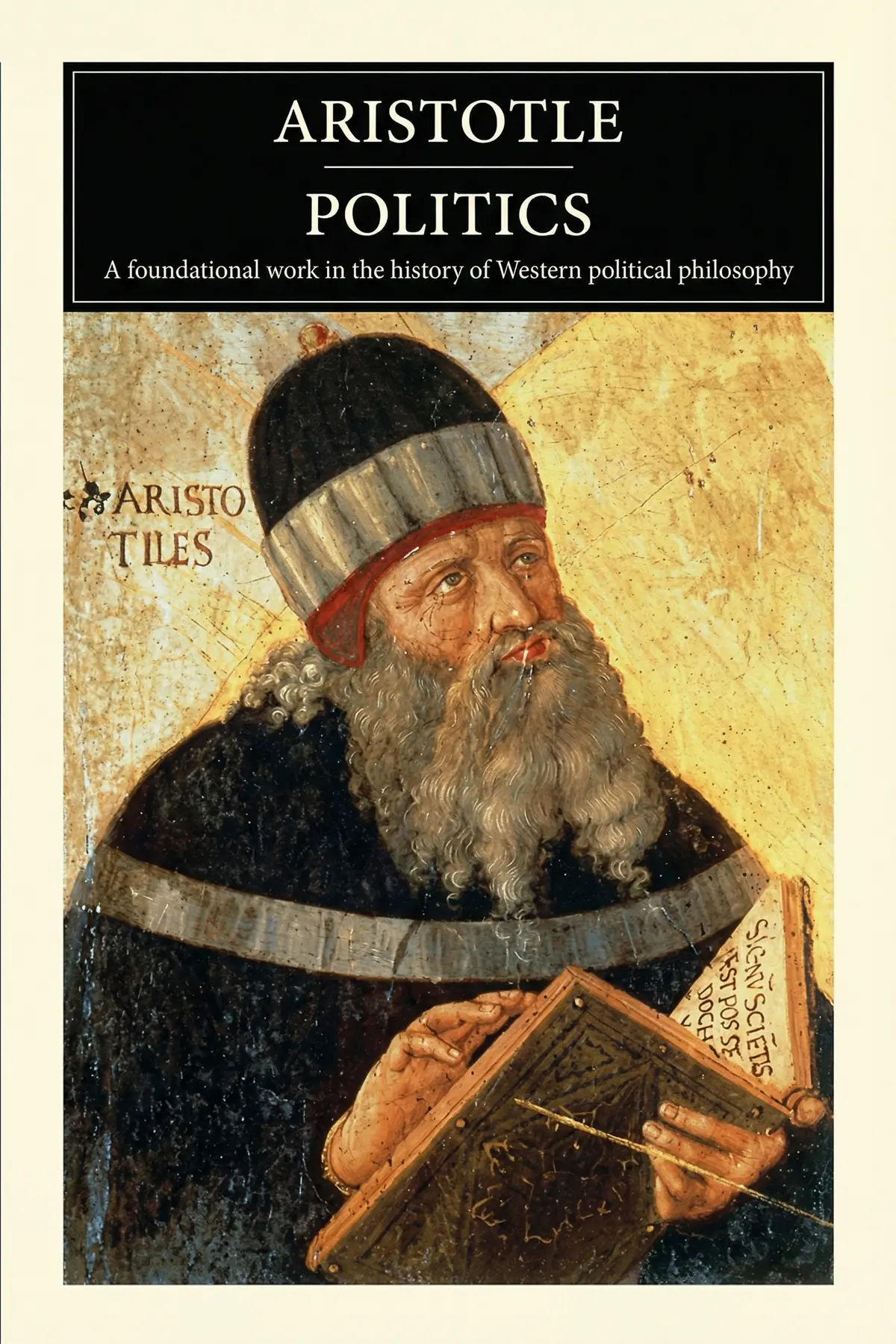
Nicomachean Ethics
Aristotle
1 min 08 sec
Most people watch politics as a contest in which each side grabs what it can. Aristotle saw something else: arguing together about how to live is what turns a clever animal into a good one. In Politics, the philosopher who trained at Plato’s Academy and later tutored Alexander the Great calls humans political animals, beings who reach their best only inside a community that reasons together.
His world is far from ours. The polis, a small independent city of at most about 100,000 citizens, disappeared in late antiquity, and it depended on slave labor that Aristotle defended. Yet the questions he raised, about the best way to organize a society and how to secure the common good, still matter. His answer runs through every idea ahead: a community thrives when reason rules over appetite, and in practice that means impartial laws and a large middle class. Follow it and you gain a test you can apply to any government, company or club, and a sharper ear for why fairness arguments explode.
1 min 55 sec
A bee works for its hive, farms, fights and obeys a queen, yet one thing separates its society from ours. Aristotle built his whole politics on that difference, and on what happens to people who live without it.
1 min 51 sec
Aristotle studied about 100 city constitutions and found almost no virtue in any of them. Instead of abandoning his ideal, he looked to a musical scale and the human body for an explanation.
2 min 04 sec
The hardest part of Politics is its defense of slavery. Buried inside that argument sits a distinction between two kinds of thinking that still separates skilled planners from people who know what is worth planning.
1 min 56 sec
Aristotle sorted every government into six types and ranked rule by one person first. Then he admitted why that ideal almost never works, and pointed to the form ordinary citizens could actually manage.
1 min 57 sec
A potluck dinner shows how crowds can outdo experts. Yet in Athens the crowd kept tearing the city apart, because rich and poor each read the same idea of justice in opposite directions.
1 min 43 sec
When rich and poor fear each other in power, every handover becomes a threat. Aristotle proposed a remedy he summed up in three words, and admitted one ancient case where it went badly wrong.
1 min 50 sec
Arrogance at the top and envy at the bottom make poor citizens, Aristotle argued. The group he trusted instead was neither the wisest nor the noblest, and its strength came from what it had to lose.
1 min 13 sec
Aristotle’s Athens is gone, along with the slave labor that gave its citizens their free hours, and his defense of that system belongs to its time. What lasts is a way of judging any shared life. He saw people as unfinished creatures who become good by reasoning together about how to live, and he measured every government by one standard: whether reason aimed at the common good is in charge, or appetite. His two most practical proposals, the rule of law and a strong middle class, turn out to be one idea in two forms. Fixed laws take appetite out of decisions, and a broad middle takes it out of the citizens who make them. Both remain central to democracies today.
You can carry the idea into ordinary life. When a dispute flares in your team or your town, notice which kind of equality each side is claiming before you choose one. Where you have a say, settle the rules before anyone knows who they will favor. A clever animal, Aristotle warned, is the most dangerous creature alive. A clever animal that argues openly about justice, under rules it agreed to in advance, can build a city worth living in.
Politics often looks like a scramble in which each group grabs what it can. Aristotle, writing in fourth-century BCE Greece, argued that it should be something better: the place where people reason together about how to live, and so become good. Humans, he said, are political animals, gifted with speech and reason and dangerous without a community to shape them. He tested that ideal against the constitutions of about 100 city-states and found most of them ruled by appetite. From there he built a map of six regimes, three that serve the common good and three that serve their rulers, and explained why rule by all citizens is the most realistic good option. He traced the instability of Athens to a fight between rich and poor over what equality means. His remedies remain familiar: let impartial laws decide as much as possible, and rely on a large middle class whose interests match the city's. The book also defends slavery, a view that belongs to its age, while drawing from it a distinction between technical and practical reason that still helps anyone who judges ends as well as means.
Professionals tired of political shouting matches who want a clear way to judge any government.
Students meeting political philosophy for the first time and looking for its starting point.
Team leads and founders who want rules and structures that keep a group fair and stable.
Aristotle lived from 384 to 322 BC. Born in Stagira in northern Greece, he was still a child when his father, Nicomachus, died. Around the age of eighteen he entered Plato's Academy in Athens and stayed until about 347 BC. In 343 BC, at the invitation of Philip II of Macedon, he became tutor to Alexander the Great. Back in Athens he set up his own school, the Peripatetic school, at the Lyceum, with a library behind his writing. His work ranged from the natural sciences and psychology to economics, the arts, philosophy and politics, and roughly a third of it is thought to survive.
Aristotle
Aristotle
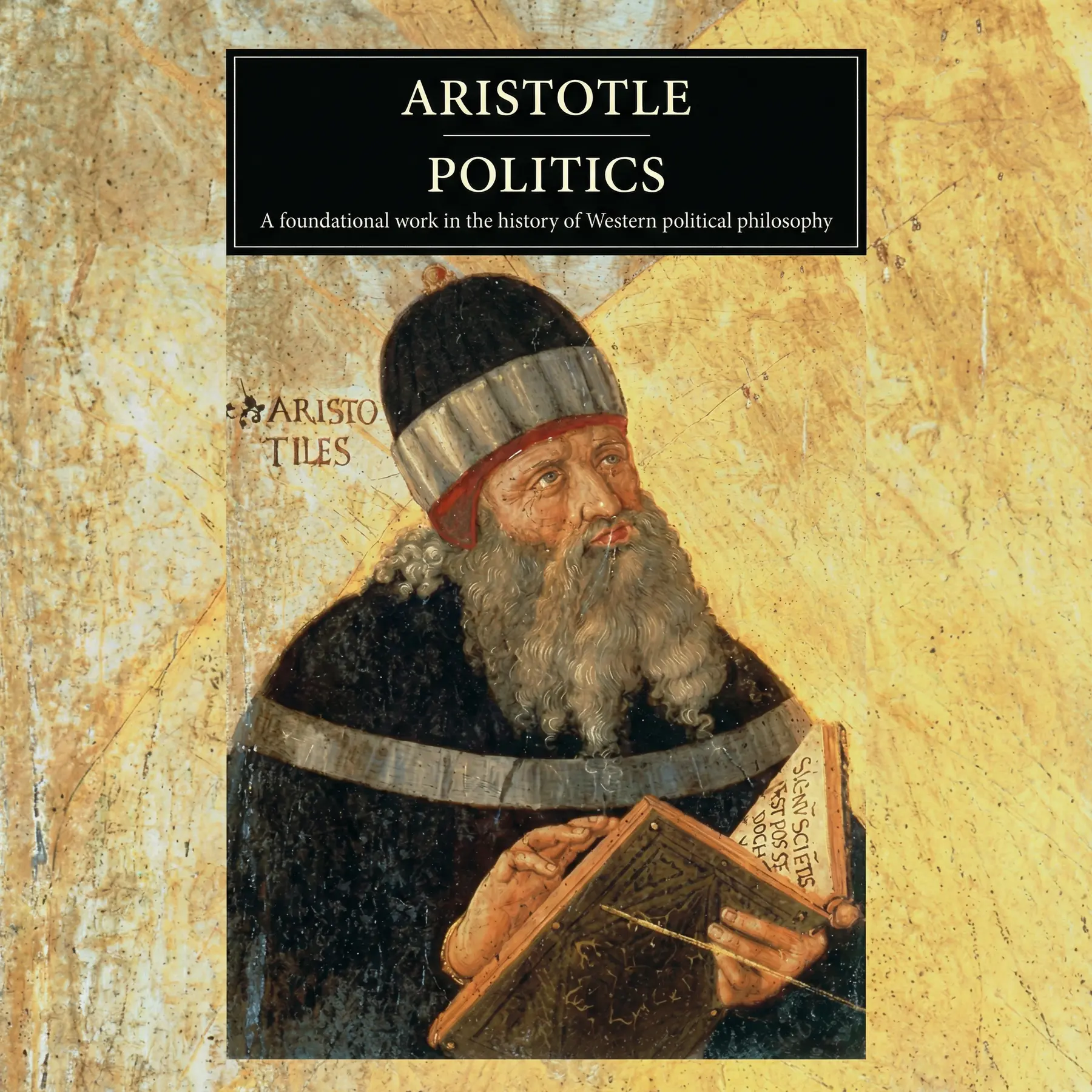
Listeners find much to value in Aristotle's writing, with one listener praising this as an excellent edition of his classic text. The book is also well-received for its political philosophy; one listener points to its fascinating insights, while another mentions how it successfully defines good government.
Few texts manage to remain so vital across two millennia, but Aristotle’s exploration of the 'political animal' feels remarkably fresh today. The way he breaks down the fundamental nature of human organization suggests that we are hard-wired for community and governance. Truth is, his insights into how a state should aim for the 'good life' rather than just survival are profound. While his specific views on who qualifies as a citizen are obviously dated, the core logic regarding the 'middle way' provides a stabilizing perspective for our polarized era. It is an excellent edition for anyone wanting to grasp the roots of Western political thought.
Show moreLook, this is the foundational blueprint for understanding how societies define good government, and it’s surprisingly readable if you take your time. Aristotle isn't just theorizing in a vacuum; he’s looking at real constitutions from his era to find what actually works for the people. His argument that humankind is by nature a political species strikes a chord because it explains our constant urge to organize and debate. I found his section on the importance of public education particularly enlightening, as it highlights how a state’s longevity depends on its citizens' values. This edition offers great clarity on complex Greek concepts that usually get lost in translation.
Show moreThe brilliance of this edition lies in how it frames Aristotle’s work as a living dialogue rather than a dusty, dead text. I was captivated by the idea that a state exists not just for trade or security, but to make life genuinely 'good' for its members. This book provides fascinating insights into the Greek mind, showing how they experimented with various forms of power long before we did. His writing can be densely populated with examples of obscure city-states, but the overarching philosophy remains the gold standard for defining justice. It really opened the windows of my mind to how deeply our modern structures are rooted in these ancient debates.
Show morePicked this up on a whim and was immediately floored by how much Aristotle understood about the psychology of property and ambition. He argues that when people feel their property rights are ignored, revolution is inevitable, a point that resonates across every century of human history. His 'middle way' approach to governance is a breath of fresh air compared to the 'winner-take-all' mentality we see in modern news cycles. The book is well-organized and this particular version provides the necessary footnotes to understand the more niche Greek references. Despite its age, the book proves that humans haven't changed nearly as much as we like to think we have.
Show moreAfter finishing the Ethics, I expected a similar focus on individual virtue, but this is a much more grounded and practical treatise. Aristotle moves from the personal desire for 'the Good' to the collective necessity of a functional polis. He asks the tough questions about who should rule and why, providing a fascinating taxonomy of different governmental structures like democracy and oligarchy. I gotta say, his warnings about the 'tyranny of the majority' and the importance of a strong middle class are eerily relevant to current headlines. It is a dense and occasionally dry read, but the intellectual payoff is undeniably worth the effort.
Show moreEver wonder why modern politicians seem to be speaking entirely different languages even when they use the same words? Aristotle suggests that because all people desire 'the Good,' but possess different preconceptions of what that is, conflict is inevitable. This book helped me realize that our political differences aren't just about policy, but about our fundamental views on human potential. The writing style is vigorous and surprisingly affable, almost like the philosopher is walking through the town square debating with friends. Not gonna lie, some of the sections on household management are a slog, but the broader political theory is absolute gold.
Show moreFinally got around to this classic after hearing it referenced in every single political science podcast I subscribe to lately. What struck me most was Aristotle’s obsession with stability and his preference for a 'polity' over a pure democracy. He clearly saw how extremes in wealth or power lead to revolution, which is a lesson we seem to be relearning the hard way. The chapter on how small changes can gradually undermine a constitution felt like it was written about the 21st century rather than the 4th century B.C. While the language is academic, the core message about balance and moderation is a necessary antidote to today's radicalism.
Show moreTo be fair, the translation I read was excellent, but the content itself is a mixed bag of timeless brilliance and archaic nonsense. Aristotle spends a lot of time categorizing things that no longer apply to our globalized world, which can make the reading experience feel a bit tedious. While his definition of a citizen as someone who 'shares in ruling and being ruled' is beautiful, the reality of his exclusionary politics is tough to square. You have to sift through a lot of outdated biological and social assumptions to find the nuggets of political gold. It’s an essential historical document, but perhaps not the 'breath of fresh air' some claim it to be.
Show morePersonally, I struggled with the dry, lecture-note style of the prose, which lacks the poetic beauty found in Plato’s dialogues. Aristotle is a scientist at heart, meaning he’s more interested in categorizing and observing than in inspiring the reader with soaring rhetoric. The truth is, his defense of things like 'natural slavery' makes it very difficult to recommend this as a moral guide, even if it is a political one. It’s a dense paysage moralisé that requires a lot of patience and historical context to truly appreciate without getting angry at the screen. Useful for students of history, but a difficult casual read for anyone looking for a quick political fix.
Show moreIt’s hard to overlook the insidious hierarchy that permeates this entire work, making it a frustrating read for a modern audience. While Aristotle is hailed as a genius, his justification for a master-slave relationship and his dismissive views on women are deeply uncomfortable. He tries to frame everything through the lens of 'nature,' but it often feels like he’s just justifying the status quo of his time. Frankly, the transition from the optimism of his Ethics to the rigid, exclusionary structures found here is jarring and quite disappointing. If you can stomach the elitism, there are scraps of wisdom, but the overall tone is too regressive for me.
Show moreAristotle argues that humans are political animals: we have reason and speech, and we become good only by working out with others how to live justly. A community is healthy when reason aimed at the common good rules over appetite. Since most real cities were ruled by appetite, he looked for practical fixes and found two: give as many decisions as possible to impartial law, and build a large middle class.
His phrase zoon politikon literally means animal of the polis, the Greek city-state. Humans, unlike bees, have logos, meaning both reason and speech, so we can argue about right and wrong and change our behavior. Aristotle held that this capacity only becomes virtue inside a community. Outside one, our cleverness makes us more dangerous than tigers or crocodiles, so the city is our natural home.
Aristotle sorted regimes by how many rule and whom they serve. Monarchy, aristocracy and polity are rule by one, a few or all citizens for the common good. Their corrupt twins are tyranny, oligarchy and democracy, which serve the rulers’ own desires. By democracy he meant a majority that plunders the city and ignores minority rights. He judged polity the most realistic good option.
He believed the rich become arrogant and the poor envious, and neither makes a good citizen. The middle classes are content with their lot, resent no one above them and attract no plots from below. Above all, they thrive when the city thrives, so they defend its institutions and side against whichever extreme grows too strong. When they form the majority, he argued, the best regime becomes possible.
Ask of any decision by a government, board or manager whose good it serves. In disputes over fairness, notice which kind of equality each side claims, as Athenian rich and poor did. Where you set rules for a team or company, agree on them before anyone knows who will benefit, since Aristotle saw fixed law as wisdom free of appetite.


Barack Obama

Masaji Ishikawa

John Rawls



Miles Taylor


William B. Irvine
AUDIO SUMMARY AVAILABLE
Get the key ideas from Politics by Aristotle, plus 5,000+ more nonfiction titles.