A Room of One’s Own
Virginia Woolf
 English
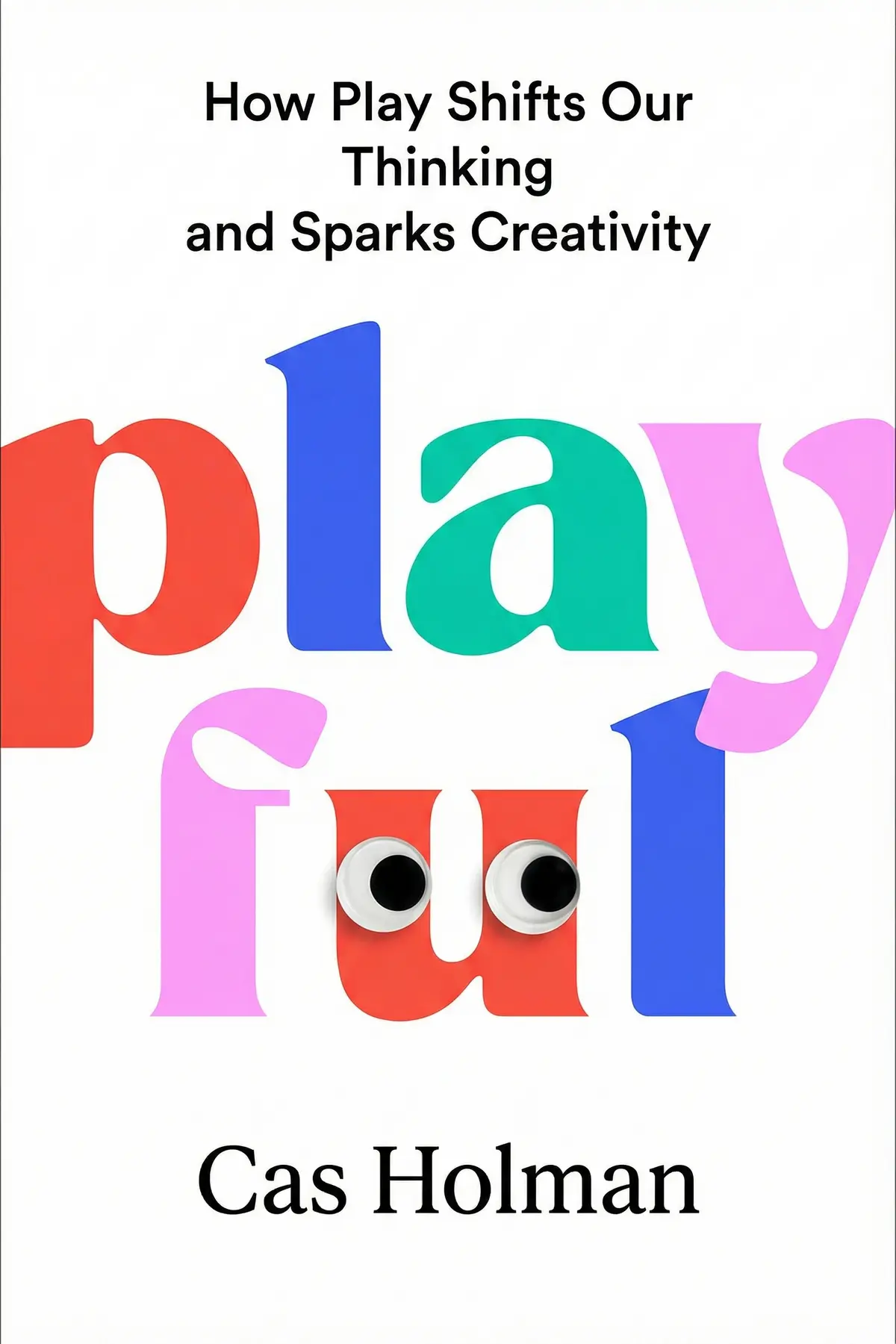
Shows adults how to get back the playful state where good ideas and real satisfaction come from: spotting openings in ordinary days, silencing the inner critic, judging time by engagement and designing routines that invite play.
1 min 00 sec
Most adults know the small urge to doodle, tinker or take a different route, and most of us squash it before it becomes anything. In Playful, designer Cas Holman, writing with Lydia Denworth, argues that this reflex costs us more than fun: the playful state we suppress is where creativity, learning and real satisfaction come from. Her first point is that play is a need that never goes away, one that adults have simply been trained to ignore.
Holman, who designs toys and spaces for open-ended play, treats the return to play as a skill with four parts. You learn to see possibilities in ordinary moments. You quiet the critic that stops you from acting on them. You judge your time by how engaged you felt. Then you arrange your days so play shows up on its own.
Each part comes with a small practice you can try at your desk, at home or with a team, starting tomorrow.
2 min 07 sec
Fifteen centuries ago, children herding animals in Namibia left tracks in the sand that nobody expected. Those footprints, and a set of animal experiments, suggest adults have given up something their brains still badly want.
2 min 20 sec
One traveler at a quiet airport gate changes how a whole corner of the room gets used, without saying a word. Holman explains what that traveler noticed and why most of us walk straight past it.
1 min 58 sec
Hand a room of adults a pile of cardboard and markers with no instructions, and something odd happens to rank and expertise. Holman shows what that reveals about the judge in your own head.
2 min 00 sec
Teachers in Anji Play preschools in China ask children what they were curious about, and Holman finds that question powerful for adults as well. It changes how teams talk about their work, and what they bother to try.
2 min 11 sec
Nobody planned the moment when millions of people stopped and looked at the sky together, yet it worked like a perfect invitation. Holman turns that moment into a habit anyone can run in a meeting room or kitchen.
1 min 10 sec
The children on the Namibian dunes skipped and hopped while they herded animals, and the sand kept the proof for fifteen centuries. That is Holman’s argument in one picture: play does not compete with a serious adult life; it runs through it, once we stop editing it out.
The skills she describes depend on one another. Seeing an opening matters only if you let yourself act on it, and acting lasts only if you stop grading every attempt by its output. Being your own playworker means doing all of this on purpose, for yourself and for the people around you.
The book supports a few small moves. When your next meeting ends, ask what the group learned or which part held its attention, and listen to how the room changes. Give yourself ten minutes with a timer and a ban on judging anything until it rings. When an ordinary place feels flat, ask what it could be for, setting aside what it is called.
Somewhere in your week there is a corner, an errand or a dull hour waiting to be used differently. Someone only has to put the bag down and start stretching.
Most adults feel a small pull to tinker, doodle or do something differently, and then shut it down. They worry about being watched, wasting time or looking childish. Cas Holman, a designer of toys and spaces for open-ended play, argues that this reflex costs far more than fun. It suppresses the state of mind where creativity, learning and genuine satisfaction live. Drawing on ancient footprints in Namibia, animal research, adventure playgrounds and Anji Play preschools in China, Holman makes the case that play is a need that never leaves us. She then lays out a practical path back to it. You learn to see possibilities in familiar places, to release the judgment that stops you from acting, to measure success by curiosity and presence, and finally to become your own playworker who arranges spaces and routines so play shows up naturally. Readers get small, repeatable practices for work and home. These include thinking sideways about a task's purpose, timed sessions where evaluation is banned, and a new question to close every meeting.
Knowledge workers whose ideas have dried up under constant pressure to be efficient.
Team leads who want meetings where people share half-formed ideas without fear of looking foolish.
Tired parents and professionals who have forgotten how to do anything just for the fun of it.
Cas Holman, born in 1974, is an American designer of toys and spaces built around unstructured play. She founded Heroes Will Rise and created the Rigamajig play system. She taught at Syracuse University and at the Rhode Island School of Design, where she was an Associate Professor of Industrial Design. Her design philosophy was featured in an episode of the Netflix series Abstract: The Art of Design. She wrote Playful with Lydia Denworth.

Listeners note that while perspectives differ on if the book provides enough fresh information for child development experts, many value the compelling invitation to reclaim play as a vital mindset for adults. Furthermore, there is significant appreciation for the focus on valuing process over performance, with one listener highlighting that learning to share "half-finished work without shame" is an important way to reduce pressure. They also emphasize how the author applies design thinking to help people view their environments as adaptable materials for creative use. Additionally, they suggest that prioritizing discovery instead of results makes this perspective a useful remedy for burnout.
Finally got around to reading this after seeing Cas on a documentary, and it’s the antidote to adult burnout I didn’t know I needed. We spend so much time obsessed with the 'finished' product that we forget how to actually exist in the middle of a mess. The idea of sharing half-finished work without shame hit me like a ton of bricks because I’ve spent my whole career hiding anything that wasn't polished. Truth is, we treat our lives like a performance review, but this book asks us to treat them like a sandbox instead. Using design thinking to re-evaluate a boring airport gate or a stale meeting room as a 'play problem' is genius. It’s light, it’s refreshing, and it made me want to go buy a pack of markers and just doodle without a goal for once. Highly recommended for the creatively exhausted.
Show moreWow. This book completely changed how I look at my daily commute and my office space. Cas Holman has this incredible way of making you realize that the world is much more flexible than we’ve been taught to believe. I loved the story about the person doing yoga at the airport gate—it’s such a perfect illustration of how one person’s playfulness can give everyone else permission to be human again. The focus isn't on winning or being an 'expert,' but on genuine engagement and curiosity. It’s a relief to be told that the goal isn't success, but asking better questions. I’ve started applying the 'loose materials' concept to my workspace, and the shift in my mood has been almost immediate. This is essential reading for anyone who feels like they’ve lost their creative spark. It’s about more than just toys.
Show moreLooking at my desk now, I see 'loose materials' instead of just clutter, and that’s entirely thanks to this book. Cas Holman has written a beautiful, slightly chaotic, and deeply moving call to action for every adult who has forgotten how to play. The pressure to stay efficient is a silent killer of joy, and this book provides the tools to fight back. I loved the idea that there is no 'correct' way to play, which immediately lowers the stakes and makes experimentation feel safe again. Whether it’s doodling in a margin or rethinking a tense group dynamic as a design problem, the opportunities for play are everywhere. It’s a hilarious, insightful, and deeply humane look at what it means to stay curious in a world that wants us to be productive. Five stars for the permission to be messy and unfinished.
Show moreThe chapter on 'thinking sideways' is worth the price of admission alone, even if some of the earlier sections feel a little repetitive. Holman argues that we need to look at what objects do rather than what they are called, which is a subtle but powerful shift in perspective. I appreciated the emphasis on how a playful mindset allows failure to become just another piece of information rather than a source of anxiety. To be fair, there are moments where the narrative leans a bit too heavily into her specific toy designs, which can pull you out of the broader philosophical message. However, the core message about prioritizing process over performance is a vital one for anyone feeling the weight of productivity culture. It’s a solid, visually-driven argument for why we should never stop messing around with the world around us. Great for shifting your daily perspective.
Show moreEver wonder why we stop being curious the second we turn twenty? This book tackles that head-on by exploring how our definition of 'fun' shrinks until it basically doesn't exist anymore. Holman uses her background as a toy designer to show how 'unstructured time' and 'blank spaces' are actually the building blocks of adult innovation. I particularly liked the section on removing the 'scoreboard' from our activities to let creativity breathe. There’s a bit of a commercial feel to the mentions of her toy brand, which is a minor distraction, but the overarching message about process over results is strong enough to carry it. It’s a gentle, humorous nudge to stop grading ourselves so harshly and start noticing the possibilities in the raw material of our lives. A very worthwhile read for the creatively stuck and those who take themselves too seriously.
Show moreThis book arrived at exactly the right time in my life, right when I was feeling most bogged down by the 'efficiency' trap of my corporate job. The truth is, we are trained to produce and compete, and we lose that internal urge to just tinker for the sake of it. Holman’s suggestion to replace 'Was this successful?' with 'What did we learn?' is a simple shift that has already changed how I run my weekly team meetings. It’s not a perfect book—some sections are definitely more engaging than others, and it can feel a little repetitive—but the central argument is incredibly powerful. It’s a practical guide to becoming your own 'playworker' and setting the conditions for joy to emerge naturally. I’m recommending it to my colleagues who need to loosen their grip on perfectionism. It makes room for real curiosity again.
Show morePicked this up after hearing a podcast interview, but the actual reading experience was a bit of a mixed bag for me. On one hand, the call to reclaim play as an adult is incredibly moving and feels very necessary in our screen-obsessed era. On the other hand, the writing style is quite wordy, and I found myself skimming through some of the longer, more rambling examples to get to the actual takeaways. It’s definitely more of a 'vibe' book than a 'how-to' manual, which might frustrate some readers looking for a structured methodology. Not gonna lie, I felt like I was being sold on her specific products every few pages, which felt a bit repetitive. Still, there are some beautiful nuggets of wisdom about reducing performance pressure and finding joy in the 'ugly' early drafts of life. Good, but not great.
Show moreTo be fair, the message here is incredibly important, but I’m not sure the book needed to be this long to convey it. The core ideas—prioritizing process, letting go of judgment, and treating environments as raw materials—are brilliant. However, the middle section really drags with anecdotes that don't always feel like they’re going anywhere. It’s a bit of a 'commercial' for her toys, which is fine, but it makes the advice feel a little less universal at times. I appreciated the link between play and neuroscience, though I wish there was more of that and less fluff. It’s a decent read for a flight or a weekend, but it didn't quite hit the life-changing heights I was expecting based on the author's reputation. Good for a quick mindset shift, but be prepared for some wordy detours along the way.
Show moreAs an educator with a deep background in Montessori and Reggio Emilia frameworks, I found this book surprisingly thin on actual new research. Cas Holman is clearly a talented designer—her Rigamajig system is brilliant—but the book feels more like a rebranding of existing child development theories rather than a groundbreaking discovery. Frankly, it was a bit frustrating to see well-established concepts like ‘loose parts’ presented as if they were fresh innovations without proper credit to the giants who came before. While her voice is engaging on podcasts, the written text is wordy and often gets bogged down in specific toy examples that feel like a long-form commercial. If you are new to the world of creative play, there might be some value here, but for professionals, it’s a pass. The insights just weren't there for me.
Show moreNot what I expected, and to be honest, I struggled to finish it despite the interesting premise. The author takes very simple concepts about creativity and dresses them up in a lot of design-school jargon that doesn't always add clarity. For a book about play, it felt surprisingly dense and difficult to get through at times. I was hoping for more practical, everyday strategies, but instead, it felt like a manifesto for her specific design philosophy. Looking back, I think I enjoyed the idea of the book more than the actual execution of the writing. It’s a bit wordy and the examples often felt like they were reaching too hard to make a point that was already obvious. If you want a deep dive into child development theory, look elsewhere; this is much more of a personal design philosophy and product showcase.
Show moreHolman argues that play is a lifelong human need, linked to creativity, learning and well-being, which most adults lose as they learn to produce, compete and watch themselves. She describes a way back in four steps: spotting playful possibilities in everyday moments, releasing self-judgment, measuring success by curiosity and engagement, and becoming your own playworker who sets up the conditions for play.
Free play is any activity that you pick yourself, steer yourself and do just because you want to, without a prize or finish line. Her example is footprints left about 1,500 years ago by children herding animals near Walvis Bay in Namibia. The tracks show hopping and skipping that nobody asked for, play woven into their daily work.
Instead of asking whether a meeting succeeded, Holman suggests closing it by asking “What did we learn?” or “Which part was most engaging?” She recommends timed creation sessions with evaluation banned until later, using “yes, and” or “what if” to keep ideas alive, and offering cardboard and markers or light constraints, such as a ten-minute limit, instead of a formal agenda.
Thinking sideways is a tool Holman takes from design thinking. You stop describing a task by its label and ask what it is for, then experiment with different ways to reach that goal. When an errand’s real purpose turns out to be connection or presence, many more options appear and the pressure to perform eases.
It suits adults who feel their creativity has been squeezed out by productivity and self-criticism, team leaders who want more open, inventive groups, and parents who want to play alongside their children. Its practices are small and concrete, from parallel play at the kitchen table to rearranging seating, lighting and tools in a stale meeting room.
AUDIO SUMMARY AVAILABLE
Get the key ideas from Playful by Cas Holman, plus 5,000+ more nonfiction titles.