

14 min 23 sec
Available in: English
Pivot to the Future: Discovering Value and Creating Growth in a Disrupted World
Shows established companies how to grow while disruptors attack, by spotting value their old models leave unclaimed and funding legacy, core and emerging businesses at once instead of betting everything on one of them.
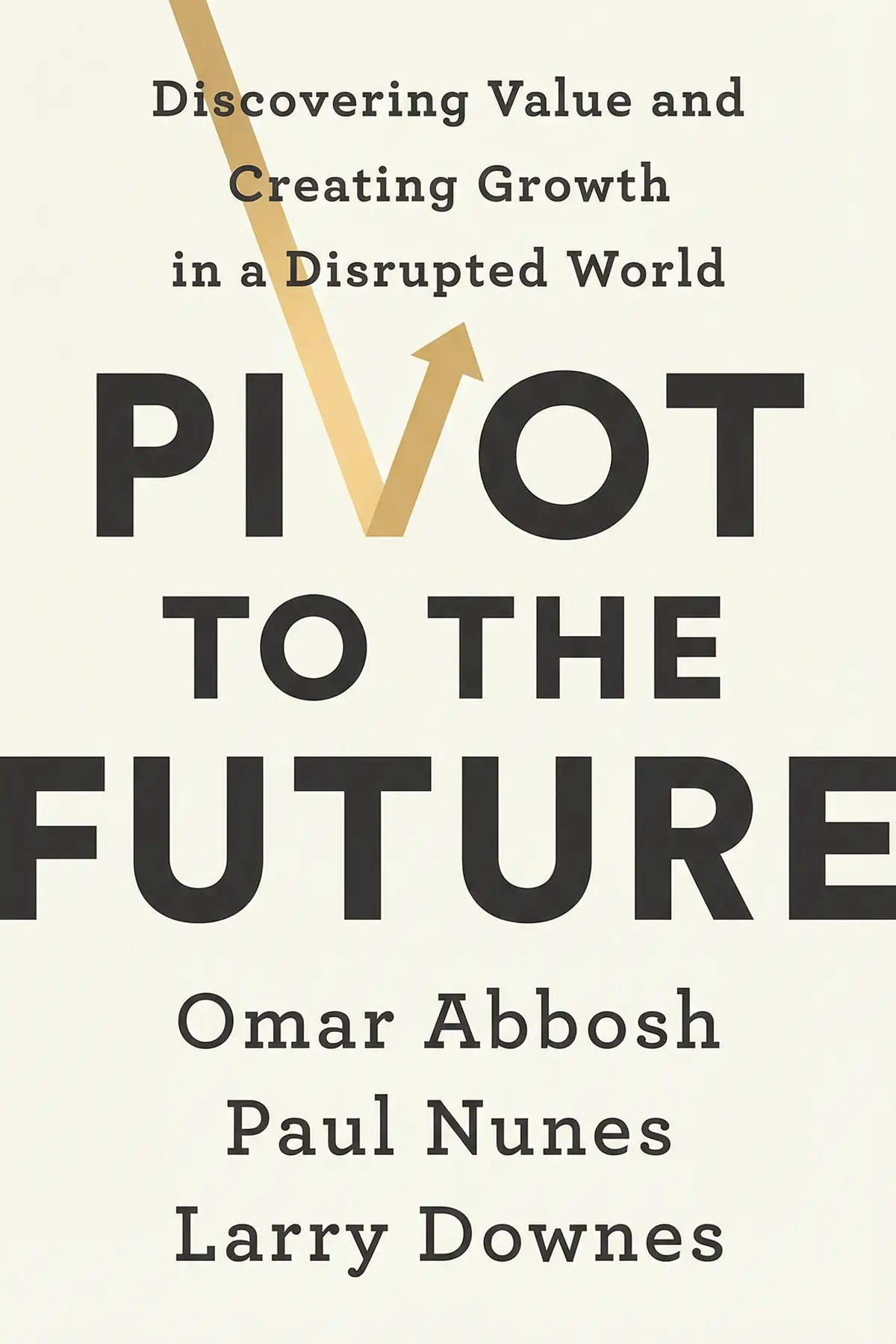
Table of Content
1. Introduction
1 min 04 sec
If your company keeps polishing yesterday’s business while a newcomer takes its customers, the problem is rarely a lack of ideas. In Pivot to the Future, Omar Abbosh, Paul Nunes and Larry Downes argue that every industry holds trapped value: needs that new technology could already meet better or more cheaply, left unmet by firms tied to old models. Whoever frees that value first takes the growth, as Sears discovered while Amazon Prime spread to half of American households by 2019.
From research into more than 1,300 global companies, the authors conclude that the winners make what they call a wise pivot. They keep earning from the old business, push the current one further and fund the new one, all at the same time, with the money, people and culture to carry it.
The cases run from a Chinese appliance maker to a cable giant, and they add up to a simple way to sort your own work into the old, the now and the new.
2. Spot the value your business leaves trapped
1 min 50 sec
Sears had decades of warning before online shopping hollowed it out. The authors argue the same slow loss is happening in most industries, and that it starts with a habit nearly every established company shares.
3. Turn technology, customers and data into new markets
1 min 40 sec
An appliance maker, a drugstore chain, an oil company and an insurer all found growth where competitors saw only routine. What they did with familiar tools shows the difference between upgrading a business and reshaping it.
4. Own less, share more and grow your people
1 min 39 sec
One of the world’s most valuable companies chooses not to make its own products. That choice, and three related moves by Alibaba, AT&T and Siemens, point to where growing firms put their capital and their trust.
5. Manage the old, the now and the new together
1 min 48 sec
Squeezed by cheap rivals on one side and tech giants on the other, a large consulting firm had every reason to play defense. What it did instead became the model at the center of this book.
6. Grow your core business without abandoning it
1 min 45 sec
Netflix once tried to drop a business it thought was finished, and customers made it pay within days. Its reversal, along with moves by Comcast and Google, shows why the past can fund the future.
7. Pay for the pivot with assets, cash and skills
1 min 50 sec
Retailers assumed the internet meant closing stores, and a sportswear giant found its warehouses working against it. The money behind a pivot, the authors argue, decides more outcomes than the strategy on paper.
8. Leaders and culture decide whether change sticks
1 min 40 sec
An outspoken telecom chief, a carmaker rethinking its robots and a retailer that let newcomers rewrite its habits all show that funding is not enough. The deciding factor sits in how a company treats risk and people.
9. Conclusion
1 min 07 sec
The book’s case comes down to a refusal to choose. Companies under disruption are tempted either to defend the business they have or to leap toward the one they want, and the authors argue that both moves leave value trapped for someone else. Accenture investing in its squeezed core while betting on blockchain, Comcast improving cable while reviving a film studio, and Netflix keeping DVDs alive to pay for its own shows all point the same way. The firms that grow treat the old, the now and the new as one portfolio, and they back it with assets, cash, skills and leaders willing to let new people change the culture.
For an ordinary working week, that becomes a few plain habits. Sort what you run into those three columns and notice which one gets nothing. Before retiring something old, ask what it could pay for. And when a new tool arrives, look for the customer need it lets you meet sooner, the way Chevron used data to shorten its drilling.
Sears had decades to move. The cost of waiting is always set by whoever moves first.
About this book
What is this book about?
Many companies see disruption coming and still lose to it. Some cling to the business that pays the bills today. Others rush toward the future without the money or skills to get there. Omar Abbosh, Paul Nunes and Larry Downes argue that both mistakes leave value trapped inside outdated models, ready for a startup or a faster rival to take. Drawing on research into more than 1,300 global companies, the authors set out seven growth strategies and a central idea they call the wise pivot. A wise pivot means managing three stages at once: the old legacy business, the growing core of now and the uncertain new bets. Cases from Accenture, Comcast, Netflix, Haier, Chevron, Uniqlo, AT&T, T-Mobile and Walmart show how it works, and how it fails. Readers get a practical way to sort their own products and projects into old, now and new, plus the financial, workforce and cultural moves that keep a pivot from stalling halfway.
Book Information
Who it's for
Leaders of established companies
Executives and founders of established companies watching faster rivals take their customers.
Managers splitting a budget
Managers deciding how to split a budget between a profitable legacy product and uncertain new bets.
Leaders planning digital change
Strategy, finance and HR leaders planning the skills and money a digital shift will need.
About the Author
Omar Abbosh
Omar Abbosh has served as Group Chief Executive of Communications, Media and Technology at Accenture and coaches senior leaders on strategy and organization. Paul Nunes is Global Managing Director of Thought Leadership at Accenture Research, where he has studied how technology changes business for more than thirty years. Larry Downes is an analyst and author on strategy and information technology whose first book, Unleashing the Killer App, was a New York Times bestseller. Nunes and Downes also co-wrote Big Bang Disruption.
Ratings & Reviews
Ratings at a glance
What people think
Listeners find the book to be a fantastic read and a top-tier guide. They value the educational benefits, with one listener remarking that it offers profound perspective through real-world examples and business cases.
Top reviews
Boy
As someone with a background in engineering transitioning into consulting, I found this to be an indispensable guide to understanding modern corporate strategy. The book explains how to release "trapped value" using seven distinct strategies that range from hyper-relevance to workforce reinvention. I especially appreciated the deep dive into how AT&T upskilled their employees rather than just replacing them with new hires. It’s rare to see a business book that balances the human element so well with financial metrics and technological integration. The tone is authoritative yet accessible, making complex ideas about AI and blockchain feel manageable. Truly an excellent playbook for anyone trying to navigate the choppy waters of the digital age without sinking their core business.
Show moreThitima
The chapter on workforce reinvention alone makes this book worth the price of admission for any HR leader or manager. The authors argue that your current employees are your greatest asset during a pivot, provided you invest in their digital literacy. Seeing how Mercedes-Benz used "cobots" to enhance human precision rather than replace workers was a refreshing take on automation. It’s an incredibly smart look at how to maintain stability while simultaneously chasing radical innovation. The writing is sharp and the structure allows you to jump between industry-specific case studies easily. I’ve already recommended this to several colleagues who are feeling the pressure of digital transformation. This is how you lead through uncertainty.
Show moreAisha
After hearing a colleague mention the "wise pivot" during a conference, I had to see if the book lived up to the hype. It does. The authors provide a brilliant framework for avoiding the "trap" of focusing only on what made you successful in the past. What stood out to me was the emphasis on creating value for all stakeholders, not just chasing quarterly profits. This long-term thinking is exactly what is missing from many modern corporate strategies. The examples of Comcast and CVS show that even "legacy" businesses can become tech leaders if they have the guts to reinvent themselves. This isn't just a book about technology; it’s a book about survival and leadership.
Show moreSuthee
This book provides a solid roadmap for any executive currently struggling with the rapid pace of technological disruption. The authors, all from Accenture, argue that companies must balance their legacy "old" businesses with the "now" and the "new" through a "wise pivot." While some of the advice feels like standard business consulting, the specific examples of companies like Reliance Jio and Netflix bring the concepts to life. I found the discussion of "trapped value" particularly enlightening because it forces you to look at your current inefficiencies as hidden opportunities. It's a dense read, but the playbook is practical enough to implement in real-world scenarios. If you are looking for a deep dive into how technology is reshaping industries, this is a great place to start.
Show moreMia
Picked this up on a whim and was pleasantly surprised by how much practical value is packed into these pages. The authors do a fantastic job of illustrating how disruption isn't a one-time event but a constant tide that you have to learn to surf. I loved the section on "asset-light" models; seeing how Apple stays agile by outsourcing manufacturing while controlling design was eye-opening. The book feels like a comprehensive playbook for the next decade of business. It moves quickly from theory to practice, which I appreciate as a busy professional with limited reading time. Truth is, most of us know we need to change, but we just don't know how to start the process without breaking what already works.
Show moreNarong
Finally got around to reading this, and the insights on "trapped value" are going to stay with me for a long time. It’s easy to see where you are losing money, but much harder to see where value is simply being "trapped" by old habits. The seven strategies are well-defined, though I found the section on data strategy to be the most compelling of the bunch. The authors explain how companies like AllLife create entirely new markets by looking at data in ways their competitors completely ignore. My only gripe is that it can feel a bit repetitive in the middle chapters. Still, for anyone in consulting or tech, this is an excellent playbook for navigating disruption.
Show moreNora
Ever wonder if a business book is just one long advertisement for a consulting firm’s internal services? While there is definitely a lot of good information here, the constant references to Accenture’s internal pivots got a bit repetitive after a while. The "old, now, new" framework is useful for visualizing growth, but it isn’t exactly a revolutionary concept in the strategy world. I would have liked more granular details on the failures mentioned rather than just the high-level success stories of giants like Google and Amazon. To be fair, the seven strategies provide a decent checklist for staying ahead, but the writing can be a bit dry. It’s a worthwhile read for the case studies, though I doubt it will change your entire worldview.
Show moreGai
Frankly, "Pivot to the Future" is a bit of a mixed bag for me despite the clear expertise of the authors. On one hand, the "wise pivot" model is a fantastic way to categorize different stages of a company's lifecycle and investment priorities. On the other hand, the book glosses over just how difficult it is to change a corporate culture that resists innovation at every turn. They mention Sears and Amazon, but these are examples we have seen in every business book for the last five years. It’s a great read if you need a refresher on modern strategy, but don’t expect a magic bullet. I’d call it a solid 3.5, mostly for the clear-eyed look at data-driven markets.
Show moreSue
To be fair, the authors clearly know their stuff, but the book feels a bit dated even just a few years after publication. The pace of change they describe is so fast that even their "new" examples are starting to feel like the "now." I appreciated the breakdown of the wise pivot, but I wanted more on the actual failures. Why exactly did some companies fail to pivot even when they saw the wave coming? The book touches on leadership, but I wanted a deeper dive into the psychological barriers to change within a firm. It's a decent high-level overview, but it lacks the long shelf life I look for in truly classic business literature.
Show moreOn
Not what I expected given the high praise I’ve seen in professional circles. The book feels like it’s written exclusively for CEOs of Fortune 500 companies, making much of the advice feel out of reach for smaller organizations. Most of the strategies, like "embedding technology at the core," are things we’ve been hearing for a decade now. I struggled to finish because the prose is quite heavy and leans far too much on "consultant-speak" that obscures the actual points. Personally, I found the lack of specificity regarding the actual hurdles of these pivots to be a major letdown. It’s more of a high-level manifesto than a usable guide for the average manager trying to innovate on the ground.
Show moreQuestions about this book
What is the main idea of Pivot to the Future?
Omar Abbosh, Paul Nunes and Larry Downes argue that technology constantly creates trapped value: customer needs that could be met better or more cheaply but are held back by old business models. Companies that release it first win, as Amazon did against Sears. The authors’ method is the wise pivot, which means investing at the same time in the legacy business, the growing core and the uncertain new areas.
What is a wise pivot?
A wise pivot is the authors’ term for managing three stages of a business at once. The old is profitable legacy work that is slowing. The now is the core that still grows but will saturate. The new is emerging bets with uncertain futures. Accenture is their main example: it made its core more efficient, expanded into AI, cloud and cybersecurity, and bet early on blockchain, doubling its market value within a few years.
Why shouldn't companies abandon their legacy business?
The authors show that old businesses can fund new ones. In 2011, Netflix tried to split off its DVD rental service, expecting streaming to take over immediately. Hundreds of thousands of subscribers left almost overnight, so Netflix backed away from the plan and put money from its DVD business toward funding original content. Comcast likewise improved cable with its X1 platform while expanding into internet, mobile and entertainment.
How can I apply Pivot to the Future in my organization?
Start by sorting your products or projects into old, now and new, and check which group receives no investment. Before closing an aging product, ask what it could pay for. Match each new initiative to the assets, working capital and skills that will fund it, as AT&T did by spending $1 billion to retrain its staff. Finally, reward sensible risk-taking so the culture supports the change.
Who should read Pivot to the Future?
It suits leaders of established companies facing faster, digital-first competitors, and managers who must balance today’s revenue against future bets. Its cases span retail, telecom, insurance, manufacturing and media, from Uniqlo’s upgraded stores to Siemens’s manufacturing platform, so readers in many industries will find a parallel to their own situation.
Readers also enjoyed




A Year with Peter Drucker: 52 Weeks of Coaching for Leadership Effectiveness
Joseph A. Maciariello



Acting with Power: Why We Are More Powerful Than We Believe
Deborah Gruenfeld

All In: How Great Leaders Build Unstoppable Teams
Mike Michalowicz

AUDIO SUMMARY AVAILABLE
Listen to Pivot to the Future in 15 minutes
Get the key ideas from Pivot to the Future by Omar Abbosh, plus 5,000+ more nonfiction titles.
- 5,000+ titles
- Listen as much as you want
- 7-day free trial
- Cancel anytime









