

13 min 42 sec
Available in: English
Pivot or Die: How Leaders Thrive When Everything Changes
By Gary Shapiro
Shows leaders how to change direction when a crisis, a failure or a fading success demands it. Cases from CES, Delta, Ring and Amazon show what early, well-chosen turns look like in practice.
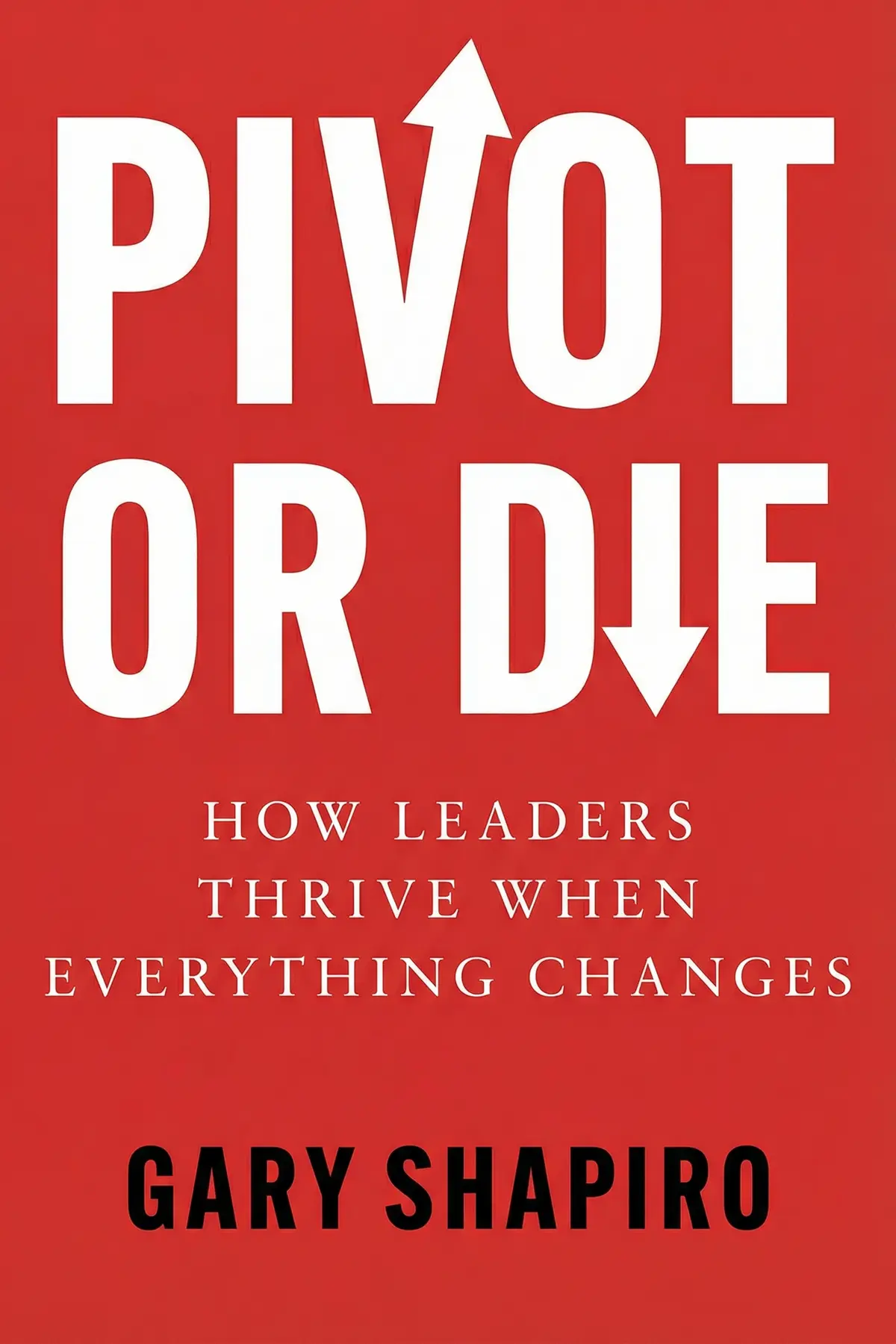
Table of Content
1. Introduction
56 sec
When a crisis, a flop or a shrinking market hits, most leaders hope to wait it out. In Pivot or Die, Gary Shapiro, who has led the trade association that runs the CES technology show, argues that waiting is the bigger gamble. The organizations that come through upheaval stronger turn early, keeping their values while changing their route.
Shapiro calls that turn a pivot, and he sorts pivots by what sets them off: a shock from outside, a failure of your own, or a success you can see will not last. Each asks for different moves. His cases run from a doorbell that investors refused to back to an airline that found new jobs for idle planes. The thread through all of them is that reading your situation early lets you keep more of your strength. By the end, you will be able to name the kind of pivot in front of you and choose the first move it calls for.
2. Know whether your field punishes standing still
1 min 43 sec
The early internet had a rule that would shock any online shop today, and a group of broadcasters chose to fight change rather than meet it. Which side of that divide your work sits on matters more than you think.
3. Make the hard call early in a crisis
1 min 39 sec
The world’s largest technology show had to decide whether to gather thousands of people during a pandemic. The choice cost money and jobs, and the timing of the decision turned out to matter as much as the decision itself.
4. Survive a shock with what you already own
1 min 43 sec
An airline with grounded jets, an electronics chain with closed doors and a prosthetics maker under bombardment all faced collapse at once. What they did next had less to do with new ideas than you might expect.
5. Let blunt customer feedback rebuild your product
1 min 40 sec
A garage inventor pitched his gadget to investors and walked away with nothing. The rejection turned out to be useful, and so did the complaints that followed. What he changed next was more than the hardware.
6. Turn a public flop into your comeback
1 min 47 sec
A young star with hit records bombed in front of a Las Vegas crowd, and a games studio failed again and again. Shapiro sees these defeats as a distinct kind of turning point, with its own rules.
7. Change course while you are still winning
1 min 41 sec
A famous electronics brand walked away from its comfort zone while sales were still coming in. Amazon did something similar with a tool built only for itself. Moving from strength has an advantage crises never offer.
8. Grow sideways from the strengths you have
1 min 28 sec
Some pivots reverse a company completely, while others change only the angle of travel. A speaker maker shows why the smaller turn can be the smarter one, and when a full reversal still makes sense.
9. Conclusion
1 min 05 sec
Shapiro’s book adds up to a way of sorting trouble. Disruption arrives in one of three shapes: a shock from outside, a failure of your own, or a success you can see fading. Each asks for a different first move, yet all of them reward the same habit, which is turning before the choice is made for you. CES chose its digital show months ahead. Siminoff took complaints about a fuzzy picture seriously. Panasonic looked past its televisions while they still sold.
The habit is practical. When a crisis hits, ask what you already own that the new situation needs, the way Delta found fresh work for its planes and buildings. When something you built fails, record the lesson before you pick the next step, as Elvis did after that first night in Las Vegas. And when things are going well, look for the 45-degree turn that makes your strengths worth more, while you still have time and money to spend on it.
The title sounds like a threat. Taken seriously, it is a deadline, and it gives the most room to those who start moving first.
About this book
What is this book about?
Crises, flops and shrinking markets tend to arrive without warning, and many leaders respond by holding still and hoping the storm passes. Gary Shapiro argues that this instinct is the real risk. In his view, the organizations that come through upheaval stronger are the ones that change direction early without abandoning what they stand for. Shapiro calls that change a pivot and sorts pivots by their trigger. Forced pivots follow outside shocks, like the pandemic that pushed CES online and grounded Delta's international flights. Failure pivots grow out of setbacks, from Elvis Presley's first Las Vegas show to Rovio's dozens of failed games before Angry Birds. Success pivots happen from strength, as when Panasonic moved toward electric vehicle batteries or Amazon turned an internal tool into AWS. Readers get a practical way to diagnose the kind of change in front of them, lessons from founders who rebuilt products around blunt feedback, and the idea of a 45-degree pivot that grows from existing strengths instead of starting over.
Book Information
Who it's for
Founders after harsh feedback
Founders whose first product drew harsh feedback and who must decide what to change.
Management facing sudden shocks
Managers and executives facing a sudden shock, from a pandemic to a collapsing market.
Leaders of thriving businesses
Leaders of successful businesses who sense their main product will not sell forever.
About the Author
Gary Shapiro
Gary Shapiro is an American author and lobbyist who has served as CEO of the Consumer Technology Association, the US trade group for consumer technology companies that owns and produces CES. Besides Pivot or Die, he has written Ninja Future, Ninja Innovation and The Comeback, the last two of which were New York Times best-sellers. He has also written more than 1,000 opinion pieces and has spoken at events including SXSW and Milken.
Ratings & Reviews
Ratings at a glance

What people think
Listeners find that while perspectives differ on the author’s political views and US-centric approach, many value the book’s functional advice on leadership and innovation. They emphasize the compelling tech sector examples and real-life case studies detailing the four different pivot types, with one listener describing it as a "good introductory book" for those new to studying leadership. Additionally, they appreciate the focus on the necessity of flexibility and choosing people over profit margins. Ultimately, the emphasis on cultivating a resilient organizational culture provides inspiration for managing complicated business obstacles.
Top reviews
Paisley
Wow, this was exactly the kick in the pants my startup needed during our recent transition phase. The emphasis on fostering a culture of resilience instead of just chasing short-term margins is a message that more CEOs need to hear immediately. Shapiro does a fantastic job of explaining why prioritizing people over profits actually leads to more sustainable innovation in the long run. Personally, I found the success pivot stories to be the most enlightening part of the entire book, as they challenge the notion that you only change when things are going wrong. It's rare to find a business guide that balances high-level strategy with such practical, human-centric advice that can be applied the very next morning. Whether you are running a small team or a massive corporation, the lessons on remaining agile are invaluable. I particularly enjoyed the section regarding how to listen to your boots-on-the-ground employees during a crisis.
Show moreFang
Finally got around to reading this after seeing Shapiro speak, and the focus on prioritizing people over profit really resonated with me. We often get so caught up in metrics and technical milestones that we forget that innovation is driven by human beings. The writing is simple, direct, and avoids the usual buzzword-heavy jargon that plagues this genre. I found the real-world examples of how companies survived the recent global health crisis to be particularly moving and practical. If you want a book that teaches you how to be a more empathetic and agile leader, this is definitely it. It is an inspiring read for navigating complex business challenges.
Show moreBo
Picked this up specifically for the case studies on CES and CTA, and Gary Shapiro definitely delivers on that front. The behind-the-scenes look at how the technology industry handled the massive disruptions of the last few years is incredibly informative. I appreciated the direct writing style and the way the author breaks down complex organizational shifts into manageable concepts. One minor gripe is that the second half of the book focuses a bit too much on regional challenges that might not translate well for international readers. Still, the core lessons on innovation and adaptability are universal. It serves as a great reminder that even established giants must remain nimble to survive.
Show moreSomporn
The chapter on the success pivot alone makes this worth the price of admission for mid-level managers and aspiring entrepreneurs. Shapiro argues convincingly that we need to change our approach to failure. It is a necessary stepping stone toward true innovation. Frankly, the way he integrates stories about personal pivots alongside corporate ones makes the book feel much more relatable than your average dry business manual. It’s inspiring to see a leader of his stature emphasize the importance of listening and remaining humble enough to adapt. A few sections felt a bit like fluff, but the highlights are definitely worth your time. If you want to foster a more creative culture, start here.
Show moreSing
After hearing so much buzz about the "four distinct pivots," I wanted to see if the substance matched the hype. Gary Shapiro provides a very practical angle on leadership that emphasizes the need to be willing to adapt before the market forces your hand. The stories about the Consumer Technology Association are fascinating for any tech fan. Gotta say, while some critics find the tone narrow, I think the focus on US industry is relevant given the author's background. It’s a compelling look at what it takes to stay relevant in a fast-paced economy. Truly worth a read for the case studies alone.
Show moreWatchara
Gary Shapiro writes with a level of authority that can only come from decades in the trenches of the technology industry. He successfully highlights why a culture of resilience is the secret weapon of the world's most successful businesses. The distinction between different types of pivots—like the success pivot—is a clever way to categorize the choices leaders face. Truth is, the book could have been shorter if he had trimmed some of the personal anecdotes, but they do add a human element. I would definitely recommend this to anyone looking for a fresh take on innovation. It’s practical, engaging, and mostly avoids the dry tone of traditional business books.
Show morePisit
As someone who follows the consumer tech space closely, I found Shapiro's perspective on adaptability to be quite grounded in reality. The breakdown of the four types of pivots offers a useful framework for anyone navigating a volatile market. However, the narrative takes a sharp turn into political commentary that felt somewhat out of place and distracted from the core business lessons. To be fair, the real-world examples from his time at the CTA are genuinely engaging and offer a peek behind the curtain of industry giants. It’s a solid read if you can filter out the more opinionated tangents regarding American politics. I think most people will find Chapters 1 through 6 to be the most valuable part of the experience.
Show moreBond
In my experience, if you've already read Ninja Innovation, you might find some of the themes in this new book a bit redundant. It’s a good introductory book for those who haven't studied much leadership literature, but it doesn't necessarily advance the conversation in a groundbreaking way. The case studies are engaging, and Shapiro is a clear writer, but I would have liked to see more practical steps for preparation. It serves as a decent reminder of the importance of adaptability, even if it feels a bit light on actionable strategy for smaller companies. A decent read, but not quite a classic for the leadership shelf. The US-centric focus was also a bit much at times.
Show moreLucas
Is it just me, or does every business book these days feel like a 200-page LinkedIn post? While the central premise of "Pivot or Die" is sound, the execution suffers from a heavy dose of survivor bias that makes the advice feel less actionable. Most of the case studies focus on massive tech wins without enough deep dives into the "die" side of the equation. Look, if you are brand new to leadership literature, you might find some value here. But for seasoned professionals, it feels like a collection of cliches wrapped in a very US-centric viewpoint. The writing style is fine, but the lack of engagement with existing leadership research makes it feel shallow compared to other books in the field.
Show moreJoe
This book starts strong with some interesting frameworks for innovation, but it quickly devolves into a series of predictable political takes that I didn't sign up for. It is incredibly frustrating to see a good business thesis get derailed by partisan bickering. The initial chapters on the quartet of transition strategies are actually quite insightful. Not gonna lie, I expected a more global perspective on technology, yet the narrative remains stubbornly focused on American interests and CES events. If you’re looking for a deep, academic study on leadership, you might find this a bit too simplistic. It feels like "Pivot for Dummies" in several chapters, which is a shame given the author's pedigree.
Show moreQuestions about this book
What is the main idea of Pivot or Die by Gary Shapiro?
Shapiro argues that businesses and individuals must be ready to change direction, or pivot, to survive disruption, and that the best pivots keep core values while changing strategy. He sorts pivots into forced ones caused by outside shocks, failure pivots that grow out of setbacks, and success pivots made from strength. Cases include CES moving its 2021 show online, Ring rebuilding a rejected doorbell, and Amazon turning an internal tool into AWS.
What are the three types of pivot in Pivot or Die?
A forced pivot follows events outside your control, like Delta converting planes to carry medical supplies during the pandemic. A failure pivot turns a setback into growth, as Rovio did after more than 50 unsuccessful games before Angry Birds. A success pivot happens from strength, like Panasonic moving toward electric vehicle batteries as its television market tightened. Shapiro notes that success pivots come with more time and resources.
What is a 45-degree pivot?
In Shapiro’s description, a 45-degree pivot shifts a company’s course by building on strengths it already has, rather than remaking the entire business. It adds or adjusts offerings that complement current products and improve the customer experience. A 180-degree pivot, by contrast, changes course entirely. His example is Sonos launching Sonos Radio, using its success in audio hardware to move into streaming.
How can I apply the ideas in Pivot or Die at work?
Start by naming the kind of change you face. In a crisis, ask what you already have that the new situation needs, as Best Buy did with curbside pickup set up within days. With a weak product, put it in front of real users and act on the harshest feedback, as Jamie Siminoff did with Ring. When things go well, look for a nearby opportunity that builds on your current strengths.
Readers also enjoyed





A Year with Peter Drucker: 52 Weeks of Coaching for Leadership Effectiveness
Joseph A. Maciariello



Acting with Power: Why We Are More Powerful Than We Believe
Deborah Gruenfeld

All In: How Great Leaders Build Unstoppable Teams
Mike Michalowicz
AUDIO SUMMARY AVAILABLE
Listen to Pivot or Die in 15 minutes
Get the key ideas from Pivot or Die by Gary Shapiro, plus 5,000+ more nonfiction titles.
- 5,000+ titles
- Listen as much as you want
- 7-day free trial
- Cancel anytime









