

13 min 14 sec
Available in: English
Pig Wrestling: The Brilliantly Simple Way to Solve Problems and Create Change
A fable about a worn-out manager that shows how to get unstuck from problems that keep coming back. Its method has you redefine the problem, study the moments it disappears and change the setting that holds it in place.
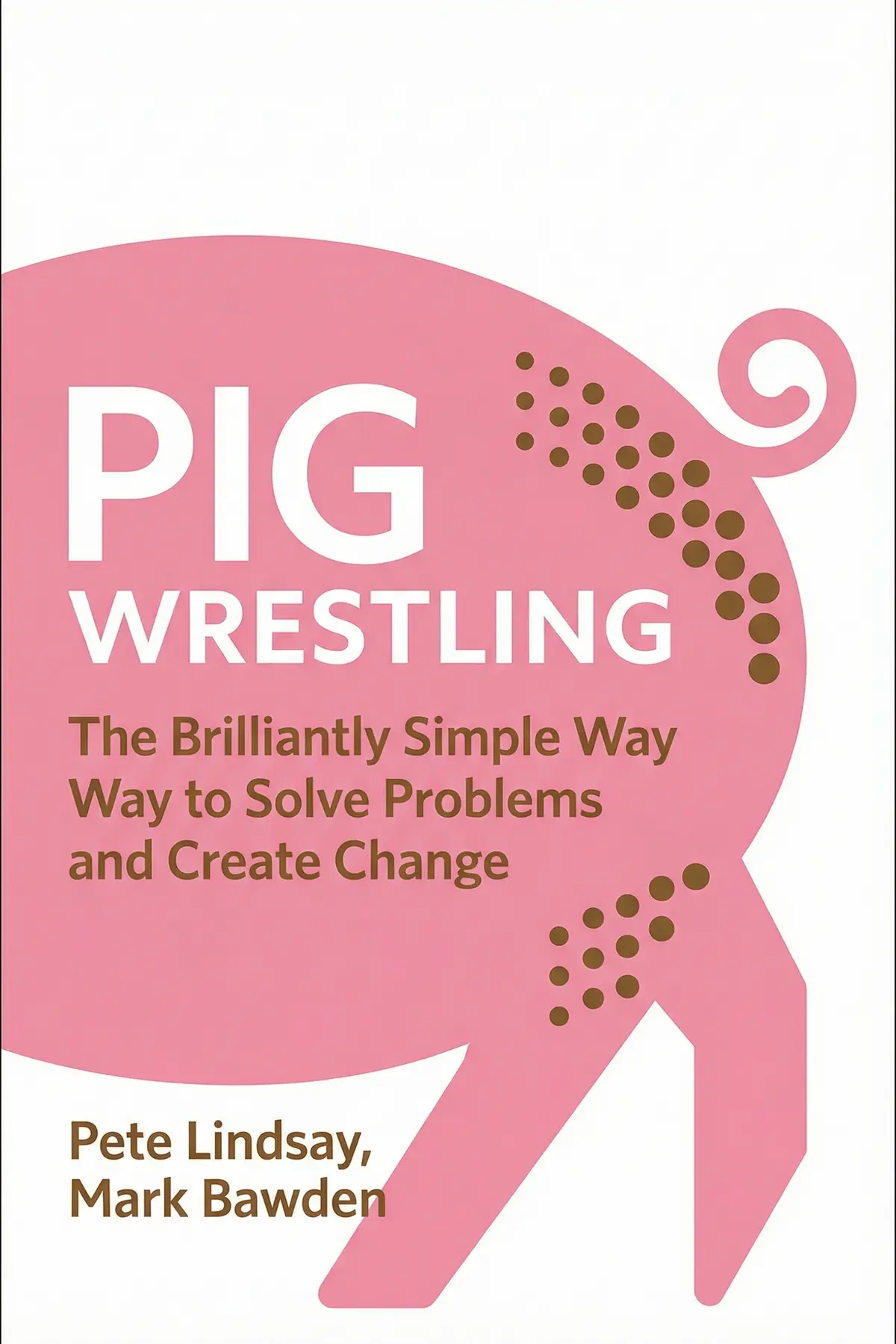
Table of Content
1. Introduction
56 sec
If you have tried every fix you can think of and a problem keeps coming back, your solutions may not be the trouble. In Pig Wrestling, psychologists Pete Lindsay and Mark Bawden argue that stubborn problems survive because we define them badly, and then pour our energy into fighting the wrong thing. An old saying carries the point: wrestle a pig and you both get muddy, but the pig enjoys it.
The book is a fable. A young manager, worn out by two teams who will not stop clashing, meets an older barista who sends him through a converted power station to learn a method called the Pig Pen. Each person he meets hands him one piece. Together the pieces show how to question a problem’s definition, find the times it vanishes, change the setting around it and read difficult people more generously, so that a situation stuck for months can finally shift.
2. Spot the signs you're fighting the wrong problem
1 min 50 sec
A manager has tried coaching, team building and a new structure, and his two teams still fight. A stranger behind a coffee counter suggests his effort was never the issue, and names the signs that give it away.
3. Rename the problem before you try to fix it
2 min 00 sec
A team building a human-powered plane kept failing until it changed one thing, and it was not the design. An airport cleaned up its washrooms with an even smaller change. Both point to where stuck problems really live.
4. Stop your fixes from feeding the problem
1 min 59 sec
Officials in Hanoi paid a reward to get rid of rats and ended up with far more of them. The same trap may be hiding inside your own favorite solution, and a simple imagination exercise helps expose it.
5. The good days that point to the answer
1 min 47 sec
Even a conflict that never seems to end has moments when it goes silent. Most people ignore them. One forgotten meeting in a coffee shop turned out to hold more information than months of effort.
6. Better behavior from a better setting
1 min 48 sec
A talented striker kept playing badly at home and well on the road, and only comparing the conditions of each revealed why. The real cause was found by comparing two lists, a method anyone can use on a stuck team.
7. See difficult colleagues as strengths gone too far
1 min 51 sec
The trait that makes a colleague exhausting may be the same one that makes them good at their job. In a rooftop garden, Andrea Strenson explains why, and a gate that kept swinging open reveals how quick judgments invent problems.
8. Conclusion
1 min 03 sec
The pig in the title is any problem you have fought so long that the fight has become the routine. Lindsay and Bawden’s fable suggests the mud comes mostly from how we look at it. The manager’s new plan for his teams did not come from finding a stronger tool. They changed once he stopped treating his first description of the problem as the truth, and the same lesson came back to him when he learned who the barista really was.
Their method asks for curiosity more than force. When you catch yourself saying you have tried everything, pause and ask whether the problem is really yours and whether you have seen it firsthand. Describe the morning after it disappears, in results and not methods. Then look for the coffee shop moment in your own situation, the time it did not happen, and compare it with the times it did until the difference in the setting shows itself.
The pig, as the saying goes, enjoys the wrestling. The better move is to step out of the pen and study it from the fence.
About this book
What is this book about?
Some problems survive every fix. You coach, reorganize and try again, and the same conflict returns, leaving you drained and sure you have run out of options. Psychologists Pete Lindsay and Mark Bawden argue that the trouble usually lies in how the problem is defined. If you have defined it wrongly, more effort just means more mud, like wrestling a pig. Their book tells this as a story. A young manager whose two teams will not stop clashing meets an older barista. The barista sends him through a business center built inside an old power station, where a picture framer, a marketing head, a football coach and a woman in a rooftop garden each teach him one part of a method called the Pig Pen. The lessons cover pausing before acting, renaming the problem, spotting fixes that feed it, picturing success in concrete terms, finding the times the problem is absent and changing the conditions that keep it alive. Readers get a short, memorable set of questions and images to use on any stuck situation, at work or at home, plus the warnings that stop them chasing problems that are not really there.
Book Information
Who it's for
Managers caught in conflicts
Managers caught between teams or colleagues who keep clashing despite coaching and restructuring.
Professionals losing energy
Professionals who feel they have tried everything on a problem and are running out of energy.
Stuck in a rut
Anyone stuck in a rut at work or at home who wants a simple set of questions to see it fresh.
About the Author
Pete Lindsay
Mark Bawden is a performance psychologist who has worked with organizations and teams including the English Institute of Sport and England's cricket side. Pete Lindsay is a fellow psychologist. Together they run the consultancy Mindflick, which also involves the former England cricket captain Andrew Strauss. Pig Wrestling, which they wrote together as a fable, sets out their method for tackling problems between people at work and in private life. It speaks to readers who feel stuck in a rut or have stopped trying.
Ratings & Reviews
Ratings at a glance
What people think
Listeners find that *Pig Wrestling* offers a non-traditional method for tackling problems, even if reactions to the fable-based narrative style are mixed. Those who listen value the integration of "memory palace" strategies and bizarre mnemonic devices, which many report are effective for remembering key ideas such as setting boundaries and reframing issues. Additionally, they praise the material for being a fast, easy-to-digest listen that translates sophisticated psychological theories into simple terms for everyone. The utility of the guidance is also highlighted, with one listener observing that the work’s distinct narrative approach "smuggles learning" straight into the mind.
Top reviews
Ruangrat
Picked this up during a particularly stressful week at the office and it was exactly what I needed to reset. The concept of 'pig wrestling' sounds silly at first, but once you dive into the story of the Young Manager and the Barista, the logic really starts to click. I loved the memory palace technique; having those vivid, surreal images like the pig in the picture frame makes the steps actually stick in your brain long after you close the cover. Usually, business books are a dry, repetitive slog, but this felt like a quick journey that 'smuggles' in heavy psychology without the academic jargon. To be fair, the fable format isn't for everyone, and some might find the dialogue a bit staged. Regardless, the practical shift in perspective is worth it. I’ve already told two colleagues that certain projects aren't their pigs to wrestle. It is a total game-changer for professional boundaries.
Show moreBella
Wow, I didn't think a book about pigs would help me handle my family drama, but here we are. While it's marketed for business, the 'not your pig to wrestle' mantra is incredibly applicable to personal boundaries and toxic dynamics. The authors use a quirky story to explain why we get stuck in loops, and the visual of the red plastic bucket and the feeding trough really helped the lessons sink in. Personally, I struggle with 'premature evaluation,' and seeing it laid out in such a surreal, memorable way helped me catch myself in the act this morning. It’s rare to find a book that simplifies complex behavioral science into something you can actually use while standing in line for coffee. Short, punchy, and genuinely transformative if you're willing to embrace the weirdness of the metaphors. Highly recommended for anyone feeling overwhelmed by 'stubborn' problems.
Show moreDuangjai
Ever wonder why some problems just seem to follow you around no matter how hard you try to fix them? This book explains exactly why, and it does so in the most engaging way possible. By using a surreal story and vivid imagery, the authors ensure the lessons aren't just understood, but ingrained. I loved the shift from 'wrestling' to 'framing.' It’s a subtle change. It makes a massive difference. The memory palace technique is brilliant; I can still see the whole pig pen setup in my mind’s eye right now. This isn't just another business book filled with fluff; it’s a practical manual for mental clarity. I’ve already bought a couple of extra copies for my team to help us stop over-analyzing the wrong things. It’s that good.
Show moreSue
After hearing a lot of buzz about this one, I decided to give the 'pig' a go. The genius of this book lies in its simplicity and the use of the ancient memory palace technique to ensure you don't forget the framework. By attaching concepts like 'gold nuggets' and 'capability assessment errors' to bizarre visual cues, Lindsay and Bawden have created something far more memorable than a standard 10-step list. I especially liked the section on identifying when a problem doesn't occur, which is a nuance most of us overlook in the heat of a crisis. Look, the storytelling is definitely a bit cheesy and the Young Manager feels more like a vessel for the reader than a real person, but that's standard for this genre. It’s a solid tool for anyone looking to clean up their thinking and stop over-complicating their professional hurdles.
Show moreEthan
Finally got around to reading this and I’m pleasantly surprised by how much I remembered a week later. The whole 'memory palace' thing actually works! I can still picture the pig pen and the crystal ball vividly. The book focuses on reframing how we see problems. It pushes us to stop wrestling the 'pig'—the messy, unsolvable part—and start looking for the frame. It’s a very fast read. I finished it in two sittings, which is perfect for busy schedules. My only gripe is that the dialogue in the fable feels a little stiff and unrealistic at times. Truth is, you’re here for the mental framework, not the prose. If you want a fresh way to approach team conflicts or project bottlenecks, this is a worthy addition to your shelf. It’s simple. It's effective. It stays with you.
Show moreNiramai
As someone who has spent years in management, I've seen every problem-solving model under the sun, but this one stands out for its delivery. Instead of a dry PowerPoint-style lecture, you get a 'hero’s journey' through a repurposed power station called The Collective. It’s a smart way of leveraging neurological firepower to make learning stick. I found the concept of 'gold nuggets'—noticing the exceptions to the problem—to be the most valuable takeaway. The book is short enough that you don't feel like your time is being wasted, though I will say some of the mnemonics feel a bit clunky toward the end. Gotta say, it's much better than the standard corporate self-help fare. It encourages you to throw away old assumptions and actually look at the source of the mess rather than the symptoms.
Show moreEvelyn
The advice regarding boundary-setting was the highlight for me, though the rest of the fable felt a little repetitive. I liked the premise of the Young Manager visiting different mentors, but the story was so thin it felt like it was just there to pad the page count. To be fair, the psychological principles like 'fundamental attribution error' are explained well for a general audience. It's a great read if you've never read a book on systems thinking or cognitive biases before. If you're already familiar with those topics, you might find yourself skimming through the fable to get to the actual meat. It's a solid 4-star read for me because it is useful, even if it's not entirely earth-shattering. The pig metaphor is catchy, and the 'crystal ball' section gave me a lot to think about regarding future-proofing my projects.
Show moreClara
Is this a management manual or a dream sequence? In my experience, it’s a bit of both. The fable of the Young Manager and the various quirky characters he meets is definitely unconventional, but it serves the purpose of making the advice stick. I particularly appreciated the focus on 'confirmation bias'—how we only see what we expect to see. The book is quite short, which makes it accessible, but I did find the ending a little abrupt. It leaves you wanting a bit more concrete 'how-to' after the story concludes. However, the core message about not taking on problems that aren't yours is worth the price of admission alone. Most workplace stress comes from 'pigs' that we shouldn't even be in the pen with. A solid, thought-provoking read for anyone in a leadership role.
Show moreSing
Not what I expected when I saw the cover, but I appreciate the effort to make problem-solving less clinical. While the authors use a fable to illustrate their points, I found the narrative about 'The Collective' and the constant traveling between departments a bit tedious for such a short book. Many of the core ideas—like confirmation bias and reframing—will be familiar to anyone who’s dipped a toe into pop psychology. That said, the mnemonic device involving the pig pen and the soapy bucket is clever for retention. Frankly, I’m not sure I’ll be using the phrase 'pig wrestling' in a boardroom anytime soon without getting some weird looks from my boss. It’s a decent introductory text for beginners, but seasoned managers might find it a bit light on new substance. Still, it's a fast read if you need a quick mental reset.
Show moreRungtip
This book isn’t very long, but it managed to feel like a total slog. I found the 'fable' structure incredibly patronizing, as if the reader couldn't handle the psychology without a fairy tale about a barista and a 'Young Manager' to hold their hand. The constant summaries and bullet points on the character's tablet felt forced and broke whatever immersion the story tried to build. Most of the advice boils down to 'think outside the box' and 'don't take on other people's problems,' which isn't exactly groundbreaking stuff. Not gonna lie, I was hoping for deep, actionable strategies, but instead, I got a collection of buzzwords and a weird picture of a pig in a frame. If you like the 'Who Moved My Cheese?' style of business books, you might enjoy this, but for me, it was a frustrating experience that lacked real depth.
Show moreQuestions about this book
What is the main idea of Pig Wrestling?
Pete Lindsay and Mark Bawden argue that when a problem will not change despite real effort, you are probably working on the wrong problem. Fighting it harder is like wrestling a pig: you get tired and muddy and nothing improves. Their Pig Pen method helps you pause, redefine the problem, spot fixes that feed it, find the moments it disappears and change the conditions that keep it in place.
What is the Pig Pen method?
The Pig Pen is a memory picture in which each part of a pen stands for a step. Foot on the Fence means pausing to get a better view. The Picture Frame is the problem’s definition. The Feeding Trough warns that fixes can feed problems. Gold Nuggets are times the problem is absent, Pink Bungee Cords are the conditions holding it in place, and the Green Recycling Bin and Yellow Warning Sign cover overused strengths and common traps.
Who should read Pig Wrestling?
It suits managers and team leaders dealing with conflict that will not go away, and anyone who feels stuck or has stopped trying. Because it is told as a fable about a young manager whose two teams keep clashing, it is easy to follow and remember, and its questions apply to problems between people at work or in private life.
How can I apply Pig Wrestling to a conflict at work?
Start by asking how the conflict is really a problem for you and whether you have seen it firsthand. Picture the problem gone overnight and describe the results, not the methods. Then list the times the conflict did not happen, compare their people, place, timing and rules with the bad times, and change the setting. The manager in the book replaced tense Monday meetings with informal talks and joint updates.
What does Pig Wrestling say about difficult people?
The authors suggest seeing difficult behavior as a useful quality taken too far, an idea they call the Green Recycling Bin. Determination can look like stubbornness in the wrong place. In the book, two competitive team heads were turning their drive against each other, so the aim became redirecting that energy toward shared work instead of trying to fix the people themselves.
Readers also enjoyed



A High-Performing Mind: Strengthen Your Mind and Live Your Best Life
Andrew D. Thompson

A Year with Peter Drucker: 52 Weeks of Coaching for Leadership Effectiveness
Joseph A. Maciariello



Abundance: The Inner Path to Wealth
Deepak Chopra


AUDIO SUMMARY AVAILABLE
Listen to Pig Wrestling in 15 minutes
Get the key ideas from Pig Wrestling by Pete Lindsay, plus 5,000+ more nonfiction titles.
- 5,000+ titles
- Listen as much as you want
- 7-day free trial
- Cancel anytime









