

15 min 38 sec
Available in: English
Partnering: How to Forge the Deep Connections That Make Great Things Happen
By Jean Oelwang
Shows how to build partnerships at work and at home that last and achieve more, through a shared purpose, all-in commitment, trust, planned rituals, conflict used as a lesson, and teams designed around relationships.
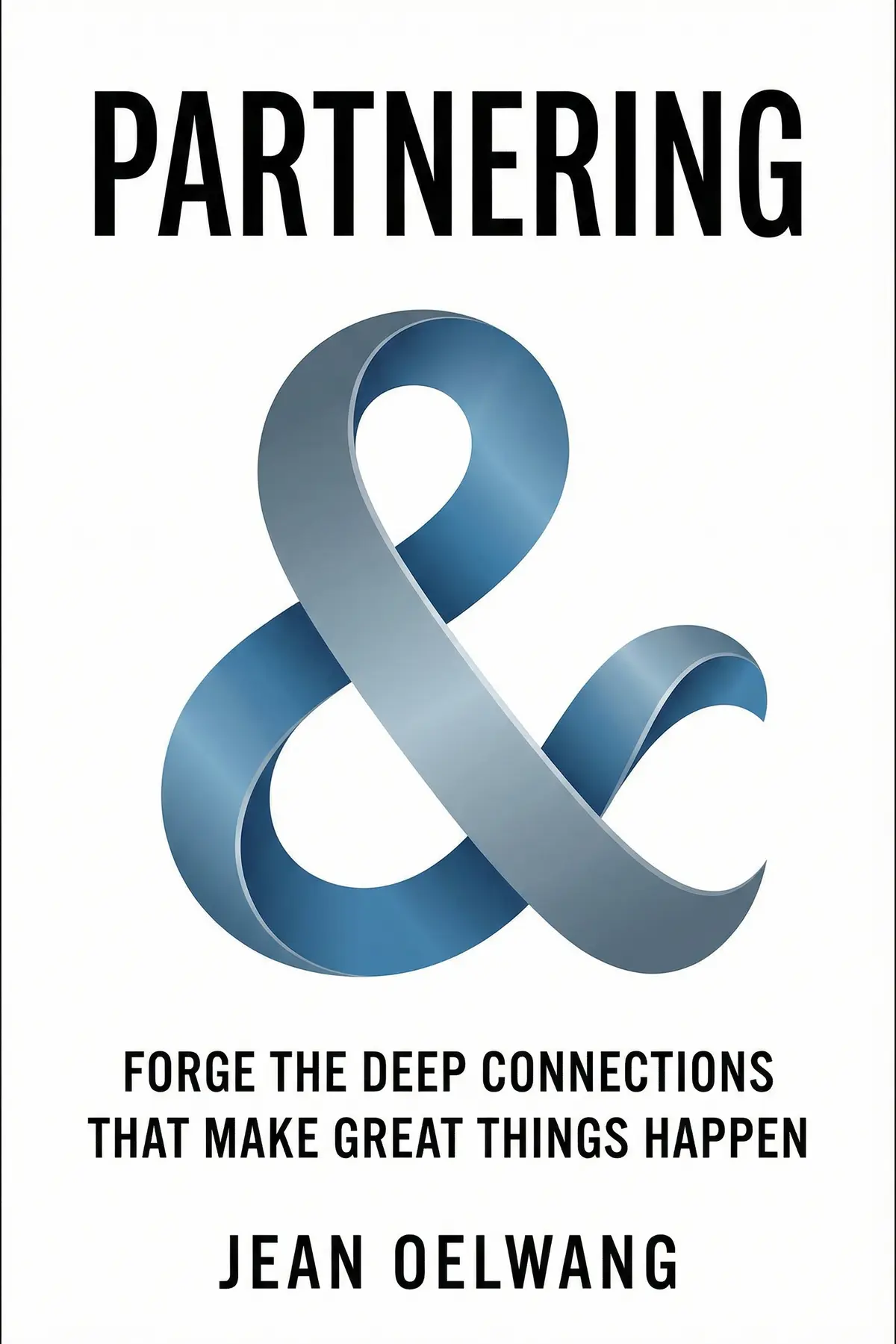
Table of Content
1. Introduction
1 min 03 sec
If your calendar is full but your relationships feel thin, Jean Oelwang has an uncomfortable diagnosis: the lone achiever you were taught to become is the problem. In Partnering, the founding CEO of Virgin Unite argues that both a meaningful life and a thriving organization rest on a few enduring partnerships. She calls them Deep Connections, and she studied sixty of them to learn what holds them together.
Her finding is that these bonds can be built deliberately. Partners share a purpose larger than themselves, commit fully, live by common virtues led by trust, plan the moments that bind them, treat friction as a teacher and, at scale, design groups around relationships. The cases run from two chemists who helped close the hole in the ozone layer to a smoothie company held together by a Monday meeting. Each one ends in a move to try with a cofounder, a team or a spouse.
2. Trade solo achievement for connections that lift you
1 min 54 sec
A senior executive with twenty years of success realized, on a visit to Johannesburg, that she had been measuring her life the wrong way. One afternoon with a famous couple changed what she thought success was made of.
3. Aim your partnership at something bigger than both
2 min 11 sec
Two chemists made a discovery so alarming that companies attacked them and colleagues scolded them. What kept them going for over a decade had little to do with ambition, and everything to do with how they framed their partnership.
4. Repair broken trust with candor and humility
2 min 01 sec
A company whose entire product was strangers trusting strangers made one decision during a crisis that left its own partners feeling betrayed. How the founders responded holds a lesson for anyone who has let a partner down.
5. Build a bond that survives the hard years
1 min 58 sec
A former president and his wife disagreed so often while writing a book together that their editor suggested printing both versions of their stories. Yet their marriage outlasted every other in American presidential history.
6. Turn your next argument into a skill swap
1 min 52 sec
Two men who flew around the world on sunlight nearly let media coverage that credited only one of them damage their friendship. The way they settled it turned a bruised ego into an advantage for both of them.
7. Plan the rituals that keep partners close
1 min 46 sec
Three university friends started a drinks company with a small festival stall and stayed close friends for decades. Their method looks almost too simple, and it involves millions of tiny knitted hats.
8. Build teams where relationships carry the weight
1 min 46 sec
Most project teams are chosen for skills and reputation. A Brazilian company grew into a global business by choosing a different starting point, and its partners now push its mission further than its founders could alone.
9. Conclusion
1 min 07 sec
Every story here began small: two chemists, a married couple, three friends with 500 pounds, two men who wanted to fly on sunlight. What made them matter was the connection between the people, tended deliberately over years. Oelwang’s case is that this is how great things get done and how a life gains meaning, and that the self-sufficient ideal so many chase leaves people lonelier and less effective.
The practices she draws from her sixty partnerships are modest enough to begin this week. Name what you and one partner want to give the world, so the next conflict has something larger to answer to. Put a recurring moment on the calendar and keep it, the way Innocent’s founders keep their Monday afternoons. When friction comes, leave ego outside and look for what each of you can learn, as Piccard and Borschberg did when they traded speaking lessons for flying lessons. And when you let a partner down, apologize plainly and make it right.
Mandela did not become Mandela alone. Neither will anyone else.
About this book
What is this book about?
Many capable people reach success and find that their friendships, marriages and working relationships have been squeezed into the gaps. Jean Oelwang lived that pattern herself until a meeting with Nelson Mandela and Graça Machel convinced her that meaning, and real impact, come from deep partnerships rather than solo achievement. She spent years studying sixty partnerships to learn what holds them together, and she sets out six degrees of connection. Partners serve a purpose larger than themselves, go all in, live by shared virtues led by trust, create rituals on purpose, treat friction as a teacher and, at scale, build organizations on relationships. The cases include the chemists who exposed the threat to the ozone layer, Jimmy and Rosalynn Carter, the founders of Airbnb and Innocent Drinks, the pilots of Solar Impulse and the Brazilian company Natura. Readers get practical moves for any important relationship: a question to ask a partner about shared purpose, a rule for handling disagreement, a way to repair broken trust and a reason to protect a weekly meeting.
Book Information
Who it's for
Founders wanting lasting partnerships
Founders and cofounders who want a partnership that survives disagreement and crisis.
Team leads wanting trust
Team leads who build project groups and want trust to spread beyond the top.
Busy professionals
Busy professionals whose friendships and marriage have shrunk to quick calls between commitments.
About the Author
Jean Oelwang
Jean Oelwang is the founding CEO of Virgin Unite, the charitable branch of the Virgin Group, and a co-founder of Plus Wonder. For more than 15 years she has worked alongside figures such as Desmond and Leah Tutu and Jimmy and Rosalynn Carter. As a collaboration architect she helped start global groups including The Elders, The B Team and Ocean Unite. Earlier she spent 18 years helping launch and lead mobile phone companies across six continents. For this book she interviewed sixty partnerships.
Ratings & Reviews
Ratings at a glance
What people think
Listeners find this work highly inspiring, with one individual remarking that it is a necessary read for anyone with a growth mindset. Furthermore, they value the way it demonstrates how significant partnerships improve all aspects of life, and one listener stresses its worth for both personal and career development. The book is well-regarded for being an easy read filled with intriguing narratives. Additionally, listeners applaud the high caliber of the content, with one noting that it is brought to life through compelling case studies.
Top reviews
Prapaiwan
Wow. I’m usually skeptical of books written by CEOs, but this one truly moved me. Not gonna lie, I teared up a bit reading about the lifelong devotion between Jimmy and Rosalynn Carter. It’s not just a business book; it’s a manifesto for a better way of living. Jean Oelwang uses her unique position to show us that the most successful people in the world didn't get there alone. They had someone in the trenches with them. The idea of 'going all-in' and providing a safety net for your partner to fail is so powerful. It completely shifts the perspective from 'what can I get?' to 'what can we build?' The layout is great, the stories are inspiring, and the tangible takeaways are actually useful. I bought three extra copies to give to my team because I want us to build our own 'moral ecosystem' based on these principles.
Show moreElla
Picked this up because I’ve been feeling burnt out by the typical 'solopreneur' hustle culture that dominates my LinkedIn feed. Frankly, this was the perfect antidote. The book is a beautiful reminder that no one achieves greatness in a vacuum. Whether it’s saving the ozone layer or building a global smoothie brand like Innocent Drinks, the common thread is a deep, meaningful connection. I loved the concept of 'magnetic moments'—those intentional rituals that keep a relationship afloat during the hard times. The sentence structure is varied and the tone is incredibly encouraging, making it a very quick read despite the depth of the subject matter. It’s rare to find a book that manages to be both highly practical and deeply soulful. If you are looking to deepen your relationships and maximize your positive impact on the world, start here.
Show moreSomkid
Jean Oelwang has managed to distill something incredibly complex—human relationship dynamics—into a usable framework that applies to every facet of life. Actually, I was so inspired by the 'Partnering' journey that I shared it with my colleagues immediately. The way she describes 'nurturing generosity' as a spiritual operating system is just brilliant. It really challenges the 'winner-takes-all' mentality that is so prevalent today. The stories aren't just about business success; they are about lives well-lived. Reading about the Elders and their collaborative approach to global conflict gave me a renewed sense of hope for the future. The book is beautifully paced, switching between intimate personal details and large-scale global achievements. It’s a rare gem that manages to be both a professional development tool and a guide for personal fulfillment. If you want to build something that lasts, you need to read this book.
Show moreDao
Finally got around to reading this after seeing it recommended as a must-read for collaborative leaders. This book offers a fascinating look at the backbone of success: deep connection. In my experience, most business books focus way too much on the individual 'genius' at the top, so Oelwang’s pivot toward the power of the pair is incredibly refreshing. The chapter on 'unshakeable mutual respect' really hit home for me, especially the story about André Borschberg and Bertrand Piccard navigating their solar-powered flight. The writing is fluid and the pace is quick, making it an easy read for a busy professional. My only minor gripe is that the framework can feel a bit 'checklist-y' at times. Still, the message that we are better together is one that our current individualistic society desperately needs to hear. It’s a rewarding read that made me reflect on my own professional alliances.
Show morePrayoon
This book is quite elevated compared to the typical 'insight' books that flood the market. Personally, I found the stories of Desmond and Leah Tutu to be the emotional heart of the work. Oelwang manages to weave together the personal and the professional in a way that feels organic rather than forced. She introduces the concept of a 'moral ecosystem' which I think is a brilliant way to describe the foundation of a long-term partnership. The book is well-illustrated with compelling case studies that move beyond just 'business' into the realm of human rights and environmentalism. While it can feel slightly repetitive toward the end, the core principles are sound. I’ve already started implementing the 'weekly check-in' ritual with my business partner, and the clarity it has provided is worth the price of the book alone. Definitely a solid four-star read for anyone looking to scale their impact.
Show morePenelope
The chapter on the ozone hole discovery was genuinely gripping and served as a perfect anchor for the author's arguments. It shows how shared purpose can literally save the planet. To be fair, I felt some of the other sixty partnerships mentioned were a bit glossed over, but the major ones are treated with a lot of care and detail. The writing style is approachable and the tone is humble, which fits the 'shared humility' virtue Oelwang champions. I found the section on 'celebrating friction' to be the most valuable part of the book. Most of us try to avoid conflict, but this book teaches you how to use it as a catalyst for innovation. It's a great choice for anyone with a growth mindset who wants to understand the 'we' over the 'me.' A few sections felt like they could have been trimmed, but overall, it’s a very strong contribution to the leadership genre.
Show moreNoi
Ever wonder how big movements actually start? Jean Oelwang argues they start with 'Deep Connections,' and she uses her experience with Virgin Unite and The Elders to prove it. The book is packed with an almost overwhelming number of examples—sixty partnerships in total! Because there are so many stories squeezed into 200-something pages, I found it difficult to keep track of who was who. One minute we are talking about Ben & Jerry, and the next, we are looking at the scientists who saved the ozone layer. Look, the 'six degrees' framework is a solid conceptual tool, particularly the parts about 'magnetic moments.' However, the writing style can feel repetitive as the same virtues are recycled across different chapters. It’s an inspiring read for a Sunday afternoon, but it lacks the analytical weight to be a definitive guide on the subject.
Show moreRod
As someone who works in the non-profit sector, I was drawn to the mentions of Peter Gabriel and the global impact stories. The truth is, the book is a mixed bag. On one hand, the case studies regarding the Montreal Protocol and the partnership between Sherry Rowland and Mario Molina were genuinely gripping and well-researched. On the other hand, the prose often feels like an extended corporate brochure for Virgin’s philanthropic arms. It’s very 'rah-rah' about collaboration without addressing the power imbalances that often ruin these partnerships in the real world. I appreciated the emphasis on 'celebrating friction,' yet I wish the author had spent more time on that and less on the sentimental anecdotes. It is a decent resource for those with a growth mindset, but it requires some sifting to find the real gems.
Show morePracha
I'll be blunt: I had high hopes after hearing Peter Gabriel mention this in an interview, but the result was just okay. The book follows a very predictable 'story-then-lesson' format that you see in a lot of Simon Sinek-style literature. It’s well-written, but it feels a bit like a collection of very high-level summaries. For instance, the discussion on 'enduring trust' felt like it stayed on the surface without getting into the psychological barriers that prevent trust in the first place. That said, the end notes and references are fantastic. I actually found myself enjoying the last 30 pages of resources almost as much as the main text. It’s a good introduction to the power of collaboration, but if you’re looking for a deep psychological study on human bonding, you might find this a little too light. It’s a solid three-star effort that serves as a good conversation starter.
Show moreAnna
Not what I expected. While the author clearly has an impressive Rolodex and access to incredible figures like Nelson Mandela, the book itself felt incredibly basic and, frankly, a bit dry. It hits all the standard notes you'd find in any introductory management text: build trust, have a mission, and communicate well. But where is the actual 'how-to' for when things fall apart? To be fair, the anecdotes about the Carters were sweet, but they didn't offer the deep, actionable insights I was hoping for. It mostly glosses over the grit of conflict resolution in favor of high-level idealism. If you’ve never read a book on relationship dynamics or leadership, this might feel fresh, but for anyone else, it’s a lot of fluff around very simple concepts. I wanted a deep dive into the messy mechanics of partnership, not just a highlight reel of famous friends.
Show moreQuestions about this book
What is the main idea of Partnering by Jean Oelwang?
Oelwang argues that a meaningful life and a successful organization both rest on a few deep, lasting partnerships, which she calls Deep Connections. After studying sixty partnerships, she describes six degrees of connection: a shared purpose bigger than the partners, all-in commitment, a set of virtues led by trust, planned magnetic moments, friction used as a lesson, and groups designed around relationships.
What are the six degrees of connection in Partnering?
The first is elevating purpose by sharing a mission beyond yourselves. The second is going all in, so both partners feel safe to take risks. The third is a moral ecosystem of six virtues, starting with enduring trust. The fourth is magnetic moments created through rituals. The fifth is celebrating friction as a chance to learn. The sixth is collective connections, design principles for large collaborations.
How does Partnering suggest handling conflict with a partner?
Oelwang treats conflict as a chance to learn. Put your ego aside, look at your own role, and believe that your partner hopes for what is best for you. Pilots André Borschberg and Bertrand Piccard turned a dispute over media credit into a trade: Bertrand coached André in public speaking and André taught Bertrand to fly. Jimmy and Rosalynn Carter talked through every disagreement before going to sleep.
How can I apply Partnering at work?
Ask a cofounder or teammate what you want to contribute together, beyond what each of you gets. Protect a recurring meeting, as Innocent Drinks’ founders do on Monday afternoons. When you break trust, apologize and repair it, as Airbnb did with a 250 million dollar fund for hosts. When building a team, weigh existing relationships and keep information open, as Natura does.
Who should read Partnering?
It suits founders who rely on a cofounder, team leads who assemble groups for big projects, and anyone whose career has crowded out friends and family. The book covers business partners, married couples and global collaborations, so its ideas apply to an office, a startup and a home alike.
Featured in
Readers also enjoyed

A Bigger Prize: How We Can Do Better Than the Competition
Margaret Heffernan





A Year with Peter Drucker: 52 Weeks of Coaching for Leadership Effectiveness
Joseph A. Maciariello



AUDIO SUMMARY AVAILABLE
Listen to Partnering in 15 minutes
Get the key ideas from Partnering by Jean Oelwang, plus 5,000+ more nonfiction titles.
- 5,000+ titles
- Listen as much as you want
- 7-day free trial
- Cancel anytime









